
Is Globe Life a Good Insurance Company?

Jason Stolz CLTC, CRPC
Is Globe Life a good insurance company? For many families, the answer is yes—especially if your goal is straightforward life insurance like basic term coverage or final expense protection. Globe Life is widely known for simplified, consumer-friendly life insurance products that are often marketed as easy to understand and easy to buy. But if your goal is guaranteed retirement income, tax-deferred growth, or building a retirement “paycheck” strategy using annuities, Globe Life is not usually the first carrier we compare—because the annuity market is dominated by insurers that specialize in retirement-income contract design.
At Diversified Insurance Brokers, our job is not to push one brand. Our job is to help you compare companies based on outcomes: how the policy works in real life, how long it is designed to be held, how flexible it is when life changes, and whether the value you receive is competitive compared to what the market offers right now. When clients ask us about Globe Life, we typically start by clarifying the goal. If the goal is simple life insurance, Globe Life may be worth considering. If the goal is retirement income optimization through annuities, we usually recommend a side-by-side comparison across multiple retirement-focused carriers before you decide.
Because “good company” is a broad phrase, this page is designed to help you evaluate Globe Life in the two most common contexts we see. First, as a life insurance brand for basic protection. Second, as a comparison point when your real objective is retirement planning, where annuities and income guarantees are the focus. When you separate those two goals, the answer becomes much clearer.
Ensure you are receiving the absolute top rates
Compare today’s best fixed and bonus annuity options, then run a personalized lifetime income benchmark in minutes.
💡 Note: The calculator accepts premiums up to $2,000,000. If you’re investing more, results increase in direct proportion — for example, doubling your premium roughly doubles the guaranteed income at the same age and options.
Globe Life at a Glance
Globe Life is best known for life insurance that is positioned as simple and approachable. Many consumers first encounter the brand through direct marketing that highlights affordability and convenience, especially around term life and final expense coverage. In that role—basic life insurance protection—Globe Life can be a practical option for people who want coverage without a complicated shopping process.
However, the question “Is Globe Life a good insurance company?” is often asked by people who are also thinking about retirement. That’s where a lot of confusion happens, because retirement income planning and life insurance protection are not the same category. Retirement planning is typically driven by a different set of products and a different set of priorities, including guaranteed lifetime income, principal protection from market volatility, predictable contract rules, and long-term performance under real withdrawal patterns. That’s why the best way to evaluate Globe Life is to decide which problem you are solving first.
If you are primarily looking for life insurance, Globe Life may be worth comparing to other carriers that offer simplified underwriting or affordable term coverage. If you are primarily looking for retirement income, you should compare annuity carriers and contract designs side by side, because the differences in payouts, rider math, and withdrawal flexibility can be significant from one company to another.
What Globe Life Typically Does Well
Globe Life’s strongest “value proposition” is straightforward protection. Many households want life insurance that is easy to understand, easy to maintain, and sized appropriately for the financial obligation they are trying to cover. That might mean term life coverage during working years, or smaller policies intended to cover funeral costs or final expenses. In those use cases, simplicity and ease of purchase can matter as much as advanced features.
When people use life insurance for basic family protection, the key questions tend to be practical: Do I qualify? How much will it cost? Will the policy stay in force if I pay my premium? Can my beneficiary get paid quickly and cleanly? For those core needs, many mainstream life insurers can do a good job, and Globe Life’s approach to simplified products can appeal to consumers who prefer a more straightforward process.
That said, we do not recommend evaluating any insurer based only on branding or convenience. The policy details still matter. In life insurance, it is important to understand whether a policy is fully underwritten or simplified-issue, whether it has graded benefits early in the policy, how premiums are structured, and whether there are product limitations based on age or health class. Those details determine whether a policy is actually a good fit for the role you want it to play.
Where Globe Life Is Not Usually the Best Fit: Retirement Income Strategy
Many people assume “insurance company” automatically means “annuity company.” In reality, the annuity market is a specialized segment where the contract design and long-term income mechanics matter more than brand familiarity. If your goal is secure, measurable retirement income, you typically want to compare carriers that are deeply focused on retirement-income contract design, including fixed annuities, fixed indexed annuities, and income annuities.
Retirement income planning is not simply about owning an annuity; it is about structuring the annuity correctly for your timeline and cash flow needs. That includes the surrender period, free-withdrawal rules, and whether the annuity is designed for accumulation or income. It also includes how optional income riders work, how payout percentages change by age, and what flexibility exists if you need to adjust withdrawals later.
This is why many people who are exploring retirement income begin by learning the basics of annuities and then benchmarking today’s market. If you want a conservative baseline for what guaranteed rates look like right now, start by reviewing current fixed annuity rates. If you want to see how bonus designs compare (and how the tradeoffs are structured), review current bonus annuity rates. Those comparisons give you a realistic benchmark for what “competitive” means in the current market.
Why Lifetime Income Comparisons Can Be Eye-Opening
One of the main reasons people explore annuities is the desire for a reliable paycheck that is not dependent on market timing. Retirees are often less concerned with “maximum possible return” and more concerned with whether their plan will reliably fund a 25- to 35-year retirement. In that context, lifetime income planning becomes a different conversation than accumulation investing.
Two contracts that appear similar on the surface—same age, same premium, same planned start date—can produce very different outcomes, especially when an income rider is involved. That is why we encourage people to compare income options using identical assumptions, then evaluate the contract rules behind the numbers. This is also why the lifetime income calculator above can be useful. It provides a planning benchmark so you can quickly see the range of outcomes and ask the right questions before choosing a carrier.
When a company is not specialized in retirement income strategies, it may not offer the most competitive payout factors, the most flexible withdrawal rules, or the most favorable rider structures. That does not mean the company is “bad.” It simply means the company is not optimized for the outcome you are trying to achieve. In retirement planning, that distinction matters because small differences in income design can compound into meaningful differences in lifetime cash flow.
How We Evaluate “Good Company” for Retirement Clients
At Diversified Insurance Brokers, we evaluate carriers based on how they perform within real retirement planning constraints. That includes what a client needs today, what they may need later, and how the contract behaves if life changes. In practice, we look at several major categories: principal protection, predictable crediting or rates, reasonable liquidity rules, income reliability, and long-term contract clarity.
For people who are considering annuities alongside a life insurance decision, we often explain that these products solve different problems. Life insurance primarily protects against premature death and can support legacy planning. Annuities primarily protect against longevity risk and sequence-of-returns risk, helping create cash flow that can last as long as you do. Some households benefit from both products, but the decision-making criteria should be different because the objective is different.
A strong retirement strategy often blends guaranteed components with growth components. The guaranteed components are designed to cover essential living expenses with predictable cash flow, while the growth components can remain invested for long-term inflation fighting. If you are thinking about how to protect your retirement lifestyle from market volatility, it is often helpful to review a protection-first framework like how to protect your funds in retirement and then compare annuity options accordingly.
Globe Life and Final Expense: When It Can Make Sense
Many consumers associate Globe Life with smaller policies designed for straightforward protection needs. Final expense life insurance, for example, is typically used to cover funeral costs, medical bills, and end-of-life administrative expenses, reducing the financial burden on family members. In that context, the priorities are usually affordability, eligibility, and keeping the policy active—rather than advanced contract features.
For a retiree who wants simple coverage and does not want to navigate a complex application process, a simplified approach can be attractive. The tradeoff is that simplified underwriting can sometimes lead to higher premiums relative to fully underwritten policies for healthier applicants. That is why we often recommend comparing both approaches. Some clients can save money by qualifying for traditional underwriting. Other clients value the convenience and are comfortable with the pricing tradeoff.
In practical terms, Globe Life can be a reasonable option for basic protection needs, particularly when the goal is not large coverage amounts or complex planning. The key is ensuring the product matches the purpose and that you understand how premiums and benefits are structured over time.
Globe Life vs. Retirement-Focused Annuity Carriers
If you are reading this page because you are primarily concerned about retirement income, the most important takeaway is that annuity comparison shopping is where results are created. Carriers that focus heavily on annuities often compete aggressively on rates, crediting options, and income rider structures. Those companies may be less familiar to the average consumer, but they can be highly competitive in the exact area retirees care about: measurable income guarantees.
We typically help clients evaluate annuity options using a framework that starts with purpose. If you want guaranteed growth for a specific period, you compare fixed-rate annuities first. If you want upside potential without direct market loss exposure, you compare fixed indexed annuities and crediting methods. If you want lifetime income, you compare income rider rules and payout factors first, then evaluate how liquidity rules align with your needs.
If you have never compared fixed and indexed annuities side by side, it can help to start with a plain-English overview such as fixed annuities vs fixed indexed annuities. That page can help clarify how these products differ, and why one might be a better fit than the other depending on your time horizon and goals.
Why Withdrawals and Flexibility Matter More Than Most People Expect
One of the most overlooked parts of retirement contracts is liquidity. People often focus on the best-case illustration and overlook what happens if they need access to funds beyond the planned withdrawal amount. In real life, retirees face healthcare changes, family needs, home repairs, and other expenses that can force withdrawals at the wrong time. The “best” annuity is not only the one that has a competitive payout; it is also one that fits the way you actually live.
That is why we pay close attention to free-withdrawal rules, surrender schedules, and optional waivers that may apply in specific circumstances. If liquidity flexibility is a priority for you, it is worth reviewing annuity free withdrawal rules so you understand how different contracts handle access. Many retirement clients find that the quality of a contract becomes obvious once they evaluate what is allowed and what is restricted.
For income-focused planning, it is also important to understand that an income rider typically has “guardrails.” Withdrawals above the allowed rider amount can reduce future income guarantees. That is not necessarily a problem, but it is a rule that should be understood before the annuity is purchased. In retirement, clarity and predictability are worth a lot.
How We Help Clients Compare Globe Life (and Any Carrier) the Right Way
We start by clarifying what the policy is supposed to accomplish. If the goal is life insurance protection, we help you compare policy types and underwriting approaches, then identify the carriers that best fit your health profile and budget. If the goal is retirement income, we help you compare fixed, indexed, and income annuity options across the market. If both goals exist, we help you decide which goal should be prioritized first, because the strategy is different for each.
We also build comparisons that mirror real decision points, not hypothetical ones. That includes your state, your age, whether the plan is single life income or joint life income, whether income is needed now or later, and how much liquidity you want to preserve. We then show you the difference between “good enough” and “best available,” so you can choose with confidence instead of guessing.
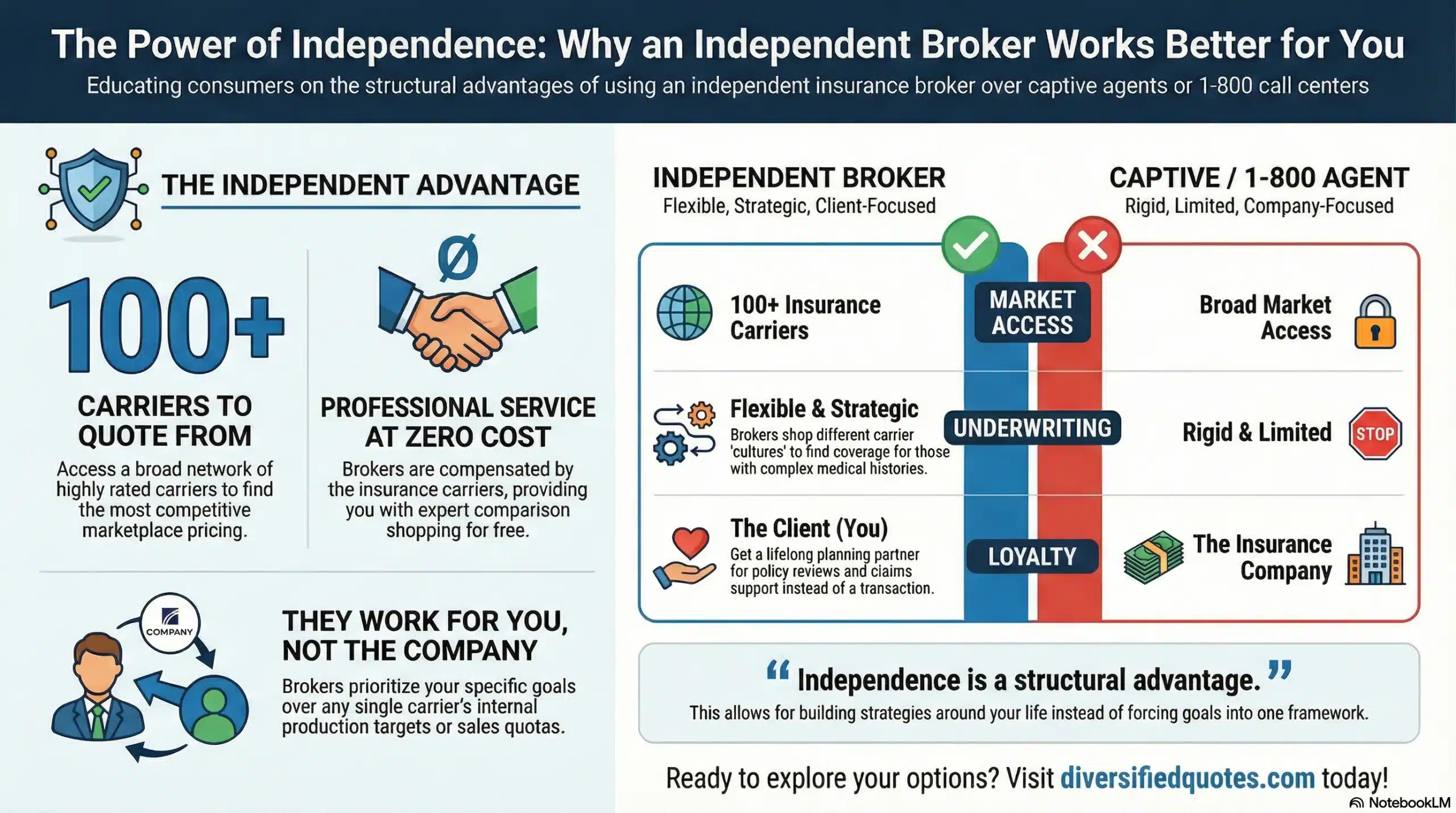
Another important advantage of working with an independent brokerage is that you are not limited to one product shelf. We are licensed nationwide and compare many carriers, which means you get an apples-to-apples comparison rather than a one-brand recommendation. If Globe Life is the right fit for your life insurance need, we can show you that. If another carrier offers better value for that need, we can show you that too. The same is true for retirement income planning, where contract design differences can materially affect retirement outcomes.
A Practical Retirement Example: Protecting Essentials First
Consider a couple in their early 60s who wants to retire within the next three years. They are not trying to “beat the market.” They are trying to ensure they never have to worry about paying essential bills, even if markets are down early in retirement. They also want to keep flexibility for travel and healthcare surprises. In that scenario, we often build the plan in layers.
The first layer covers essential living expenses using predictable income sources—Social Security, pensions, and potentially an annuity income stream. The second layer preserves liquidity for emergencies and lifestyle choices. The third layer keeps growth-oriented assets invested for inflation fighting and long-term flexibility. This layered approach helps many retirees reduce anxiety because they can see where their essential income comes from, regardless of what the market does in the short term.
When you build a plan this way, the annuity decision becomes clearer because the annuity has a job: create a dependable income floor or lock in conservative growth while protecting principal. This is also where annuity comparison shopping becomes valuable. You are not buying an annuity “because annuities are good.” You are selecting a contract that is good at a specific job within your retirement plan.
So, Is Globe Life a Good Insurance Company?
Globe Life can be a good insurance company for the right purpose. If your goal is straightforward life insurance protection—especially simplified products or smaller-face-amount coverage—Globe Life may be worth considering. If your goal is retirement income optimization through annuities, Globe Life is usually not the first place we start, because annuity specialists tend to compete more aggressively on income design and retirement contract features.
The most important step is aligning the company to the outcome. When you do that, the decision becomes less emotional and more practical. If you want a basic life insurance policy, you compare life insurance policies. If you want a retirement paycheck strategy, you compare annuity income options across carriers. And if you want both, you structure each product so it supports a clear role in your plan.
If you want to see what you would actually receive from today’s top annuity options, use the calculator above as a starting point, then request a personalized illustration so you can compare real contract designs side by side.
Compare Your Best Guaranteed Income Options
We’ll benchmark multiple carriers in your state and show you which contracts produce the strongest income and most flexible rules for your timeline.
Related Pages
If your goal is retirement income planning rather than basic life insurance, these pages help you compare annuity types, understand contract rules, and evaluate retirement income strategies.
Financial Protection Essentials
Explore annuity interest examples, disability income protection for key professions, and retirement planning resources to help evaluate income strategies.
Talk With an Advisor Today
Choose how you’d like to connect—call or message us, then book a time that works for you.
Schedule here:
calendly.com/jason-dibcompanies/diversified-quotes
Licensed in all 50 states • Fiduciary, family-owned since 1980
FAQs: Is Globe Life a Good Insurance Company?
What does Globe Life mainly offer?
Primarily term life, final-expense, and accidental death policies. If you want retirement income from annuities, we compare multiple specialist carriers for stronger payouts and features.
Is Globe Life good for guaranteed lifetime income?
It can be part of a quote set, but dedicated annuity issuers often deliver higher guaranteed income or more flexible rider options. Always compare.
How do I know which carrier pays the most?
Use identical inputs—age(s), premium, start date, single vs. joint—and run side-by-side illustrations. We’ll do this for you and highlight differences.
Can I protect principal and still pursue growth?
Yes. Fixed indexed annuities offer measured, index-linked growth with no market-loss risk to principal. They can include income riders or be used for accumulation only.
What about inflation?
Some contracts offer fixed or inflation-adjusted payout options. We’ll compare level vs. COLA-style income so you can see the trade-offs.
Can I still leave a legacy to beneficiaries?
Yes. We can structure cash-refund, period-certain features, or beneficiary-friendly riders so income doesn’t mean sacrificing legacy goals.
How do free-withdrawal provisions work?
Many annuities allow limited annual withdrawals without penalty. Rules vary by carrier. We’ll align the right contract with your liquidity needs.
About the Author:
Jason Stolz, CLTC, CRPC and Chief Underwriter at Diversified Insurance Brokers (NPN 20471358), is a senior insurance and retirement professional with more than two decades of real-world experience helping individuals, families, and business owners protect their income, assets, and long-term financial stability. As a long-time partner of the nationally licensed independent agency Diversified Insurance Brokers, Jason provides trusted guidance across multiple specialties—including fixed and indexed annuities, long-term care planning, personal and business disability insurance, life insurance solutions, Group Health, and short-term health coverage. Diversified Insurance Brokers maintains active contracts with over 100 highly rated insurance carriers, ensuring clients have access to a broad and competitive marketplace.
His practical, education-first approach has earned recognition in publications such as VoyageATL, highlighting his commitment to financial clarity and client-focused planning. Drawing on deep product knowledge and years of hands-on field experience, Jason helps clients evaluate carriers, compare strategies, and build retirement and protection plans that are both secure and cost-efficient. Visitors who want to explore current annuity rates and compare options across multiple insurers can also use this annuity quote and comparison tool.
