
Money During Lawsuit – Get Fast Legal Funding Now

Jason Stolz CLTC, CRPC
Being involved in a legal case can be financially draining—especially when you’re injured, missing work, facing mounting bills, and hearing the same frustrating answer over and over: “it’s going to take time.” If you need money during a lawsuit, pre-settlement funding can provide a fast, practical solution that helps you cover essential expenses while your case is still pending, without forcing you to accept a low settlement just to survive.
For most people, the hardest part of a lawsuit is not only the legal process—it’s the financial pressure that builds while you wait. Rent doesn’t pause. Car payments keep coming. Medical bills pile up. Groceries, utilities, childcare, and basic household expenses do not stop simply because the timeline of your case is unpredictable. And if your injury prevents you from working, the financial stress often becomes the loudest voice in the room, influencing decisions that should be based on what your case is actually worth.
That is exactly where pre-settlement funding comes in. It’s designed to help plaintiffs access a portion of their anticipated settlement value before the case resolves, so they can stay afloat while their attorney negotiates the strongest outcome. Instead of rushing into a quick settlement due to financial hardship, funding can help create breathing room—giving you time, stability, and leverage while your legal claim progresses.
At Diversified Insurance Brokers, we help clients connect with a broad network of funding partners to secure the highest possible advance their case supports, with clear, upfront terms and a simple approval process. If you’re currently trying to figure out how to pay bills during your lawsuit, this page will break down how pre-settlement funding works, who qualifies, how much you may be able to receive, what your attorney will need to provide, and the most common mistakes people make when evaluating lawsuit advances.
Get Money During Your Lawsuit
Request a fast pre-settlement funding review and see what your case may qualify for.
What Does “Money During a Lawsuit” Mean?
When people search for “money during a lawsuit,” they are usually looking for a way to access cash while their injury claim, liability case, or civil lawsuit is still in progress. This financial need is extremely common, because lawsuits often move slower than people expect—even when the facts seem clear. Insurance companies may delay. Medical treatment may take months. Legal back-and-forth may drag on. Meanwhile, the person who is hurt or financially impacted is still trying to pay for real life.
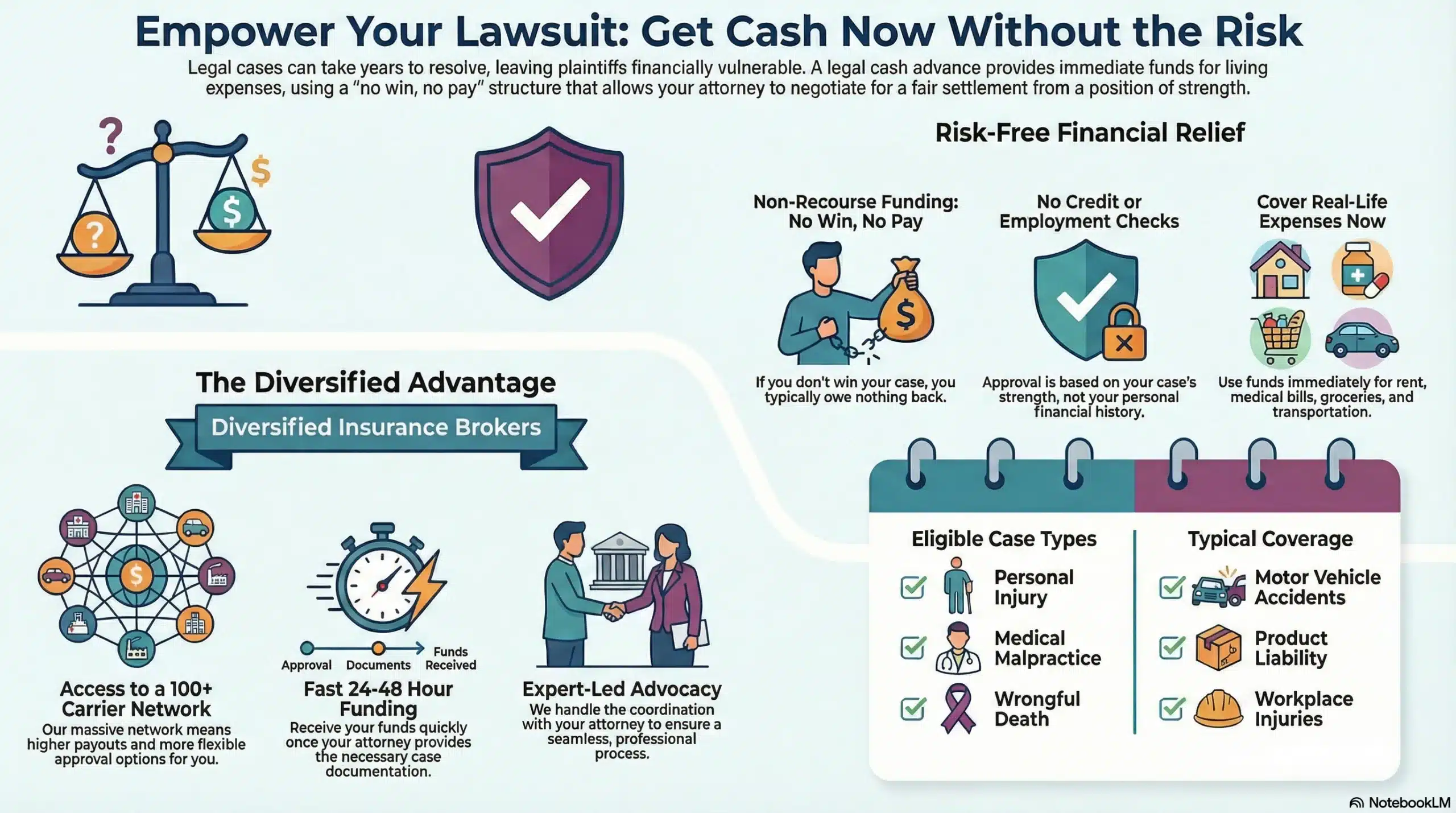
Pre-settlement funding is one of the most common solutions used in this situation. It is sometimes referred to as a lawsuit advance, settlement advance, or lawsuit settlement loan. You will see all of those terms online. However, the most important thing to understand is that pre-settlement funding is typically structured as non-recourse funding. That means repayment usually depends on the outcome of the case, and most funding arrangements do not require monthly payments while the lawsuit is pending.
That difference is important. Traditional loans require repayment no matter what happens. Pre-settlement funding is usually tied to the case resolution, which is why underwriting focuses on case strength, insurance coverage, and expected recovery—not on your credit score, income, or employment history.
If you are trying to understand how this compares to other options, you may also want to review our broader breakdown of lawsuit settlement loans and how pre-settlement funding is typically structured.
How Pre-Settlement Funding Works
Pre-settlement funding works by providing you with an advance against a portion of your expected settlement or judgment value. You are not borrowing money from a bank based on your personal financial profile. Instead, a funding provider evaluates the strength of your legal claim, the likelihood of recovery, and the potential value of the case.
Once you submit an application, the funding provider typically asks your attorney for specific case details and supporting documentation. This protects both the plaintiff and the funding company because the review is grounded in actual case facts, not guesses or assumptions. In many cases, funding can be approved quickly once the attorney provides the requested documentation and the terms are accepted.
Most funding arrangements are structured so that there are no monthly payments while the case is open. Instead, repayment typically occurs at settlement or judgment, directly from the disbursement proceeds handled by your attorney. This is one reason funding is often used by plaintiffs who are already financially stressed and cannot afford additional monthly debt obligations.
It also means funding should be used strategically. The goal is not to take the maximum amount possible just because it is offered. The goal is to get enough financial support to remove the pressure that could lead to a bad settlement decision, while still preserving as much of the final recovery as possible.
If you’re looking for an advance request option with a streamlined review, you can also view our related page on pre-settlement cash advances.
Is Pre-Settlement Funding a Loan?
This is one of the most important questions people ask, and it’s one of the most confusing areas online because the words “loan” and “advance” get used interchangeably. Technically, pre-settlement funding is often referred to as a “loan” in casual language because it provides cash upfront that is repaid later. However, it is not a traditional loan in the way a bank loan or personal loan works.
In most cases, lawsuit funding is non-recourse, meaning repayment is generally dependent on your case outcome. If you do not recover money from the case, you typically do not repay the advance. That’s different from a traditional loan where repayment is required regardless of outcome.
Another major difference is that traditional loans evaluate the borrower. Pre-settlement funding evaluates the case. Approval is usually not based on credit score, income, or employment. Instead, underwriting is based on liability, damages, insurance coverage, and the overall likelihood of settlement or judgment.
This is why people who are unemployed, out of work due to injury, or dealing with medical restrictions can still often qualify for funding—because the decision is about the legal claim itself, not the applicant’s personal financial profile.
Why People Need Money During a Lawsuit
Most legal claims take longer than expected. Even cases that appear straightforward can face delays due to insurance carrier negotiations, medical documentation requirements, ongoing treatment, litigation deadlines, and scheduling issues. The longer a case takes, the more likely it is that financial hardship becomes the primary factor driving decision-making.
Many plaintiffs initially assume that because the injury was serious, the payout will happen quickly. In reality, the legal system often moves slowly. And when someone is waiting months (or longer), financial obligations don’t stop. This creates a situation where the person who is injured may be forced to choose between protecting their case value and keeping the lights on at home.
In many cases, the need for funding is caused by one or more of the following:
- Missing work due to injury or disability restrictions
- Medical bills, rehabilitation costs, and treatment expenses
- Rent or mortgage payments falling behind
- Vehicle replacement or repairs after an accident
- Childcare expenses and household financial strain
- Utilities, insurance payments, groceries, and everyday costs
- Pressure from creditors or collection activity
Pre-settlement funding is designed to help reduce these pressures so that you are not forced into settling your case too early. The goal is to give you the freedom to let your attorney negotiate from a position of strength instead of desperation.
How Much Money Can You Get During a Lawsuit?
The amount of money you can receive through pre-settlement funding depends on the expected value and structure of your case. In most situations, funding is offered as a percentage of the estimated settlement value. That percentage varies based on risk, timeline, and claim details. Funding providers rarely advance the full amount of a case because they need to account for attorney fees, case costs, medical liens, and repayment structures.
In practical terms, lawsuit funding is often used to cover essential needs rather than fund large purchases. Many plaintiffs use it to stabilize their household finances, catch up on overdue bills, and avoid financial decisions that could undermine the final case outcome.
The variables that typically affect funding amounts include:
- Liability clarity (who was at fault and how clear the evidence is)
- Injury severity and whether treatment supports damages
- Insurance coverage limits and available defendants
- Case stage (early investigation vs. nearing resolution)
- Attorney representation and cooperation with documentation
- Existing liens (medical, child support, etc.)
- Prior funding already taken against the same case
If you want a personalized estimate based on your case details, the fastest way is usually to apply and allow the review team to coordinate with your attorney. That’s because attorney-confirmed documentation is typically the basis for any funding offer.
What Types of Cases Are Eligible for Pre-Settlement Funding?
Pre-settlement funding is most common in civil cases where there is a legitimate injury or damages claim and a realistic expectation of settlement or judgment. Many case types qualify, but eligibility always depends on the specifics of the claim.
Common qualifying case types include:
- Auto accident cases involving injury and liability coverage
- Personal injury lawsuits with documented damages
- Slip and fall claims where negligence can be established
- Workplace injury claims (depending on jurisdiction and structure)
- Medical malpractice cases involving clear damages
- Wrongful death lawsuits with documented recovery potential
Not every case will qualify, and that’s okay. Funding companies evaluate risk. If the case is too early, too uncertain, or lacks adequate coverage, funding may not be available. But many people are surprised to find that their case qualifies when they initially assumed it would not.
Why Choose Diversified Insurance Brokers for Pre-Settlement Funding?
When you’re in the middle of a lawsuit, you don’t want to waste time chasing unreliable options, dealing with confusing terms, or filling out paperwork that goes nowhere. You need a fast, organized process and a realistic answer.
At Diversified Insurance Brokers, we work with a large funding network, which helps improve the odds of finding the best fit for your case and the most competitive offer available. Because we’re focused on helping clients find real solutions—not pushing one single provider—we can support a broader range of cases and funding needs.
Our focus is simple: help you request an advance the right way, with clear expectations, attorney coordination, and an approval timeline that makes sense. The funding process should reduce stress, not create more of it.
What Will My Attorney Need to Provide?
Most pre-settlement funding approvals depend on attorney cooperation. That’s because the funding provider needs reliable details about your case, the claim status, the damages, and the expected outcome. Your attorney is usually the one who can provide this information in a way the funding company can trust.
While requirements vary by case type and provider, the documents requested often include:
- A signed authorization form allowing the funding review
- Accident or incident details (date, location, circumstances)
- Insurance carrier information and policy limits
- Medical treatment summaries and injury documentation
- Proof of representation and attorney contact information
- Any settlement offers or negotiation updates (if available)
- Known liens or obligations that could affect the net recovery
This is also why you should be cautious of any funding company that claims they can approve large advances without speaking to your attorney or reviewing documentation. Legitimate funding reviews are documentation-based and coordinated through legal representation.
How Fast Can You Get Funds?
Many pre-settlement funding approvals can be completed quickly once the paperwork is received and reviewed. In many cases, funding may occur within 24 to 48 hours after the attorney provides the necessary documentation and the agreements are signed. However, timelines can vary depending on the speed of document delivery, case complexity, and underwriting review requirements.
Cases with clearly established liability, strong insurance coverage, documented injuries, and an attorney who responds quickly are typically the fastest to fund. Cases that are very early, heavily disputed, or missing documentation may take longer or may not qualify.
The best way to speed up funding is to complete the application accurately and ensure your attorney knows you are requesting a pre-settlement funding review so they can respond to documentation requests quickly.
Common Mistakes People Make with Lawsuit Funding
Pre-settlement funding can be helpful, but it should be handled carefully. The biggest mistake is treating it as “free money” or a long-term financial strategy. It is a short-term tool designed to help you survive a difficult period while your case is pending.
Here are some of the most common mistakes we see:
Mistake #1: Taking more funding than you need. The goal is to create breathing room, not drain the future settlement. When possible, take only what you need to stabilize your situation.
Mistake #2: Not understanding repayment terms. Some funding options can become expensive over time depending on the structure. Always review the disclosed terms and ask questions.
Mistake #3: Applying without attorney awareness. Most approvals require attorney documentation. If your attorney is not aware of the request, the process can stall.
Mistake #4: Believing approvals are guaranteed. Funding is case-based. If liability, coverage, or damages are unclear, a case may not qualify.
Mistake #5: Waiting until crisis mode. If you wait until eviction, repossession, or collections are happening, your situation becomes harder and more urgent. Applying earlier often creates better flexibility.
How the Funding Process Works (Step-by-Step)
If you’ve never requested lawsuit funding before, it helps to understand what the step-by-step process looks like. Most clients assume it will be complicated, but in reality, it can be very straightforward when the attorney provides the required documents quickly.
Step 1: Submit your request. You complete the application with basic information about your case and attorney representation.
Step 2: Attorney coordination. The funding partner contacts your attorney for case verification and documentation.
Step 3: Underwriting review. The claim is reviewed for liability, damages, coverage, and expected recovery.
Step 4: Funding decision. If approved, you receive an offer and disclosures outlining the terms.
Step 5: Agreement and disbursement. Once signed, funds are typically issued quickly.
Throughout this process, the intent is to keep things clear and efficient. The biggest variable is usually documentation speed, which is why attorney response time matters so much.
Will Pre-Settlement Funding Affect My Case?
In most situations, pre-settlement funding does not change the legal strategy of the case because the funding provider does not control the lawsuit. The case is still handled by your attorney, and settlement decisions still belong to you and your legal team.
The main “impact” is financial: if you receive an advance, that advance must be repaid from the settlement proceeds, which reduces the net amount you receive at the end. That’s why funding should be used intentionally and only when it improves your ability to hold out for a better settlement rather than accept less due to financial pressure.
In many cases, the advantage is that funding helps you avoid settling too soon. If financial stress is removed, you may have more time and leverage to negotiate a fair outcome.
Request a Pre-Settlement Funding Review
See what your case may qualify for and how quickly funds may be available.
Related Pages
Talk With an Advisor Today
Choose how you’d like to connect—call or message us, then book a time that works for you.
Schedule here:
calendly.com/jason-dibcompanies/diversified-quotes
Licensed in all 50 states • Fiduciary, family-owned since 1980
Pre-Settlement Funding: Frequently Asked Questions
What is “money during a lawsuit” (pre-settlement funding)?
How fast can I get funds?
Do I qualify if my credit is poor or I’m unemployed?
Is pre-settlement funding a loan?
Do I owe anything if I lose my case?
What types of cases are eligible for pre-settlement funding?
How much money can I get during my lawsuit?
What information will my attorney need to provide?
What are the costs, and how are they paid?
Can I request additional funding later?
About the Author:
Jason Stolz, CLTC, CRPC and Chief Underwriter at Diversified Insurance Brokers, is a senior insurance and retirement professional with more than two decades of real-world experience helping individuals, families, and business owners protect their income, assets, and long-term financial stability. As a long-time partner of the nationally licensed independent agency Diversified Insurance Brokers, Jason provides trusted guidance across multiple specialties—including fixed and indexed annuities, long-term care planning, personal and business disability insurance, life insurance solutions, and short-term health coverage. Diversified Insurance Brokers maintains active contracts with over 100 highly rated insurance carriers, ensuring clients have access to a broad and competitive marketplace.
His practical, education-first approach has earned recognition in publications such as VoyageATL, highlighting his commitment to financial clarity and client-focused planning. Drawing on deep product knowledge and years of hands-on field experience, Jason helps clients evaluate carriers, compare strategies, and build retirement and protection plans that are both secure and cost-efficient.
