
Travel Medical and Evacuation from Central African Republic

Jason Stolz CLTC, CRPC
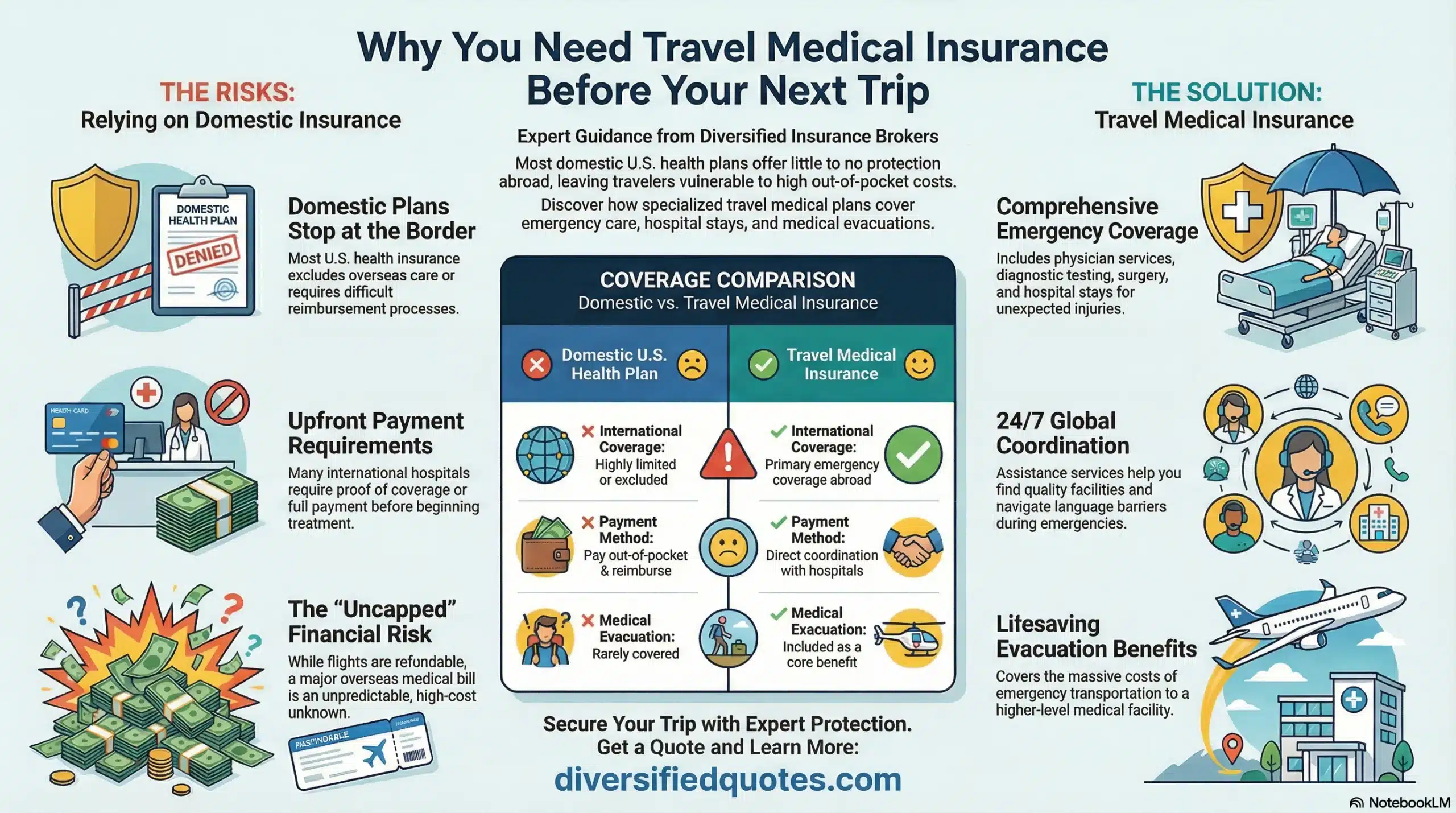
Travel medical and evacuation insurance from the Central African Republic is one of the most important protections you can put in place before you travel, work, or live in the region. In many parts of the Central African Republic, healthcare access can be limited, specialist care may be unavailable outside major cities, and emergency transportation can be difficult to coordinate quickly without the right coverage and assistance support. When a medical emergency happens overseas, the cost isn’t only the hospital bill—it’s also the logistics of getting to the right facility fast, which can become an even bigger financial risk than the treatment itself.
At Diversified Insurance Brokers, we help travelers and expatriates secure international plans built for real-world emergencies, including high-cost hospitalization, emergency surgeries, and medical evacuation services that can transport you to a facility capable of treating your condition. These plans are designed to work when your destination is remote, medical systems are under-resourced, or you want the confidence of knowing there is a coordinated team available when every minute matters.
If you’re comparing destination-based coverage options, it can also help to review our broader guidance on travel medical insurance so you understand how medical limits, deductibles, and evacuation terms work together. Many travelers assume their domestic health insurance or credit card protections will “kick in,” but those benefits often do not include meaningful international emergency coverage or the type of coordinated evacuation support that high-risk regions may require.
Secure Travel Medical & Evacuation Coverage
Get international medical coverage options designed for emergencies, hospitalization, and evacuation support.
Why Travel Medical & Evacuation Insurance Matters in the Central African Republic
The Central African Republic is a destination where being “prepared” is not just smart—it’s essential. Even if you are traveling to a main population center, emergency medical situations do not always happen near the best hospital, and local response times can vary dramatically. The real risk is that a routine medical event at home can become a complicated, expensive, and time-sensitive situation abroad when you need diagnostics, advanced medications, surgical support, or intensive care that is not locally available.
In a higher-risk travel environment, the purpose of travel medical insurance is not to cover small inconveniences. It’s designed for major events—serious accidents, sudden illness, unexpected infections, and emergency treatment that can’t be delayed. The purpose of evacuation coverage is even more critical: it is what connects you to a higher level of care when the facility you are in cannot treat you safely, quickly, or completely.
Many travelers underestimate how fast costs can escalate. Emergency room stabilization, imaging, lab work, and inpatient monitoring can add up quickly. If a transfer is needed to another city or another country, expenses can multiply. This is why many travelers also explore emergency medical evacuation insurance as a standalone concept, even though most people ultimately choose a plan that combines both medical and evacuation benefits in one integrated policy.
What Travel Medical Coverage Typically Helps Pay For
Travel medical insurance is designed to help pay for unexpected healthcare expenses outside your home country. In the Central African Republic, this matters because many facilities may require proof of payment or upfront payment arrangements before providing high-level treatment. Having a plan with a global assistance team can make it easier to coordinate care, locate appropriate facilities, and manage paperwork during a stressful time.
Depending on the plan and the benefits selected, travel medical coverage can help with hospitalization, emergency physician services, outpatient treatment, emergency imaging and diagnostics, prescription medications related to the event, ambulance transport, and medically necessary follow-up care that needs to happen while you are still abroad. Coverage may also include dental emergency benefits when the issue is caused by an accident rather than routine dental care.
In many cases, the most important factor is not just whether a benefit exists, but whether the plan has a high enough maximum limit to realistically cover the type of emergency you want protected. A low-limit plan can provide a false sense of security if the medical maximum is exhausted by a short hospital stay. For travelers who want more complete protection, we often recommend higher benefit levels, especially for destinations where evacuation is a realistic possibility.
Medical Evacuation: The Coverage That Changes Everything
Medical evacuation coverage can be the difference between receiving basic stabilization care locally and receiving specialized treatment at a facility that can actually resolve the emergency. In many high-risk travel destinations, evacuation is not a luxury—it is the bridge to real care. When local resources are limited, the most medically appropriate next step may be a transfer to another country that has advanced trauma, cardiology, neurology, surgical, or ICU capabilities.
Evacuation is expensive because it is operationally complex. It may involve medical staffing, aircraft coordination, equipment, flight clearance, secure routing, coordination with receiving hospitals, and rapid documentation. In a real emergency, you do not want to be negotiating these details or comparing providers from a hospital bed. A properly structured plan should provide coordinated support, not just a reimbursement promise after the event.
That is why many travelers choose a plan that includes both evacuation and assistance services, because even the best coverage is less valuable if it is difficult to activate quickly. When the assistance team is involved early, it can reduce delays, lower complications, and help ensure the patient is transferred to the right facility for the specific medical need.
What Makes Travel “High Risk” (Even for Healthy Travelers)
High-risk travel is not only about personal health. It’s often about the environment. Travel is considered higher risk when it involves destinations with limited medical infrastructure, inconsistent emergency response, remote travel routes, language barriers, limited access to stable transportation, or unpredictable conditions that create delays in care. In these conditions, even a healthy traveler can face higher medical exposure simply because basic problems become harder to solve quickly.
In the Central African Republic, a common concern is the ability to access advanced diagnostics or specialist evaluation in a timely way if something serious happens. When care is delayed, complications can rise, and that is when evacuation becomes necessary. This is especially true for injuries, infections, cardiovascular events, or any condition that requires surgical intervention or intensive monitoring.
Some travelers also need protection for extended time abroad, and that is where plans designed for longer stays or broader international coverage can be more appropriate than short trip-only designs. If your travel or residence plan includes multiple international stops, you may also benefit from exploring international health insurance options that are structured for longer duration and more consistent medical access abroad.
Example Scenario: Why Coverage Matters in Real Life
Imagine a contractor working near Bangui who suffers a serious injury in a roadside accident. Local facilities may be able to provide stabilization, but they may not have the imaging equipment, surgical resources, or ICU capacity needed to manage complications. Without a travel medical and evacuation plan, the family may be forced to coordinate emergency transport independently, including arranging an air ambulance, selecting a receiving hospital, and managing international approvals—all while facing bills that can easily exceed $100,000.
With the right coverage, the process can be dramatically different. The plan’s assistance team can coordinate care, arrange medical transport, and support the transfer to a facility that can deliver the appropriate level of treatment. This doesn’t just protect finances. It protects outcomes by reducing the chance that care is delayed when timing is critical.
Pre-Existing Conditions and Travel to the Central African Republic
Pre-existing condition coverage is one of the most misunderstood parts of travel medical insurance. Some plans exclude pre-existing conditions entirely. Some offer limited coverage for what the policy defines as an “acute onset” event. Others may offer broader coverage depending on underwriting, plan structure, and the timing of purchase. The details matter because the wrong assumption can cause a denial when a traveler needs help the most.
If you have ongoing medications, chronic conditions, past surgeries, or prior diagnoses, it’s important to understand exactly how the plan treats that history. Even if you feel stable and healthy, the policy language can determine whether an event is considered a covered emergency or an excluded recurrence. This is one of the most valuable reasons to work with an advisor: we can help you compare wording and benefits so you are not relying on guesswork.
Even if your medical history is clean, travelers sometimes experience unexpected infections, injuries, or complications from environmental conditions. A plan focused on emergency medical treatment can still be a strong fit for travelers who want coverage for unexpected events without unnecessary add-ons.
What Impacts the Cost of Coverage
Travel medical and evacuation insurance is typically priced based on age, trip length, destination, medical maximum selected, evacuation limit, deductible choices, and any optional benefits that expand coverage. In higher-risk regions, pricing can reflect increased logistical complexity and the higher expected cost of emergency transport.
While it may be tempting to choose the lowest-cost option, a low premium can sometimes mean lower medical limits, weaker evacuation definitions, or stricter exclusions. In a destination like the Central African Republic, a plan should be chosen based on realistic exposure, not just price. A single emergency transfer can dwarf years of premium savings if coverage is too limited when a serious situation occurs.
If your trip includes group travel, mission work, or coordinated organizational travel, it can also be helpful to review options like cheap group travel insurance, which can sometimes provide a more structured approach for teams traveling together while still keeping coverage practical and accessible.
What to Look for in a Policy Before You Buy
Before selecting a plan, it’s important to confirm how the policy defines a covered emergency, how evacuation is triggered, what approval requirements exist, and whether evacuation is provided as a coordinated service or a reimbursement-only benefit. In higher-risk travel, coordination is often the difference between smooth execution and chaos.
It’s also important to confirm how the plan handles hospital admission requirements, whether direct billing networks are available, and what documents may be needed in a claim. Even the best plan can become frustrating if the claims process is unclear or overly restrictive during an urgent situation.
Another key point is understanding whether the plan is primarily “travel insurance” with limited medical coverage, or a true travel medical policy built for emergencies. Many travelers mistakenly buy basic travel insurance because it is heavily marketed, but those plans may focus on trip cancellation, baggage loss, and delays while offering lower medical limits. If your priority is medical stability and evacuation access, you typically want a policy that is medical-first rather than trip-first.
For travelers who are price-sensitive but still want meaningful medical protection, it can be useful to also compare general options like cheap travel insurance, while keeping in mind that the cheapest plan is not always the safest plan when travel conditions are higher risk.
Why Work With Diversified Insurance Brokers
When travel is high risk, the wrong coverage can be almost as dangerous as having no coverage at all. The goal is not just to “have a policy.” The goal is to have the right type of protection that will actually respond when a serious medical event happens in a challenging destination.
At Diversified Insurance Brokers, we help travelers select coverage based on real-world risk and how the plan works in practice, not just how it looks on a quote screen. Our role is to help you choose a plan that matches your timeline, your destination profile, and your risk tolerance—especially when evacuation and coordinated support could be required.
We also help clients understand how travel medical plans fit into a broader protection strategy. Some travelers may need additional financial safeguards before they travel, such as making sure their family has life coverage or income protection in place. Depending on the trip and the household situation, it can make sense to also review broader protection planning like life insurance and other solutions that reduce financial strain if something unexpected happens abroad or shortly after returning home.
Apply Before You Travel
The most important rule with travel medical and evacuation coverage is simple: you have to secure it before you need it. Once a medical emergency happens overseas, coverage gaps cannot be fixed retroactively. That is why travelers planning time in the Central African Republic should treat travel medical and evacuation insurance as a proactive step—not a last-minute purchase.
When your plan is in place, you gain access not only to financial protection, but to global support resources that can help coordinate care, guide you to appropriate facilities, and manage emergency transportation when needed. This is the type of protection that gives travelers confidence to focus on the purpose of their trip, knowing that coverage and support systems are in place if the unexpected happens.
Get Covered Before You Travel
Apply online in minutes to secure travel medical and evacuation coverage for the Central African Republic.
Related Travel Medical & Evacuation Pages
Talk With an Advisor Today
Choose how you’d like to connect—call or message us, then book a time that works for you.
Schedule here:
calendly.com/jason-dibcompanies/diversified-quotes
Licensed in all 50 states • Fiduciary, family-owned since 1980
Travel Medical & Evacuation from Central African Republic — FAQs
What does travel medical and evacuation insurance cover?
Why is evacuation coverage important in the Central African Republic?
Is this coverage only for extreme travelers or high-risk jobs?
Do plans cover pre-existing conditions?
How does medical evacuation actually work during an emergency?
Can evacuation take me back home?
What are common exclusions to watch for?
How much can evacuation cost without insurance?
How do I buy coverage and when should I purchase it?
About the Author:
Jason Stolz, CLTC, CRPC and Chief Underwriter at Diversified Insurance Brokers (NPN 20471358), is a senior insurance and retirement professional with more than two decades of real-world experience helping individuals, families, and business owners protect their income, assets, and long-term financial stability. As a long-time partner of the nationally licensed independent agency Diversified Insurance Brokers, Jason provides trusted guidance across multiple specialties—including fixed and indexed annuities, long-term care planning, personal and business disability insurance, life insurance solutions, Group Health, and short-term health coverage. Diversified Insurance Brokers maintains active contracts with over 100 highly rated insurance carriers, ensuring clients have access to a broad and competitive marketplace.
His practical, education-first approach has earned recognition in publications such as VoyageATL, highlighting his commitment to financial clarity and client-focused planning. Drawing on deep product knowledge and years of hands-on field experience, Jason helps clients evaluate carriers, compare strategies, and build retirement and protection plans that are both secure and cost-efficient. Visitors who want to explore current annuity rates and compare options across multiple insurers can also use this annuity quote and comparison tool.
