
Travel Medical and Evacuation from East Timor

Jason Stolz CLTC, CRPC
Traveling to East Timor (also called Timor-Leste) is one of those trips that feels remote in the best way—quiet coastlines, mountainous drives, smaller communities, and a tourism footprint that’s still developing compared to many parts of Southeast Asia. That same “off the beaten path” appeal is also why travelers, expats, contractors, researchers, and NGO teams should think about medical planning differently here than they would for more built-out destinations. In Timor-Leste, routine care can often be handled locally, but serious injuries and complex medical situations frequently require evacuation to a higher-level facility outside the country.
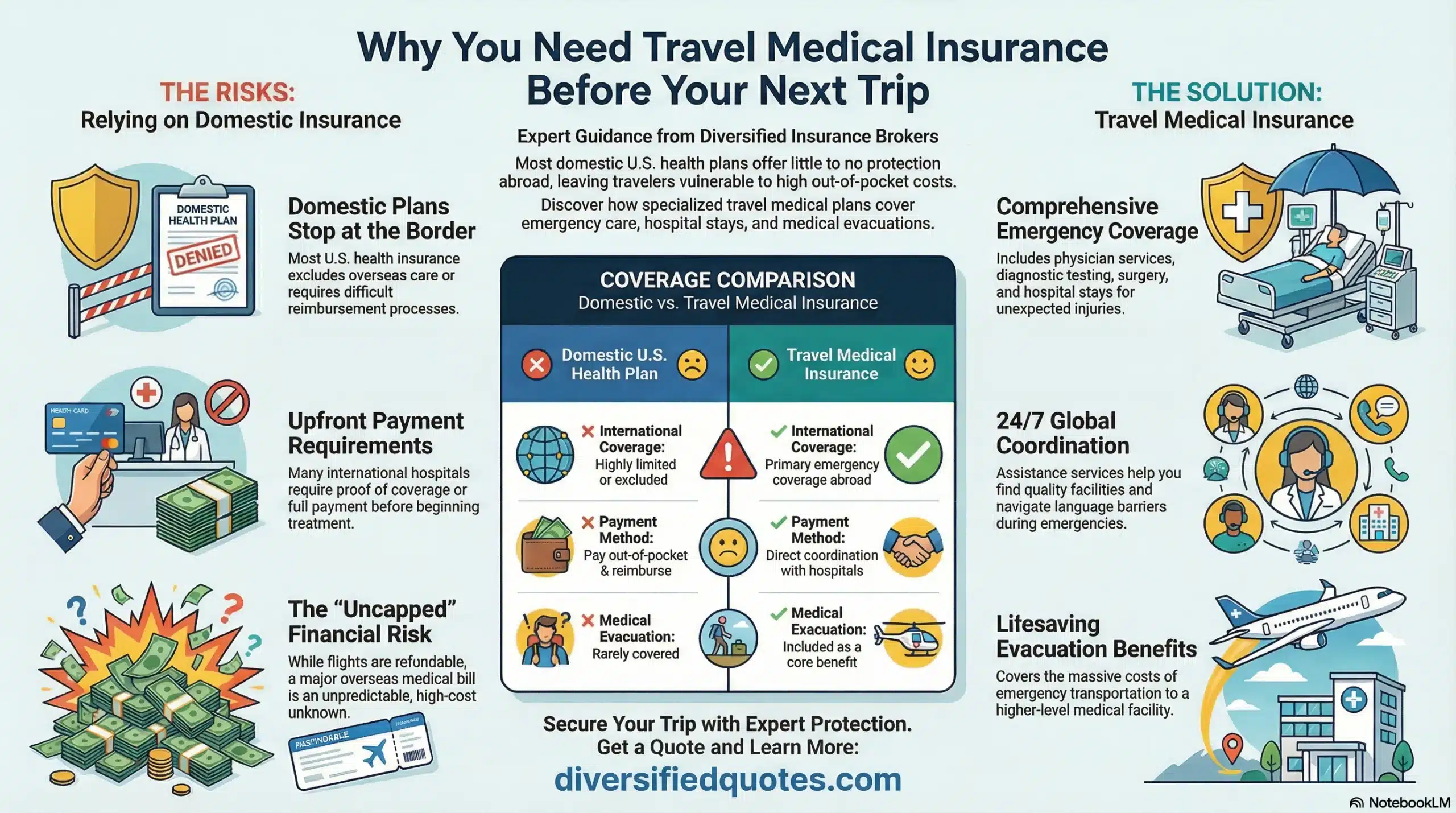
That’s where travel medical and evacuation insurance from East Timor becomes less of a checkbox and more of a practical travel tool. A strong plan is designed to do two things at the same time: help pay for emergency care you may need while you’re in-country, and coordinate transport when the best care isn’t realistically available where you are. If you’ve ever tried to solve a complicated logistical problem while stressed, injured, or dealing with a family member’s emergency, you already understand the value of having a plan that comes with a 24/7 assistance team and a clear process. At Diversified Insurance Brokers, we help travelers and long-stay visitors match coverage design to the realities of the destination, so you’re not relying on assumptions that work fine in big hub cities but fail in a remote environment.
Many people assume “travel medical insurance” is mainly reimbursement for doctor visits. In a destination like Timor-Leste, it’s better to think of coverage as a system—medical benefits plus coordination. The benefit limits matter, but so does how the plan defines medical necessity, how authorizations work for high-cost services, and how quickly the assistance team can move when a situation is evolving. That coordination is often the difference between “we got to the right place quickly” and “we lost critical time trying to figure out what to do.” If you’re comparing plan types, start with a strong foundation like Medical Travel Insurance, then evaluate whether your trip profile needs broader protections like International Health Insurance, especially for longer stays, repeat travel, or residency-like scenarios.
Why Timor-Leste Changes the Planning Conversation
Timor-Leste is not “no-care,” but it is “limited-care” in the ways that matter most during major emergencies. Outside of Dili, access to advanced diagnostics, specialist coverage, ICU-level capability, or rapid surgical response can be constrained by location, staffing, equipment availability, and transport time. Even in Dili, there can be situations where the best medical decision is stabilization and transfer. This is not unique to Timor-Leste, but it shows up more quickly because there are fewer layers of options locally.
When a traveler needs escalation of care, the question becomes: where is the nearest facility that is truly capable for the specific problem? In many cases, that means evacuation to a larger regional hub—often Australia or Singapore, depending on the condition, routing, and what the plan’s assistance team determines as medically appropriate under the contract terms. Transport is expensive because it’s not just a “flight.” It can involve medical staffing, specialized equipment, ground coordination, receiving facility arrangements, and in some cases multiple legs of transport. That’s why travelers can be shocked by the cost of evacuation when they learn how it’s actually executed.
If you want a simple mental model, treat Timor-Leste as a destination where evacuation is not a fringe scenario. It’s a realistic, predictable contingency. That’s why travelers who prioritize certainty often compare evacuation-focused options alongside broader risk profiles such as Emergency Medical Evacuation Insurance, especially when their itinerary involves rural travel, island-hopping, or any assignment where time-to-care could stretch longer than they’re comfortable with.
What “Travel Medical + Evacuation” Coverage Is Designed to Do
A well-structured travel medical and evacuation plan is built for one core problem: unexpected medical events away from home. That includes emergency doctor and hospital services for covered illness or injury, but it also includes the “what happens next” side—when local care is insufficient, overwhelmed, or simply not the right match for the condition. That second part is the reason evacuation benefits exist.
In a real emergency, the benefit limit matters, but the most valuable component is often the assistance process. The 24/7 team typically coordinates case management, supports communication between providers, helps arrange transfer logistics, and guides the authorization process when high-cost services are needed. Travelers who assume they can “figure it out on their own” usually underestimate the complexity of coordinating cross-border care—especially under time pressure. If you’ve ever dealt with a domestic hospital transfer and insurance authorization, you can imagine how quickly it becomes more complicated when you add distance, language barriers, and international routing.
For many travelers, the goal is not to buy the biggest numbers available. The goal is to buy coverage that matches realistic exposure. Someone staying in central Dili for a short trip may design the plan differently than a traveler who is touring rural coastlines by motorbike, a diver spending time offshore, or a contractor operating on a remote assignment. That’s why the “best plan” depends on the trip profile, not just the destination name.
Common Reasons Travelers in East Timor Actually Use Coverage
The most common triggers aren’t exotic. They’re normal situations that become higher-stakes when you’re far from advanced care. Motorbike accidents are a recurring issue across many island destinations, and Timor-Leste is no exception. A fracture, head injury, or internal trauma can require higher-level imaging and specialist evaluation. Illness can escalate quickly as well—severe infection, dehydration complications, or gastrointestinal issues that move from “uncomfortable” to “hospitalization” faster than expected. Even something that seems routine, like appendicitis, can become a situation where stabilization and rapid transfer is the best decision depending on timing and local capability.
Another common scenario is the traveler who has a known health history that is “stable” at home but becomes complicated abroad. This is where plan definitions matter. Some policies treat pre-existing conditions narrowly. Others offer limited protections for certain sudden flare-ups under strict definitions. The point isn’t that one approach is always right; it’s that the traveler should not assume coverage exists without confirming how the policy applies in real-world terms. If you’re staying longer or you have medical history you’re managing, comparing plan structure to broader travel settings can help—especially if you’re deciding between a short-term approach and more ongoing solutions like International Health Insurance.
A Realistic Scenario: Why Evacuation Benefits Matter
Imagine a traveler in Dili who is involved in a vehicle accident. Initial evaluation is possible locally, but the injury profile suggests internal trauma and a need for specialist care and advanced imaging that may not be accessible quickly enough. The medical recommendation becomes transfer to a higher-level facility. If the traveler has no plan, they’re now trying to solve two problems at once: “Where do we go?” and “How do we pay?” The logistics—transport coordination, receiving facility intake, documentation, timing, and stabilization—move fast. Without coverage, the family may be forced into reactive, expensive decisions under pressure.
With a properly structured travel medical and evacuation plan, the situation becomes more controlled. The assistance team coordinates the transfer pathway, confirms the medically appropriate destination under the policy terms, and manages the authorization and logistics so the traveler’s family is not trying to negotiate complex decisions at the worst possible time. That doesn’t mean every situation is effortless, but it dramatically reduces the chaos and financial shock that often comes with cross-border transport.
This is also why travelers who plan multi-country travel often compare destination realities. You might begin a trip in a more developed location and then route through Timor-Leste. Understanding how coverage needs shift across your route can matter more than the destination itself. If you like comparing different destination contexts, you can explore how “coverage thinking” changes by browsing pages like Travel Medical and Evacuation from Bali, Travel Medical and Evacuation from Cuba, and Travel Medical and Evacuation from Belarus to see how infrastructure, distance to care, and logistics influence the planning conversation.
Secure Travel Medical & Evacuation Coverage for East Timor
Apply online for coverage designed for destinations where advanced care may require evacuation to a regional medical hub.
Short Trip vs. Long Stay: How Coverage Design Changes
One of the most important questions for Timor-Leste isn’t “Do I need coverage?”—it’s “What kind of coverage matches how I’m using the destination?” If you’re taking a short trip, you can often structure the policy around travel dates and realistic exposure, focusing on emergency care and evacuation benefits that align with your route. If you’re staying longer—working on assignment, living as an expat, or traveling through multiple countries over a long period—you may need a structure that behaves more like ongoing coverage rather than a simple trip add-on.
Long stays change the risk profile in a few predictable ways. First, you have more time for something unexpected to occur. Second, the likelihood you’ll travel outside the capital increases, especially if you’re working or living there. Third, continuity of care matters more. If you need follow-up treatment, medication support, or a longer recovery pathway, you want to be sure your plan design isn’t overly narrow. This is where travelers often compare major-medical style travel coverage to broader options like International Health Insurance, depending on duration and residency realities.
For travelers who are moving across risk tiers—urban to rural, developed to developing, stable to higher-risk zones—coverage selection becomes a strategy, not a purchase. That’s also where broader category pages like High Risk Travel Insurance can help you frame what features matter most when you’re not traveling in a “standard tourist” footprint.
How to Think About Medical Limits and Evacuation Limits
It’s easy to focus on medical maximums, because they’re visible. But in destinations like Timor-Leste, the evacuation limit and the rules that govern how evacuation is executed are often just as important. Evacuation costs are not standardized. They depend on where you are, how urgently you need to move, what level of medical staffing is required, and where you’re being routed. Even when the goal is “the nearest adequate facility,” that facility might be outside the country, and the logistics can be complex.
In practice, travelers should think in terms of “worst plausible scenario.” Not a dramatic fantasy—just the realistic scenario where a traveler needs stabilization, transfer, and advanced care. If your plan is weak in evacuation, you might still have decent medical benefits but face a massive financial exposure when you need transport. If your plan is strong in evacuation but weak in medical, you might have transport support but still face substantial out-of-pocket treatment costs. The goal is balance.
Another area travelers should understand is authorization. Many policies require the assistance team to coordinate evacuation for the benefit to apply. That’s not a trap; it’s how the plan controls cost and ensures transport decisions are medically appropriate. The best traveler behavior is simple: if something serious happens, get immediate care first, and when the situation is stable enough, involve the assistance team as soon as possible. That keeps the plan’s process aligned with your real-world decision-making.
Pre-Existing Conditions: The Part Travelers Should Not Guess About
Pre-existing conditions are one of the most misunderstood topics in travel medical insurance. Some travelers assume coverage exists for everything, while others assume nothing is covered and give up. The reality depends on the policy definition and the carrier. Some plans exclude pre-existing conditions entirely. Some offer limited protections for certain sudden events under strict definitions. Others may treat the topic differently depending on plan tier or optional structure.
If you’re traveling to Timor-Leste and you have medical history, the right approach is not fear—it’s clarity. Know how the plan applies, know what triggers coverage, and understand what documentation or disclosure might be required. When people “cut corners,” it’s usually here—because it’s easy to skim the policy and assume the marketing language is the same as the contract language. This is one of the main areas where working with an agency that compares plans matters.
Who This Coverage Is Most Valuable For in Timor-Leste
Travel medical and evacuation coverage is useful for almost anyone visiting Timor-Leste, but it becomes especially important when your trip includes rural travel, boat travel, mountain roads, or extended stays where you’ll be living life normally rather than traveling as a managed tourist. That includes digital nomads and long-stay remote workers, contractors and project teams, NGO staff, missionaries, educators, researchers, and families visiting for an extended period.
It also matters for travelers who are stacking destinations. Timor-Leste is sometimes combined with other countries in the region. If you’re building a route that includes both developed hubs and less-developed areas, the coverage you choose should be based on the most demanding segment of your trip, not the easiest one. That’s where comparing page-to-page differences can help—like contrasting a higher-logistics destination with a more infrastructure-rich location, or comparing the evacuation assumptions across multiple “from” pages such as Travel Medical and Evacuation from the Democratic Republic of Congo versus more tourism-heavy destinations.
How to Use Your Coverage in an Emergency
In an overseas medical event, the priorities are simple: seek care immediately, then coordinate. If the situation is minor, you may just need to keep documentation and follow the claim submission steps. If the situation is serious—hospitalization, transfer, or anything that could involve evacuation—the best step is to involve the plan’s assistance team as soon as it’s feasible. Many plans require authorization for evacuation, and the assistance team also helps coordinate receiving facility arrangements and transport routing.
Documentation matters. Keep discharge paperwork, medical notes, diagnostic summaries, and receipts. Even when a plan supports direct coordination, having clear paperwork reduces friction. Most claim problems don’t happen because someone is “trying to cheat the system.” They happen because documentation is incomplete or the traveler accidentally bypassed the plan’s required process under stress. A good plan paired with good process awareness is what creates clean outcomes.
Why Work With Diversified Insurance Brokers
Diversified Insurance Brokers is an independent, family-owned agency that helps clients nationwide compare travel medical and evacuation options across established international carriers. Our job is not just to point you to an application link. It’s to help you avoid under-insuring evacuation, help you match plan structure to trip duration and risk profile, and help you understand where policy language matters most—especially around evacuation rules and pre-existing conditions.
For destinations like Timor-Leste, you don’t need fear-based planning. You need reality-based planning. A plan designed for the real logistics of East Timor gives you the ability to travel with confidence, knowing you have both financial protection and a coordination pathway if a serious event occurs.
Get Covered Before You Travel
Apply online in minutes to secure travel medical and evacuation coverage for East Timor.
Related Travel Medical Pages
If you’re comparing plan types or planning a route across multiple countries, these pages help you match coverage design to real-world medical access and evacuation logistics.
Related Destination Pages
Use these destination pages to compare how coverage needs can change with infrastructure, distance to advanced care, and evacuation routing.
Talk With an Advisor Today
Choose how you’d like to connect—call or message us, then book a time that works for you.
Schedule here:
calendly.com/jason-dibcompanies/diversified-quotes
Licensed in all 50 states • Fiduciary, family-owned since 1980
Travel Medical & Evacuation from East Timor — FAQs
What does “travel medical & evacuation” insurance include for East Timor?
Why is this coverage especially important in East Timor (Timor-Leste)?
Does the plan cover evacuation by air ambulance?
Are pre-existing conditions covered?
What are common exclusions to watch out for?
How are premium costs determined?
How do I arrange evacuation or start a claim while abroad?
Will evacuation send me home or to the nearest adequate hospital?
What should I check before buying coverage for East Timor?
About the Author:
Jason Stolz, CLTC, CRPC and Chief Underwriter at Diversified Insurance Brokers (NPN 20471358), is a senior insurance and retirement professional with more than two decades of real-world experience helping individuals, families, and business owners protect their income, assets, and long-term financial stability. As a long-time partner of the nationally licensed independent agency Diversified Insurance Brokers, Jason provides trusted guidance across multiple specialties—including fixed and indexed annuities, long-term care planning, personal and business disability insurance, life insurance solutions, Group Health, and short-term health coverage. Diversified Insurance Brokers maintains active contracts with over 100 highly rated insurance carriers, ensuring clients have access to a broad and competitive marketplace.
His practical, education-first approach has earned recognition in publications such as VoyageATL, highlighting his commitment to financial clarity and client-focused planning. Drawing on deep product knowledge and years of hands-on field experience, Jason helps clients evaluate carriers, compare strategies, and build retirement and protection plans that are both secure and cost-efficient. Visitors who want to explore current annuity rates and compare options across multiple insurers can also use this annuity quote and comparison tool.
