
Travel Medical and Evacuation from Kuwait

Jason Stolz CLTC, CRPC
Kenya is one of Africa’s most iconic travel destinations, known for safari routes like the Maasai Mara, coastal travel around Mombasa, and major urban centers like Nairobi. But Kenya can also be a “high-variance” destination from a medical planning standpoint. In other words, what happens after an illness or injury depends heavily on where you are, how quickly you can access higher-level facilities, and whether you have a plan that can coordinate the next step. That’s why travel medical and evacuation insurance from Kenya matters. It is designed to help cover emergency treatment and, when local care is not sufficient, help coordinate and pay for medically necessary evacuation to a facility that can properly manage the situation.
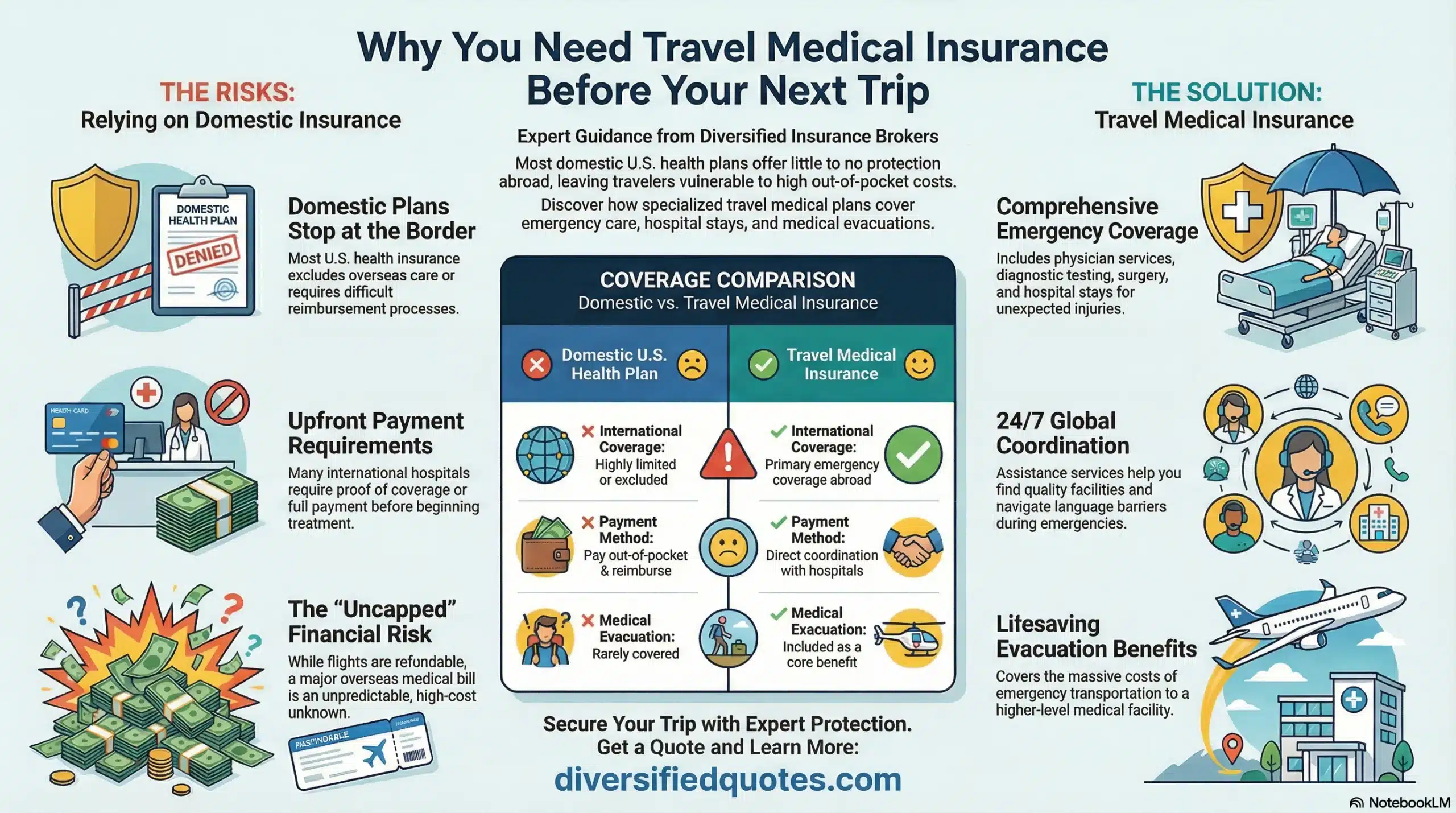
At Diversified Insurance Brokers, we help travelers compare plan options that focus on the realities that drive costs and outcomes in an overseas emergency: access to care, clear benefit limits, and 24/7 assistance coordination. Many travelers assume their domestic health plan will follow them internationally. Often it does not, or it only provides limited “out-of-network” reimbursement after you pay upfront. In Kenya, that detail matters because serious events can require deposits, immediate decisions, and transport logistics you do not want to manage alone while you’re trying to get stable.
If you want to start with the basics and make sure you’re building the right foundation, review our overview of travel medical insurance. If you’re traveling into remote areas, going on safari, doing field work, or you simply want a clearer understanding of how evacuation is approved and coordinated, our guide on emergency medical evacuation insurance is a strong companion page. And if your trip is longer than a standard vacation (or you want more “major medical-like” coverage abroad), you may want to compare options with international health insurance.
Kenya is also a destination where the “best plan” depends on your itinerary. A traveler staying primarily in Nairobi may feel comfortable with the local care access, but a traveler spending days in safari regions, coastal routes, or rural project sites is dealing with a different reality: long distances to higher-capability facilities and fewer options if the situation escalates. That’s where evacuation benefits stop being a buzzword and become the core of why travelers buy coverage in the first place.
Why Travel Medical and Evacuation Coverage Matters in Kenya
The most important reason to consider coverage in Kenya is that serious cases can become a logistics problem before they become a billing problem. If an injury happens in a remote safari region, the first challenge may be stabilization and transport to a capable facility. If a sudden illness becomes complicated, the challenge may be locating the right hospital and coordinating admission. Even when care is available, the difference between “available” and “appropriate” can be significant depending on the diagnosis, required diagnostics, and level of monitoring needed.
Travel medical insurance is built to cover eligible emergency treatment abroad—hospital care, physician services, diagnostics, surgery, and prescriptions in an emergency scenario. Evacuation coverage exists for the moment when the local facility cannot provide adequate care, the case requires advanced capability, or the timeline matters and transfer is medically necessary. In Kenya, evacuation can be within the country to a higher-level facility, or it can involve a cross-border transfer depending on medical necessity and plan terms. This is why the plan’s assistance coordination is not optional—it is often the main feature that determines whether the process is smooth or chaotic.
Many travelers also want the option to choose a plan that fits “how” they’re traveling. A short-term tourist itinerary looks different than an extended stay for work, volunteer assignments, or a longer expatriate-style living arrangement. A good rule of thumb is that the more time you spend abroad—and the more your travel includes rural routes or remote excursions—the more you should prioritize robust evacuation benefits and clear assistance procedures.
What Medical Evacuation Really Means (And Why It’s Often the Biggest Risk)
Evacuation is frequently the highest-cost portion of a serious travel claim. It is also the portion travelers misunderstand the most. Evacuation is not simply “a flight home.” It can include ground transport, coordination with a receiving hospital, commercial transport with medical escort, or air ambulance depending on severity. The assistance team typically coordinates the logistics, confirms medical necessity, and determines what pathway fits the policy’s definition of “appropriate care.”
This is why we encourage travelers to look beyond the words “evacuation included” and confirm the structure. Some policies evacuate you to the nearest adequate facility, which may be within Kenya or may be outside the country depending on the case and local capacity. Other policies may include repatriation once you are stabilized. Those differences matter if you’re traveling with family, if you have trusted physicians at home, or if you want the ability to recover in a specific location.
If you are planning a higher-risk itinerary—remote safari routes, rugged excursions, or field-based work—it’s also worth reviewing our broader guidance on high risk travel insurance. Not every plan treats activities, terrain, or remote access the same way, and you don’t want to discover a limitation after an incident occurs.
Example Scenario: A Safari Emergency Outside Major City Access
Imagine a traveler on safari who suffers a severe injury hours away from higher-level hospital capability. Local clinics may be able to provide initial stabilization, but advanced imaging, surgical capacity, or ICU-level monitoring might require transfer to a more capable facility. In a scenario like this, the plan’s value is not just financial reimbursement. It is the coordinated response: the ability to call a 24/7 assistance team, document the case properly, coordinate transport, confirm receiving facility acceptance, and execute the transfer without forcing the traveler’s family to improvise a complex solution under stress.
Without coverage, travelers can face major out-of-pocket exposure for evacuation logistics alone. With appropriate coverage, eligible costs are covered according to policy terms and the assistance team helps coordinate the process so you can focus on stabilizing and getting to the right care.
Travel Medical & Evacuation Coverage for Kenya
Apply online for travel medical insurance that includes emergency care and evacuation coordination for Kenya travel and extended stays.
Who Should Consider Travel Medical and Evacuation Insurance in Kenya?
This coverage is especially valuable for travelers whose “Plan B” cannot be improvisation. That includes tourists on safari routes, families traveling with children, older travelers, business professionals with tight schedules, contractors working outside major city corridors, students studying abroad, and volunteer or NGO teams operating in rural regions. The more distance you place between yourself and high-capability care, the more you should treat evacuation as a realistic possibility rather than a remote contingency.
It can also be important for travelers with known medical history. Many travel medical plans treat pre-existing conditions differently, and some provide limited benefits only under specific “acute onset” style definitions. If you have a known condition, plan choice matters more—because a flare-up in a destination where the case could escalate quickly can turn into an evacuation event. The correct move is not to assume every plan is the same, but to choose coverage with clear understanding of how it handles your situation.
Coverage Details That Matter in Real Claims
When comparing plans for Kenya, we focus on practical claim-driving features. First is the strength of emergency medical benefits. That means eligible hospital and physician charges, diagnostics, and treatment are covered up to meaningful limits. Second is evacuation limits and coordination procedures—because that is where costs can escalate quickly. Third is the quality of the assistance infrastructure: the 24/7 team that coordinates care and transport, confirms receiving facilities, and helps keep the case aligned with the policy requirements.
We also encourage travelers to think about how the plan matches the trip length and purpose. Short-term travel coverage can be a strong fit for vacations and safari itineraries. Longer stays often benefit from an international medical structure that functions more like ongoing health coverage abroad, while still including evacuation. If you’re not sure which bucket you fit into, compare short-term travel structure on travel medical insurance versus longer-stay options under international health insurance.
Finally, pay attention to how the policy requires evacuation to be coordinated. Many plans require you to contact the assistance provider for approval except in truly impossible-to-contact emergencies. This is not a technicality—it can determine whether the evacuation is handled smoothly and covered properly. A good plan is not just “coverage on paper.” It is a process that works in real time.
Why Travelers Use Diversified Insurance Brokers
Travel medical coverage is one of those categories where the fine print becomes “the entire story” once something happens. Two plans can look similar at a glance but behave very differently when a real emergency requires transport, hospital coordination, and time-sensitive decisions. Diversified Insurance Brokers helps you match coverage to your travel reality—where you’re going, how you’re traveling, how long you’ll be away, and what type of safety net you want if a medical or security event forces an urgent decision.
The best time to arrange coverage is before you depart. Once an incident starts, you can’t retrofit better coverage. Getting your plan in place early gives you the assistance contacts, policy documents, and a clear next-step playbook if something goes wrong while you’re in Kenya.
Get Covered Before You Travel
Apply online now to secure travel medical and evacuation coverage for Kenya.
Related Travel Medical Pages
Use these pages to compare plan types, understand evacuation coordination, and match coverage structure to how you travel.
Related Destination Pages
Compare how coverage needs change based on medical access, distance to advanced care, and travel logistics across different destinations.
Talk With an Advisor Today
Choose how you’d like to connect—call or message us, then book a time that works for you.
Schedule here:
calendly.com/jason-dibcompanies/diversified-quotes
Licensed in all 50 states • Fiduciary, family-owned since 1980
Travel Medical & Evacuation from Kenya — FAQs
What does travel medical & evacuation insurance from Kenya typically cover?
Why is evacuation coverage especially important for Kenya trips and safaris?
Does this coverage work differently for short trips versus long stays in Kenya?
Are security evacuations included?
Are pre-existing conditions covered on Kenya travel medical plans?
What are common exclusions or limitations to watch for?
How do I request evacuation or start the claim process during an emergency?
About the Author:
Jason Stolz, CLTC, CRPC and Chief Underwriter at Diversified Insurance Brokers, is a senior insurance and retirement professional with more than two decades of real-world experience helping individuals, families, and business owners protect their income, assets, and long-term financial stability. As a long-time partner of the nationally licensed independent agency Diversified Insurance Brokers, Jason provides trusted guidance across multiple specialties—including fixed and indexed annuities, long-term care planning, personal and business disability insurance, life insurance solutions, and short-term health coverage. Diversified Insurance Brokers maintains active contracts with over 100 highly rated insurance carriers, ensuring clients have access to a broad and competitive marketplace.
His practical, education-first approach has earned recognition in publications such as VoyageATL, highlighting his commitment to financial clarity and client-focused planning. Drawing on deep product knowledge and years of hands-on field experience, Jason helps clients evaluate carriers, compare strategies, and build retirement and protection plans that are both secure and cost-efficient.
