
Travel Medical and Evacuation from Lebanon

Jason Stolz CLTC, CRPC
Lebanon is a destination with deep history, coastal cities, vibrant culture, and strong ties for families, business travelers, and expats. But it’s also a place where travel planning needs to be practical. When you’re outside your home healthcare system, the biggest risk is not just getting sick or injured—it’s what happens next. That’s why travel medical and evacuation insurance from Lebanon matters. It helps cover eligible emergency treatment and, when local care is not sufficient for the situation, it can coordinate and pay for medically necessary evacuation to a facility that can properly manage the case.
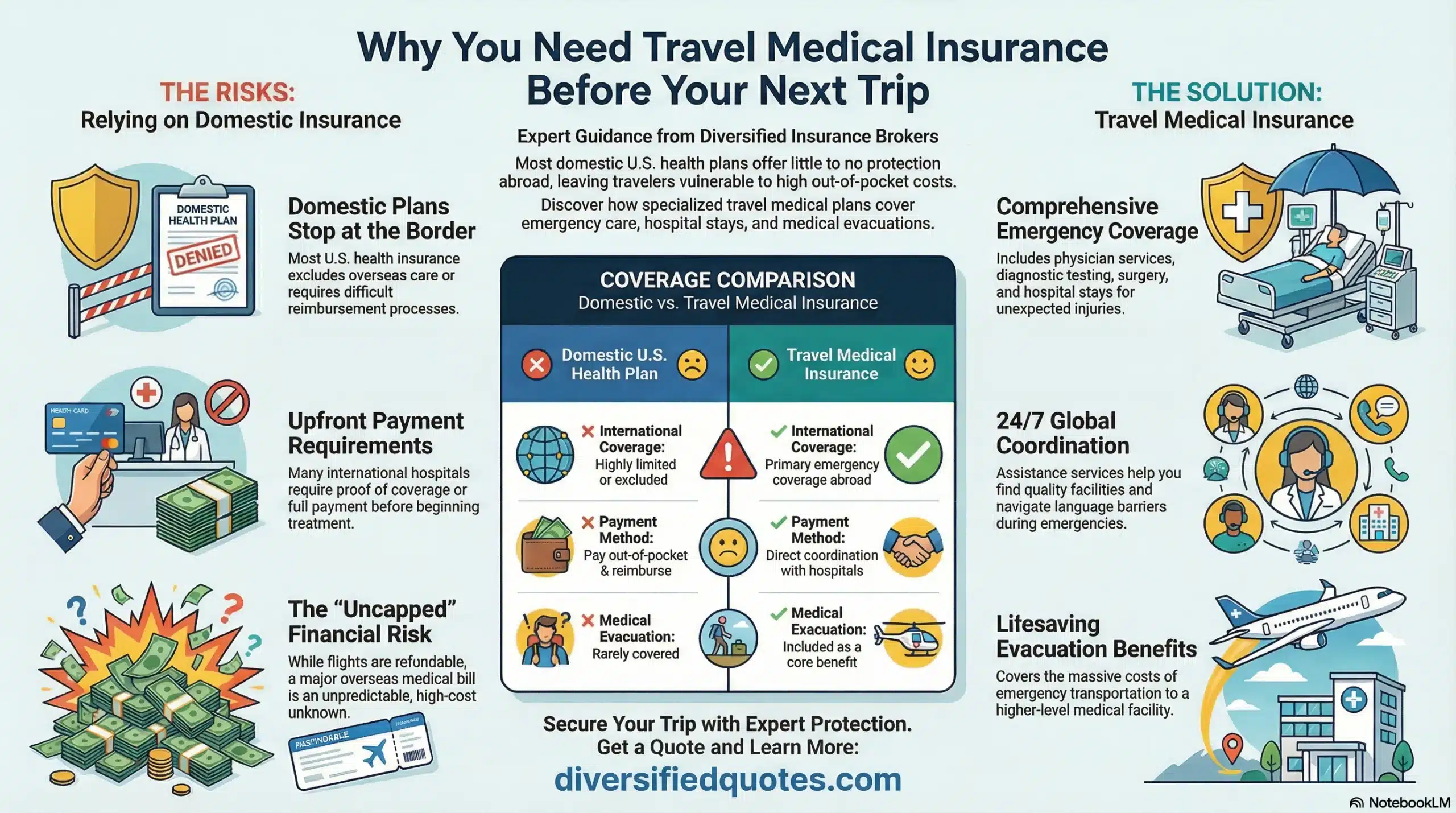
At Diversified Insurance Brokers, we help travelers compare international medical plans that focus on real-world emergency performance: meaningful emergency medical benefits, clear evacuation language, and 24/7 assistance coordination. Many travelers assume their domestic health plan automatically covers them abroad. In practice, coverage can be limited, out-of-network reimbursement can be slow, and you may still be responsible for upfront payments at the point of care. In an emergency—especially one involving transport logistics—having coverage that is built for international scenarios can be the difference between a manageable disruption and a crisis that expands into a major financial event.
If you are comparing plan types, it helps to start with the fundamentals. Our overview of travel medical insurance explains how these plans work when your regular insurance doesn’t follow you. If you want a deeper look at how evacuation is approved, coordinated, and paid for during serious cases, review emergency medical evacuation insurance. And if your stay is longer than a typical trip—or you need broader, more “major medical-like” coverage abroad—compare options with international health insurance.
Why Travel Medical and Evacuation Coverage Matters in Lebanon
In Lebanon, medical access and quality can vary based on location, facility, and the type of care required. Routine or minor issues may be manageable locally, especially in and around major population centers. But serious medical events tend to force a different set of questions: Where is the appropriate level of care? How quickly can you reach it? Who coordinates transfers and approvals? And how do payment logistics work during a high-acuity situation?
Travel medical coverage is designed to help with the first phase of the problem—getting eligible emergency treatment covered when you need it. That can include emergency physician services, hospital care, diagnostic testing, imaging, surgery when medically necessary, and prescriptions tied to an emergency. Evacuation coverage is designed for the second phase: when the treating facility cannot provide appropriate care, when the case requires advanced capability, or when the safest medical decision is transfer to a better-equipped facility. That transfer may be within the region or may require cross-border coordination depending on medical necessity and policy terms.
This is why the assistance infrastructure behind the policy matters. In most serious claims, the key value is not just reimbursement after the fact. It is the ability to call a 24/7 global assistance team that can help coordinate hospital admissions, confirm receiving facilities, manage documentation, and arrange the correct transport pathway based on severity. When you are sick or injured, you do not want to improvise a complex transport plan and then discover the policy required authorization or assistance-team coordination to keep the claim eligible.
What “Medical Evacuation” Actually Means
Medical evacuation is often misunderstood as “an air ambulance” or “a flight home.” In real life, evacuation is a coordinated medical transport decision driven by medical necessity, local capability, and safety. Depending on the case, evacuation might involve ground ambulance to a higher-level facility, commercial travel with a medical escort for a stable patient, or air ambulance for time-sensitive, high-acuity cases. It may involve one step or several steps, especially when the nearest appropriate option is across a border or requires receiving-facility acceptance.
Evacuation benefits also differ by policy language. Some plans provide evacuation to the nearest adequate facility, which can be appropriate for many scenarios because it focuses on getting you to capable care quickly. Other plans may include repatriation provisions once you are stabilized, depending on the policy. The right choice depends on your situation: how long you will be abroad, how much you want “return home” flexibility, whether you are traveling with family, and where your trusted medical team is located if follow-up treatment becomes necessary.
Because evacuation is frequently the highest-cost element of a serious claim, it is often the most important part of the plan design for destinations where advanced specialty care may require transfer. That is why we encourage travelers to verify not just whether evacuation exists, but how it works, what triggers it, how it is coordinated, and what the benefit limits are. If you want a focused explanation of this feature, our Emergency Medical Evacuation Insurance page breaks down what these benefits are designed to do.
Security Evacuation and Destination Risk Planning
Security evacuation is different from medical evacuation. Medical evacuation is driven by clinical necessity—your diagnosis and the capability of the treating facility. Security evacuation is driven by safety necessity—events that make it unsafe to remain in place due to defined triggers in the policy. Not every plan includes security evacuation, and plans that do include it can vary in definitions, activation rules, and where you can be moved (for example, to the nearest safe location).
For many travelers, the goal is not fear-based planning. It is clarity. If your travel involves business operations, journalism, NGO work, project assignments, or extended stays that require you to move around the country, it can be helpful to choose a plan structure that includes robust assistance support and clearly defined evacuation benefits. In a real event, you want to know who you call, what the plan will coordinate, and what the process looks like when time is limited.
Example Scenario: When Local Care Isn’t Enough
Imagine an expatriate or long-stay traveler in Lebanon who suffers a severe injury or sudden medical event that requires specialized diagnostics and treatment. Initial stabilization may be possible, but the next step can become complicated if advanced specialty care is needed quickly. In these situations, the transport decision becomes as important as the medical decision. The question is not only “Where can I get treated?” but “How do I get there safely and how is it coordinated?”
Without a well-structured travel medical and evacuation plan, travelers can face large deposits, immediate transport costs, and fragmented coordination between facilities. With the right coverage, the assistance team helps coordinate the process—confirming medical necessity, locating an appropriate receiving facility, arranging the correct transport level, and managing covered expenses according to the policy terms. That coordinated response is often the real value of coverage in a serious event.
Travel Medical & Evacuation Coverage for Lebanon
Apply online for travel medical insurance that includes emergency care and evacuation coordination for Lebanon travel and extended stays.
Who Should Consider Travel Medical and Evacuation Insurance for Lebanon?
This coverage is most valuable for travelers who cannot afford to “figure it out later” during a real emergency. That includes tourists visiting for leisure or family travel, expats and students living in Lebanon for an extended stay, business professionals on assignment, and travelers with multi-city routes who will be away from major medical corridors. It is also especially relevant for travelers who will be operating under time constraints, traveling with children, managing prescriptions, or moving between regions where medical capability can vary.
For short trips, a travel medical plan with strong evacuation benefits can be a practical solution. For longer stays, it can make sense to compare plan structures that provide broader coverage while abroad. This is where comparing Travel Medical Insurance and International Health Insurance can help you match the policy style to your actual time abroad and coverage expectations.
What to Look For in a Lebanon Travel Medical Plan
Not every plan is built the same way, and the differences matter most during serious claims. Strong plans typically include meaningful emergency medical maximums, a clear evacuation framework, and a reliable assistance team that can coordinate care and transport. The practical goal is simple: if a situation escalates, the plan should respond quickly, provide clear next steps, and reduce the chances you are forced into upfront, high-cost decisions without support.
It also helps to understand limitations before you buy. Many plans exclude elective or non-emergency care, and some plans require that evacuation be coordinated through the assistance provider to be covered. Pre-existing conditions are also a major differentiator; some plans exclude them, while others may provide limited coverage depending on policy definitions. If you have known medical history, plan selection matters more, because a flare-up can quickly become an evacuation scenario if advanced care is required.
If your itinerary includes remote routes, higher-risk travel patterns, or frequent movement between countries, you may also want to review High Risk Travel Insurance and compare it to standard travel medical structures. The goal is not to overbuy coverage, but to avoid the common mistake of buying a plan that looks adequate on paper but is not designed for the realities of how you will travel.
Why Travelers Work With Diversified Insurance Brokers
Travel medical and evacuation coverage is one of those categories where details drive outcomes. Two plans can look similar at a glance but behave very differently when evacuation coordination, facility acceptance, or high-cost approvals become necessary. Diversified Insurance Brokers helps travelers match the plan design to the real trip profile—length of stay, locations, activities, and how important it is to have a clear escalation path if local care is not enough.
The best time to secure coverage is before departure. Once an incident starts, coverage gaps cannot be fixed retroactively. Getting your plan in place early gives you the assistance contacts, plan documentation, and a clear pathway to follow if something happens while you are in Lebanon.
Get Covered Before You Travel
Apply online now to secure travel medical and evacuation coverage for Lebanon.
Related Travel Medical Pages
Use these pages to compare plan types, understand evacuation coordination, and match coverage structure to how you travel.
Related Destination Pages
Compare how coverage needs change based on medical access, distance to advanced care, and travel logistics across different destinations.
Talk With an Advisor Today
Choose how you’d like to connect—call or message us, then book a time that works for you.
Schedule here:
calendly.com/jason-dibcompanies/diversified-quotes
Licensed in all 50 states • Fiduciary, family-owned since 1980
Travel Medical & Evacuation from Lebanon — FAQs
What does travel medical and evacuation insurance from Lebanon cover?
Why is evacuation coverage important for Lebanon travelers and expats?
Does this coverage include security evacuation?
How does medical evacuation actually work during a real emergency?
Will I need to pay upfront for care in Lebanon?
Are pre-existing conditions covered?
What are common exclusions or limitations to watch for?
Can evacuation take me back to my home country?
How do I request evacuation or start a claim?
About the Author:
Jason Stolz, CLTC, CRPC and Chief Underwriter at Diversified Insurance Brokers (NPN 20471358), is a senior insurance and retirement professional with more than two decades of real-world experience helping individuals, families, and business owners protect their income, assets, and long-term financial stability. As a long-time partner of the nationally licensed independent agency Diversified Insurance Brokers, Jason provides trusted guidance across multiple specialties—including fixed and indexed annuities, long-term care planning, personal and business disability insurance, life insurance solutions, Group Health, and short-term health coverage. Diversified Insurance Brokers maintains active contracts with over 100 highly rated insurance carriers, ensuring clients have access to a broad and competitive marketplace.
His practical, education-first approach has earned recognition in publications such as VoyageATL, highlighting his commitment to financial clarity and client-focused planning. Drawing on deep product knowledge and years of hands-on field experience, Jason helps clients evaluate carriers, compare strategies, and build retirement and protection plans that are both secure and cost-efficient. Visitors who want to explore current annuity rates and compare options across multiple insurers can also use this annuity quote and comparison tool.
