
Travel Medical and Evacuation from Niger

Jason Stolz CLTC, CRPC
If you’re traveling, working, or living in Niger, having travel medical and evacuation insurance is one of the smartest ways to protect yourself before you leave. Niger is a unique destination with deep history, desert landscapes, and important humanitarian and business activity, but it also presents real-world challenges when it comes to medical access and emergency response. Outside of major hubs like Niamey, advanced care can be extremely limited, and even a “routine” emergency can quickly turn into a situation where you need transportation to a different city—or even a different country—for appropriate treatment.
At Diversified Insurance Brokers, we help travelers compare coverage that is built for real emergencies, not just basic reimbursement. The goal is simple: if something goes wrong in Niger, you want a plan that helps you access care quickly, helps coordinate the next steps, and protects you from the out-of-pocket costs that can follow a major medical event abroad. For higher-risk destinations, the evacuation component is often the most important part of the policy because it can determine how quickly you can reach a capable hospital when local options are limited.
Travel Medical & Evacuation Coverage for Niger
Apply online for travel medical insurance that includes emergency care and evacuation coordination for higher-risk destinations.
One of the biggest misunderstandings travelers have is assuming “travel insurance” and “travel medical insurance” are the same thing. Trip protection policies usually focus on items like trip cancellation, trip interruption, baggage delays, or reimbursement if plans change. Those benefits can be useful, but they do not solve the biggest risk in Niger: the possibility of a serious medical event requiring hospitalization and potentially evacuation. A travel medical plan is designed to cover emergency medical treatment abroad, and the stronger plans include a built-in assistance team that coordinates care when time matters.
If you want to compare what medical-focused coverage includes (and how it differs from trip reimbursement coverage), it helps to start with our guide on travel medical insurance. That page provides a clearer overview of what these plans are designed to handle during real emergencies outside the U.S.
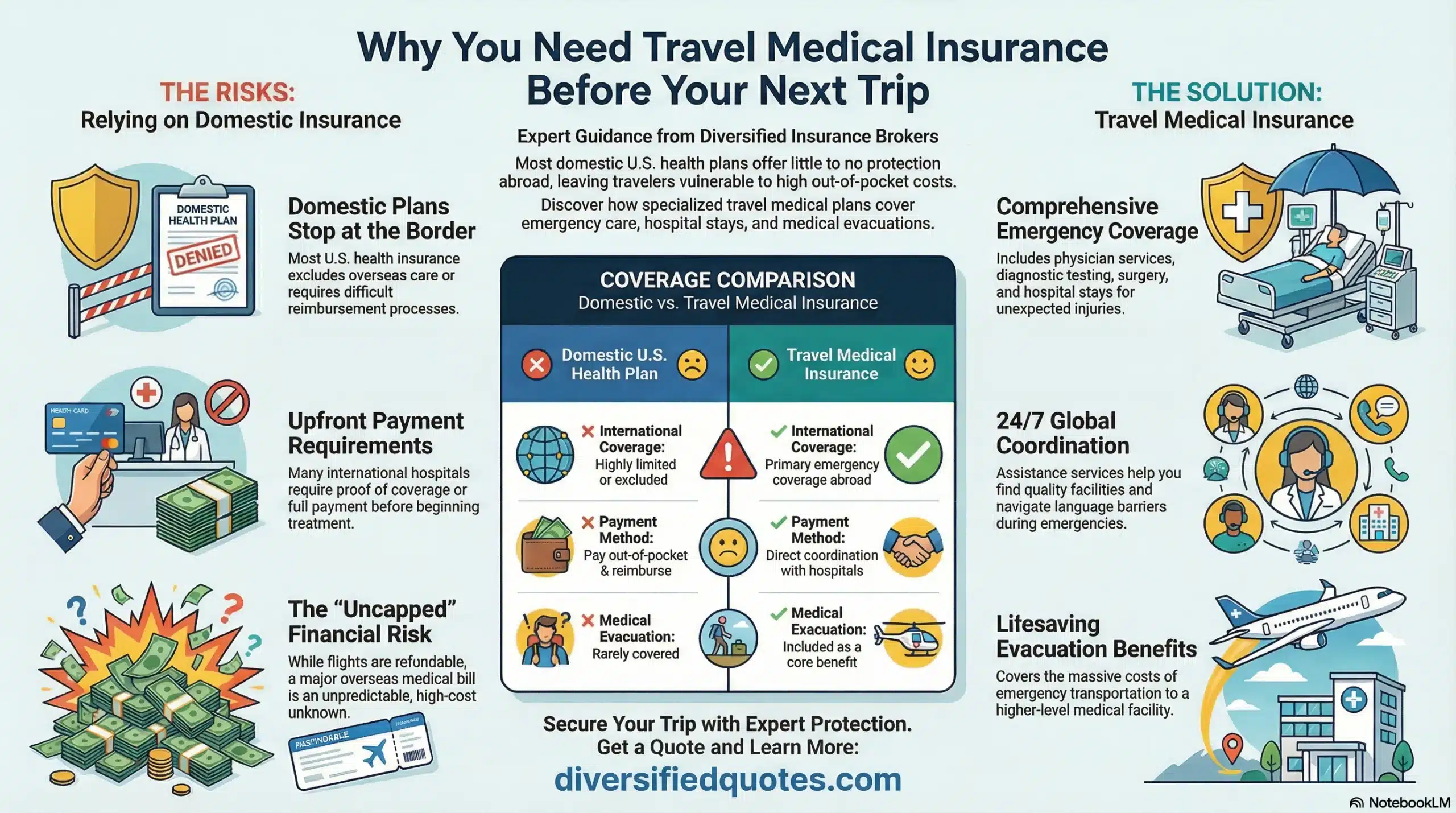
Travelers often assume their domestic health insurance will cover them internationally. In many cases, that assumption is risky. Some U.S. plans exclude international care entirely, while others may treat it as out-of-network and require large upfront payments before reimbursement. Even when reimbursement is possible, the bigger issue is that you still need to find care, coordinate approvals, and handle logistics while dealing with a medical emergency. This is why travel medical insurance exists as a dedicated solution for international travel.
For travelers who need broader, long-stay protection instead of short-term travel medical coverage, you may want to compare options with international health insurance. That type of coverage is often used for longer assignments, expatriate living, and extended stays when you want a more comprehensive structure than a short-duration travel plan.
In Niger, access to capable care can vary dramatically by location. Niamey may have more resources than remote areas, but even within cities, care availability and capacity can shift quickly. If you’re working with a project team, traveling for research, supporting humanitarian missions, or visiting remote regions, it is critical to plan for the possibility that your best treatment option may be outside the immediate area. This is where evacuation coverage becomes less of a “nice extra” and more of a central piece of the plan design.
When people hear the word “evacuation,” they often picture an air ambulance flying directly home. That is not always how real evacuation decisions work. Evacuation benefits are typically triggered when local care is not adequate, and a physician and assistance team determine a transfer is medically necessary. That transfer could be to the nearest capable hospital in the region—not necessarily your home country. In many situations, the plan’s assistance team coordinates hospital acceptance, transportation logistics, and medical staffing requirements so you are not trying to solve those problems while under stress.
This is why many travelers who are visiting remote or higher-risk regions also review our dedicated page on emergency medical evacuation insurance. That guide helps explain how evacuation benefits work, what travelers should look for, and why the assistance infrastructure behind the policy matters.
Medical evacuation can be expensive even in “simple” scenarios. Ground transport between facilities, medically staffed transfers, and cross-border coordination can escalate quickly. The reason travel medical insurance is so important for Niger is not because every trip results in a crisis, but because if something serious does happen, the cost can become catastrophic without the right structure in place. Evacuations routinely move into five-figure or six-figure territory depending on the distance and complexity of the case.
Travel medical and evacuation insurance is designed to protect you from two major financial risks: (1) emergency medical treatment costs and (2) the cost of getting you to the right place for treatment. Hospitalization, diagnostics, specialty consultations, medications, and procedures can add up quickly. When transport is required, it is often the single most expensive part of the claim. A strong plan helps reduce the risk that a medical emergency becomes a financial emergency.
In addition to the benefit limits, one of the most valuable parts of a quality policy is the assistance infrastructure. That typically includes 24/7 global support teams that can help locate appropriate facilities, coordinate approvals, communicate with providers, and guide you through what steps must be followed for evacuation benefits to be covered. Many policies require that evacuation be coordinated or authorized by the assistance team, meaning you do not want to make assumptions and improvise a solution without calling first.
For Niger, where local systems can be unpredictable and travel distances can be long, that coordination is not just helpful—it can be essential. In a serious medical event, the difference between a smooth process and a chaotic, delayed process often comes down to whether the plan has an active, responsive assistance team that can coordinate the next step quickly.
Common claim situations in Niger include severe gastrointestinal illness, dehydration, infections, respiratory issues, injuries from road accidents, and conditions requiring urgent diagnostics or stabilization. Even if you do not expect your trip to be “high risk,” the reality is that an unexpected event can happen anywhere. What changes by destination is the complexity and cost of responding to that event. In Niger, the response complexity can increase quickly because the best treatment option may not be close by.
Travelers and organizations often underestimate how quickly logistics matter. For example, a simple injury may be treatable locally, but if complications develop, you may need advanced imaging, surgery, or specialist care. If those services are not available where you are, the cost and coordination required to move you can be significant. A good policy does not just reimburse you later—it supports the process as it happens.
One of the biggest planning decisions is whether a traveler is best served by a short-term travel medical plan or something closer to international major medical coverage. Short-term travel medical is usually designed for trips lasting days to months and focuses on unexpected emergencies. International health insurance may be better suited for longer stays, expat living, or situations where you need more robust routine and specialist care built into the policy design. The right choice depends on your trip length, your location within Niger, and your overall risk profile.
Another critical consideration is how a policy handles pre-existing conditions. Some travel medical plans exclude pre-existing conditions entirely, while others provide limited coverage for acute onset situations or offer waivers under certain conditions. The wording matters because the definition of “pre-existing” and the look-back period can determine whether something is covered or excluded. When traveling to a destination where escalation may require evacuation, you want to be very clear about how the policy treats known medical issues.
For clients with known medical conditions, we usually recommend choosing a plan intentionally rather than defaulting to the cheapest option. In many cases, the “best” plan is not the one that looks best on paper, but the one with realistic benefits, strong assistance support, and clear rules about what triggers evacuation and how it must be coordinated. This is one area where details matter, because the wrong plan can leave you paying out-of-pocket for a major event that you assumed would be covered.
It is also important to understand exclusions and limitations. Some plans restrict coverage for certain activities or higher-risk travel environments unless you add riders. Others require that you contact the assistance team before arranging transport. Some plans exclude non-emergency care entirely, and some have limitations based on destination risk levels. If you are traveling for work, mission travel, research, or humanitarian deployment, your itinerary may include remote travel that needs to be reflected in your plan selection.
That is why we often recommend travelers compare their coverage needs against the reality of their itinerary. Visiting only major cities may look “lower risk” than overland travel through remote areas, but even within cities, the need for evacuation can still exist if a case requires higher-acuity care than what is accessible locally. For Niger, the best approach is usually to assume evacuation is a real possibility and choose a plan designed to handle it.
Another consideration for Niger is how quickly you can access emergency transportation and whether the plan’s assistance infrastructure can coordinate local and regional services. In a serious event, this is not something you want to test for the first time while you are already dealing with medical stress. A plan with responsive assistance services provides structure and reduces the uncertainty of decision-making during emergencies.
It is also worth mentioning that many travelers do not travel alone. Families, teams, organizations, and business groups often have multiple people on the ground. When a medical emergency affects one person, the entire team can be impacted. The goal of travel medical and evacuation insurance is not just to protect one person financially, but also to provide a pathway for coordinated response so the situation is managed efficiently.
For business travelers and contractors, travel medical and evacuation insurance is often used as part of broader risk management. A medical emergency can disrupt schedules, operations, and project timelines. Even if the traveler’s condition is handled correctly, the costs associated with hospitalization and evacuation can be significant. A good plan helps protect both the individual and the organization from unexpected financial exposure.
For aid workers and humanitarian travelers, the risk profile can be different. Travel may involve rural areas, longer distances from major medical centers, and exposure to environmental and health risks that may not exist in more developed regions. In those situations, evacuation coverage and assistance coordination are often the most important parts of the policy. The goal is to make sure the plan assumes the reality of where work is happening, not just the idea of “travel coverage” on paper.
For students or volunteers traveling through Niger as part of a program, coverage can be equally important. Many students assume they are covered through a school program or local arrangements, but the details matter. It is worth verifying whether evacuation is included, whether there is a real assistance team coordinating emergencies, and what the medical limits are. Even when a school provides some coverage, individual travel medical insurance can fill gaps depending on trip design and program scope.
Another frequently overlooked issue is that foreign hospitals and clinics may require payment up front. This is not always the case, but it happens enough that travelers should be prepared. A high-quality policy may provide guidance, direct billing assistance, or a guarantee of payment in certain situations. This is where calling the assistance hotline early matters. When you’re abroad, you do not want to wait until the bill is already escalating before asking for help.
From a practical standpoint, travelers should also carry key documents with them: policy ID details, emergency assistance numbers, passport information, itinerary details, and emergency contact information. It’s also a good idea to share the assistance hotline with companions, team leaders, or hosts so they can help coordinate if you are unable to communicate during a medical event. The goal is to remove delays when minutes matter.
When a serious emergency happens abroad, the process usually moves quickly. First, you seek immediate medical care. Then, as soon as it is safe to do so, you contact the policy’s assistance team to coordinate next steps, confirm what facilities are appropriate, and ensure required authorizations are handled correctly. This is not only a claims issue—it is a medical coordination issue. In higher-risk destinations, that assistance support can make the difference between being stuck in the wrong place and being moved quickly to the right facility.
If you are planning a multi-country itinerary that includes Niger, it is also worth comparing how coverage needs change across borders. Even if a traveler is only in Niger for part of the trip, the insurance needs to match the highest-risk portion of the itinerary. A plan that works for lower-risk destinations may not be enough for Niger if the evacuation risk and medical access limitations are higher. The safest approach is to choose coverage based on the most demanding part of the trip.
We also recommend that travelers consider the length of stay. For short trips, travel medical plans can be a strong solution. For longer stays, you may need coverage that is structured differently. Some travelers may move from short-term travel medical coverage into longer-term international health insurance coverage depending on the duration and nature of the stay. If you are unsure, we can help you compare plan structures and identify what fits your situation best.
Ultimately, travel medical and evacuation insurance is about creating a clear plan of action before you need it. Travel brings unpredictability, and emergencies do not wait for perfect timing. By choosing coverage that includes strong medical benefits, coordinated evacuation support, and 24/7 assistance infrastructure, you reduce uncertainty and protect yourself financially. Niger is a destination where that planning can have a meaningful impact, because access to advanced care and emergency transport options may not be simple if something goes wrong.
The best time to arrange your coverage is before you depart. Travel medical plans are designed to be purchased in advance, and once an incident occurs, coverage cannot be added retroactively. Getting your policy in place early ensures you have the documents, contact numbers, and benefit structure ready for day one of travel. It’s the simplest step you can take to avoid a difficult situation turning into an expensive and stressful emergency abroad.
Get Covered Before You Travel
Apply online now to secure travel medical and evacuation coverage for Niger.
Related Travel Medical Pages
If you’re comparing plan types or building a route through multiple regions, these pages help you line up coverage design with real-world medical access and evacuation needs.
Related Destination Pages
These destination pages help you compare how needs change based on infrastructure, distance to care, and travel logistics.
Talk With an Advisor Today
Choose how you’d like to connect—call or message us, then book a time that works for you.
Schedule here:
calendly.com/jason-dibcompanies/diversified-quotes
Licensed in all 50 states • Fiduciary, family-owned since 1980
Travel Medical & Evacuation from Niger — FAQs
Do I need travel medical and evacuation insurance for Niger?
What does travel medical insurance usually cover in Niger?
What does “medical evacuation” mean in real life?
Does evacuation always mean getting flown back to the U.S.?
How much coverage should I consider for Niger?
Will a policy help if a hospital requires payment up front?
Are pre-existing conditions covered under travel medical plans?
What should I do first if I have a medical emergency in Niger?
Is travel medical insurance the same as trip cancellation insurance?
When should I buy coverage for travel to Niger?
About the Author:
Jason Stolz, CLTC, CRPC and Chief Underwriter at Diversified Insurance Brokers (NPN 20471358), is a senior insurance and retirement professional with more than two decades of real-world experience helping individuals, families, and business owners protect their income, assets, and long-term financial stability. As a long-time partner of the nationally licensed independent agency Diversified Insurance Brokers, Jason provides trusted guidance across multiple specialties—including fixed and indexed annuities, long-term care planning, personal and business disability insurance, life insurance solutions, Group Health, and short-term health coverage. Diversified Insurance Brokers maintains active contracts with over 100 highly rated insurance carriers, ensuring clients have access to a broad and competitive marketplace.
His practical, education-first approach has earned recognition in publications such as VoyageATL, highlighting his commitment to financial clarity and client-focused planning. Drawing on deep product knowledge and years of hands-on field experience, Jason helps clients evaluate carriers, compare strategies, and build retirement and protection plans that are both secure and cost-efficient. Visitors who want to explore current annuity rates and compare options across multiple insurers can also use this annuity quote and comparison tool.
