
Travel Medical and Evacuation from Sierra Leone

Jason Stolz CLTC, CRPC
Sierra Leone sits on West Africa’s Atlantic coast and is known for its beaches, rainforest ecosystems, and a steady rise in business, development, and humanitarian activity. Travelers come for everything from cultural immersion and eco-tourism to mining and infrastructure projects, academic research, faith-based missions, and NGO support. And while the country can be an incredible place to visit and work, it’s also a destination where you should plan for medical logistics before you arrive—not after an emergency happens. In Sierra Leone, the difference between a manageable situation and a stressful, expensive crisis often comes down to one thing: how quickly you can access the right level of care when you need it.
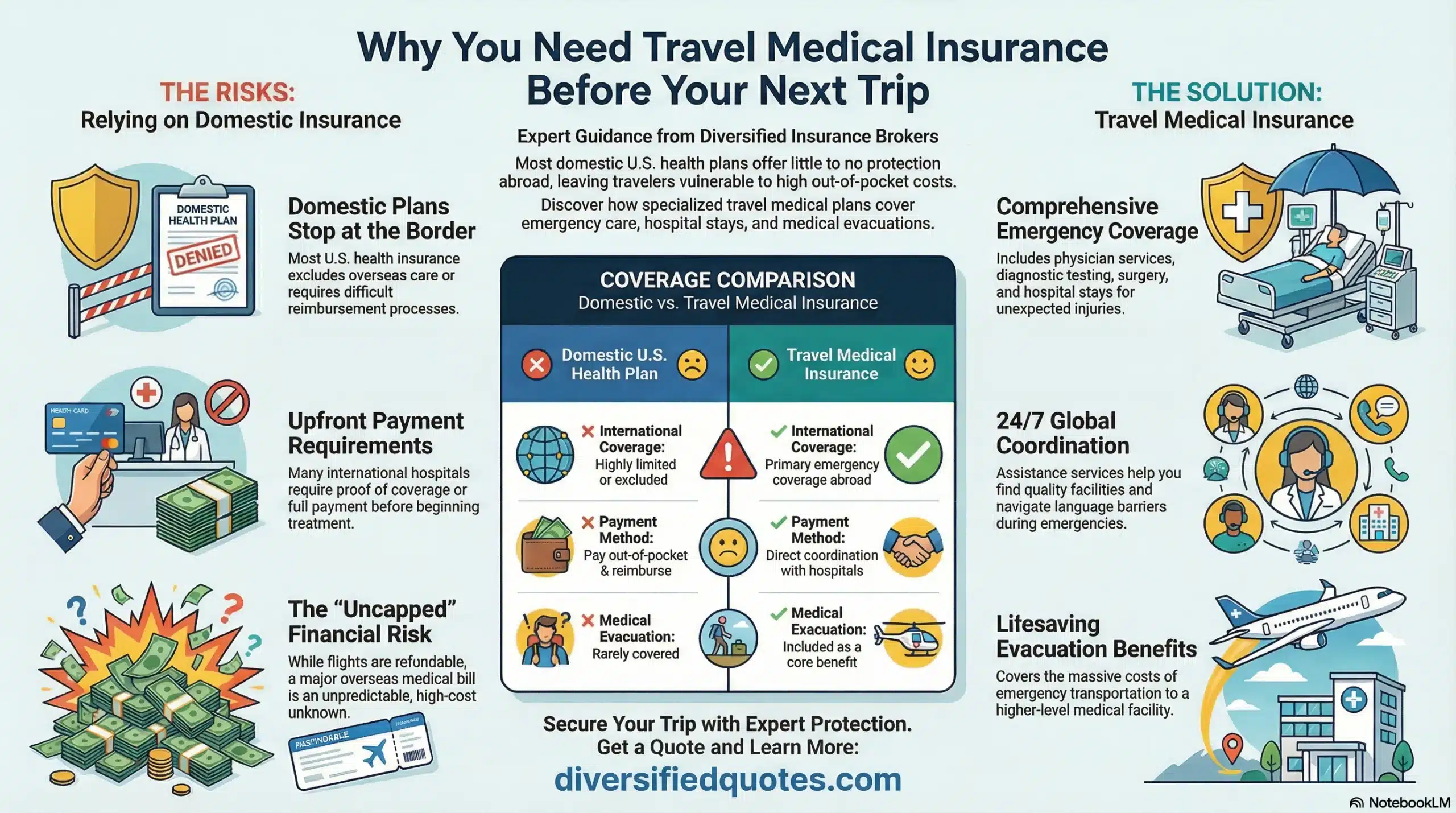
That’s why travel medical and evacuation insurance from Sierra Leone is such an important safeguard. This coverage is designed to help with eligible emergency medical expenses for an unexpected illness or injury during your trip, and—just as importantly—to provide a structured, coordinated evacuation pathway when local resources aren’t adequate for the condition you’re dealing with. For many travelers, evacuation is the real “plan B.” It’s the mechanism that gets you from “stabilized” to “treated properly,” especially when advanced imaging, specialist intervention, ICU-level monitoring, or specific medications are not readily available where you are.
At Diversified Insurance Brokers, our advisors help travelers match plan design to real-world conditions. That means thinking through where you’ll be based, how remote your itinerary is, how long you’ll be in-country, and whether you’ll be mostly in Freetown or traveling across provinces. A short visit to Freetown for meetings is very different from spending weeks in rural districts on an aid project. It’s also different from a multi-country route where Sierra Leone is one stop among several. In all cases, the goal is the same: choose a plan that can respond appropriately if a serious medical event happens and the nearest “good enough” facility isn’t good enough.
Why Coverage Matters More in Sierra Leone Than Many Travelers Expect
Sierra Leone’s healthcare system has improved over time, but it remains under-resourced relative to what many international travelers are used to. In Freetown, you’ll find more clinics and hospital options than in rural districts, but capability and consistency can still vary depending on staffing, supply chains, equipment availability, and the specific type of emergency. Outside Freetown, the gap widens quickly. Many facilities are oriented toward basic stabilization and routine care rather than complex procedures, specialist management, or advanced diagnostics. In a serious emergency, you may be faced with a decision to transfer—sometimes within the country, and sometimes outside of it—to reach higher-acuity care.
Evacuation is also a financial issue. Cross-border transport, medical escorts, and coordination can become expensive quickly, especially if timing and routing are complex. Travelers who assume they can “just figure it out” during an emergency often discover that the hardest part is not finding a hospital, but coordinating payment, approvals, transport logistics, and medical communication in real time. A well-structured travel medical and evacuation plan is meant to reduce that chaos. It provides a 24/7 assistance team that can help coordinate care, confirm medical necessity, identify appropriate facilities, and arrange transport pathways based on your condition and location.
This isn’t only about worst-case scenarios, either. Most travel claims start as common problems: dehydration, gastrointestinal infections, respiratory illness, skin and wound infections, injuries from falls, and complications from untreated minor issues that worsen because access is delayed. In Sierra Leone, where heat, humidity, food and water exposure, and travel conditions can strain the body, the “ordinary” emergency is often more likely than the dramatic one. A strong policy helps you handle both—starting with urgent outpatient evaluation and escalating to hospitalization or evacuation when necessary.
A Realistic Scenario: When Evacuation Becomes the Difference-Maker
Imagine a volunteer working in a rural province who develops severe malaria complications. A local clinic can provide initial stabilization, but the patient’s condition worsens and requires a higher level of monitoring and intervention. If advanced critical care isn’t locally available, the treating team may recommend transfer to a higher-acuity facility, potentially outside Sierra Leone. With medical evacuation coverage in place, the assistance team can coordinate the case from the start: confirm medical necessity, help select an appropriate facility, arrange the safest transport option based on the medical condition, and guide the traveler through documentation and payment coordination steps that can otherwise delay care.
Without coverage, the traveler and their family may face overwhelming costs and limited options under pressure. The issue isn’t merely “how much does it cost?” It’s also “how quickly can it happen?” In emergencies, the speed of coordinated action matters. Evacuation benefits and assistance services are designed to support that speed.
Traveling to Sierra Leone?
Apply today for travel medical and evacuation insurance to protect yourself during your stay.
What Travel Medical Insurance Usually Covers in Sierra Leone
Travel medical insurance is built for unexpected illness or injury that occurs during your covered travel dates. In practical terms, eligible benefits often include emergency physician evaluation, hospital services if you are admitted, diagnostics such as labs and imaging, and certain prescription medications tied to a covered event. The exact scope depends on the plan design you choose, which is why comparing coverage structure matters. Some plans are “emergency-focused” and work best for short trips. Others offer broader support that can be helpful when you’re abroad longer, traveling frequently, or operating in environments where you may need more routine access to care.
It’s also important to understand how help is delivered. In many situations, the most valuable part of a strong plan is not only reimbursement, but access to a professional assistance team that can help route you to appropriate care and coordinate escalation when needed. If you want a clean overview of how plan types differ, start here: Travel Medical Insurance. That page helps clarify what to expect from travel medical coverage and how to think about limits, eligibility, and how benefits are commonly used in real-world travel situations.
What Medical Evacuation Means (and What It Doesn’t)
Medical evacuation coverage is meant for cases where local treatment options are not adequate for your condition. The key phrase is “nearest appropriate facility.” Evacuation is typically not about preference or convenience. It is generally about medical necessity and the ability to access the level of care your condition requires. Depending on where you are in Sierra Leone, evacuation might involve ground transport to a higher-capability facility in-country, air transport to another country, or a multi-leg pathway coordinated by the assistance team based on safety, timing, and available resources.
Evacuation benefits usually involve the assistance team coordinating the situation: communicating with treating clinicians, validating medical necessity, helping determine the safest transport method, and arranging logistics. When travelers are remote, transport routing can become complex. That’s why comparing evacuation structures is important—especially if you’re traveling outside Freetown or working on assignments with limited local medical infrastructure. If evacuation is a core concern for your itinerary, review this resource: Emergency Medical Evacuation Insurance.
How to Think About Coverage Limits for Sierra Leone Trips
Coverage limits should match the reality of what a serious event could require. Many international travelers consider a practical baseline of $100,000 or more in emergency medical coverage and $250,000+ in evacuation coverage, especially when traveling in regions where evacuation may require cross-border routing and specialized transport. If you are staying mostly in Freetown, your risk profile may be different than someone working in rural provinces—but even Freetown-based travelers can face scenarios where higher-acuity care is recommended outside the country.
Limit selection should also reflect trip length. If you’re staying for weeks or months, you are simply exposed to more potential medical events than someone traveling for four days. For longer stays, many travelers consider options that function more like broader coverage—especially when outpatient access, ongoing evaluation, and continuity are important. In those cases, it can be helpful to compare against International Health Insurance as part of the decision process.
Health Risks Travelers Actually Face in Sierra Leone
While dramatic emergencies can happen anywhere, most travel medical claims arise from common issues: gastrointestinal illness, dehydration, fever and respiratory infections, allergic reactions, minor injuries that require evaluation, and infections that need antibiotics or observation. Sierra Leone’s climate and travel conditions can increase exposure to mosquito-borne illnesses and gastrointestinal risk, and travel by road can increase accident risk. The best coverage approach is to plan for routine urgent care needs and to ensure the plan also has the escalation pathway—hospitalization and evacuation—if a situation becomes serious.
For travelers doing field work, volunteering, or staying in rural areas, the key issue is not only the illness itself, but the potential distance from definitive care. If you’re hours away from the nearest facility that can handle your scenario, evacuation coordination can quickly become part of the clinical plan. That is why the assistance component of your plan matters as much as the dollar limit. A strong assistance team reduces delays, helps route you appropriately, and can coordinate the practical steps that are otherwise overwhelming in the moment.
Pre-Existing Conditions: The Most Important “Fine Print” to Get Right
Pre-existing condition coverage varies widely by plan. Some policies exclude pre-existing conditions. Some offer limited benefits for acute onset or sudden exacerbation under specific definitions. Some offer a waiver if you purchase coverage within a defined time window tied to your initial trip deposit. These differences are not minor. They can determine whether a claim is eligible and whether evacuation is coordinated in the way you expect.
If you take regular medications, have chronic conditions, or even have a health history that could plausibly become relevant during travel, it’s important to choose the plan based on the policy definitions rather than assumptions. The same is true if you are traveling with children, traveling with older family members, or supporting a group trip where multiple people may have different risk profiles. We help travelers align the plan’s definition language with the reality of their health and itinerary so there are fewer surprises if coverage is actually needed.
Payment and Claims: What Travelers Should Expect in Sierra Leone
In many travel medical scenarios, travelers pay out of pocket at the point of service and then submit documentation for reimbursement. That process usually requires itemized receipts, medical notes, diagnosis documentation, and proof of payment. In more serious events—especially hospitalization or evacuation—assistance services may help coordinate case management, facility communication, and in some cases payment support mechanisms such as guarantees of payment where available. The right approach in Sierra Leone is to involve the assistance team early if the situation is anything more than minor urgent care.
If you want a simple operational rule: if hospitalization is possible, if advanced imaging is being discussed, if a specialist referral is needed urgently, or if you’re being told you need transfer to another facility, call the assistance number right away. Early coordination reduces delays and improves the odds that the pathway stays organized.
Who Should Strongly Consider Sierra Leone Travel Medical & Evacuation Coverage?
This coverage is a fit for many travelers, but it’s especially important for people whose plans include rural travel, multi-day inland itineraries, or work assignments away from Freetown. Volunteers and humanitarian workers often operate in areas where local facilities can stabilize but not treat complex cases. Business travelers tied to mining, energy, and development projects may be far from the capital and on tight schedules. Students, researchers, and long-term visitors have greater exposure over time and may need more than a minimal emergency-only plan. And expatriates living outside major cities often benefit from coverage that includes a realistic evacuation strategy.
If you’re building a broader travel plan across multiple countries, it can also be useful to compare how coverage needs shift by location. For example, see how infrastructure and logistics differ in Travel Medical and Evacuation from Senegal versus Travel Medical and Evacuation from Rwanda. If your route includes higher-risk environments or more complex security dynamics, you may also want to review a higher-risk framework like High Risk Travel Insurance to compare plan structures and benefit expectations.
Choosing the Right Plan: A Practical Checklist
Start with geography. If your itinerary is mostly in Freetown, the plan emphasis might be different than if you’re traveling across provinces. Next, think about trip length. The longer you’re abroad, the more likely you’ll need some form of medical care—even if it’s minor. Then consider your health profile and medication needs. If pre-existing conditions are relevant, definition language becomes critical. Finally, think about evacuation as a logistics plan, not a hypothetical. If you’re remote, the question is not “could evacuation happen?” The question is “if evacuation is medically necessary, do you have a plan that can coordinate it quickly and realistically?”
When the plan is well-matched to the trip, it creates peace of mind. You can travel knowing that if the unexpected happens, you aren’t making decisions based on panic, confusion, or financial fear. You have a structured response backed by coverage, coordination, and professional assistance.
Get Covered for Your Trip to Sierra Leone
Apply online now for travel medical and evacuation coverage.
Related Travel Medical Pages
If you’re comparing plan types or building a multi-country route, these pages help you line up coverage design with real-world medical access and evacuation needs.
Related Destination Pages
These destination pages help you compare how needs change based on infrastructure, distance to care, and travel logistics.
Talk With an Advisor Today
Choose how you’d like to connect—call or message us, then book a time that works for you.
Schedule here:
calendly.com/jason-dibcompanies/diversified-quotes
Licensed in all 50 states • Fiduciary, family-owned since 1980
Travel Medical & Evacuation Insurance — Sierra Leone (FAQ)
Do I need travel medical & evacuation insurance for Sierra Leone?
Yes. Medical resources can be limited outside Freetown, and serious cases may require transfer or evacuation to reach higher-acuity care.
What does travel medical coverage typically pay for?
Most plans cover eligible emergency treatment for unexpected illness or injury during your covered travel dates, such as physician services, hospital charges, diagnostics, and certain prescriptions tied to a covered event.
What does medical evacuation typically include for Sierra Leone trips?
Evacuation benefits generally include coordination by a 24/7 assistance team and transport to the nearest appropriate facility when local care is not adequate for your condition.
How much medical and evacuation coverage should I consider?
Many travelers choose at least $100,000 for emergency medical coverage and $250,000+ for evacuation, especially for rural travel, long stays, or complex itineraries.
Will the plan help with hospital bills up front?
It depends on the plan and facility. Stronger plans include assistance services that can help coordinate billing support or documentation where available. Contact the assistance hotline early if hospitalization is possible.
Are pre-existing conditions covered?
Coverage varies by policy. Some plans exclude pre-existing conditions, others offer limited acute onset coverage, and some provide waivers with timing requirements. Review definitions and look-back periods before purchase.
Does a standard plan include political or security evacuation?
Usually not. Standard benefits generally focus on medical evacuation. If you need non-medical evacuation coverage, choose a plan or rider that explicitly includes it.
How do I request evacuation or start a claim while in Sierra Leone?
Call the 24/7 assistance number immediately. Provide your location, condition, and treating facility details so the team can coordinate care, approvals, transfers, and required documentation.
What should I keep on hand during my trip?
Keep your policy number, assistance contact details, itinerary, passport/visa information, a medication list, and digital copies of key documents accessible offline.
When should I buy the policy and how long should it last?
Buy coverage before departure so it starts on day one, and set dates to cover your full trip—including transit days and side trips—to avoid gaps.
About the Author:
Jason Stolz, CLTC, CRPC and Chief Underwriter at Diversified Insurance Brokers (NPN 20471358), is a senior insurance and retirement professional with more than two decades of real-world experience helping individuals, families, and business owners protect their income, assets, and long-term financial stability. As a long-time partner of the nationally licensed independent agency Diversified Insurance Brokers, Jason provides trusted guidance across multiple specialties—including fixed and indexed annuities, long-term care planning, personal and business disability insurance, life insurance solutions, Group Health, and short-term health coverage. Diversified Insurance Brokers maintains active contracts with over 100 highly rated insurance carriers, ensuring clients have access to a broad and competitive marketplace.
His practical, education-first approach has earned recognition in publications such as VoyageATL, highlighting his commitment to financial clarity and client-focused planning. Drawing on deep product knowledge and years of hands-on field experience, Jason helps clients evaluate carriers, compare strategies, and build retirement and protection plans that are both secure and cost-efficient. Visitors who want to explore current annuity rates and compare options across multiple insurers can also use this annuity quote and comparison tool.
