
Understanding Annuity Bonuses: What They Are and How They Work
When researching annuities, one of the first terms that grabs attention is the “bonus.” It sounds like free money for opening a contract, and in many cases it can meaningfully improve an annuity’s projected outcomes. But bonuses are never “free” in the way people assume. They’re a contract feature that changes how value is credited, how income may be calculated, and sometimes how the annuity is priced through caps, participation rates, spreads, rider charges, or surrender periods. If you understand the mechanics, a bonus can be a legitimate advantage. If you don’t, it’s easy to select a contract that looks great on day one but underperforms over time.

A good place to start is understanding what the bonus actually applies to. An annuity bonus is typically an upfront percentage credit—often advertised in ranges like 5% to 20%—added when you fund a new fixed indexed annuity. For example, if someone deposits $500,000 into a contract that offers a 10% bonus, the insurer may credit an additional $50,000 on day one. The key detail is where that $50,000 is credited and what it can be used for. Some bonuses increase the value used to calculate guaranteed lifetime income, while others increase the accumulation value that can potentially be withdrawn or left to beneficiaries. Those are very different outcomes, even when the headline bonus percentage is identical.
That’s why we encourage people to treat “bonus” as a starting point, not the deciding factor. Before you choose any bonus annuity, it’s worth reviewing the tradeoffs that might come with it. In some contracts, the bonus is paired with a longer surrender schedule. In others, the bonus is offset by lower crediting terms (like reduced caps or participation rates) or higher rider charges if you add a lifetime income option. The goal isn’t to avoid bonuses. The goal is to choose a bonus structure that supports what you actually want the annuity to do—income, accumulation, legacy, or a blend of the three.
Different Types of Bonuses
Most bonus annuities fall into two main categories, and knowing the difference will immediately clarify why some bonuses feel “real” while others feel confusing. Here are the two common bonus types and what they typically affect.
Income Value Bonus: This type of bonus increases the value used to calculate lifetime income, but it usually does not increase the cash value you can surrender for a lump sum. In practice, that means the bonus may improve the projected income numbers on the illustration (especially when paired with a lifetime income rider), but it may not increase what you can walk away with if you cancel the contract early. Income-value bonuses can be useful for people whose primary objective is guaranteed income later, especially when the timeline is long enough to justify the tradeoffs.
Account Value Bonus: This type of bonus is credited to the accumulation value (the account value) and is more likely to be relevant if your focus is growing funds conservatively or leaving money to beneficiaries. Account value bonuses can be more tangible because they impact the value you see as your “account,” though surrender charges and policy terms still control what you can access in the early years. Depending on the contract, some or all of the bonus may be subject to vesting rules, meaning it becomes fully yours over time rather than immediately.
Beyond those two main categories, you’ll also see bonuses structured as roll-ups, step-ups, or enhanced payout features that only apply under certain conditions. Some contracts offer a roll-up rate on an income base used for future payout calculations. Others offer enhanced payout factors at specific ages. These designs can be powerful when they align with your retirement income plan, but they’re also where many people get misled by illustrations that look great in the “income column” while the “cash value column” grows more slowly. That’s why reviewing the underlying crediting strategy and rider costs matters as much as the bonus itself.
If you want a deeper look at the tradeoffs and decision points, this breakdown on bonus annuity pros and cons is a helpful next step. The short version: the bonus is only “good” when it improves the outcome you care about more than the costs required to offer it.
Where the “bonus” actually shows up in the contract
One of the most important practical questions is where you’ll see the bonus and when it becomes meaningful. Some annuities show the bonus clearly in the income base (used for calculating future lifetime income) but not in the surrender value. That can be fine if you’re committed to keeping the annuity long enough to turn that income base into real income payments. But if you want flexibility—meaning you might take larger withdrawals, reposition the annuity later, or keep the option to surrender—then an income-only bonus may not help you the way you expect.
Other annuities credit the bonus to the account value but apply surrender charges that can reduce access in the early years. In that situation, the bonus may still be valuable, but you have to be realistic about time horizon. The more important the bonus is to the decision, the more important it is to confirm how long you’re expected to keep the contract to “earn” the full benefit of it.
We typically evaluate bonus annuities by asking three questions: What is the primary goal (income, accumulation, or legacy)? What is the intended time horizon? And how much liquidity does the client need along the way? Once those three points are clear, it becomes much easier to tell whether the bonus is truly additive or simply a marketing lever that shifts value from one column of the illustration to another.
Are bonuses always a good idea?
Not always. Bonuses can be attractive, but they often come with tradeoffs that matter more than the headline number. A higher bonus may be paired with lower caps, a higher spread, reduced participation rates, or longer surrender periods. In other cases, the bonus is tied to an optional rider with ongoing charges, meaning you’re paying for the feature every year. That isn’t automatically a problem—some riders can be worth the cost—but it should be part of a clear decision, not an afterthought.
One common mistake is choosing a bonus annuity simply because the day-one credit “feels” like a win, even though the long-term crediting strategy is weaker than non-bonus alternatives. Another mistake is assuming the bonus applies to the value you can withdraw, when in reality it only affects an income calculation base. The best way to avoid both is to compare multiple contracts side by side and focus on the outcomes that matter: projected income at your intended start age, realistic accumulation growth under reasonable assumptions, liquidity rules, and what happens if plans change.
If your objective is guaranteed income, you’ll usually evaluate the bonus through the lens of payout potential. That means looking at the income base growth, rider charges, and payout factors. If your objective is conservative growth with principal protection, you’ll focus more on account value, crediting options, and surrender value behavior. If your objective is legacy planning, you’ll consider beneficiary rules and how the annuity behaves in different timing scenarios. The bonus can support any of those goals, but only when the underlying design fits the strategy.
How bonus annuities fit into a broader retirement plan
Most people don’t buy an annuity in isolation. They buy it as part of a larger plan that may include Social Security timing, pensions, IRAs, brokerage accounts, and risk-managed allocation decisions. In that context, a bonus annuity can serve specific roles. For example, it can accelerate the income base used for a future lifetime payout, which may help cover fixed expenses later. Or it can improve early accumulation values in a principal-protected strategy, depending on the contract design. Either way, the “right” annuity bonus is the one that complements what the rest of the plan is already doing.
It can also be helpful to think about time horizon and sequence-of-returns risk. For retirees who are approaching their distribution years, volatility early in retirement can create long-term damage when withdrawals occur during down markets. Fixed and fixed indexed annuities can reduce that stress by creating contractual guarantees. In that framework, the bonus can be seen as an incentive to commit funds to a longer-term guarantee structure. Again, it’s not free—there’s always a contract tradeoff—but it can be an intelligent trade when it improves retirement stability.
Comparing rates and bonus options (keep these tools)
Ensure you are receiving the absolute top rates
Current Fixed Annuity Rates
Compare today’s best fixed annuity rates from top carriers.
Current Bonus Annuity Rates
See which annuities offer the highest upfront bonus today.
Request an Annuity Quote
Submit our annuity request form to get personalized rate options.
Lifetime Income Calculator
Use our calculator to see how much guaranteed income your annuity can provide.
How to evaluate a bonus annuity the right way
If you’re considering a bonus annuity, the most productive approach is to evaluate it like an engineer instead of a shopper. Start with what you need the annuity to do: generate lifetime income, preserve principal, create predictable growth, or support a legacy plan. Then examine how the contract delivers that result: crediting options, rider charges, income base rules, surrender schedules, and withdrawal provisions. When you do it in that order, the bonus becomes a useful feature—because you can see whether it improves the outcome you care about or simply shifts value around.
Finally, compare more than one option. Bonus annuities vary widely, and “10% bonus” can mean very different things depending on the carrier. A side-by-side comparison often reveals that a smaller bonus with stronger crediting terms can outperform a larger bonus with weaker long-term mechanics. That’s why the best decision usually isn’t based on the bonus percentage alone—it’s based on the total contract design and how well it fits your retirement timeline.
Related Pages
Financial Protection Essentials
Explore annuity interest examples across different investment sizes along with professional disability insurance options and long-term care planning resources.
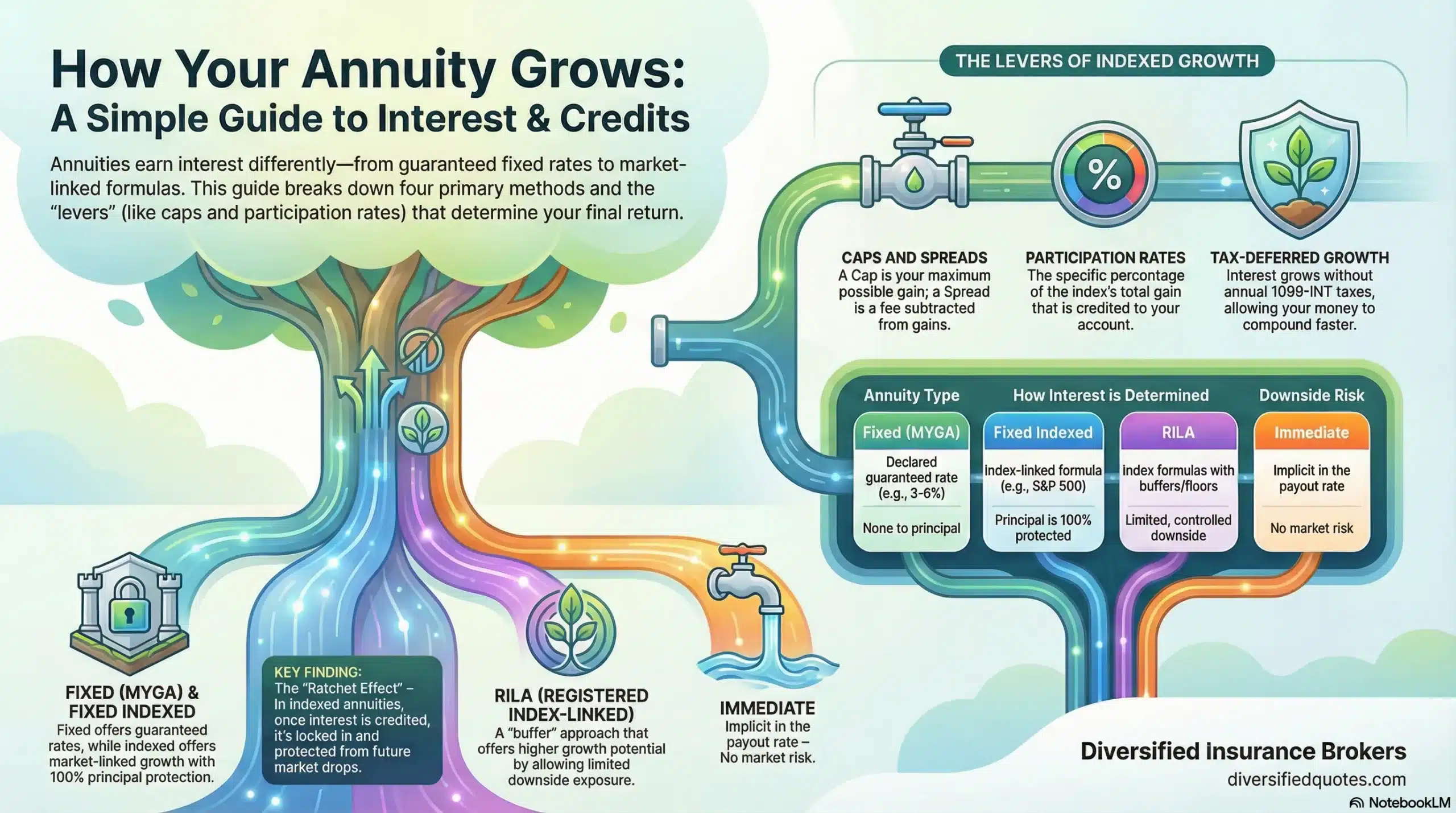
Talk to an Advisor or Request Your Annuity Quote
Ready to explore this annuity in more detail—or compare it with other carriers to see if even higher rates are available? With guaranteed income, principal protection, and long-term growth potential on the line, making the right choice is essential. The experienced advisors at Diversified Insurance Brokers will guide you through the options and design a strategy tailored to your retirement goals.
Schedule here:
calendly.com/jason-dibcompanies/diversified-quotes
Licensed in all 50 states • Fiduciary, family-owned since 1980
FAQs: Understanding Annuity Bonuses
What is an annuity bonus?
An annuity bonus is an upfront increase to your annuity value—usually a percentage of your premium—credited immediately when you open the contract. Bonuses are most common in fixed indexed annuities (FIAs) and are used to enhance income riders, contract value, or death benefits.
Do bonus annuities increase my actual account value?
It depends on the contract. Some annuities credit the bonus to the accumulation value, while others credit it only to the income benefit base. Income-base bonuses increase future lifetime income but may not be accessible as cash.
Are bonuses free?
No. Bonus annuities often include trade-offs such as longer surrender periods, lower caps or participation rates, spreads, or income rider fees. The key is evaluating whether the long-term benefits outweigh the added restrictions.
Who benefits most from an annuity bonus?
People close to retirement—typically within 5–10 years—often benefit most. A bonus can immediately boost the income base for lifetime withdrawals, which is useful when building a guaranteed income stream. See also: How Social Security and annuities work together.
Are annuity bonuses taxable?
No, not immediately. Bonuses grow tax-deferred inside the annuity. Withdrawals—from the bonus or gains—are taxed as ordinary income unless the annuity is inside a Roth account.
Do bonuses apply to additional contributions?
Some annuities offer bonuses only on the initial premium. Others apply them to all premiums within the first contract year. Each carrier sets its own rules, so it’s important to read the product details carefully.
Do bonus annuities have lower growth potential?
Sometimes. To compensate for the bonus, insurers may reduce caps, participation rates, or impose spreads on indexed crediting. This doesn’t make bonus annuities “bad,” but it does mean you should compare overall long-term performance, not just the upfront bump.
Is a higher bonus always better?
No. A high bonus doesn’t guarantee a better contract. What matters is how the bonus interacts with income rider growth rates, payout factors, caps, spreads, and liquidity options. A balanced, competitive contract often performs better than one with the highest headline bonus.
How do I compare bonus annuities?
Comparisons should include the bonus amount, crediting mechanics, rider fees, surrender length, renewal rate history, and income payout factors. Our page on annuity fees helps explain how bonuses interact with costs.
Where can I see today’s top bonus annuity rates?
You can browse current offerings using our updated resource here: Current Bonus Annuity Rates. Options change frequently, so reviewing periodically is smart.
About the Author:
Jason Stolz, CLTC, CRPC and Chief Underwriter at Diversified Insurance Brokers (NPN 20471358), is a senior insurance and retirement professional with more than two decades of real-world experience helping individuals, families, and business owners protect their income, assets, and long-term financial stability. As a long-time partner of the nationally licensed independent agency Diversified Insurance Brokers, Jason provides trusted guidance across multiple specialties—including fixed and indexed annuities, long-term care planning, personal and business disability insurance, life insurance solutions, Group Health, and short-term health coverage. Diversified Insurance Brokers maintains active contracts with over 100 highly rated insurance carriers, ensuring clients have access to a broad and competitive marketplace.
His practical, education-first approach has earned recognition in publications such as VoyageATL, highlighting his commitment to financial clarity and client-focused planning. Drawing on deep product knowledge and years of hands-on field experience, Jason helps clients evaluate carriers, compare strategies, and build retirement and protection plans that are both secure and cost-efficient. Visitors who want to explore current annuity rates and compare options across multiple insurers can also use this annuity quote and comparison tool.
