
Understanding Hybrid Long-Term Care Insurance
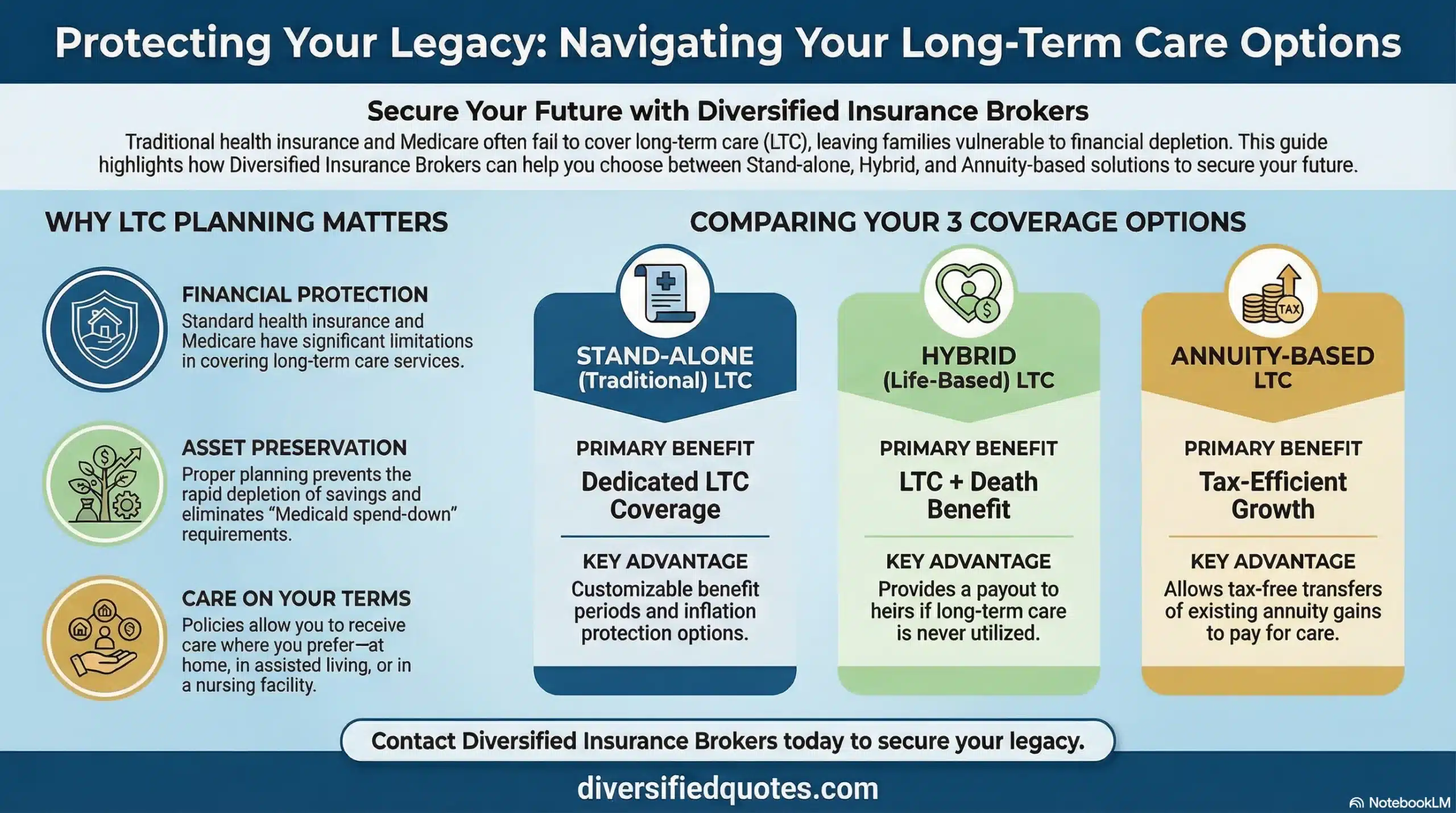
Traditional long-term care insurance can feel like a gamble—if you don’t use it, you lose it. Hybrid long-term care insurance was designed to eliminate that fear by combining long-term care coverage with either a life insurance policy or an annuity. Instead of paying premiums for decades and hoping you never need the benefit, hybrid coverage ensures that your dollars will create value one way or another. If you require care, the policy pays for it. If you never need care, your family receives a death benefit or the policy retains meaningful value. That outcome certainty is why hybrid long-term care planning has become one of the fastest-growing segments in retirement protection today.

For many families, the hesitation around traditional long-term care coverage isn’t about denying the risk. It’s about efficiency. People understand that extended care—whether at home, in assisted living, or in a nursing facility—can cost hundreds of thousands of dollars over time. They also understand that Medicare does not cover ongoing custodial care. Yet they hesitate because they don’t want to commit large premium dollars to something that might never be used. Hybrid long-term care insurance addresses that exact concern by repositioning assets in a way that creates leverage for care while preserving wealth if care is never needed. Instead of “use it or lose it,” the structure becomes “use it or leave it.”
In practice, hybrid long-term care insurance integrates long-term care benefits into either a life insurance chassis or an annuity contract. Many policies are funded with a single premium or a limited payment schedule rather than open-ended lifetime premiums. The result is predictability. You know what you are committing, you know what the minimum benefits will be, and you know that the policy cannot simply evaporate without value. For retirees, pre-retirees, and asset-conscious households, that predictability often makes planning psychologically and financially easier.
The real power of hybrid coverage becomes clear when you look at the three possible outcomes every policy is designed to address. First, if you need long-term care, the policy activates and pays benefits—often monthly—based on the structure selected at issue. These benefits can typically be used for home health care, adult day care, assisted living, memory care, or skilled nursing, depending on policy terms. Second, if you never require long-term care, the life insurance-based hybrid pays a death benefit to your beneficiaries, often income-tax-free. Third, many policies provide access to cash value or return-of-premium features if circumstances change and you need liquidity. No matter which path life takes, the policy is structured to deliver something tangible.
Compare Hybrid vs. Traditional Long-Term Care Options
See side-by-side illustrations of life-based and annuity-based hybrid LTC plans tailored to your age, health, and assets.
Start Your LTC ReviewTo understand whether hybrid long-term care insurance makes sense, it helps to revisit why traditional coverage can feel uncomfortable for some households. Traditional policies are designed to maximize pure long-term care leverage per premium dollar. For individuals primarily focused on obtaining the largest possible care pool at the lowest upfront cost, traditional insurance can still be extremely effective. However, traditional policies typically require ongoing premiums, and while modern policies are more stable than older generations, the history of premium adjustments in the long-term care market still weighs on consumer confidence. In addition, if care is never needed, there is generally no residual benefit for heirs.
Hybrid policies trade a portion of that pure leverage for certainty and flexibility. Rather than emphasizing maximum multiplier alone, hybrid designs focus on balanced outcomes. Many clients appreciate knowing that the dollars repositioned into a hybrid policy are not disappearing into a one-dimensional contract. Instead, those funds create a protected pool that can expand for care, pass to beneficiaries, or remain accessible under defined conditions.
Life insurance-based hybrid long-term care policies are particularly attractive for individuals who prioritize legacy and estate continuity. In these structures, the base of the policy is a permanent life insurance contract. Long-term care benefits are attached as riders that allow acceleration of the death benefit for qualified care expenses. If care is needed, the death benefit is reduced as benefits are paid. If care is never required, the full remaining death benefit passes to heirs. Some policies also offer extension riders that multiply the available long-term care pool beyond the original face amount, providing additional leverage for extended care scenarios.
Annuity-based hybrid long-term care policies serve a slightly different purpose. These designs are often used when individuals already hold conservative assets—such as CDs, savings, or existing non-qualified annuities—that are earning modest returns. By repositioning those assets into an annuity with a long-term care rider, policyholders can create a multiple of their original deposit for care needs while maintaining tax-deferred growth on unused funds. If long-term care is never required, the annuity value remains available or passes to beneficiaries according to contract terms. This approach can be especially appealing for retirees who want to make idle assets work harder without exposing them to market volatility.
Another important distinction is funding structure. Traditional long-term care policies are usually funded with annual or monthly premiums that continue for many years. Hybrid policies are frequently funded with single-pay, 5-pay, or 10-pay schedules. That limited funding horizon creates psychological clarity. Clients often say they prefer knowing they will be “done paying” within a defined timeframe. It transforms the planning conversation from an indefinite obligation to a finite strategic allocation.
Tax considerations also play a role in hybrid planning. Long-term care benefits are generally received income-tax-free when structured properly. Life insurance death benefits typically pass income-tax-free to named beneficiaries. Annuity-based hybrids preserve tax deferral on growth while potentially enhancing distributions used for qualified long-term care expenses. The interaction between tax law, asset structure, and policy design can meaningfully influence overall retirement efficiency, which is why hybrid LTC is often integrated into broader estate and income planning strategies rather than purchased in isolation.
Couples frequently find hybrid long-term care insurance especially compelling. Statistically, there is a strong likelihood that at least one spouse will require some form of extended care during retirement. Hybrid designs may offer shared benefit options, survivorship protections, or coordinated coverage that allows benefits to be accessed in a flexible manner. Instead of managing two rigid policies independently, couples can structure coverage that adapts to whichever spouse needs care first—or potentially both.
Underwriting remains a critical factor in any long-term care planning decision. Approval is not based solely on age but on functional independence, cognitive clarity, and overall health profile. Insurers evaluate medical history, prescription use, mobility, recent falls, and assistance with activities of daily living. Because underwriting standards vary by carrier, working with an independent brokerage that represents multiple companies can significantly improve approval outcomes. Hybrid policies sometimes offer more flexible underwriting pathways than traditional standalone long-term care contracts, particularly in asset-based designs, though eligibility still depends on individual health circumstances.
One of the most common questions we hear is whether hybrid long-term care insurance is “better” than traditional coverage. The honest answer is that it depends on your objective. If your sole goal is to secure the largest possible care benefit for the lowest current premium outlay, traditional coverage may offer greater raw leverage. If your goal is to protect assets while ensuring that no premium is wasted, hybrid coverage may align more closely with your priorities. The right solution is not determined by marketing labels but by aligning policy mechanics with personal values, financial capacity, and family goals.
Hybrid long-term care insurance is particularly well-suited for individuals who have accumulated meaningful savings and want to protect those assets from erosion due to extended care expenses. It is also appropriate for those who have previously declined traditional LTC coverage because of premium uncertainty or “use it or lose it” concerns. For retirees with idle cash positions or conservative holdings, annuity-based hybrids can convert low-yield assets into leveraged protection. For estate-focused households, life-based hybrids create a dual-purpose asset that serves both care protection and wealth transfer objectives.
Importantly, hybrid long-term care planning is not about assuming you will need care. It is about recognizing that the cost of extended care can disrupt even well-built retirement plans. Home care, assisted living, and memory care services continue to rise in cost across the country. Even a few years of custodial care can meaningfully reduce investment portfolios, alter legacy plans, or create financial strain for surviving spouses. Hybrid policies are designed to intercept that risk while preserving dignity and choice.
At Diversified Insurance Brokers, our approach to hybrid long-term care insurance is consultative rather than transactional. We evaluate age, health, asset structure, liquidity needs, income sources, and estate intentions before recommending a specific design. Because we represent numerous top-rated carriers, we are able to compare policy structures side by side rather than forcing a single proprietary solution. The goal is clarity—understanding how each option behaves under best-case, moderate, and worst-case scenarios.
Get Personalized Hybrid LTC Illustrations
Receive detailed projections showing care benefits, death benefits, and return-of-premium values based on your specific situation.
Request Your LTC Plan ReviewHybrid long-term care insurance exists because retirement planning is no longer one-dimensional. Families want flexibility. They want protection without waste. They want guarantees where possible, but they also want adaptability if circumstances change. By combining long-term care benefits with life insurance or annuity structures, hybrid policies create a multi-outcome solution that aligns with how modern retirees think about risk management.
If you are evaluating whether hybrid long-term care insurance fits into your broader retirement strategy, the next step is not guessing—it is comparing. Seeing actual numbers, funding schedules, care multipliers, and legacy projections clarifies the decision quickly. Whether your objective is protecting a spouse, preserving an estate, leveraging idle assets, or simply gaining peace of mind, hybrid long-term care insurance can be structured to serve a defined purpose rather than functioning as a speculative expense.
Related Pages
Financial Protection Essentials
Explore annuity interest examples across different investment sizes along with professional disability insurance options and long-term care planning resources.
Talk With an Advisor Today
Choose how you’d like to connect—call or message us, then book a time that works for you.
Schedule here:
calendly.com/jason-dibcompanies/diversified-quotes
Licensed in all 50 states • Fiduciary, family-owned since 1980
FAQs: Understanding Hybrid Long-Term Care Insurance
What is hybrid long-term care insurance?
Hybrid long-term care insurance combines long-term care benefits with either a life insurance policy or an annuity. If you need long-term care, the policy pays benefits; if you don’t, the policy provides a death benefit or account value instead of expiring unused.
How is hybrid long-term care insurance different from traditional LTC?
Traditional long-term care insurance is use-it-or-lose-it, while hybrid policies guarantee value in some form. Hybrid plans also typically use fixed or single premiums and are not subject to the same type of rate increases common with standalone LTC policies.
What types of products can include hybrid LTC benefits?
Hybrid LTC benefits are commonly added to permanent life insurance policies or fixed and fixed indexed annuities. The structure determines whether unused benefits convert to a death benefit or remain as annuity value.
Are hybrid long-term care benefits guaranteed?
Yes. Hybrid policies generally provide contractual guarantees for long-term care benefits, death benefits, or annuity values, subject to the insurer’s claims-paying ability and the specific terms of the contract.
How are long-term care benefits paid from a hybrid policy?
If long-term care is needed, the policy typically accelerates the death benefit or annuity value to pay for qualifying care expenses. Some policies also multiply the base benefit to provide more total LTC coverage.
Do hybrid LTC policies have premium increases?
Most hybrid policies use single premiums or fixed payment schedules, meaning premiums are generally guaranteed and not subject to future rate increases, unlike many standalone LTC policies.
Who might benefit most from hybrid long-term care insurance?
Hybrid LTC insurance can be a good fit for individuals who want long-term care protection but dislike the idea of paying premiums without guaranteed value, or for those with assets they want to reposition for care planning and legacy goals.
Are there drawbacks to hybrid long-term care insurance?
Hybrid policies usually require a larger upfront premium and may offer less long-term care leverage compared to traditional LTC insurance. They are best evaluated in the context of overall retirement, income, and estate planning goals.
About the Author:
Jason Stolz, CLTC, CRPC and Chief Underwriter at Diversified Insurance Brokers (NPN 20471358), is a senior insurance and retirement professional with more than two decades of real-world experience helping individuals, families, and business owners protect their income, assets, and long-term financial stability. As a long-time partner of the nationally licensed independent agency Diversified Insurance Brokers, Jason provides trusted guidance across multiple specialties—including fixed and indexed annuities, long-term care planning, personal and business disability insurance, life insurance solutions, and short-term health coverage. Diversified Insurance Brokers maintains active contracts with over 100 highly rated insurance carriers, ensuring clients have access to a broad and competitive marketplace.
His practical, education-first approach has earned recognition in publications such as VoyageATL, highlighting his commitment to financial clarity and client-focused planning. Drawing on deep product knowledge and years of hands-on field experience, Jason helps clients evaluate carriers, compare strategies, and build retirement and protection plans that are both secure and cost-efficient. Visitors who want to explore current annuity rates and compare options across multiple insurers can also use this annuity quote and comparison tool.
