
Accident Only Disability Income Insurance

Jason Stolz CLTC, CRPC
Accident Only Disability Income Insurance is designed to replace a portion of your income if you’re unable to work due to a covered accidental injury. For many people, it’s a practical middle-ground between “no protection at all” and a full traditional disability insurance policy that covers both injuries and illnesses. If your biggest concern is getting hurt on the job, in a car accident, or during everyday life—and missing weeks or months of pay—this type of coverage can be a smart, affordable option.
At Diversified Insurance Brokers, we help clients compare disability income strategies based on real-world risk, job duties, and budget. Accident-only coverage is especially appealing to people who want income protection but don’t want to overpay for bells and whistles they may not need. And because accident-only plans are narrower in scope than traditional disability insurance, they can sometimes be easier to qualify for, with fewer underwriting hurdles depending on the design.
Before you choose any plan, it helps to understand a simple reality: the risk of being unable to work is not always “catastrophic.” Many income interruptions are short-term but still financially painful. Missing a few paychecks can trigger a chain reaction—rent or mortgage pressure, credit card balances, depleted savings, and a forced return to work before you’re fully recovered. That’s exactly where accident only disability income insurance fits in.
Get Accident-Only Disability Income Options Built Around Your Job
Tell us your occupation and income target—we’ll help you compare benefit amounts, elimination periods, and policy designs that fit.
Request Accident-Only DI Quotes Explore Disability Insurance Options
What Is Accident Only Disability Income Insurance?
Accident only disability income insurance pays a monthly benefit when an insured person becomes disabled due to a covered accident and cannot perform their job. It’s fundamentally different from traditional long-term disability insurance because it typically does not cover sickness or illness-related disabilities.
That distinction is important because it changes how the policy is priced, how claims work, and who the coverage is best for. A traditional disability policy is designed to protect your income whether you’re out of work due to a broken ankle or a serious illness. Accident-only disability focuses on the “injury” side of the risk equation.
When someone searches for accident-only coverage, they’re usually trying to solve a simple problem: “If I get hurt and can’t work, how do I keep paying my bills?” They may already have some protection through employer benefits, but it’s often incomplete. Or they’re self-employed and want a lean, affordable policy that covers the most obvious scenario.
In many households, the highest financial vulnerability isn’t necessarily a once-in-a-lifetime disability—it’s a temporary loss of income that happens at the worst time. Accident-only disability is one way to create a dependable backstop without committing to the full price tag of comprehensive disability coverage.
How Accident-Only Disability Income Coverage Works (Simple Breakdown)
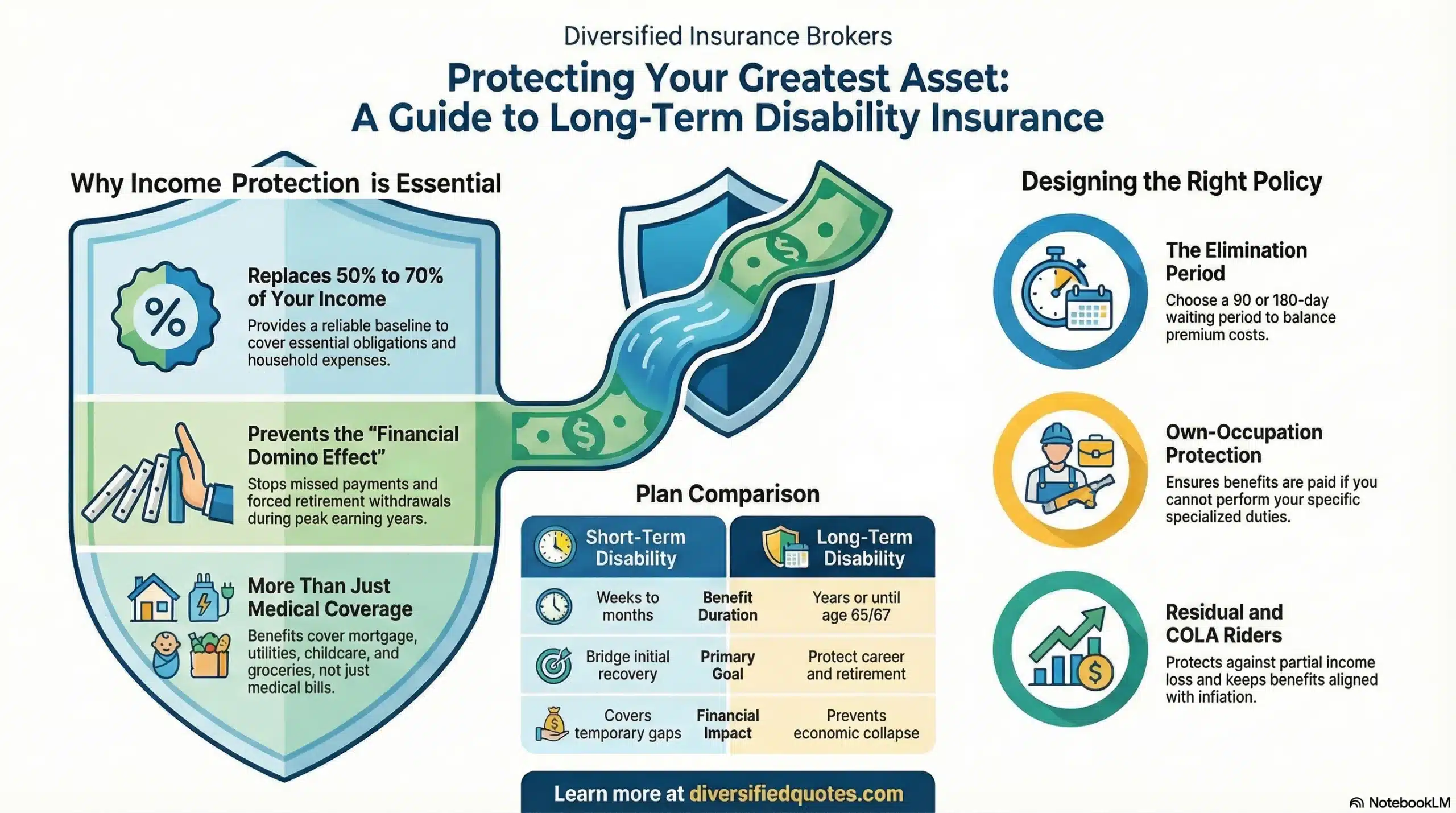
Most accident-only disability income plans follow the same general structure. You choose a benefit amount, a waiting period (also called an elimination period), and the maximum benefit duration. If you have a covered accident and meet the plan’s definition of disability, the policy pays you income while you’re unable to work.
The elimination period is one of the most important parts of the design because it determines how quickly benefits begin. Many people assume disability benefits pay immediately, but most plans are built for “income replacement,” not emergency cash. This is why some policies coordinate well with an emergency fund, short-term savings, or paid time off.
When you’re deciding on accident-only disability income coverage, you’re really choosing how to handle the first few weeks after an injury. Some people want fast-starting benefits. Others are comfortable waiting longer if it means a lower premium. A good disability plan isn’t just about “the maximum payout”—it’s about matching the plan to how your household actually functions financially.
To see how accident-only disability fits into a bigger protection plan, it helps to compare it side by side with full disability insurance. You can start with our main overview of disability insurance options and then determine whether accident-only coverage is an ideal starter policy or a supplement.
Who Accident Only Disability Income Insurance Is Best For
Accident-only disability insurance tends to work best for people who have a real injury exposure and a shorter-term income gap concern. It can be an especially good fit if you want meaningful protection but don’t want to pay for a more comprehensive plan right now.
We often see accident-only disability requested by people in physically active roles, trades, and occupations where an injury is a realistic scenario. It can also be a fit for people who participate in activities where injuries happen more frequently, even if their job itself is not hazardous.
Another common use-case is someone who has a health history that makes full disability insurance harder to qualify for. While accident-only coverage is not “guaranteed issue,” it may be easier to navigate depending on the specific policy design and underwriting approach. For many families, the goal is simple: get something in place that provides income protection if life happens.
Finally, accident-only disability coverage is often used by individuals who already have some protection for illness-related disability through other sources, such as an employer plan, and they want to strengthen the “accident” side of the risk with an additional individual policy layer.
What Accident Only Disability Insurance Typically Covers
Accident-only disability income insurance usually covers disability caused by a sudden accidental event that results in injury. The policy definition matters, because every plan has its own language around what qualifies as an accident, what qualifies as a disability, and what the insured must prove to receive benefits.
Common examples that may trigger benefits include fractures, torn ligaments, serious back injuries from an accident, or injuries caused by motor vehicle collisions. It may also include injuries from falls, sports incidents, or workplace-related accidents, depending on plan terms.
The key idea is that the disabling event must be accident-related—not a gradual onset illness or a medical condition that develops over time. That’s why accident-only coverage is best viewed as targeted income protection, not full “disability planning.”
If you’re unsure whether accident-only disability covers your situation, the best approach is to request sample policy language and compare it to a comprehensive plan. We help clients do that every day so they can buy a policy with confidence rather than guesswork.
What Accident Only Disability Income Insurance Does NOT Cover
The biggest limitation is also the biggest reason it’s affordable: accident-only disability generally does not cover illness. That means many of the most common causes of disability—things like chronic conditions, autoimmune disorders, or other medical issues—are not part of the protection.
This is why we always position accident-only disability as a “gap filler” or a “starter plan” rather than a perfect solution for everyone. If your goal is to protect your income against the broadest range of risks, you’ll usually want to explore a traditional disability income policy instead.
It also means you should be careful about how you label your plan. Many people assume “I have disability coverage” means “I’m protected.” But if the policy is accident-only, it’s more accurate to say: “I’m protected if the disability is caused by an accident.”
In retirement planning conversations, we often explain it this way: accident-only DI is like insuring one side of the problem. Full DI covers both sides. Which one you need depends on risk, budget, and how much financial damage would occur if you couldn’t work.
How Much Income Can Accident Only Disability Coverage Replace?
Most disability policies replace a portion of your income rather than 100%. That’s intentional. Disability benefits are generally designed to provide meaningful support while still encouraging return-to-work when you’re medically able.
Accident-only disability plans vary widely, but many offer monthly benefit amounts that can meaningfully help cover core household obligations such as rent, mortgage, utilities, vehicle payments, and groceries. The best benefit amount is rarely “the maximum available.” Instead, it’s the amount that keeps your financial life stable while you recover.
For many working adults, the goal is to ensure they do not have to drain retirement accounts, take on high-interest debt, or depend on family while injured. Disability insurance is often the difference between “this injury is stressful” and “this injury becomes a financial disaster.”
If you’re also using annuities as part of your retirement income strategy, disability protection can help keep that plan intact. It’s hard to build long-term income security if you’re forced to liquidate assets early due to a preventable income interruption.
Choosing the Right Elimination Period (Waiting Period)
The elimination period is the number of days you must be disabled before benefits begin. In practical terms, it’s how long you’re responsible for covering your own income gap before the policy steps in.
This is where many people make costly planning mistakes. Some choose the shortest waiting period available without thinking through the cost. Others choose a long waiting period to save money, only to find out later that their emergency savings would be drained quickly in a real-world injury.
A good way to choose the waiting period is to start with your current cash reserves and your household monthly burn rate. If you can comfortably cover 60 to 90 days of expenses without using credit cards or retirement accounts, you may be able to use a longer elimination period and still have a resilient plan.
But if your income is the backbone of your household, a shorter waiting period may be worth the premium because it prevents “the gap” from causing bigger damage than the injury itself.
Find the Best Waiting Period and Benefit Amount for Your Budget
We’ll help you structure accident-only DI so it actually works when an injury happens—without paying for the wrong design.
How Long Benefits Can Last (Benefit Period Options)
Accident-only disability income insurance can be designed with different maximum benefit periods. Some plans are built to cover short-term injuries for a defined number of months, while others may extend longer depending on the policy design.
The right benefit period is tied to the reality of recovery timelines. Some injuries resolve quickly, while others can require months of rehab, physical therapy, or follow-up procedures. The purpose of the benefit period is to keep your finances stable while your body catches up.
When you’re evaluating benefit periods, we typically recommend thinking in terms of “What is the longest realistic time I could be unable to perform my job after an accident?” A desk-based professional may be able to return sooner than a surgeon or a tradesperson, even with the same injury. That’s why disability planning is always job-specific.
The Definition of Disability Matters More Than Most People Realize
Disability policies are not all the same. The definition of disability is what determines whether a claim pays. This is why we emphasize design and language—not just premium or marketing promises.
Some plans focus on whether you can perform the duties of your own occupation, while others use broader definitions like “any occupation.” Accident-only policies vary, but the principle is always the same: you want the definition to match your real-world work situation.
If your work is highly specialized, even a partial limitation could prevent you from doing your job. That’s why the language around disability is not a fine print detail—it’s the core of what you’re purchasing.
If you want a full breakdown of disability plan structures, visit our main resource hub on disability insurance and then build from there into accident-only coverage as a specific subset.
Why People Choose Accident-Only Disability Income Insurance
People usually choose accident-only disability for one of three reasons: cost, simplicity, or underwriting concerns. A traditional disability policy can be an outstanding solution, but not everyone wants to pay for full coverage—or needs it as their first step.
Accident-only disability income insurance can be a disciplined way to protect your most important asset—your ability to earn income—while keeping the premium manageable. This is especially true for younger professionals, self-employed workers, and families who are balancing multiple priorities like childcare expenses, saving for retirement, or paying down debt.
It’s also a way to reduce stress. Injuries are hard enough physically. Most people don’t want to worry about whether the mortgage will bounce while they’re recovering. Income replacement coverage creates breathing room and gives you time to recover the right way instead of rushing back too early.
For many people, accident-only DI is the policy they get now while planning to upgrade later. And that’s perfectly valid, as long as the buyer understands what it does and does not cover.
Accident Only Disability Income Insurance for Self-Employed Workers
If you’re self-employed, an accident doesn’t just stop your paycheck—it can disrupt your entire business. There’s no employer safety net, and there may be no paid time off. That’s why disability income planning is especially important for entrepreneurs, contractors, and business owners.
Accident-only coverage can serve as a lean and efficient form of protection when you want something in place, but you also want to keep overhead low. It’s a way to create “income stability insurance” without overcomplicating the plan.
If you’re building a larger protection strategy, you may also want to explore how disability coverage pairs with other safety tools. In many cases, income protection complements retirement planning instead of competing with it, because it prevents you from pulling money out of long-term accounts during short-term emergencies.
What If You Already Have Disability Coverage Through Work?
Employer disability coverage can be helpful, but it often has limitations. The benefit amount may be capped, taxable (depending on how premiums are paid), or based on a narrow definition of income. Many employer plans also change or disappear when you change jobs.
Accident-only disability income insurance can be used as a “layer” to strengthen your protection. For example, someone might have short-term disability through work but still want additional income coverage if an injury causes them to miss an extended period of work.
The only way to know what you really have is to review the employer plan details and compare them to what your household needs. We can help you run that comparison and decide whether accident-only coverage fills an important gap.
What Determines the Cost of Accident Only Disability Insurance?
Pricing is influenced by a handful of major factors, including your age, occupation, income amount, benefit amount, waiting period, and benefit duration. Even in accident-only coverage, job duties matter because injury exposure is different depending on how you work.
Coverage is also shaped by how the plan defines disability and how benefits are structured. Two accident-only plans can look similar on the surface but behave very differently during a claim.
That’s why we focus on helping you compare policies using the same inputs. When you compare apples to apples, you can see the real value difference between designs rather than just looking at premium alone.
If you want a quote comparison specific to your job and income, you can request it here and we’ll help you map the best options available.
Compare Accident-Only Disability Income Quotes (Fast)
We’ll build a simple comparison based on your occupation, age, and income target—then walk you through the trade-offs.
Common Mistakes People Make With Accident-Only Disability Coverage
The most common mistake is assuming accident-only disability is “full disability insurance.” It’s not. It’s a targeted policy that can be very helpful, but only when it’s understood and matched properly to the buyer’s goal.
Another mistake is buying a small benefit amount that feels safe, but doesn’t actually cover anything meaningful. Disability coverage should stabilize your household, not just make you feel like you checked a box.
We also see people overlook waiting periods. A low premium can be appealing, but if the waiting period is too long, the plan may not help during the exact window you need it most.
Finally, people sometimes skip disability planning entirely because they assume “it won’t happen to me.” But accidents are unpredictable by nature. Insurance exists for the scenarios you cannot schedule.
How to Choose the Right Accident Only Disability Income Insurance Plan
The best way to choose the right plan is to start with your monthly essential expenses and work backward. Your goal is not to insure “everything.” Your goal is to keep your lifestyle stable while you recover.
Then, choose a waiting period that fits your savings and household structure. If you have cash reserves, you can often choose a longer waiting period to lower premium. If you don’t, you may need quicker-start benefits.
Finally, verify how disability is defined and what proof is required. The most important part of disability coverage isn’t the brochure—it’s the claims language.
When you build the plan correctly, accident-only disability income insurance can create real confidence. You’re not buying fear. You’re buying stability.
Next Steps
If you’re considering accident only disability income insurance, your next step should be a simple comparison based on your job, age, and the monthly income you’d want protected. Once you see a few structured options side by side, it becomes much easier to choose the right waiting period, benefit amount, and policy design.
And if you decide accident-only coverage is not enough, that’s still a win—because you’ll know you need comprehensive disability insurance instead of guessing. Either way, your goal should be the same: make sure a temporary injury doesn’t permanently derail your financial plan.
For broader disability planning, visit our main disability hub here: Disability Insurance.
Related Disability Income Pages
Explore more disability income strategies, underwriting tips, and coverage options based on how you work.
Financial Protection Essentials
High-risk life insurance planning, disability income protection with COLA, and financial institution reviews.
Talk With an Advisor Today
Choose how you’d like to connect—call or message us, then book a time that works for you.
Schedule here:
calendly.com/jason-dibcompanies/diversified-quotes
Licensed in all 50 states • Fiduciary, family-owned since 1980
FAQs: Accident Only Disability Income Insurance
Does accident-only disability insurance cover illnesses?
No. Accident-only disability insurance pays benefits only for covered injuries caused by accidents. Illness-related disabilities are excluded. If you need broader protection that includes sickness, review short-term vs long-term disability insurance options.
Is accident-only disability insurance cheaper than full disability coverage?
Yes. Because coverage is limited to accidents, premiums are typically much lower than traditional disability income insurance. You can compare broader protection options through disability income insurance examples to see pricing differences.
Can I qualify if I have medical conditions?
Often, yes. Accident-only policies generally have simpler underwriting and may be available even when full coverage is declined. If you’ve struggled to qualify before, see what to do if nobody will insure you for related guidance.
How long do benefits last?
Benefit periods vary by policy but are usually shorter than traditional disability insurance, often ranging from several months to a few years. For a deeper explanation of how payout timing works, review disability insurance elimination periods explained.
Is this coverage enough on its own?
It depends on your situation. Many people use accident-only disability insurance as a supplement rather than a full replacement for comprehensive income protection such as income protection insurance.
About the Author:
Jason Stolz, CLTC, CRPC and Chief Underwriter at Diversified Insurance Brokers (NPN 20471358), is a senior insurance and retirement professional with more than two decades of real-world experience helping individuals, families, and business owners protect their income, assets, and long-term financial stability. As a long-time partner of the nationally licensed independent agency Diversified Insurance Brokers, Jason provides trusted guidance across multiple specialties—including fixed and indexed annuities, long-term care planning, personal and business disability insurance, life insurance solutions, Group Health, and short-term health coverage. Diversified Insurance Brokers maintains active contracts with over 100 highly rated insurance carriers, ensuring clients have access to a broad and competitive marketplace.
His practical, education-first approach has earned recognition in publications such as VoyageATL, highlighting his commitment to financial clarity and client-focused planning. Drawing on deep product knowledge and years of hands-on field experience, Jason helps clients evaluate carriers, compare strategies, and build retirement and protection plans that are both secure and cost-efficient. Visitors who want to explore current annuity rates and compare options across multiple insurers can also use this annuity quote and comparison tool.
