
Burial Insurance Calculator

Jason Stolz CLTC, CRPC
Best burial insurance usually means one thing: a simple, affordable policy that is easy to qualify for, stays in force for life, and pays a predictable death benefit when your family needs it. Burial insurance (also called final expense insurance) is typically a small whole life policy designed to cover funeral costs, burial or cremation expenses, and the “extra” bills that show up after a loss—travel, medical copays, outstanding balances, and other last expenses that can put stress on loved ones.
At Diversified Insurance Brokers, we help families compare burial insurance options across many carriers and product types so you can get the best value for your age, budget, and health profile. The “best” policy isn’t always the one with the lowest monthly premium on the screen. It’s the one that matches your goals and your timeline—especially when you compare level benefit (day-one full coverage) versus graded benefit (limited natural death benefit early on, then full coverage later). This guide explains how to choose the right policy structure, how to avoid common mistakes, and how to use the calculator below to make smart comparisons.
Many people start with a simple question: “What does it cost?” Pricing depends primarily on age, tobacco status, state, and how the carrier categorizes health history. The good news is that burial insurance underwriting is often easier than traditional life insurance, and many common conditions still qualify. If you’re planning around a specific health profile, it can help to start with a condition-focused page and then circle back to this guide to compare options with more realistic expectations. For example, if diabetes is part of the picture, begin with burial insurance for people with diabetes. If you want to minimize friction in underwriting, it’s also worth reviewing burial insurance with no health exam so you understand how simplified approval tends to work.
Compare the Best Burial Insurance Options
Tell us your age, state, and coverage goal. We’ll match you to the most affordable options you can realistically qualify for.
Burial Insurance Calculator
Run real-time quotes and compare multiple coverage amounts to find the best fit for your monthly budget.
What Is Burial Insurance?
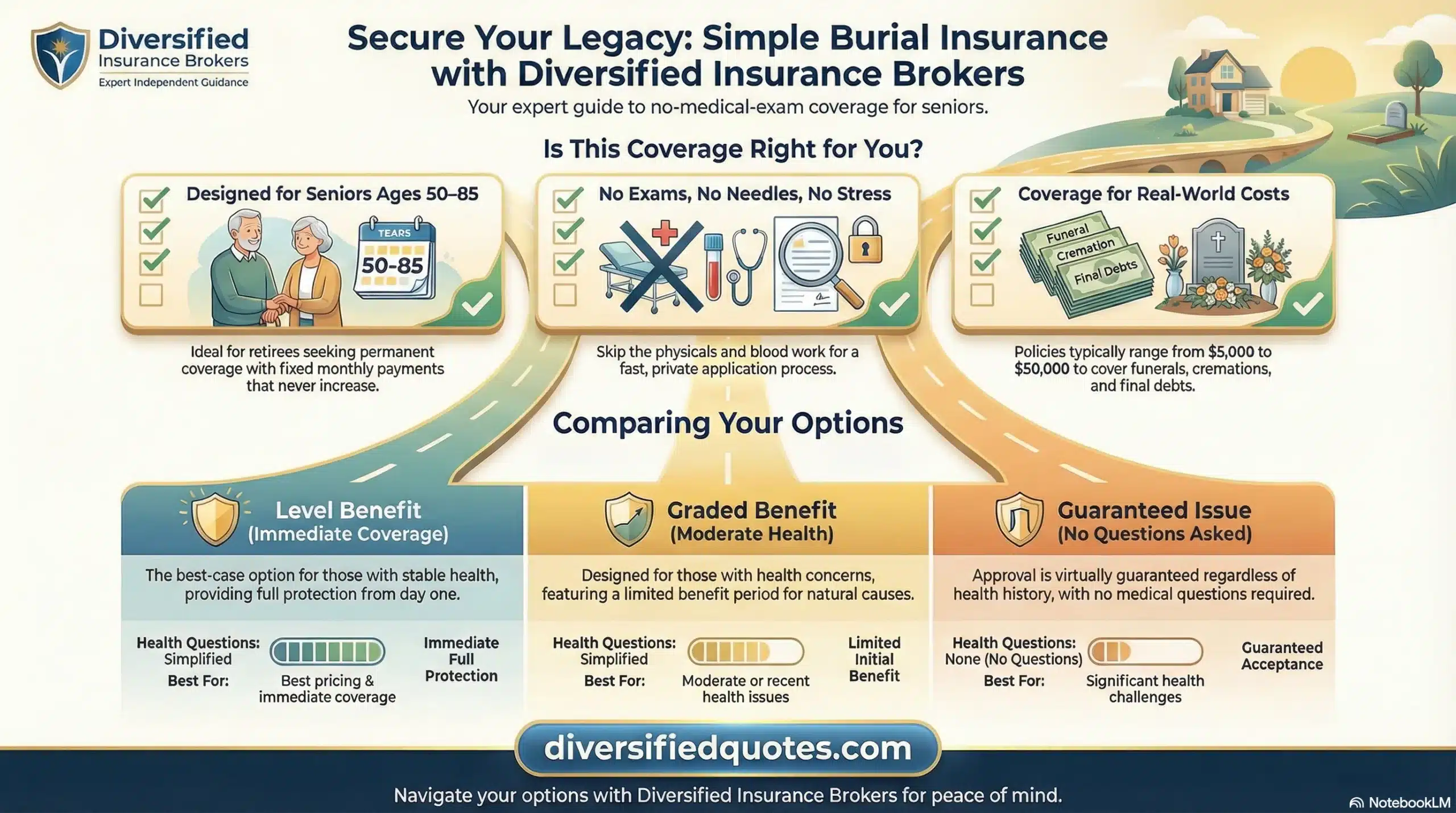
Burial insurance is a form of whole life insurance with smaller benefit amounts—often in the range of $5,000 to $25,000 (and sometimes higher). The coverage is designed to stay in place for life, with premiums that typically do not increase. That combination—permanent coverage plus predictable premiums—makes burial insurance a practical tool for families who want to handle final expenses without creating a financial burden for children or other loved ones.
Most burial insurance is structured for straightforward underwriting. Instead of a long medical exam process, many policies use a short health questionnaire plus electronic checks. That’s why burial insurance is often a better fit for seniors than applying for a larger term policy late in life. If your priority is simplicity and speed, you may find the underwriting approach described on burial insurance with no health exam to be a useful reference point when you evaluate options.
Burial insurance also matters because final expenses are real and often higher than expected. Families commonly focus on funeral home costs and forget the surrounding expenses: travel, time off work, a memorial gathering, medical bills, and the small balances that show up after a death. Even when a family has savings, paying out of pocket can create stress in the wrong moment. A dedicated policy can reduce friction and give the person handling arrangements immediate resources to work with.
What “Best Burial Insurance” Really Means
“Best” can mean different things depending on the family. For some, the best burial insurance is simply the lowest premium for a specific face amount. For others, best means a policy that offers immediate full coverage from day one. In some situations, best means finding a carrier that is more flexible for a particular health condition, even if it costs slightly more, because it avoids delays and surprises.
Most of the time, the best burial insurance is a policy that matches your goals in three ways. First, it aligns the face amount with what you actually want the benefit to cover. Second, it matches the policy type to your protection timeline—immediate full coverage versus a graded structure. Third, it fits your budget in a way that you can maintain long-term. A policy that is technically “better” on paper doesn’t help if premiums are stretched and the policy lapses later.
If you are buying burial insurance for an older parent, the meaning of “best” often shifts even more toward simplicity and reliability. Many families prefer straightforward approval, level premiums, and a clear benefit structure. When planning for older parents, it can be helpful to compare age-specific guides. For example, you can review best burial insurance for parents over 70 and best burial insurance for parents over 80 to see how underwriting and pricing often change at higher ages.
How Much Burial Insurance Do Most People Buy?
Most families choose a burial insurance amount based on local funeral costs and the amount of “cushion” they want beyond the service itself. Many people begin with $10,000 because it feels like a standard final expense number, and it can be a reasonable baseline for smaller services or cremation. In many areas, however, costs can run higher, especially when cemetery fees, burial vaults, headstones, and service arrangements are included. That’s why it’s common to see coverage amounts in the $15,000 to $25,000 range as well.
If you’re cost-focused and want a clean reference point, it can help to start with a $10,000 quote and then scale up or down based on your budget. This page is useful if you want a specific benchmark: monthly cost of a $10,000 burial insurance policy. From there, you can test $15,000 and $20,000 and see how the premium changes. This is one of the simplest ways to use the calculator above: run three amounts back-to-back and choose the option that balances coverage and affordability.
A practical approach is to choose a benefit amount that covers the service you want, plus a buffer for “last bills.” If you want the policy to cover only funeral expenses, you may choose a smaller face amount. If you want the policy to reduce stress for family members by handling more of the after-death financial cleanup, a larger amount can make sense. The “right” amount is the one that matches your objective without creating premium strain.
Level Benefit vs. Graded Benefit: The Most Important Decision
In burial insurance, the difference between level benefit and graded benefit is often the most important factor in choosing the right policy. A level benefit burial policy generally provides the full death benefit immediately for natural and accidental causes of death once the policy is in force (subject to policy provisions). This is often what families mean when they say they want “immediate coverage,” and it’s the preferred structure when health history supports it.
A graded benefit (sometimes called modified benefit) burial policy is designed for applicants whose health profile makes immediate full coverage less likely under simplified underwriting. In many graded structures, the natural death benefit is limited during an initial period—often one to two years—then becomes the full face amount after the graded period ends. Accidental death is commonly covered at the full face amount from day one, even on graded plans, but the natural death provision is staged early on.
Graded policies exist because they provide a path to coverage when simplified-issue level benefit approval is not realistic. They can be a smart solution for people who have been declined or postponed elsewhere, or who have more complex medical histories. The key is to choose them intentionally. If your primary goal is immediate full coverage, you should aim for a level benefit plan if you can qualify. If your priority is simply to get something in place and protect your family from being uninsured, a graded plan can still be the best practical option.
If you’re trying to find the lowest premium possible, you may want to explore cost-focused strategies in addition to policy type comparisons. Start here: low cost burial insurance. Often, the best “cost outcome” comes from choosing a face amount that is comfortably payable long-term and matching the underwriting niche of the carrier to the applicant’s health profile.
How Health Affects Burial Insurance Approval and Pricing
Burial insurance underwriting is typically simpler than traditional life insurance underwriting, but health still matters. Carriers tend to focus on a short list of questions designed to identify higher-risk situations. The details that matter most are usually related to recent hospitalizations, current cancer treatment, severe chronic conditions, and whether certain diagnoses are stable or actively progressing. Within that framework, many common conditions can still qualify for coverage, sometimes with level benefit approvals and sometimes with graded structures.
One reason burial insurance shopping is so important is that different carriers have different “sweet spots” for health history. Two carriers may price similarly for healthy applicants, but one may be significantly more flexible for a specific condition. This is why it’s often better to work from a multi-carrier perspective rather than applying randomly and risking unnecessary declines. If diabetes is in play, begin with burial insurance for people with diabetes so you can understand what tends to move an applicant toward level benefit versus graded benefit outcomes.
If you want a broader context for underwriting logic across insurance products, reviewing a condition-specific life insurance guide can also help you understand how insurers think about stability and risk factors. For example, this type of educational page can provide useful context: life insurance for alcohol use. While final expense underwriting is often shorter and simpler, the general concept is consistent: stability, control, and time since major events usually improve options.
How to Use the Burial Insurance Calculator the Right Way
The burial insurance calculator is most useful when you use it as a comparison tool rather than a one-time quote screen. The best first step is to run multiple face amounts back-to-back. Start with a number you know you can afford, then test the amount you would ideally want, then test a slightly higher amount so you can see how premium changes. This creates immediate clarity about what benefit amount is realistic for your monthly budget.
The next step is to pay attention to policy type and benefit structure. If you have the option to compare level benefit and graded benefit outcomes, take that seriously. A lower premium can be tempting, but if the policy is graded and your goal is immediate natural death coverage, you may be buying something that does not align with what you’re trying to accomplish. It’s better to choose a policy intentionally than to choose the cheapest number on a screen.
Finally, treat the calculator as a starting point and refine your decision with real-world objectives. Ask what you want the policy to do. If the answer is strictly “cover funeral costs,” you may choose a smaller amount. If you want the policy to reduce stress and provide additional cash for after-death bills, you may choose a higher amount. The best policy is the one that fits the purpose without stretching premiums.
If you are shopping for a parent or helping a family member, it’s often helpful to compare age-specific guidance because carrier options and underwriting thresholds can shift at older ages. These are useful companion reads: best burial insurance for parents over 70 and best burial insurance for parents over 80.
Common Mistakes to Avoid When Buying Burial Insurance
A common mistake is choosing a policy based only on premium and not confirming the benefit structure. If a policy is graded for natural causes early on, the premium can look better than a level benefit alternative. That may be fine if your goal is simply to get coverage in place and you understand the early limitations. But if your goal is day-one full coverage, you should prioritize a level benefit plan when available.
Another mistake is choosing a face amount without anchoring it to expected costs. Funeral expenses vary widely by location and by the type of service you want. Burial tends to cost more than cremation, and cemetery costs can vary dramatically. Rather than guessing, estimate the type of service you want and add a buffer for last expenses. Then run that face amount in the calculator and see if the premium fits.
Another mistake is applying randomly with a single carrier. Burial insurance underwriting niches vary by carrier, and applying with the wrong company can lead to unnecessary declines or graded offers when another carrier would have been more favorable. The better approach is to compare options before you apply and position the application with the best underwriting fit.
Finally, people sometimes wait because they believe they can “save up the money” instead. That strategy can work if savings are strong and truly protected, but life tends to interrupt plans. Burial insurance can create dedicated protection immediately, which is often the key benefit for families who want to eliminate uncertainty.
Get Matched to the Best Burial Insurance for Your Situation
We’ll help you choose the right face amount, confirm level vs. graded benefits, and compare the best options you can qualify for.
Who Usually Gets the Best Results With Burial Insurance?
Burial insurance often works best for people who want permanent coverage designed for final expenses and who prefer a straightforward approval process. It is especially useful for adults and seniors who don’t want to deal with medical exams, and for families who want to reduce financial stress for children, spouses, or caregivers. The goal is not to build a large legacy; the goal is to create a predictable benefit that shows up quickly when it’s needed.
It also works well for people who have been told they are “too old” or “too risky” for other life insurance. Burial insurance is built for accessibility, and there are often options even when health is more complex. The key is choosing the right policy structure. For some applicants, that will mean level benefit simplified issue coverage. For others, graded benefit or guaranteed acceptance products may be more realistic. Understanding the difference helps you avoid buying the wrong structure for your timeline.
If you are a veteran or you are planning for a veteran in your family, you may also want to review the veteran-specific page because private burial insurance can coordinate with other benefits and still be a practical planning tool. Start here: burial insurance for veterans. That page can help you understand how families often combine resources while still keeping the insurance solution simple and predictable.
Related Burial Insurance Pages
Helpful guides that expand on pricing, underwriting paths, and choosing the right benefit amount.
Related Age & Approval Topics
If you’re planning for a parent or navigating health concerns, these pages help set expectations.
Financial Protection Essentials
Legal funding solutions, benefit riders, annuity concepts, and carrier evaluations to support stronger financial decisions.
Talk With an Advisor Today
Choose how you’d like to connect—call or message us, then book a time that works for you.
Schedule here:
calendly.com/jason-dibcompanies/diversified-quotes
Licensed in all 50 states • Fiduciary, family-owned since 1980
FAQs: Burial Insurance Calculator
Is this burial insurance calculator giving me an exact final price?
No. The calculator provides an estimated range based on the inputs you choose. Final pricing still depends on the carrier, the product type (level vs. graded), and the underwriting outcome after the application questions are reviewed.
What’s the fastest way to use the calculator effectively?
Run three face amounts back-to-back: a “minimum” amount, an “ideal” amount, and a “stretch” amount (for example $10,000, $15,000, and $20,000). This shows how premiums scale and helps you choose a benefit that fits your budget long-term.
Why do burial insurance premiums rise so quickly with age?
Burial insurance pricing is closely tied to age-based mortality risk. As age increases, the cost to insure a given benefit increases, so premiums typically rise year over year. Carrier choice and policy type can still make a meaningful difference.
Does tobacco use really change the price that much?
Yes. Tobacco is one of the biggest pricing drivers in life and final expense insurance. Non-tobacco rates are usually meaningfully lower, and the difference can increase as age increases.
What’s the difference between level benefit and graded benefit burial insurance?
Level benefit policies generally provide full natural-death coverage immediately once the policy is in force. Graded (or modified) benefit policies typically limit natural-death payouts during an initial period (often 1–2 years), then provide full coverage afterward. Accidental death is often covered immediately, even on graded plans.
Why would someone choose a graded benefit policy?
Graded benefit policies can make coverage available when health history is too complex for immediate level-benefit approval. They can be a practical way to put protection in place now, especially when simplified-issue approval is uncertain.
How much burial insurance coverage do most families buy?
Many families choose $10,000–$20,000, but the right amount depends on local funeral costs and whether you also want funds for medical bills, travel, and other final expenses. The best amount is the one that matches your real costs without stretching your monthly budget.
Can I use the calculator if I have health conditions like diabetes or heart history?
Yes. The calculator helps you estimate pricing, but your final policy type and rate depend on how carriers view your condition and stability. Some applicants still qualify for level benefit coverage, while others may be offered graded options depending on the health profile.
Does burial insurance require a medical exam?
Often no. Many final expense policies are simplified issue, meaning they use health questions and database checks without a paramed exam. Some options are designed to be even simpler, depending on the carrier and product.
Do burial insurance premiums ever increase or does the policy expire?
Most burial insurance is whole life coverage with level premiums that do not increase and coverage that does not expire as long as premiums are paid. Product details can vary by carrier, so it’s important to confirm the benefit type and premium structure.
About the Author:
Jason Stolz, CLTC, CRPC and Chief Underwriter at Diversified Insurance Brokers (NPN 20471358), is a senior insurance and retirement professional with more than two decades of real-world experience helping individuals, families, and business owners protect their income, assets, and long-term financial stability. As a long-time partner of the nationally licensed independent agency Diversified Insurance Brokers, Jason provides trusted guidance across multiple specialties—including fixed and indexed annuities, long-term care planning, personal and business disability insurance, life insurance solutions, Group Health, and short-term health coverage. Diversified Insurance Brokers maintains active contracts with over 100 highly rated insurance carriers, ensuring clients have access to a broad and competitive marketplace.
His practical, education-first approach has earned recognition in publications such as VoyageATL, highlighting his commitment to financial clarity and client-focused planning. Drawing on deep product knowledge and years of hands-on field experience, Jason helps clients evaluate carriers, compare strategies, and build retirement and protection plans that are both secure and cost-efficient. Visitors who want to explore current annuity rates and compare options across multiple insurers can also use this annuity quote and comparison tool.
