
Current Fixed Annuity Rates

Jason Stolz CLTC, CRPC
Review current fixed annuity rates from more than 75 highly rated carriers—without sales pressure or aggressive tactics. Fixed annuities remain one of the most straightforward tools for predictable retirement accumulation because the interest rate is declared in advance, your principal remains protected, and earnings grow tax-deferred. For many retirees and those nearing retirement, this combination provides a way to reduce market exposure while still earning a competitive return.
At Diversified Insurance Brokers, fixed annuities are often used as a foundational component of retirement planning. Some individuals use them as a stable place to position funds they do not want subject to volatility. Others implement ladder strategies, selecting multiple terms that mature at different intervals to create liquidity windows or reinvestment flexibility. In many situations, fixed annuities serve as the conservative allocation within a broader retirement strategy—particularly for those who prefer to avoid daily market fluctuations.
When people reference “fixed annuity rates,” they are typically comparing MYGAs (Multi-Year Guaranteed Annuities). These contracts function similarly to CDs in that you choose a term—such as 3, 5, or 7 years—and receive a guaranteed interest rate for that entire period. The key distinction is that fixed annuities are issued by insurance companies and are backed by the insurer’s claims-paying ability, while also offering tax deferral outside qualified retirement accounts. That tax-deferred feature is one of the primary reasons many individuals select a MYGA for non-qualified funds.
🖊️ Request a Personalized Annuity Quote
Receive customized fixed annuity options from 100+ carriers based on your state, deposit amount, and goals.
Why Consider Fixed Annuities?
Fixed annuities eliminate two primary uncertainties: exposure to market losses and interest rate changes during the guaranteed term. When you purchase a MYGA, you are securing a defined outcome over a specific time horizon. That predictability becomes especially valuable when retirees are coordinating withdrawals, managing sequence-of-returns risk, or stabilizing a portion of assets regardless of future market performance.
Guaranteed interest for a defined period. A MYGA locks in your rate for the entire selected term. The interest rate does not fluctuate during that guarantee window, making planning more precise. Some individuals align terms with retirement milestones—such as stopping work, initiating Social Security, or finalizing pension decisions—while others intentionally stagger maturities to avoid re-rating all assets in the same year.
Principal protection from market losses. Fixed annuities do not participate in market downturns. Your initial deposit is protected, and interest credits are contractually specified. For investors who value stability over volatility, fixed annuities can provide peace of mind. Many buyers compare them first to bank products because the objective is consistency and planning confidence rather than market-driven upside.
Tax-deferred growth. For non-qualified funds, tax deferral is a meaningful advantage. Unlike certain taxable accounts, you do not receive an annual 1099 on interest growth. Gains remain inside the annuity until distributions begin. This structure can assist with long-term compounding and tax bracket management. If you anticipate converting the annuity into an income stream, understanding payout taxation is important; see our annuity exclusion ratio guide.
No explicit management fees. MYGAs do not charge annual advisory fees or fund expense ratios. While pricing is built into the declared rate, many retirees appreciate the transparency and simplicity of knowing their guaranteed return without layered annual costs.
Term flexibility. Fixed annuities are available in various durations, and the term selected should align with the purpose of the funds. Shorter terms provide quicker liquidity and re-rate opportunities. Longer terms may secure higher rates in certain environments and reduce reinvestment risk. Selecting the appropriate term is about alignment with your timeline—not identifying a universal “best” option.
To compare fixed annuities with other conservative annuity structures, review highest annuity rates and highest guaranteed annuity rates to see how MYGAs fit within the broader rate environment.
Example of Growth with Fixed Annuities
If you allocate $1,000,000 into a 5-year fixed annuity earning 5.40% compounded annually, the value would grow to approximately $1,300,000 at the end of the term—without exposure to market volatility. This example highlights why fixed annuities appeal to conservative retirees: the calculation is straightforward, downside risk is limited, and the time horizon is clearly defined.
It is equally important to understand what happens at maturity. If your objective is continued accumulation, evaluate renewal provisions. If income is the goal, review income rider or annuitization options. If liquidity is critical, confirm penalty-free withdrawal allowances during the contract term. A fixed annuity performs best when matched carefully to the intended use of the funds.
💰 Current Fixed Annuity Rates (as of March 2026)
The table below provides a general snapshot across multiple term lengths. Treat it as a reference point. Rates may vary by state, premium band, and timing. Certain carriers may lead in specific durations but not others, which is why side-by-side comparison supports ladder planning.
When reviewing rates, look beyond the headline percentage. Confirm whether the contract includes a Market Value Adjustment (MVA), the percentage allowed for penalty-free withdrawals, the timing of interest credits, and renewal terms at maturity. If funding within an IRA, verify how Required Minimum Distributions (RMDs) are handled and whether surrender charges are waived for RMD amounts.
Some of the highest annuity rates are sometimes offered by carriers with B or B+ ratings. However, we also work with many insurance companies rated A-, A, A+, and A++ by AM Best. In many cases the difference in rates between carriers is small, and the most important factor is choosing a company you feel comfortable with. We have access to dozens of carriers and can help you shop the market to find the option that best fits your goals.
| Term | Rate | Provider | Product | AM Best Rating |
|---|---|---|---|---|
| 1 Year | 4.15% | GCU Life | 1+4 Choice | A- |
| 2 Years | 5.25% | Mountain Life | Secure Summit | B |
| 3 Years | 5.85% | Wichita National | Security 3 | B+ |
| 4 Years | 6.05% | Mountain Life | Secure Summit | B |
| 5 Years | 6.30% | American Gulf | Anchor MYGA | B++ |
| 6 Years | 6.30% | American Gulf | Anchor MYGA | B++ |
| 7 Years | 6.30% | American Gulf | Anchor MYGA | B++ |
| 8 Years | 6.00% | Mountain Life | Secure Summit | B |
| 9 Years | 5.40% | Mountain Life | Secure Summit | B |
| 10 Years | 6.05% | Wichita National | Security MYGA | B+ |
Rates are subject to change and may vary by state, age, and premium amount. Larger deposits may qualify for additional enhancements.
To make these rates practical, consider your intended use. Shorter durations may suit near-term liquidity needs. Longer terms may help reduce reinvestment uncertainty. A ladder strategy can balance both objectives by creating staggered maturity dates while capturing today’s available rates.
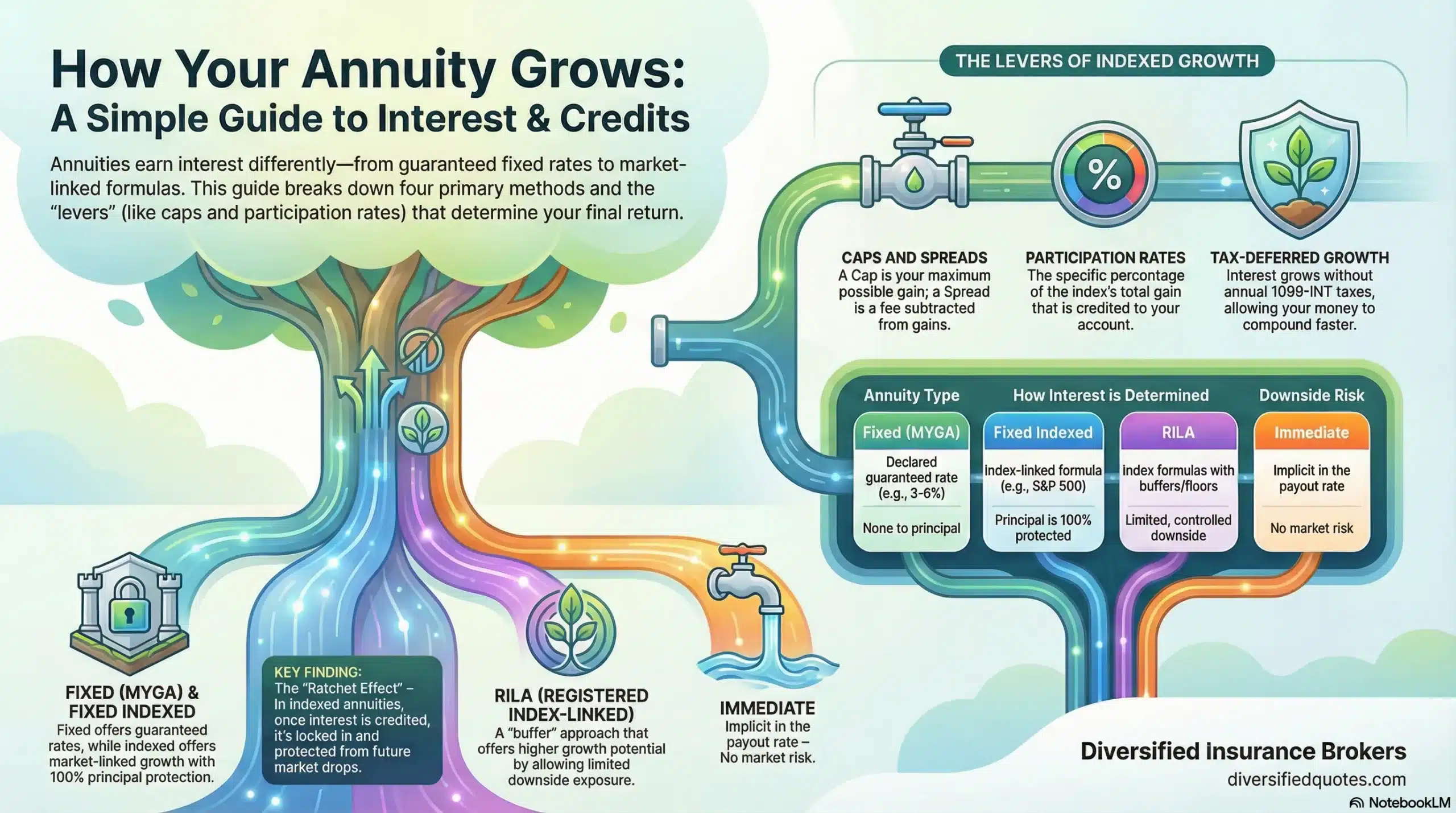
If you are deciding between a MYGA and a fixed indexed annuity, remember the core difference: MYGAs provide declared, guaranteed growth, while fixed indexed annuities offer principal protection with potential index-linked upside. To evaluate that comparison further, review best fixed indexed annuity options.
Annuity Interest Rate Examples by Deposit Size
See how annuity interest and income potential can vary depending on the size of your investment.
How Fixed Annuities Can Support Income Planning
Although often selected for accumulation, fixed annuities can also contribute to income strategy. Some retirees use a MYGA as a bridge asset—locking a competitive rate for a defined term and reassessing at maturity for potential income conversion. Others utilize MYGAs to reduce early retirement reliance on market withdrawals, helping manage sequence risk.
If guaranteed lifetime income is your priority, consider reviewing annuities for monthly retirement income and lifetime income annuity options. Even if you begin with a fixed annuity for growth, understanding income-focused alternatives prepares you for future decisions.
Some individuals also compare fixed annuity strategies to pension-style planning—creating predictable retirement paychecks independent of market performance. For additional insight, review pension alternative strategies.
What’s Next?
Fixed annuities can be a strong fit for those seeking guaranteed growth, principal protection, and predictable returns. The most effective approach involves aligning the contract term with your timeline, verifying liquidity provisions, and selecting a financially strong carrier. With access to over 75 top-rated insurers, we help you compare rates, terms, and features clearly and efficiently.
If you are also evaluating bonus-oriented products, compare them separately. While bonus annuities may provide an upfront enhancement, they can involve longer surrender schedules or adjusted crediting structures. To review current offers, see current bonus annuity rates and assess whether the bonus structure aligns with your intended holding period.
Get Today’s Best Fixed Annuity Rates
Compare leading carriers side by side and secure guaranteed rates for your retirement savings.
Retirement Account & Income Transition Planning
Evaluate rollover, distribution, and income strategy decisions across major retirement account types.
Advanced Planning, Insurance, and Income Strategy Topics
Explore advanced strategy topics including diversification, Medicare timing, income design, and insurance planning fundamentals.
Financial Protection Essentials
Specialized life insurance solutions, disability coverage comparisons, and international travel protection strategies.
Talk With an Advisor Today
Choose how you’d like to connect—call or message us, then book a time that works for you.
Schedule here:
calendly.com/jason-dibcompanies/diversified-quotes
Licensed in all 50 states • Fiduciary, family-owned since 1980
FAQs: Current Fixed Annuity Rates
What are current fixed annuity rates?
They’re today’s crediting rates on fixed annuities—especially MYGAs (Multi-Year Guaranteed Annuities)—that lock a guaranteed interest rate for a set term such as 3, 5, 7, or 10 years.
How often do MYGA rates change?
Carriers can update rates frequently based on interest rate markets, demand, and state availability. In some cases, rates shift monthly, and sometimes more often.
Are fixed annuity rates guaranteed for the entire term?
Yes. MYGA rates are generally guaranteed for the full term stated in the contract. Your principal is protected, and the declared rate won’t fluctuate during the guarantee window.
What affects the current rate I’m offered?
Term length, premium band (deposit size), product design (including MVA vs. non-MVA), state availability, and carrier pricing all influence the final rate.
How is interest credited on fixed annuities?
Many MYGAs accrue interest daily and credit annually, though the exact timing is contract-specific. The important point is that credited interest compounds and is generally tax-deferred until withdrawn.
What is a Market Value Adjustment (MVA)?
An MVA can adjust your surrender value (up or down) on withdrawals above free amounts or full surrender during the term based on interest rate movements since issue. It does not change the declared interest rate itself.
How much can I withdraw each year without penalty?
Most contracts allow a penalty-free withdrawal amount each year, often around 10% of account value after the first contract year. Exceeding that can trigger surrender charges and any MVA.
Do fixed annuities work inside IRAs and for rollovers?
Yes. MYGAs can be used inside Traditional or Roth IRAs via transfers or rollovers. In IRAs, tax deferral follows IRA rules; in non-qualified annuities, tax deferral is provided by the annuity contract.
How do RMDs interact with a MYGA?
For Traditional IRAs, you must take required minimum distributions when applicable. Many carriers waive surrender charges on RMD amounts, but you should confirm the provision before purchasing.
Can I lock today’s rate while funds transfer?
Many carriers offer a rate-lock window once an application is submitted and/or funds are received. The exact lock period varies, so it’s smart to confirm the carrier’s rate-lock policy.
How do fixed annuity rates compare with CD rates?
Both offer guaranteed accumulation over a term. CDs are FDIC-insured; annuities are backed by the insurer’s claims-paying ability and state regulation. MYGAs can be competitive and may offer tax-deferred growth outside IRAs.
What happens at the end of the term?
Typically, you’ll have a window to renew, transfer, or withdraw without surrender charges. If you do nothing, some contracts auto-renew or move into a renewal rate period. Check the contract’s maturity rules.
Can I use a 1035 exchange to capture a better rate?
Often yes for non-qualified annuities. Compare any surrender charges or MVA in your current contract against the new rate, term, and features before exchanging.
Does insurer financial strength matter?
Yes. Your guarantees rely on the insurer’s claims-paying ability. Many clients also diversify across carriers or terms if they’re investing larger amounts.
Should I ladder fixed annuities?
Laddering different terms can improve liquidity planning, reduce reinvestment timing risk, and create periodic maturity windows so you can adjust as rates change.
About the Author:
Jason Stolz, CLTC, CRPC and Chief Underwriter at Diversified Insurance Brokers (NPN 20471358), is a senior insurance and retirement professional with more than two decades of real-world experience helping individuals, families, and business owners protect their income, assets, and long-term financial stability. As a long-time partner of the nationally licensed independent agency Diversified Insurance Brokers, Jason provides trusted guidance across multiple specialties—including fixed and indexed annuities, long-term care planning, personal and business disability insurance, life insurance solutions, and short-term health coverage. Diversified Insurance Brokers maintains active contracts with over 100 highly rated insurance carriers, ensuring clients have access to a broad and competitive marketplace.
His practical, education-first approach has earned recognition in publications such as VoyageATL, highlighting his commitment to financial clarity and client-focused planning. Drawing on deep product knowledge and years of hands-on field experience, Jason helps clients evaluate carriers, compare strategies, and build retirement and protection plans that are both secure and cost-efficient. Visitors who want to explore current annuity rates and compare options across multiple insurers can also use this annuity quote and comparison tool.
