
Disability Insurance for Professionals Over age 65

Jason Stolz CLTC, CRPC
Disability insurance for professionals over age 65 is a niche but increasingly important form of income protection. Many people work well into their late 60s and early 70s—by choice, necessity, or a mix of both. Physicians, attorneys, consultants, executives, CPAs, and business owners often remain active after age 65, and as long as you have earned income, you still have exposure to a disability-related income interruption.
At Diversified Insurance Brokers, we help older professionals evaluate disability options that fall outside traditional underwriting guidelines. Coverage after age 65 tends to involve fewer carriers, tighter policy language, shorter benefit windows, and renewability conditions. When the goal is to protect the transition from work to retirement—rather than replace income for decades—late-age disability coverage can still be a meaningful hedge.
This page explains how disability insurance can work after age 65, who typically qualifies, how benefits are defined, what limitations are common, and how we help clients compare options with clear expectations.
Disability Insurance Options for Professionals Over 65
If you are still working and earning income after age 65, we’ll help you determine what’s realistic in your state—and which carriers may consider your case.
Request a Disability Insurance Review
Confidential • Nationwide • No obligation
Why Disability Insurance Still Matters After Age 65
Disability risk does not disappear at age 65. For many professionals, the financial impact of a disability can actually be more disruptive later in life because the timeline to recover is shorter. Retirement assets are often fully accumulated by this stage, and a disabling event can trigger unplanned withdrawals, unexpected tax consequences, and a permanent reduction in the sustainability of retirement income.
Many older professionals keep working to delay Social Security, preserve investment accounts, fund healthcare costs, or maintain cash flow from a business they are gradually transitioning. A disability—even a temporary one—can accelerate retirement at the worst possible time. Late-age disability insurance is best viewed as a bridge that helps protect retirement timing rather than a long-duration income replacement tool.
If you are coordinating work income with a broader retirement plan, it can also help to review related retirement-income resources such as our lifetime income planning approach and the tools on our annuities hub, especially if you are considering guaranteed-income strategies as a Plan B if work stops earlier than expected.
Is Disability Insurance Available After Age 65?
Yes—some carriers may offer disability income insurance to applicants between ages 65 and 70, but coverage is typically structured differently than traditional individual disability policies issued earlier in life. Policy language is often tighter, benefits are usually designed for shorter timeframes, and renewability is commonly conditional rather than guaranteed.
Coverage in this age range is generally intended for actively working professionals with meaningful earned income to protect. It is usually not designed for someone who is already retired or only has minimal earned income. The central purpose is to help preserve lifestyle stability and retirement timing if illness or injury forces an earlier-than-planned stop.
Because disability insurance over 65 is specialized, the application approach matters. How your occupation is described, how your hours are documented, and how income is verified can influence whether a carrier will consider the case. This is one reason many professionals prefer working with a brokerage familiar with late-age underwriting.
Who Typically Qualifies for Disability Insurance Over 65?
Disability insurance after age 65 is designed for a narrower applicant profile. Eligibility often depends on active work status, minimum hours, and earned-income documentation. Passive income, investment income, or “semi-retired” consulting without consistent hours may not qualify depending on carrier rules.
Most approvals in this age band are for professionals with stable duties, consistent work activity, and verifiable income. Physicians who still see patients, attorneys who still practice, CPAs who maintain client work, executives who remain in leadership roles, and business owners who are operationally involved are common examples. Underwriting is trying to confirm that your occupation and earnings are still meaningfully exposed to a disability-related interruption.
If you are self-employed or a business owner, there may also be value in evaluating business-focused coverage such as business overhead disability insurance, which can help reimburse ongoing business expenses during a disability—an important consideration when the business remains part of your retirement plan.
How Disability Is Typically Defined After Age 65
The definition of total disability is one of the biggest differences between late-age disability coverage and classic own-occupation disability insurance. Many late-age policies define total disability as being unable to perform the main duties of your occupation due to sickness or injury while also meeting additional requirements, such as being under the care of a physician and not working in another occupation.
This is a meaningful departure from strong own-occupation contracts that may pay even if you can work elsewhere. After age 65, insurers commonly restrict the definition to reduce moral hazard and claims complexity at older ages. If your plan is to shift into different work—such as moving from clinical work into consulting—the exact disability definition becomes even more important because it can affect how benefits would apply to your changing duties.
If you want a foundation on disability definitions and how occupational class affects coverage design, see our overview at disability income insurance and compare how different policy structures handle specialized occupations.
What These Policies Commonly Do Not Include
Professionals are often surprised to learn that disability insurance after age 65 may not include features that are common in traditional policies. Partial disability benefits, residual benefits, and return-to-work incentives are often limited or unavailable in this age range. In many designs, benefits primarily apply for total disability as defined by the contract.
This is why expectations matter. Late-age disability insurance can be valuable, but it should be purchased for the right reason. If your biggest concern is a gradual income decline rather than a clean “stop working” event, the fit may be weaker than it would be for a younger professional buying a robust own-occupation policy with strong residual benefits.
For some high-earning professionals, a stronger risk-management approach may involve combining modest disability coverage with retirement-income planning. If that is part of your conversation, it may also help to review resources such as retirement income planning and current annuity rates to understand how guaranteed income can support the plan if work ends earlier than expected.
Benefit Periods and Waiting Periods
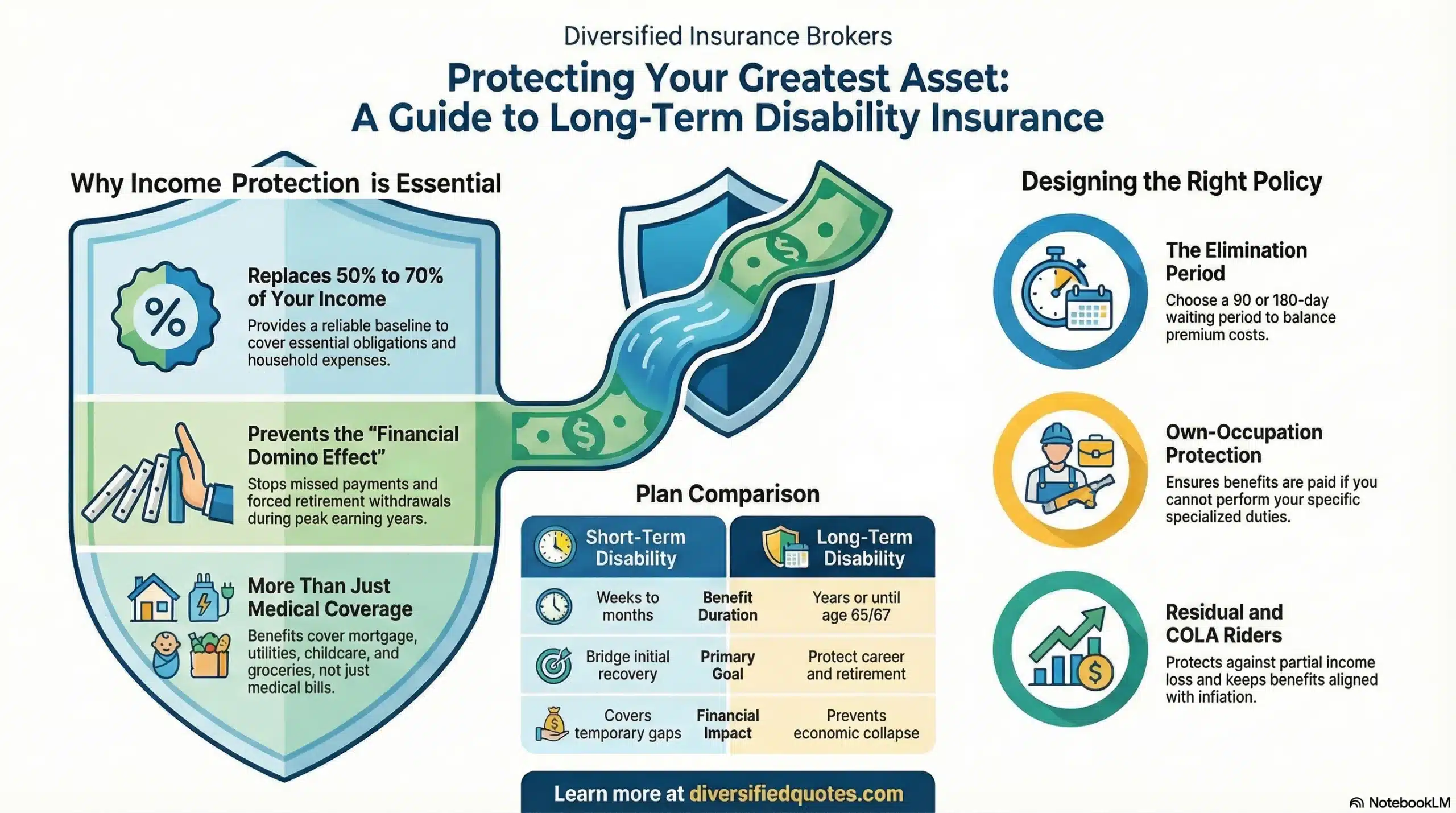
Late-age disability policies are commonly designed with shorter maximum benefit periods. Benefits begin only after the waiting period (elimination period) is satisfied, and no benefits accrue during that time. The structure is intended to align coverage with the most disruptive portion of late-career income risk and reduce the likelihood of short, frequent claims.
Once benefits start, payments generally continue only while the insured remains totally disabled and only up to the maximum benefit period shown in the policy. Multiple causes of disability do not extend the benefit period. In practice, the right way to view coverage after age 65 is as a bridge—supporting income while you adjust retirement timing, business transition decisions, and the broader financial plan.
Still Working After 65? Verify What’s Available
We’ll review your occupation, hours, and income documentation and then outline what carriers typically allow in your age band.
Renewability and Premium Structure After 65
Renewability and premium behavior often change after age 65. Many late-age disability plans are conditionally renewable on an annual basis. Renewal may require that you remain actively working a minimum number of hours per week, remain within the eligible age range, and not be disabled or receiving benefits at the time of renewal.
Premiums are typically not guaranteed level and may increase annually, which is expected given age-related risk. The right evaluation is not “Is it cheap?” but “Is the benefit meaningful relative to the risk I am protecting over the next few years?” For a professional still earning meaningful income, this coverage can function as a strategic hedge even if premiums rise.
If you are still earning strong income and want benefit design context for complex income, our resource on high income disability insurance can help frame how documentation and income structure impact what’s available.
When Disability Insurance Over 65 Can Make Sense
Coverage is most appropriate when earned income is still meaningful and the loss of that income would materially change retirement decisions. If you are working to delay retirement benefits, reduce reliance on portfolio withdrawals, or stabilize a business through a transition, disability insurance can protect the plan’s timing.
It may also make sense when income supports obligations that do not disappear at retirement age—such as a mortgage, business liabilities, family support, or healthcare expenses. In these cases, the risk is not “retirement at 65.” The risk is being forced to retire abruptly before you are ready. Disability coverage can help create breathing room.
On the other hand, if earned income is limited, retirement assets are sufficient, and stopping work would not materially change lifestyle, disability insurance may not add meaningful value. We routinely tell clients when the value equation does not make sense. The goal is a strategy that matches your reality—not a policy for the sake of a policy.
Common Scenarios We See with Older Professionals
One common scenario involves a professional planning to work until age 70 to maximize Social Security and preserve retirement assets. A disability at age 66 or 67 can create immediate cash-flow strain, forcing earlier portfolio withdrawals and potentially increasing taxes. A late-age disability benefit can provide stability for a defined period while the long-term plan is recalibrated.
Another scenario involves a business owner gradually transitioning responsibilities to a partner or successor. A disability can disrupt the transition and force an exit on unfavorable terms. In these cases, a personal disability benefit may help stabilize household income, while business overhead disability insurance may help keep the business operational during recovery, depending on the structure of the business.
We also see professionals who reduce production duties but still work consistent hours and generate meaningful income. Here, occupational definition and documented day-to-day duties become critical. Carriers often underwrite based on what you actually do—not just your title.
How Diversified Insurance Brokers Helps You Compare Options
Disability insurance for professionals over age 65 is not something most agents work with frequently. Fewer carriers offer it, rules vary by state, and underwriting is more selective. Our role is to translate those constraints into a clear plan and help you evaluate whether coverage aligns with your goals.
We start by understanding your current duties and how you earn income today—hours worked, role responsibilities, and how stable your income is. We then compare what carriers typically allow in your age band and clarify how definitions and renewability rules could apply to your situation. If a carrier is unlikely to consider an application due to work status, hours, occupation type, or health profile, we can often identify that early so you avoid a dead-end process.
Key Takeaway: This Is “Transition” Coverage
Disability insurance over age 65 is best thought of as a transition strategy. It is designed to protect earned income during the years when you are still working but are closer to retirement. It typically includes a narrower disability definition, shorter benefit periods, and conditional renewability. Those trade-offs are not flaws—they are the structure that often makes coverage possible at later ages.
If you are an older professional still working and you would experience real financial disruption if illness or injury forced you to stop, this coverage may be worth exploring. The next step is a short review to determine whether you qualify, whether the benefits are meaningful, and how this fits alongside your broader retirement plan.
Explore Late-Age Disability Income Options
If you’re still earning income after age 65, we’ll outline what’s realistically available and whether it fits your retirement timeline.
Related Pages
Explore additional disability and income-planning resources:
Financial Protection Essentials
Burial insurance comparisons, travel protection planning, carrier reviews, and post-heart attack life insurance guidance.
Talk With an Advisor Today
Choose how you’d like to connect—call or message us, then book a time that works for you.
Schedule here:
calendly.com/jason-dibcompanies/diversified-quotes
Licensed in all 50 states • Fiduciary, family-owned since 1980
Can you buy disability insurance after age 65?
Yes, certain carriers offer disability income policies for professionals aged 65–70, provided the applicant is actively working, earning income, and meets underwriting requirements.
How long do benefits last on disability insurance after 65?
Benefit periods are shorter than traditional policies and are defined in the contract. Benefits only pay while the insured is totally disabled and only up to the maximum benefit period.
Are premiums guaranteed?
No. Premiums typically increase annually and policies are conditionally renewable based on continued work status and health.
Does this coverage include partial disability?
No. Disability insurance issued after age 65 generally only covers total disability and does not include partial or residual benefits.
Is disability insurance worth it if I plan to retire soon?
It can be, especially if you rely on earned income to delay retirement benefits, protect assets, or maintain financial flexibility during the transition to retirement.
About the Author:
Jason Stolz, CLTC, CRPC and Chief Underwriter at Diversified Insurance Brokers (NPN 20471358), is a senior insurance and retirement professional with more than two decades of real-world experience helping individuals, families, and business owners protect their income, assets, and long-term financial stability. As a long-time partner of the nationally licensed independent agency Diversified Insurance Brokers, Jason provides trusted guidance across multiple specialties—including fixed and indexed annuities, long-term care planning, personal and business disability insurance, life insurance solutions, Group Health, and short-term health coverage. Diversified Insurance Brokers maintains active contracts with over 100 highly rated insurance carriers, ensuring clients have access to a broad and competitive marketplace.
His practical, education-first approach has earned recognition in publications such as VoyageATL, highlighting his commitment to financial clarity and client-focused planning. Drawing on deep product knowledge and years of hands-on field experience, Jason helps clients evaluate carriers, compare strategies, and build retirement and protection plans that are both secure and cost-efficient. Visitors who want to explore current annuity rates and compare options across multiple insurers can also use this annuity quote and comparison tool.
