
Do Fixed Indexed Annuity Rates Change

Jason Stolz CLTC, CRPC
Do fixed indexed annuity rates change? The most accurate answer is that some do and some do not, and understanding that distinction is absolutely critical before using a fixed indexed annuity as part of your retirement strategy. Many investors assume that because the word “fixed” appears in the name, every component of the contract is permanently locked in. In reality, the term “fixed” refers to principal protection, not to how interest is credited. Your account value is protected from market losses, but the rate used to calculate gains may be adjustable depending on the product design.
This nuance matters more than most people realize. When an annuity is being used for conservative accumulation, small annual rate adjustments may not feel urgent. But when that same annuity is intended to serve as a retirement income anchor, variability in caps, participation rates, or spreads can meaningfully influence long-term projections. At Diversified Insurance Brokers, we help clients evaluate whether they need flexibility or contractual certainty, because the correct structure depends entirely on how the annuity will be used within the broader retirement plan.
Understanding What “Fixed” Actually Means in a Fixed Indexed Annuity
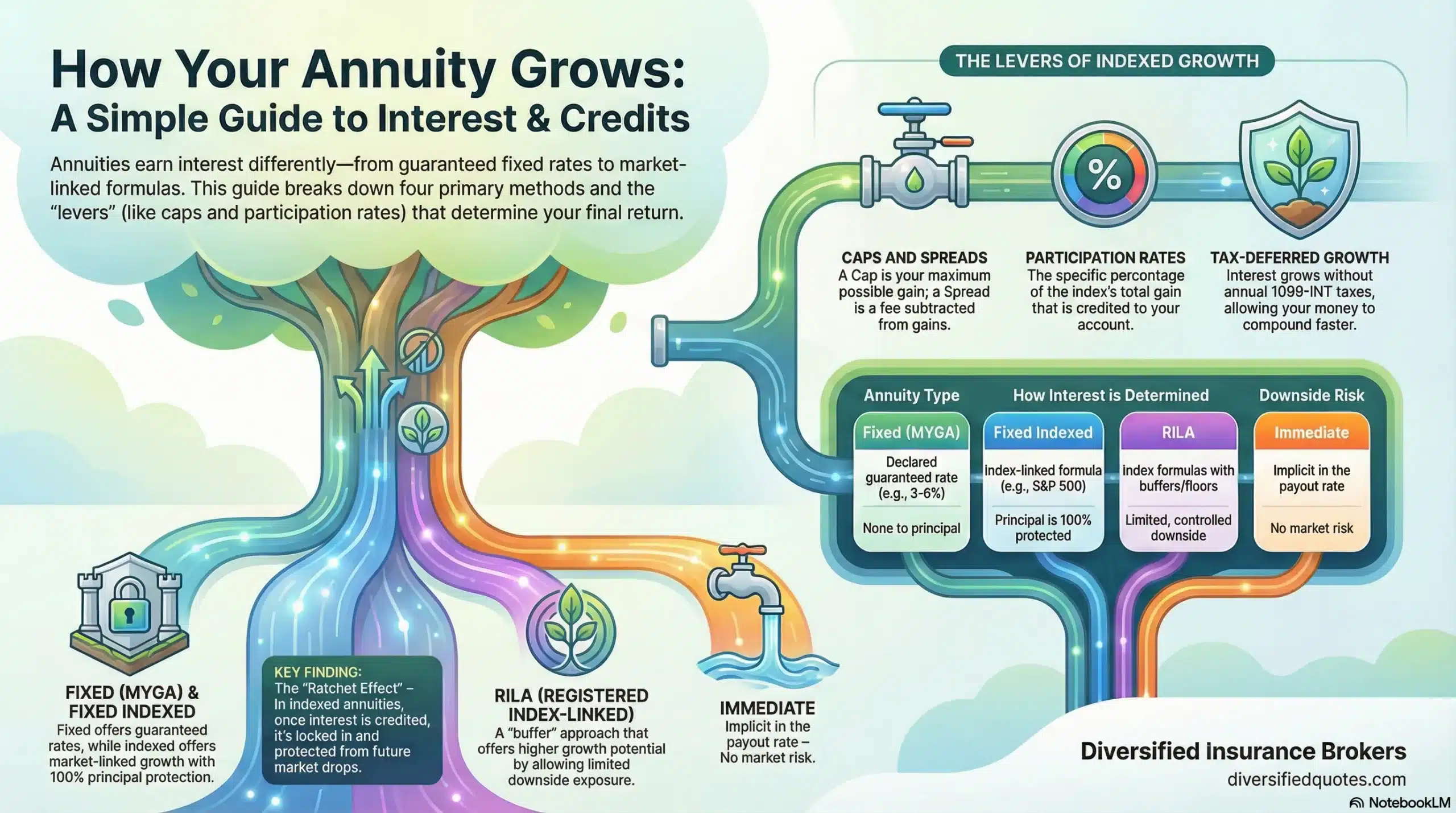
In a fixed indexed annuity, “fixed” means your principal will not decline due to stock market losses. It does not mean the interest rate is permanently set. Unlike traditional fixed annuities, where the interest rate is declared upfront for a guaranteed period, indexed annuities link potential growth to an external index such as the S&P 500. However, you are not directly invested in the market. Instead, the insurance company uses a formula—often involving caps, spreads, or participation rates—to determine how much of the index performance is credited to your contract.
Some of those crediting components may be adjustable annually. Others may be guaranteed for the entire surrender period. That structural difference is what drives the confusion around whether fixed indexed annuity rates change.
The Two Core Rate Structures in Fixed Indexed Annuities
Broadly speaking, fixed indexed annuities fall into two categories. The first includes products with adjustable annual crediting terms. These contracts allow the insurance carrier to modify caps, spreads, or participation percentages once per policy year. Adjustments are influenced by prevailing interest rates, options pricing, and overall hedging costs. The second category includes products that guarantee specific crediting terms for the full surrender charge period. If the surrender schedule lasts seven or ten years, the guaranteed terms cannot be reduced during that timeframe.
Neither structure is inherently superior. The better choice depends on whether you prioritize adaptability or predictability. Adjustable designs can potentially improve in rising interest-rate environments. Guaranteed structures provide stability and planning clarity.
How Adjustable Crediting Terms Work in Practice
With adjustable structures, the insurance company reviews economic conditions at each policy anniversary. Suppose a contract offers a 7% cap in year one. In year two, that cap may increase, decrease, or remain unchanged depending on interest rates and market conditions. The contract does include minimum guarantees, but those minimums are often lower than the initial illustrated rate. This means your long-term growth experience depends partly on future pricing decisions.
For investors with longer time horizons and moderate flexibility in income timing, this structure may be perfectly acceptable. In fact, in higher interest-rate environments, adjustable caps can become more attractive. However, if you are using the annuity to support a defined retirement start date, variability can complicate planning assumptions.
Guaranteed Crediting Structures and Planning Stability
Guaranteed-rate fixed indexed annuities remove that annual uncertainty. Specific participation rates, hybrid allocations, or fixed-interest buckets may be locked in for the full surrender period. This allows for more consistent modeling when using income riders or planning deferred lifetime payouts. Individuals who are approaching retirement and need predictable projections often gravitate toward these designs.
Many retirees compare guaranteed indexed structures with traditional fixed annuities such as those listed on our Best MYGA Annuity Rates page. Multi-year guaranteed annuities lock in a declared rate for a set term with no index-based variability, which appeals to highly conservative investors.
Compare Guaranteed Fixed Annuity Rates
See today’s multi-year guaranteed annuity rates with no market linkage and no annual cap adjustments.
View Fixed RatesWhy Interest Rates Influence Indexed Annuity Caps
Insurance companies hedge fixed indexed annuities using interest-rate-sensitive instruments. When broader interest rates rise, hedging costs relative to yield decline, allowing carriers to offer more competitive caps or participation rates. When rates fall, the opposite occurs. Adjustable designs give insurers the flexibility to manage this dynamic environment responsibly. Guaranteed designs transfer more risk to the carrier, which is why initial guaranteed terms may appear slightly more conservative.
This is also why reviewing Current Annuity Rates regularly is important. Interest-rate cycles can influence both fixed and indexed product competitiveness.
Impact on Retirement Income Planning
When fixed indexed annuities are paired with guaranteed lifetime withdrawal benefits, accumulation performance affects the income base but does not override the payout percentage once income begins. In other words, variability during the accumulation phase influences growth but does not eliminate contractual income guarantees once activated. Understanding how rate behavior affects pre-income growth helps set realistic expectations for future withdrawals.
Lifetime Income Calculator
Model how premium size, age, and rider structure translate into guaranteed lifetime income.
Clear Comparison of Adjustable vs Guaranteed FIA Designs
| Feature | Adjustable Structure | Guaranteed Structure |
|---|---|---|
| Cap / Participation Rate | May change annually | Locked for surrender period |
| Interest Rate Sensitivity | High | Minimal during guarantee term |
| Growth Predictability | Variable | Stable and contract-defined |
| Best For | Flexible long-term accumulation | Defined retirement timelines |
Where Bonus Annuities Fit Into the Conversation
Bonus indexed annuities provide an upfront premium enhancement that increases the starting account value used for income calculations. While their caps may still be adjustable, the bonus can create early leverage for lifetime income bases. Investors comparing structures often review Highest Bonus FIA Rates to determine whether upfront leverage offsets potential future rate variability.
Explore Bonus Annuity Options
Compare premium bonuses and income rider leverage across top-rated carriers.
View Bonus RatesRelated Pages
Financial Protection Essentials
Specialized underwriting guidance, Medicare planning resources, travel medical protection, and lawsuit funding education.
Talk With an Advisor Today
Choose how you’d like to connect—call or message us, then book a time that works for you.
Schedule here:
calendly.com/jason-dibcompanies/diversified-quotes
Licensed in all 50 states • Fiduciary, family-owned since 1980
FAQs: Do Fixed Indexed Annuity Rates Change?
Do fixed indexed annuity rates change every year?
Some fixed indexed annuities use annually adjustable crediting terms, meaning caps, participation rates, or spreads may change each policy year. Other fixed indexed annuities offer contractually guaranteed rates that do not change during the surrender charge period.
What parts of a fixed indexed annuity rate can change?
Depending on the contract, the insurance company may adjust index caps, participation rates, or spreads. These changes typically occur at policy anniversary and apply prospectively, not retroactively.
Are there fixed indexed annuities with guaranteed rates?
Yes. Some fixed indexed annuities guarantee specific crediting terms—such as participation rates or fixed interest options—for the entire surrender charge period. These rates cannot be reduced by the insurer during that time.
Why do insurance companies change indexed annuity rates?
Crediting rates are influenced by interest rates, options pricing, and hedging costs. When interest rates rise, insurers may offer higher caps or participation rates. When rates fall, crediting terms may be reduced on adjustable products.
Does a rate change affect my existing account value?
No. Rate changes only apply to future interest crediting. Once interest is credited to your account, it is locked in and cannot be taken away due to market performance or rate changes.
How do guaranteed-rate FIAs compare to fixed annuities?
Guaranteed-rate fixed indexed annuities share similarities with fixed annuities, such as predictable growth during the surrender period. However, FIAs still link interest crediting to an index rather than a declared fixed rate.
Do fixed indexed annuity income riders change?
Income rider growth rates and payout factors may be guaranteed or adjustable depending on the contract. Many income riders offer guaranteed roll-up rates or payout percentages once income begins, even if accumulation crediting rates vary.
What happens to rates after the surrender period ends?
After the surrender period, guaranteed terms may expire and renewal rates apply. At that point, policyholders often reassess whether to keep the annuity, begin income withdrawals, or reposition assets.
Which is better: adjustable or guaranteed FIA rates?
Neither is universally better. Adjustable-rate FIAs may offer more upside potential over time, while guaranteed-rate FIAs provide predictability and planning certainty. The right choice depends on income needs, risk tolerance, and time horizon.
Can fixed indexed annuities ever lose value due to rate changes?
No. Fixed indexed annuities protect principal from market losses. Even if future rates are reduced, your account value cannot decline due to market performance.
About the Author:
Jason Stolz, CLTC, CRPC and Chief Underwriter at Diversified Insurance Brokers (NPN 20471358), is a senior insurance and retirement professional with more than two decades of real-world experience helping individuals, families, and business owners protect their income, assets, and long-term financial stability. As a long-time partner of the nationally licensed independent agency Diversified Insurance Brokers, Jason provides trusted guidance across multiple specialties—including fixed and indexed annuities, long-term care planning, personal and business disability insurance, life insurance solutions, Group Health, and short-term health coverage. Diversified Insurance Brokers maintains active contracts with over 100 highly rated insurance carriers, ensuring clients have access to a broad and competitive marketplace.
His practical, education-first approach has earned recognition in publications such as VoyageATL, highlighting his commitment to financial clarity and client-focused planning. Drawing on deep product knowledge and years of hands-on field experience, Jason helps clients evaluate carriers, compare strategies, and build retirement and protection plans that are both secure and cost-efficient. Visitors who want to explore current annuity rates and compare options across multiple insurers can also use this annuity quote and comparison tool.
