
How Fixed Annuities Help Protect Against Market Volatility
Market volatility can be stressful—especially when you’re close to or already in retirement. Watching your account balance swing up and down makes it difficult to plan around a steady monthly income. When the market drops 15%, 20%, or even 30%, it’s not just a number on a statement—it directly impacts how much you feel comfortable spending. For retirees who no longer have a paycheck to replenish losses, volatility creates uncertainty at exactly the stage of life when stability matters most. That’s where fixed annuities can play a powerful role. They provide a guaranteed interest rate for a set period, along with protection from market losses, so you always know what you’ll earn and what you’ll have available for future income. Instead of wondering what the market will do next quarter, you can rely on contractual guarantees backed by the financial strength of an insurance carrier.

At Diversified Insurance Brokers, we work with retirees and pre-retirees who want to protect their savings without completely giving up growth potential. Fixed annuities often serve as the “safe money” foundation of a retirement income plan—complementing market-oriented assets such as 401(k)s, IRAs, and brokerage accounts. Rather than viewing annuities as replacements for traditional investments, we help clients integrate them strategically. If you’re still learning the fundamentals, our Annuities 101 overview explains the core structures and terminology in clear, straightforward language.
Current Fixed Annuity Rates
Review today’s most competitive fixed annuity rates from top-rated carriers.
Current Bonus Annuity Rates
Compare today’s leading annuities offering attractive upfront bonuses.
Request a Personalized Quote
Tell us your age, state, and goals—we’ll shop multiple carriers for you.
A fixed annuity is an insurance contract in which you deposit a lump sum or series of payments in exchange for a guaranteed interest rate over a specified term—often three, five, seven, or ten years. During that guarantee period, your principal is protected from market losses. If the stock market declines, your fixed annuity does not lose value due to those fluctuations. In many cases, retirees compare fixed annuities to CDs, but annuities offer tax-deferred growth and the option to convert accumulated value into predictable income streams. If lifetime income is important to you, reviewing how annuities pay income for life can clarify how these guarantees function.
One of the biggest hidden dangers in retirement planning is sequence-of-returns risk—the risk that early market losses combined with withdrawals permanently reduce your portfolio’s sustainability. Even if long-term averages look reasonable, a sharp downturn in the first five years of retirement can dramatically change outcomes. Fixed annuities help mitigate this risk by carving out a portion of your savings that is insulated from volatility. That protected pool can serve as an income buffer, allowing market-based assets time to recover. Many clients also review how Social Security and annuities work together to understand how layering guaranteed sources can create a stronger income floor.
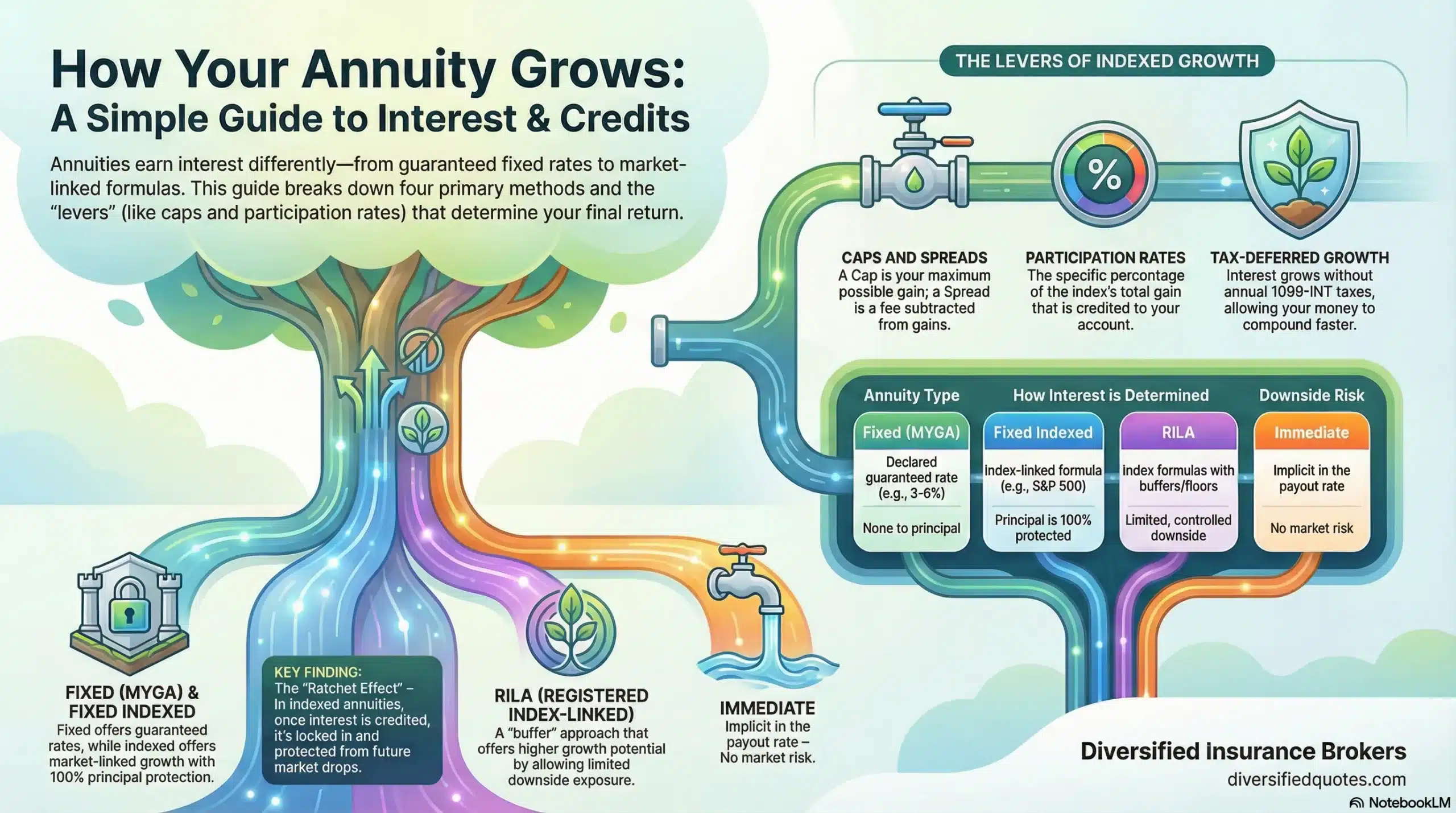
Interest crediting inside fixed annuities is straightforward: the carrier declares a rate that applies for the guarantee term. Unlike bonds or CDs that may require annual reinvestment at uncertain rates, multi-year guaranteed annuities (MYGAs) lock in the rate for the full term. To understand how compounding impacts long-term growth, our page on simple vs. compound interest annuities provides additional clarity. Over several years, compounded interest—combined with tax deferral—can meaningfully increase accumulation compared to taxable alternatives.
Liquidity is another common concern. Most fixed annuities include annual free withdrawal provisions, often allowing up to 10% of the account value to be accessed without surrender charges. Understanding these provisions is critical, which is why we recommend reviewing annuity free withdrawal rules before purchasing. Matching the annuity term to your anticipated cash flow needs helps ensure flexibility while preserving guarantees.
Some investors consider fixed indexed annuities as an alternative during volatile periods. While fixed annuities offer a set interest rate, indexed annuities credit interest based on index performance, subject to caps or participation rates, while still protecting principal from losses. If you’re evaluating this structure, our explanation of how a fixed indexed annuity works can help you compare features objectively. In many retirement plans, a blend of fixed and indexed annuities can balance safety and upside potential.
See How Much Guaranteed Income Your Annuity Can Provide
Use our Lifetime Income Calculator to estimate future income based on your age, deposit amount, and target start date.
Protect Your Retirement From Market Volatility
We’ll compare fixed annuities across dozens of carriers and design a strategy that fits your risk tolerance, income needs, and time horizon.
Related Pages
Financial Protection Essentials
Explore annuity interest examples and retirement planning insights to understand how different investment sizes can affect income potential.
Talk With an Advisor Today
Choose how you’d like to connect—call or message us, then book a time that works for you.
Schedule here:
calendly.com/jason-dibcompanies/diversified-quotes
Licensed in all 50 states • Fiduciary, family-owned since 1980
FAQs: How Fixed Annuities Help Protect Against Market Volatility
How does a fixed annuity protect my money from market losses?
With a traditional fixed annuity, your principal and credited interest are not tied directly to stock or bond market performance. As long as you follow the contract terms, market downturns do not reduce your annuity value, which is why many retirees use fixed annuities as a safe, stable portion of their plan.
Are fixed annuities a good replacement for bonds or CDs?
They can be, depending on your goals. Fixed annuities often offer competitive yields versus CDs or certain bonds, with tax-deferred growth and options for future lifetime income. CDs may have more liquidity and FDIC insurance, while annuities are backed by the insurer’s claims-paying ability. Many retirees use a mix rather than an all-or-nothing choice.
Will I lose access to my money if I use a fixed annuity?
Most fixed annuities include some level of penalty-free withdrawals each year, but they also have surrender schedules that limit larger withdrawals in the early years. It’s important to keep adequate cash and liquid savings outside the annuity so you’re not forced to take large withdrawals during the surrender period.
How long should I lock in a fixed annuity rate?
Common guarantee periods range from 3 to 10 years. Shorter terms provide flexibility if rates rise, while longer terms can offer higher guaranteed rates. Many clients ladder multiple terms so that some money becomes available more frequently while still benefiting from longer guarantees on a portion of their savings.
Can I turn a fixed annuity into lifetime income later?
Yes. At the end of the guarantee period, many fixed annuities can be annuitized or rolled into income-focused contracts that pay guaranteed income for life. Some people also transfer values into other annuities designed specifically for retirement income when they’re ready to begin withdrawals.
Are there fees associated with fixed annuities?
Traditional fixed annuities typically do not show explicit annual fees the way investment accounts do. Instead, the insurer earns a spread between what they earn on their portfolio and the rate they credit to you. Optional riders, early withdrawals, or certain features can involve costs, which we review before you commit.
Is a fixed annuity right for all of my retirement savings?
Usually not. Fixed annuities are best used for the portion of your savings earmarked for safety and predictable income. Most retirees keep a balanced mix that includes growth-oriented investments, guaranteed income sources, and conservative assets like fixed annuities so they’re prepared for both volatility and inflation.
How do I choose the right fixed annuity for my situation?
The right choice depends on your age, time horizon, risk tolerance, tax situation, and income goals. We compare multiple carriers and products, review surrender schedules and withdrawal rules, and then design a solution that aligns with your broader retirement plan rather than focusing on rate alone.
Disclaimer: This information is for educational purposes only and is not tax, legal, or investment advice. Consult your own professionals before making decisions.
About the Author:
Jason Stolz, CLTC, CRPC and Chief Underwriter at Diversified Insurance Brokers (NPN 20471358), is a senior insurance and retirement professional with more than two decades of real-world experience helping individuals, families, and business owners protect their income, assets, and long-term financial stability. As a long-time partner of the nationally licensed independent agency Diversified Insurance Brokers, Jason provides trusted guidance across multiple specialties—including fixed and indexed annuities, long-term care planning, personal and business disability insurance, life insurance solutions, and short-term health coverage. Diversified Insurance Brokers maintains active contracts with over 100 highly rated insurance carriers, ensuring clients have access to a broad and competitive marketplace.
His practical, education-first approach has earned recognition in publications such as VoyageATL, highlighting his commitment to financial clarity and client-focused planning. Drawing on deep product knowledge and years of hands-on field experience, Jason helps clients evaluate carriers, compare strategies, and build retirement and protection plans that are both secure and cost-efficient. Visitors who want to explore current annuity rates and compare options across multiple insurers can also use this annuity quote and comparison tool.
