
How to Choose the Right Annuity Based on Your Retirement Timeline
When it comes to retirement planning, timing influences nearly every financial decision you make. The age you retire, when you turn on income, how much market risk you can tolerate, and how much guaranteed income you want all shape the type of annuity strategy that may fit your situation. The annuity you choose should never exist in isolation. It should reflect your retirement horizon, your income start expectations, your need for liquidity, and your overall comfort with market volatility. A well-designed annuity strategy is not about chasing the highest advertised rate or the largest upfront bonus. It is about aligning guarantees, growth potential, and flexibility with the stage of life you are actually in.

At Diversified Insurance Brokers, we work with clients nationwide to match annuity structures to real-world retirement timelines. Some clients are months away from retirement and need income predictability immediately. Others are ten or fifteen years away and want tax-deferred accumulation with downside protection. Others still want to build future income streams today that they may not turn on for a decade or more. The right annuity solution depends less on product marketing language and more on how income, guarantees, and liquidity work together inside the contract design.
One of the biggest mistakes investors make is choosing an annuity based purely on one feature — like the highest rate, the highest bonus, or the longest guarantee period — without understanding how that feature interacts with surrender schedules, income rider costs, crediting strategies, or withdrawal provisions. The strongest retirement income plans are built by evaluating multiple annuity structures side-by-side and understanding how each performs across different retirement scenarios. This is especially important because annuities are designed to be long-term planning tools, not short-term trading vehicles.
Understanding Retirement Horizon and Income Timing
Your retirement horizon is simply the amount of time between today and when you expect to rely on retirement income. But within that simple definition sits a much more complex planning conversation. Some retirees want income immediately when they retire. Others want income later to coordinate with Social Security or pension income. Others want annuities to act as longevity insurance, meaning income may not start until their late 70s or early 80s. Each of these goals can point toward a different annuity design, even if the investor is the same age.
For example, someone retiring in two years may prioritize principal protection and guaranteed income predictability. Someone retiring in eight years may prioritize tax-deferred growth and flexibility. Someone retiring in fifteen years may prioritize long-term income base growth if they are building a future guaranteed income stream. The timeline does not just influence the type of annuity selected. It influences whether an income rider makes sense, how long of a surrender schedule may be acceptable, and whether growth potential or income guarantees should be prioritized.
Short-Term Retirement Horizon (0–5 Years)
If you are approaching retirement soon, income certainty typically becomes the dominant goal. Investors in this stage are often less concerned about maximizing market-linked upside and more focused on knowing exactly what their retirement income will look like. Fixed annuities can be attractive in this stage because they provide defined interest rates and principal protection. Multi-year guaranteed annuities (MYGAs) can provide rate lock guarantees for defined time periods, helping protect against falling interest rate environments.
For retirees who need income immediately, single premium immediate annuities (SPIAs) can convert a lump sum premium into guaranteed lifetime income payments. This can be particularly helpful for retirees who want to create a pension-like income stream that cannot be outlived. The key advantage of immediate annuities is income predictability. The tradeoff is reduced liquidity once income begins.
At this stage, liquidity and withdrawal provisions matter significantly. Many near-retirees want penalty-free withdrawal flexibility while still earning competitive rates. Others prioritize maximizing guaranteed income even if liquidity is somewhat reduced. There is no universal answer. The correct choice depends on the retiree’s broader financial plan, emergency savings, and other income sources.
Mid-Term Retirement Horizon (5–10 Years)
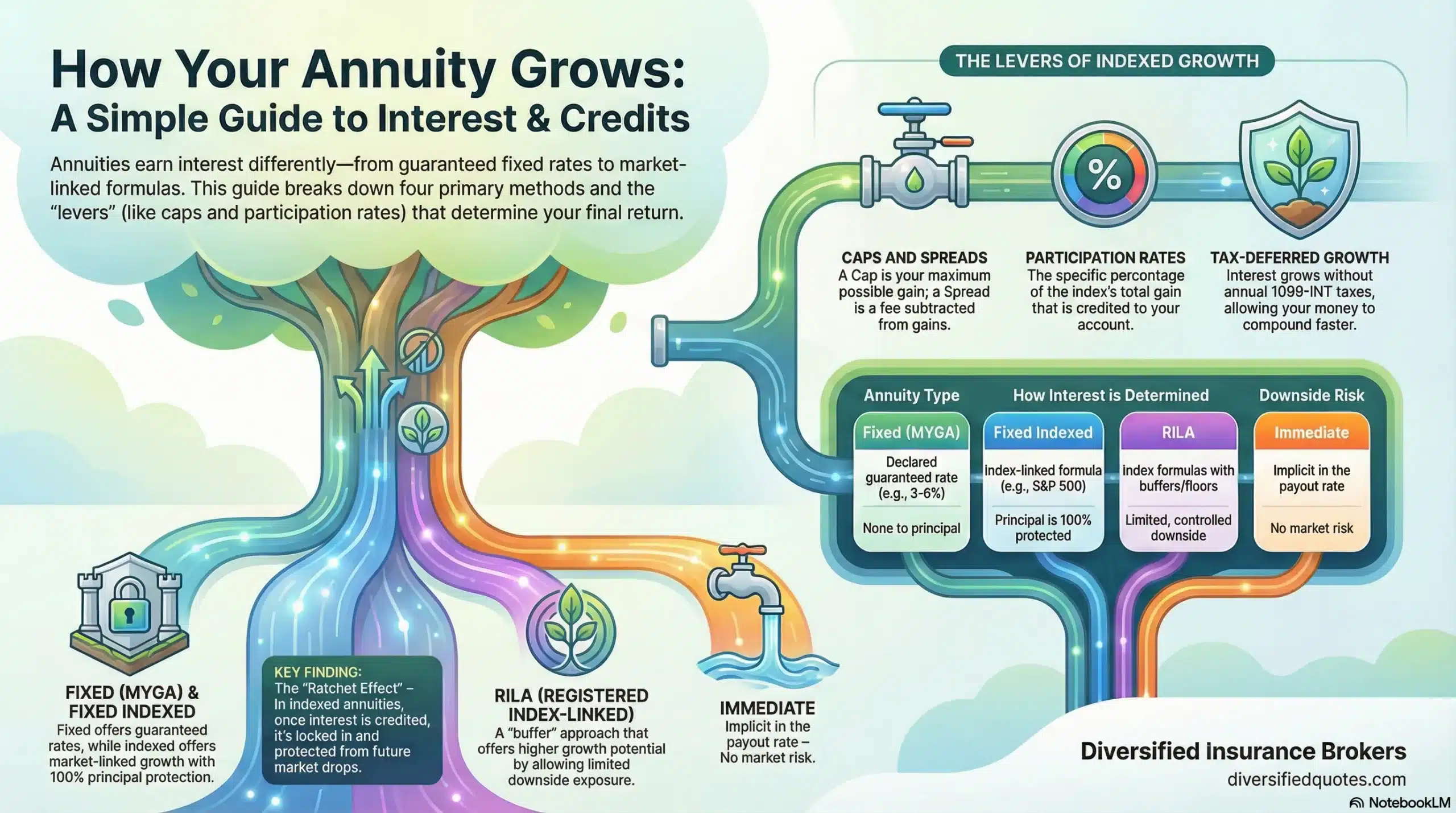
Investors who are still several years away from retirement often want a balance between safety and growth. In this stage, fixed indexed annuities can become more attractive because they offer principal protection with the potential for higher credited interest based on index performance. Indexed annuities do not directly invest in the market. Instead, they use crediting strategies tied to external indexes to determine interest credits.
Income riders may also become relevant in this stage. These optional features can allow income bases to grow at defined rates, creating higher future lifetime income potential. For investors who are not yet ready to turn income on but want to secure future guaranteed income potential, these riders can be valuable planning tools.
Mid-term investors also need to consider interest rate cycles. Locking in fixed rates during strong rate environments can be beneficial. Conversely, indexed annuities can provide flexibility if rates change or if markets perform well during accumulation periods. The correct strategy often involves balancing multiple annuity types rather than relying on a single contract design.
Long-Term Retirement Horizon (10+ Years)
Long-term retirement planning shifts the conversation toward future income building. Investors with long horizons often want growth potential combined with future income guarantees. Indexed annuities with income riders can be particularly powerful for this goal because they can build income bases over time while protecting principal from market losses.
In some cases, investors may also evaluate variable annuities if they are comfortable with market risk and want long-term market participation. However, variable annuities introduce investment risk and often include higher fee structures. The decision to use variable annuities should always be evaluated carefully against risk tolerance and retirement income goals.
For long-term planners, the biggest advantage of annuities is income certainty. Knowing that a portion of retirement income is guaranteed regardless of market conditions can allow other assets to be invested more aggressively if appropriate.
Ensure you are receiving the absolute top rates
Compare today’s leading annuity options and see how bonuses, rates, and income features stack up.
Current Fixed Annuity Rates
Review competitive fixed annuity rates designed for principal protection and predictable growth.
Current Bonus Annuity Rates
Compare bonus annuity options and evaluate long-term income impact.
Request an Annuity Quote
Receive personalized annuity illustrations tailored to your retirement timeline.
Lifetime Income Calculator
Estimate how much guaranteed income an annuity could provide based on your premium, age, and income start date.
💡 Note: The calculator accepts premiums up to $2,000,000. If you’re investing more, results increase in direct proportion.
Related Planning Resources
Explore additional retirement, annuity, and insurance planning strategies.
Financial Protection Essentials
Explore annuity interest examples and retirement planning insights to understand how different investment sizes can affect income potential.
Talk With an Advisor Today
Choose how you’d like to connect—call or message us, then book a time that works for you.
Schedule here:
calendly.com/jason-dibcompanies/diversified-quotes
Licensed in all 50 states • Fiduciary, family-owned since 1980
FAQs: Choose the Right Annuity for Different Retirement Horizons
What does “retirement horizon” mean when choosing an annuity?
Your retirement horizon refers to how far away retirement is and how long you expect income to last. It includes both the time until you begin taking income and the expected duration of retirement, which directly affects the type of annuity that may be appropriate.
Which annuities work best for retirees nearing retirement?
For those within a few years of retirement, fixed or fixed indexed annuities with income riders or immediate annuities are often used. These prioritize income stability and predictable cash flow over long-term accumulation.
What annuity types are better for longer retirement timelines?
People with longer horizons before retirement may favor deferred fixed indexed annuities focused on accumulation. These allow assets to grow with downside protection and can later be converted into income when retirement begins.
How do short-term retirement needs affect annuity selection?
If income is needed soon, liquidity, surrender periods, and payout start dates matter more than growth potential. Shorter-term annuities or immediate income annuities may better align with near-term needs.
Can annuities be layered for different retirement phases?
Yes. Many retirees use multiple annuities to cover different phases—one for early retirement income, another for later-life income, and others for long-term accumulation or legacy planning.
How does longevity risk influence annuity choice?
Longevity risk—the risk of outliving savings—becomes more important with longer retirement horizons. Lifetime income annuities help address this by guaranteeing income for as long as you live.
Are annuities flexible enough if retirement plans change?
Some annuities offer flexibility through optional riders, deferral choices, or partial withdrawals. However, surrender charges and contract terms should be reviewed carefully to ensure they align with evolving retirement timelines.
How do I match an annuity to my personal retirement horizon?
Matching an annuity to your horizon requires evaluating when you need income, how long it must last, risk tolerance, and other income sources. A side-by-side comparison of annuity types can help determine the best fit for each stage of retirement.
About the Author:
Jason Stolz, CLTC, CRPC and Chief Underwriter at Diversified Insurance Brokers (NPN 20471358), is a senior insurance and retirement professional with more than two decades of real-world experience helping individuals, families, and business owners protect their income, assets, and long-term financial stability. As a long-time partner of the nationally licensed independent agency Diversified Insurance Brokers, Jason provides trusted guidance across multiple specialties—including fixed and indexed annuities, long-term care planning, personal and business disability insurance, life insurance solutions, Group Health, and short-term health coverage. Diversified Insurance Brokers maintains active contracts with over 100 highly rated insurance carriers, ensuring clients have access to a broad and competitive marketplace.
His practical, education-first approach has earned recognition in publications such as VoyageATL, highlighting his commitment to financial clarity and client-focused planning. Drawing on deep product knowledge and years of hands-on field experience, Jason helps clients evaluate carriers, compare strategies, and build retirement and protection plans that are both secure and cost-efficient. Visitors who want to explore current annuity rates and compare options across multiple insurers can also use this annuity quote and comparison tool.
