
Life Insurance for Parkinson’s

Jason Stolz CLTC, CRPC
Life insurance with Parkinson’s disease is still possible, and for many people, it’s more achievable than they expect—especially when the diagnosis is early-stage, symptoms are stable, and daily function remains strong. At Diversified Insurance Brokers, we help clients with Parkinson’s secure coverage through our network of 100+ top-rated carriers. The goal isn’t just to find “a policy that exists.” The goal is to find a carrier that will review your case fairly, classify you appropriately, and avoid unnecessary ratings that inflate premiums long-term.
Parkinson’s can create confusion in underwriting because it’s a diagnosis with a wide range of severity. Two people can both have Parkinson’s and be in completely different places clinically. One person might have mild tremors and minimal medication, while another may have balance issues, falls, swallowing problems, and cognitive changes. Life insurance companies are not simply looking for a “yes/no” answer on Parkinson’s—they’re trying to measure the likelihood of progression, complications, and changes in independence over the life of the policy.
This is where an experienced agency makes the biggest difference. Parkinson’s cases tend to be mishandled when they’re submitted to the wrong carrier, when the application answers are vague, or when the underwriting timeline highlights the wrong information. Our job is to build your file correctly, select the right underwriting path, and shop the case strategically so you don’t waste time on companies that are almost guaranteed to decline or over-rate you.
Because we focus heavily on medically complex and “non-standard” underwriting situations, we regularly help clients who have been told no elsewhere. If you were quoted an expensive plan or declined, it doesn’t automatically mean you’re out of options. It usually means the carrier wasn’t a fit, the timing wasn’t right, or the case wasn’t presented in the strongest possible way.
Get a Personalized Parkinson’s Life Insurance Quote
We’ll compare carriers, review your Parkinson’s history, and map the best path to approval—without wasting time on the wrong companies.
Request InformationBefore you apply, it helps to understand how carriers approach neurological diagnoses. Parkinson’s is typically evaluated as a progressive condition, which means underwriting isn’t only focused on where you are today—it’s also focused on where your medical record suggests the condition may be headed over time. That sounds intimidating, but it’s not automatically negative. Plenty of applicants have slow progression, strong compliance, and stable treatment, and insurers do recognize that difference.
This page will walk you through how life insurance companies review Parkinson’s disease, what factors matter most, which policy types tend to be realistic, and how to position your application for the best possible outcome. If you want to skip the learning curve, you can request a quote above and we’ll guide you through a practical, carrier-specific approach based on your age, stage, symptoms, and full health profile.
Life Insurance Quoter
Want to see baseline term life pricing first? Compare options instantly here, then we’ll tailor the best carrier choice to your Parkinson’s history.
Can You Get Life Insurance If You Have Parkinson’s Disease?
Yes—many people with Parkinson’s disease can still get life insurance. The biggest factor is that Parkinson’s is not treated as a single “category” of risk. Underwriters are evaluating severity, stability, current function, and medical follow-up. In early-stage Parkinson’s, especially when symptoms are well-managed and independence remains high, traditional coverage may still be possible. In later stages, the options can narrow, but there are still typically workable paths—including simplified issue and guaranteed issue coverage.
One mistake many applicants make is assuming the diagnosis automatically equals a decline. That’s not how underwriting works. Life insurance companies build decisions on patterns. They want to understand how long you’ve had Parkinson’s, whether symptoms are stable or progressing quickly, what medications you need, how often you see neurology, and whether there are complications that signal increasing health risk.
For many Parkinson’s clients, the real question isn’t “Can I get approved?”—it’s “What type of policy can I realistically qualify for at a reasonable cost?” The answer depends on the underwriting approach, the carrier selection, and the accuracy of how the medical history is explained and documented.
If you’re exploring this topic because you have other health factors in your file as well, it can also help to review how insurers handle layered medical risk in general. Our guide on life insurance with pre-existing conditions explains why carrier selection matters so much, especially when more than one condition is being evaluated at the same time.
How Parkinson’s Disease Affects Life Insurance Underwriting
Parkinson’s affects life insurance underwriting because it is considered a neurological disease with the potential to impact mobility, independence, swallowing, cognition, and overall health outcomes over time. Underwriters aren’t only assessing current symptoms. They are also trying to measure the probability that the condition could lead to serious complications later—such as recurrent falls, aspiration pneumonia, dementia, or the need for significant assistance with daily living.
That said, Parkinson’s is also a condition that many people live with for years while remaining functional, active, and medically stable. Underwriting outcomes often come down to documentation and timing. A client with strong neurology notes showing stable symptoms and responsible follow-up is typically treated much differently than a client with recent ER visits, frequent falls, or unclear changes in function.
This also explains why online quoting can be misleading. A quote engine may show an attractive number, but it assumes the best possible underwriting class. Parkinson’s almost always triggers follow-up underwriting questions, and the final offer can be higher or lower depending on how the case is ultimately classified. Our job is to bridge the gap between “online quote” and “real underwriting approval.”
We also see Parkinson’s underwriting outcomes change depending on the overall health profile of the client. When Parkinson’s is the primary concern and everything else is strong—non-smoker, good build, stable blood pressure, solid labs, consistent medical care—the case is typically easier. When Parkinson’s overlaps with additional major health issues, the carrier list narrows and the product strategy becomes more important.
What Parkinson’s Details Matter Most to Life Insurance Companies?
Life insurance underwriting for Parkinson’s disease usually focuses on the same core areas because these details help underwriters measure current risk and future progression. The clearer you are on these points, the more confident the carrier can be in assessing your case. When those answers are vague or incomplete, underwriting tends to default to conservative assumptions, which can drive premiums up or create delays.
Diagnosis timing and age at onset often matter because earlier onset can be associated with longer disease duration and a different progression timeline. Underwriters typically want to know when you were diagnosed, what symptoms led to diagnosis, and whether the diagnosis is firmly established. A diagnosis that was made years ago with steady symptoms can sometimes look more stable than a brand-new diagnosis that has not yet shown a consistent treatment response.
Stage and progression pattern is another key area. Parkinson’s is often described as early-stage, moderate, or advanced, but underwriters also pay attention to what that means practically. Are symptoms controlled with medication? Are they worsening quickly? Is the neurologist documenting stability? If progression is slow and the applicant is still active and independent, underwriting outcomes are typically better.
Daily function and independence is one of the biggest drivers in Parkinson’s underwriting. Carriers often want to understand whether you can dress yourself, bathe, prepare meals, drive, manage medications, and handle daily activities without assistance. The more support required, the more likely underwriting is to view the case as higher risk. A stable client with mild tremor who is fully independent is viewed very differently than a client with frequent falls and assistance needs.
Falls, balance issues, and injuries matter because falls can signal an increased risk of major injury and complications. Underwriters may ask about fall frequency, severity, and whether there have been fractures or hospitalizations. One isolated fall may not be a major underwriting issue. A pattern of falls, especially recent falls, can change carrier options quickly.
Swallowing issues and aspiration risk are another important factor. Difficulty swallowing can increase the risk of aspiration and pneumonia. Underwriters may review ENT notes, speech therapy notes, and neurology records for any documentation of choking, swallowing evaluation, or recurrent respiratory infection history.
Cognitive changes can also influence underwriting outcomes. Parkinson’s can be associated with cognitive impairment in some cases. Insurers may ask about memory issues, diagnosis of dementia, caregiver support, and medication management. Even mild documented cognitive concerns can shift which policy types are realistic.
Medication history and stability is reviewed closely. Underwriters look at which medications are being used, how long you’ve been on them, whether doses are escalating rapidly, and whether symptoms are stable on current treatment. A stable medication routine is usually viewed more favorably than frequent changes or increasing dosages due to uncontrolled symptoms.
Deep brain stimulation (DBS) is not automatically disqualifying. Underwriters generally look at the date of implantation, whether it improved symptoms, and whether there were complications. Some carriers can be cautious with surgical interventions, but stable outcomes can support a more practical underwriting interpretation.
Because Parkinson’s is not the only medical factor insurers consider, the overall file matters. Build, cardiovascular profile, smoking history, diabetes risk, and other chronic conditions can all affect the final classification. That’s why many Parkinson’s applicants benefit from working with a broker that understands the full underwriting picture rather than just one condition in isolation.
Parkinson’s “Red Flags” That Trigger Higher Premiums or Limited Options
Most Parkinson’s cases are not automatically declined, but certain patterns tend to cause underwriting problems. These “red flags” don’t necessarily eliminate coverage, but they typically push the case into rated pricing or simplify the available product types. Knowing these ahead of time helps you set realistic expectations and avoid wasting time applying to the wrong carriers.
Frequent falls or recent injuries are one of the biggest issues. Falls suggest increased risk of severe injury, hospitalizations, and long-term decline. If your medical record shows repeated falls, an underwriter may assume a higher risk profile even if you feel stable day to day.
Swallowing issues, choking episodes, or aspiration pneumonia can be a major underwriting concern because they point to respiratory complications. Even one documented aspiration event can lead to more cautious underwriting.
Use of mobility aids such as walkers, wheelchairs, or frequent assistance may indicate a higher stage of disease. Underwriters often interpret mobility aid use as a signal of reduced independence and increased risk.
Documented cognitive decline can shift the case toward limited options. The concern is not only increased mortality risk but also the insurer’s underwriting guidelines regarding decision-making capacity and long-term stability.
Hospitalizations related to Parkinson’s or complications may lead to postponements or higher ratings depending on recency. Most carriers view recent hospital events as a sign of active instability.
Comorbidities that stack risk can also impact results. Conditions like severe sleep apnea, smoking history, uncontrolled diabetes, or cardiac disease can make Parkinson’s underwriting more difficult. In these cases, carriers may rate for multiple factors, and product selection becomes even more important.
If your situation includes multiple significant medical issues, it may be helpful to review broader high-risk insurance planning topics. We see similar underwriting strategy needs in complex respiratory cases, including people shopping for life insurance for COPD, where stability and documentation heavily influence carrier outcomes.
How Life Insurance Medical Exams and Records Affect Parkinson’s Cases
Depending on your age, coverage amount, and the carrier you apply to, you may go through a fully underwritten process that includes a paramed exam, labs, and medical records review. In Parkinson’s cases, the medical record review is often the most important part of the underwriting file. Even if you feel your symptoms are mild, your neurologist’s notes, medication history, and functional documentation will heavily influence how the insurer evaluates your risk.
Some applicants assume the exam itself is the problem. In most Parkinson’s cases, the exam is less important than what your history shows. Underwriters rely on physician documentation to confirm stability, confirm independence, and identify any complications such as falls, swallowing issues, or cognitive concerns. If those appear in the file recently, underwriting will treat the case as active risk even if your day-to-day life feels steady.
It’s also common for Parkinson’s applicants to be asked detailed follow-up questions that would not appear for standard applicants. Carriers may request an attending physician statement from your neurologist, review neurology follow-ups, and ask for clarification on medications and progression. This is not necessarily a bad sign. It’s simply the carrier doing due diligence.
If you want to understand the exam process in general, we also break that down in our guide on what a life insurance exam is. Parkinson’s cases often require more record review than average, but when your documentation is consistent and stable, underwriting outcomes can still be very workable.
Why Different Carriers Treat Parkinson’s So Differently
One of the most frustrating realities for Parkinson’s applicants is that you can submit the same medical history to two different companies and get two very different outcomes. One carrier may decline while another may offer rated coverage. One company may only allow final expense coverage, while another may offer larger amounts with table ratings. This difference is not random. It happens because each carrier has its own underwriting philosophy, its own actuarial assumptions, and its own internal guidelines for progressive neurological conditions.
Some carriers are conservative on Parkinson’s because they view it as higher risk of progression and complication. Other carriers may have more flexible guidelines, particularly when the case is early-stage and stability is clearly documented. That’s why “shopping” Parkinson’s is not just about comparing price. It’s about comparing underwriting fit.
Another reason results vary is because Parkinson’s often interacts with other underwriting categories. For example, mild tremors may be less important than fall history. A person’s blood pressure, cholesterol profile, and overall build may matter more than the diagnosis label alone. Some carriers stack these risk factors aggressively, while others focus more on the primary diagnosis. Our job is to match your profile to the carriers most likely to treat the full picture fairly.
This is also why we don’t recommend applying blindly to whichever company shows the lowest online quote. Parkinson’s cases need strategy. The correct carrier match can be the difference between a workable offer and a wasted application.
Best Types of Life Insurance for People with Parkinson’s Disease
There isn’t one “best” policy type for Parkinson’s disease, because the right fit depends on your stage, stability, goals, and budget. The good news is that Parkinson’s doesn’t automatically force you into a last-resort policy, especially in early-stage or slow progression situations. Many applicants still have more than one path available, and your goal should be choosing the option that aligns with what you’re trying to accomplish financially.
Traditional term life insurance is usually the first option people ask about because it offers the highest coverage amounts for the lowest cost during a set period of time. For Parkinson’s, term life is sometimes available in early-stage cases with stable symptoms and strong independence, but not always. Underwriters often limit term options when the disease is more advanced or if there are significant complications.
Permanent life insurance such as whole life or universal life may be a fit when the goal is lifelong protection, final expense planning, or estate planning. Whole life policies can be attractive for predictable premiums and guaranteed death benefits, but underwriting availability depends heavily on severity and age.
Simplified issue life insurance is often a practical middle-ground for Parkinson’s applicants who want to avoid long underwriting timelines or who may not qualify for fully underwritten coverage. Simplified issue typically involves fewer health questions and may not require an exam. The tradeoff is that premiums can be higher, and maximum coverage amounts may be smaller.
Guaranteed issue life insurance is usually the fallback option when underwriting is likely to be difficult. These policies often have minimal health questions and no exam, but they typically come with lower face amounts and may include graded death benefits in the first years. For many clients in more advanced stages, guaranteed issue can still provide meaningful protection and peace of mind.
If your goal is smaller coverage amounts for final expenses, many clients also evaluate final expense-focused products and compare them with other options. Our burial insurance calculator can help you get a sense of pricing ranges for smaller policies that are often designed with simpler underwriting.
How Parkinson’s Can Affect Your Rate Class (Preferred vs Standard vs Table Ratings)
Life insurance pricing is based on underwriting class. Even when a policy is approved, the pricing can vary significantly depending on whether the carrier issues the policy as standard, rated (table), or in some cases a modified class. Parkinson’s disease typically prevents preferred classes in most carriers because it is categorized as a progressive neurological diagnosis. That doesn’t mean coverage is impossible. It simply means the pricing often reflects additional risk.
For early-stage Parkinson’s with minimal symptoms, stable medication, and strong function, some carriers may still offer standard or mild table ratings depending on age and overall health profile. For moderate Parkinson’s, rated coverage is more common. For advanced cases, simplified or guaranteed issue policies may be the realistic path rather than traditional rating structures.
It’s important to remember that table ratings are not “punishment.” They are simply how insurers price extra risk. The best strategy is to find the carrier that applies the most reasonable rating based on your actual stability and progression rather than choosing a company that overreacts to the diagnosis name alone.
Rate class is also affected by non-Parkinson’s factors. Tobacco use, elevated blood pressure, diabetes risk, and build all influence underwriting class. If you have multiple factors, carrier selection becomes even more important because some companies stack ratings aggressively while others are more balanced.
What If You’ve Been Declined for Life Insurance with Parkinson’s?
A decline can feel final, but it usually isn’t. Parkinson’s declines often happen because the carrier’s internal guidelines are strict, because the application was submitted to the wrong company, or because underwriting interpreted the case as unstable due to recent falls, hospitalization, or progression markers. Sometimes a decline is simply a timing issue—applying too soon after diagnosis or too soon after a medication change can trigger a conservative decision.
When we help clients who have been declined, we don’t just resubmit the same application and hope for a different result. We take a structured approach. We identify why the decline happened, determine which carriers are more Parkinson’s-friendly, and choose the underwriting path that matches the current stage. In some cases, that means aiming for rated traditional coverage. In other cases, it means focusing on simplified issue or guaranteed issue products for immediate protection.
Another important point is that not all declines are created equal. A decline for a fully underwritten term policy does not mean you cannot get any coverage at all. It simply means that particular product and underwriting path was not a fit. Often, there are still workable alternatives that provide meaningful protection even if they are not the original plan.
Parkinson’s applicants who were declined are often dealing with the same broader underwriting challenge we see in many complex cases: stability matters more than labels. This is also why people with other medical histories often benefit from reviewing condition-specific guidance. For example, the underwriting logic around stability and functional risk can overlap with other diagnoses, including life insurance for epilepsy and seizures, even though the condition itself is different.
What Improves Parkinson’s Life Insurance Approval Chances?
There are several practical factors that can improve your chances of approval for life insurance with Parkinson’s disease. Some of these are medical, and some are documentation-related. The key is presenting the most accurate and stable version of your history and avoiding avoidable underwriting confusion.
Consistent neurology follow-ups can help because it shows compliance and monitoring. Underwriters don’t want to see long gaps in care. Regular follow-up suggests the condition is being managed proactively and that progression is being tracked.
Stable medication routines often help because frequent medication changes can signal instability. Underwriters may view steady management as a positive sign, especially when notes indicate symptoms are controlled and daily function remains consistent.
No recent hospitalizations improves the file in many cases. A recent hospital event can create a postponement or shift the case into limited options. A longer period of stability since the last serious complication often supports more flexible underwriting decisions.
Low fall frequency is important. If you have had falls, the context matters. Occasional minor balance issues are different from recurrent falls requiring medical attention. Physical therapy participation, fall-prevention strategies, and stable mobility documentation can make a meaningful difference.
Clear documentation of independence can support a stronger underwriting narrative. Underwriters often want to know if you can handle activities of daily living without assistance. If your physician notes reflect strong independence, that can help avoid assumptions that you require significant support.
A strong overall health profile helps in nearly every case. Parkinson’s may be the primary condition, but carriers still consider the entire application. Good blood pressure control, favorable lab results, and no tobacco use can meaningfully improve the outcome.
In other words, “approval odds” are often less about trying to “game” underwriting and more about making sure the file reflects reality clearly and consistently. When your records show stability and compliance, carriers tend to make more practical decisions.
Realistic Example Scenarios (What Parkinson’s Cases Often Look Like)
Most clients want a real-world sense of what Parkinson’s life insurance outcomes typically look like. While every case is unique, there are common profiles that underwriters tend to evaluate in consistent ways.
Early-stage Parkinson’s with minimal symptoms. This often looks like a diagnosis within the last several years, mild tremors, stable medication, no falls, and strong independence. In this category, some carriers may consider traditional coverage, often with rated pricing depending on age and overall health.
Moderate Parkinson’s with stable management. This often includes more noticeable motor symptoms, possible balance issues, a more established medication schedule, and consistent neurology follow-ups. The file may include some fall risk but not frequent injuries. In this category, rated coverage may still be possible, and simplified issue products may also be an option depending on age.
Advanced Parkinson’s with significant limitations. This category often includes frequent falls, mobility aids, assistance with daily living, swallowing concerns, or cognitive decline. Traditional underwriting is typically limited here, but guaranteed issue or final expense-oriented products may still be practical.
The common theme across these scenarios is that “Parkinson’s” is not a single underwriting box. Stability, function, and progression are what carriers react to most. The better your file demonstrates stability, the more options remain available.
Why Work with Diversified Insurance Brokers for Parkinson’s Life Insurance?
Buying life insurance with Parkinson’s disease is not the same as buying life insurance with no medical history. It requires more carrier awareness, more underwriting experience, and more careful positioning. At Diversified Insurance Brokers, we focus heavily on medically complex underwriting cases and help clients secure coverage without wasting months applying to carriers that are not realistic fits.
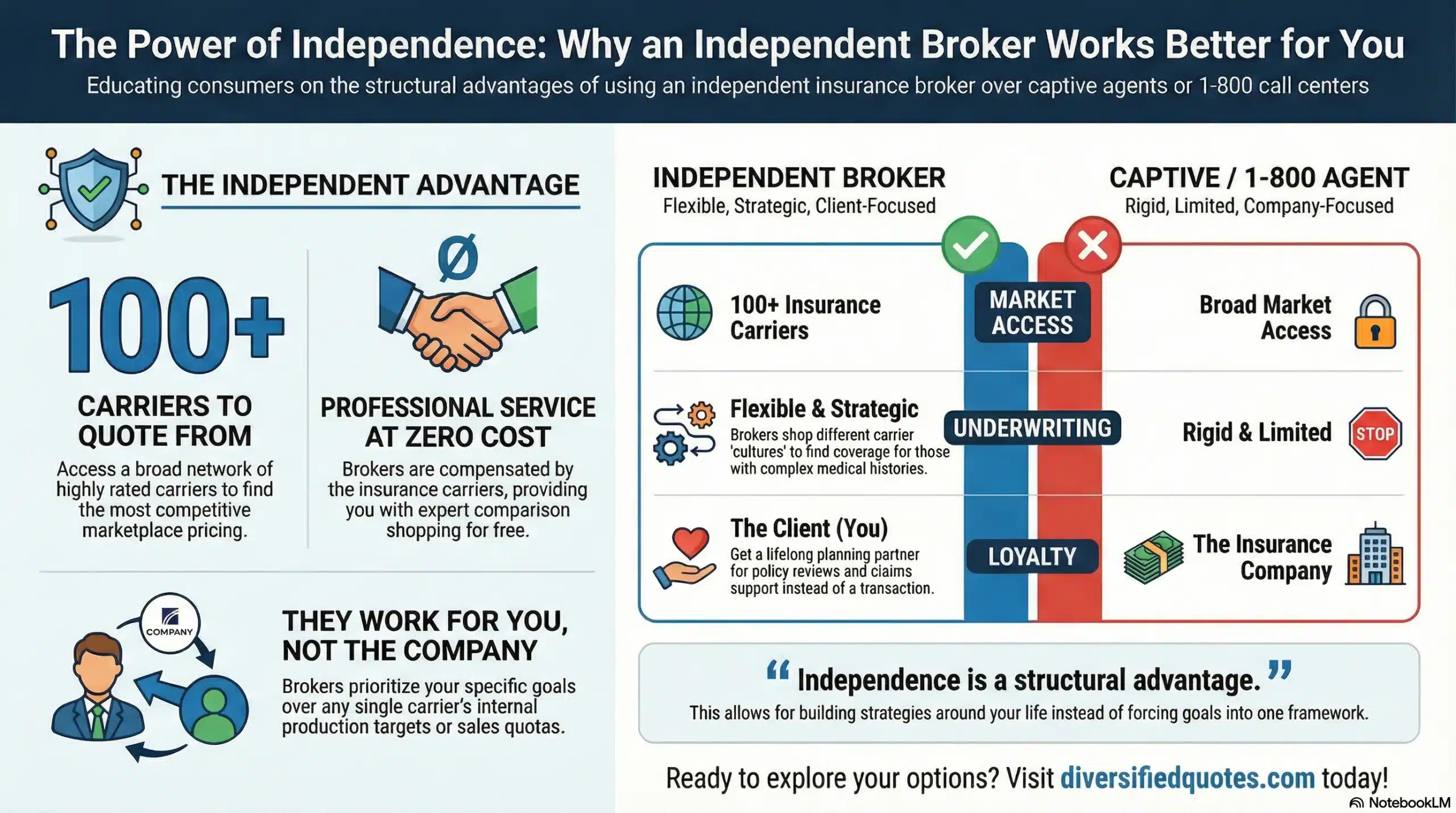
We are not tied to one company, so we’re not trying to “force” your application into a single carrier’s guidelines. Instead, we shop your case across a large network to identify which companies are most likely to treat your Parkinson’s diagnosis fairly based on your stage, function, and medical record history.
Our role is to help you avoid the common mistakes that cause Parkinson’s applications to derail, including submitting to the wrong carrier first, misaligning the policy type with the severity of the condition, or triggering conservative underwriting by providing vague or inconsistent information.
We also help many clients who have multiple underwriting concerns beyond Parkinson’s. If you have other chronic conditions in your file, the carrier match matters even more because some insurers stack risk factors aggressively. Our underwriting-first approach is designed to give you realistic options that match what carriers actually do—not what people assume they do.
Next Steps: Compare Rates and Choose the Right Underwriting Path
If you want to explore baseline pricing first, the quote tool above is a great starting point. It can help you see general ranges for traditional term life insurance based on age and coverage amount. The next step is making sure your Parkinson’s history is matched to the carriers most likely to give you a realistic underwriting class. That’s the point where most applicants either overpay or get denied when they apply without guidance.
If you want help navigating the process, you can submit your request through the quote form on this page. We’ll review the details of your diagnosis, your symptom stability, and your overall health profile, then guide you toward the most practical options for approval and pricing.
Get a Personalized Parkinson’s Life Insurance Quote
We’ll compare carriers, review your Parkinson’s history, and map the best path to approval—without wasting time on the wrong companies.
Request Information
Related Life Insurance Pages
Explore these next if you’re comparing underwriting options, building a protection plan, or navigating other health-related factors.
Talk With an Advisor Today
Choose how you’d like to connect—call or message us, then book a time that works for you.
Schedule here:
calendly.com/jason-dibcompanies/diversified-quotes
Licensed in all 50 states • Fiduciary, family-owned since 1980
FAQs: Life Insurance for Parkinson’s
Can you get life insurance if you have Parkinson’s?
Yes. Options depend on age, stage and progression, medications, mobility, cognitive status, and other health factors. Many applicants qualify for simplified issue or guaranteed issue; some early-stage applicants can still qualify for fully underwritten coverage.
Which policy types are available (term, whole life, guaranteed issue)?
Availability varies by severity and age. Early-stage applicants may access term or whole life with table ratings. If traditional underwriting isn’t available, simplified issue final expense or guaranteed issue whole life are common alternatives.
How does the stage of Parkinson’s affect approval and price?
Earlier stages with stable symptoms and strong daily functioning generally see better offers. Advanced stages, frequent falls, swallowing issues, or dementia typically limit choices and increase premiums.
What medical information will insurers ask for?
Expect questions about diagnosis date, stage, symptom control, mobility/fall history, swallowing or aspiration risk, cognitive changes, medications and dosages, neurology follow-ups, hospitalizations, and any assistive devices or home health care.
Do Parkinson’s medications impact underwriting?
Yes. Insurers review medication types, dosage, and stability over time. Well-controlled symptoms with consistent treatment generally reflect more favorably than frequent changes or escalating doses tied to complications.
What if I have deep brain stimulation (DBS)?
DBS does not automatically disqualify you. Underwriters will look at the date of implantation, results, follow-up notes, and any complications. Stable outcomes can support more favorable consideration.
How do swallowing issues or frequent falls affect eligibility?
Documented aspiration risk, pneumonia history, or recurrent falls increase perceived risk and can narrow options to simplified or guaranteed issue. Clear physician notes showing management and improvements can help.
Can cognitive impairment or dementia related to Parkinson’s be approved?
Coverage becomes more limited as cognitive impairment progresses. Guaranteed issue whole life (with graded benefits for the first two years) is often the practical path if cognitive decline is present.
What coverage amounts are realistic?
Traditional policies may be available at lower face amounts with table ratings. Final expense policies commonly range from $5,000–$40,000; some carriers allow higher amounts depending on age and underwriting.
How long does underwriting take?
Simplified issue decisions can be made within minutes to a few days. Fully underwritten cases may take 2–6 weeks depending on medical records, attending physician statements, and any required exams (when applicable).
Will I need a medical exam?
Not always. Many simplified and guaranteed issue policies require no exam. Fully underwritten options may request labs, exam, or physician records depending on age and amount of coverage.
How can I improve my chances of approval?
Provide complete neurology records, document stable medications and follow-ups, note physical therapy, fall-prevention measures, and any assistive devices. Demonstrating stability and good compliance helps.
Can I keep my current policy if I’m diagnosed after purchase?
Yes. Existing, in-force policies remain valid as long as premiums are paid and the application was truthful at the time of issue. New diagnoses after issue don’t change already issued coverage.
What if I was declined before?
A prior decline doesn’t end your options. Different carriers have different guidelines. Depending on your profile, a simplified or guaranteed issue policy may still be available.
Are riders like accelerated death benefit or waiver of premium available?
Some riders may be available depending on the product and carrier. Availability can be limited with Parkinson’s; review rider eligibility and definitions before purchase.
Does age limit my options?
Yes. Many simplified and guaranteed issue plans are built for ages 50–85, with carrier-specific ranges. Fully underwritten term may be limited after certain ages. Check age bands for each product.
How are premiums determined for Parkinson’s applicants?
Premiums reflect age, benefit amount, policy type, and underwriting class. With traditional underwriting, table ratings may apply. Simplified and guaranteed issue policies price risk into level premiums by design.
Will financial factors (income, assets) be considered?
For larger face amounts, insurers may require financial justification (income replacement or estate needs). Smaller final expense policies typically have minimal financial underwriting.
About the Author:
Jason Stolz, CLTC, CRPC and Chief Underwriter at Diversified Insurance Brokers, is a senior insurance and retirement professional with more than two decades of real-world experience helping individuals, families, and business owners protect their income, assets, and long-term financial stability. As a long-time partner of the nationally licensed independent agency Diversified Insurance Brokers, Jason provides trusted guidance across multiple specialties—including fixed and indexed annuities, long-term care planning, personal and business disability insurance, life insurance solutions, and short-term health coverage. Diversified Insurance Brokers maintains active contracts with over 100 highly rated insurance carriers, ensuring clients have access to a broad and competitive marketplace.
His practical, education-first approach has earned recognition in publications such as VoyageATL, highlighting his commitment to financial clarity and client-focused planning. Drawing on deep product knowledge and years of hands-on field experience, Jason helps clients evaluate carriers, compare strategies, and build retirement and protection plans that are both secure and cost-efficient.
