
Maximize Social Security Benefits

If you’re approaching retirement, learning how to maximize Social Security benefits is one of the highest-impact steps you can take to strengthen lifetime income you cannot outlive. Social Security is one of the only income streams that is designed to last for life, and for most households it becomes the “income floor” that keeps essential expenses covered even when markets, interest rates, or health situations change. The reason this topic matters so much is simple: the decisions you make between ages 62 and 70 can permanently shape your monthly benefit, your spousal protection, and the survivor benefit that may support the longer-living spouse for decades.
At Diversified Insurance Brokers, we help individuals and couples evaluate filing options, model different claiming ages, and coordinate Social Security with the rest of the plan so each dollar works harder across a long retirement. “Maximize” is not just about choosing the largest monthly check. It’s about designing the best lifetime outcome—including taxes, Medicare timing, continued work, retirement withdrawals, and what happens if one spouse outlives the other. If you want a broader framework before getting into the details, start here: Social Security advice. If you’re still working or expect to work later in life, this planning angle matters too: does working past 65 affect Social Security benefits.
Schedule an appointment with a Social Security Expert
Get a personalized review of your claiming options, break-even ages, spousal/survivor strategy, and tax-aware timing.
Schedule an Appointment Read Social Security Advice Call 800-533-5969
Who should focus on maximizing Social Security benefits?
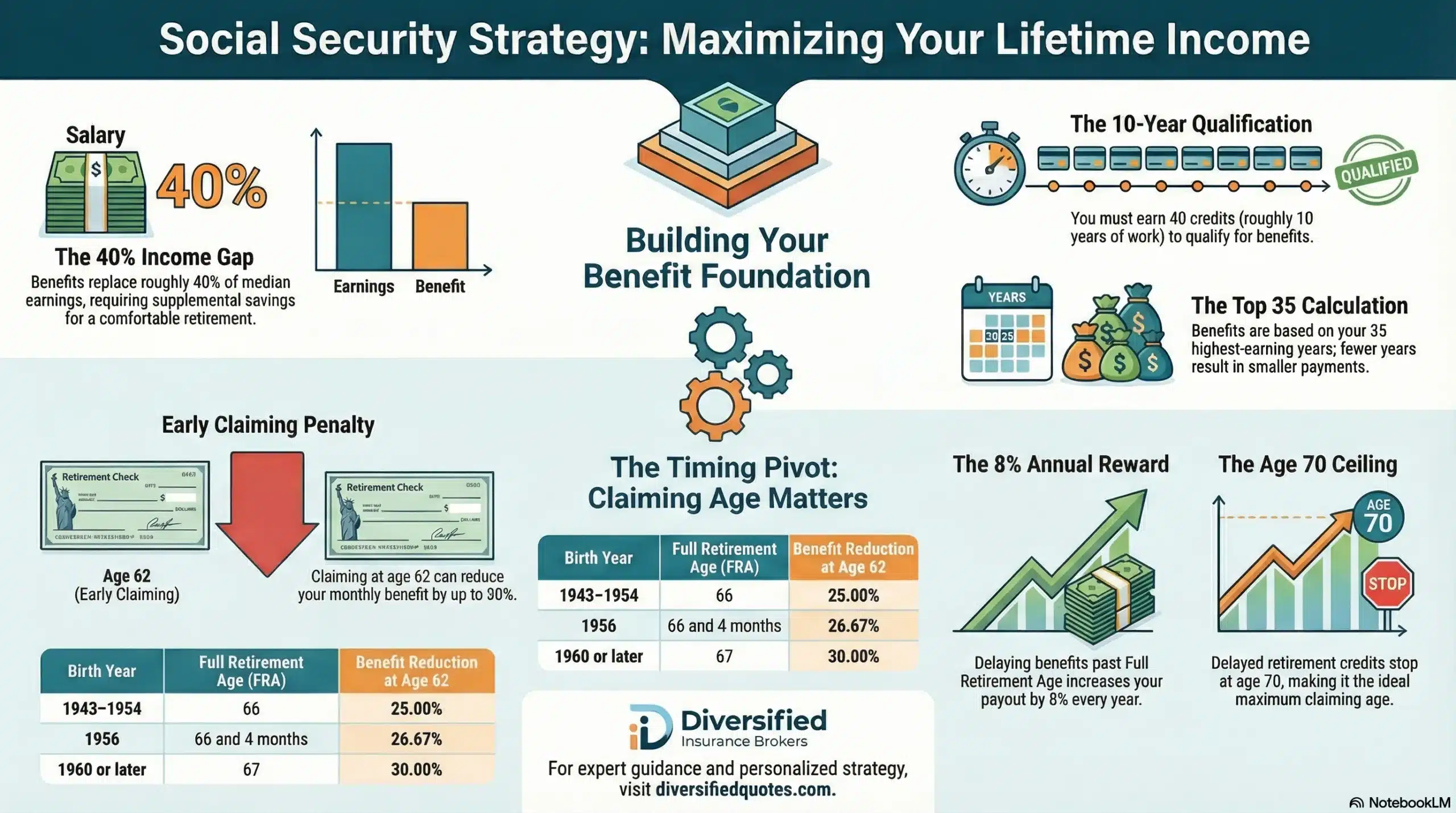
If you’re between ages 62 and 70, your Social Security filing decision is one of the largest “levers” you control in retirement. Claiming early gives you income sooner, but it permanently reduces your monthly benefit. Waiting—especially closer to age 70—can raise your monthly benefit, which can be especially valuable if you expect a long retirement, want stronger inflation-adjusted income later, or need to protect a spouse through survivor benefits. Even if you already have retirement savings, the guaranteed nature of Social Security can reduce pressure on portfolios during down markets, which is one reason maximizing benefits can be a meaningful risk-management move, not just a “bigger check” move.
Couples should pay special attention. Household optimization usually creates larger gains than individual optimization because the higher earner’s benefit often becomes the survivor benefit if that spouse passes away first. That means maximizing benefits is frequently about strengthening the higher earner’s check—even if the household initially feels like it could use income sooner. Divorce history is another reason to plan carefully, because divorced-spouse benefits can be available based on an ex-spouse’s record and timing rules can change the best path. If divorce is part of your story, start here: divorced spousal benefits timing.
High-income households have an additional layer: maximizing benefits should be coordinated with taxes, retirement withdrawals, and Medicare premium planning. In that context, the best outcome is often the best after-tax and after-Medicare outcome—because those factors determine what you actually keep and what arrives in your bank account each month.
What “maximize” really means
Many retirees assume maximizing Social Security benefits means one of two things: “wait as long as possible” or “claim as soon as possible.” In reality, maximizing is more personal and more strategic. It means choosing a filing approach that produces the strongest lifetime outcome when you consider: longevity, spousal needs, survivor protection, work plans, taxes, Medicare timing, and how your retirement withdrawals will be structured. A plan that creates the “biggest check” is not always the plan that creates the best household outcome, especially if it forces large taxable withdrawals or increases Medicare premiums later.
The reason Social Security deserves special attention is that it is designed to be stable and inflation-adjusted. It functions like a personal pension and can become the backbone of the retirement plan. When Social Security is optimized, it can reduce how much you need to pull from portfolios during weak market years, which can improve long-term portfolio survival. When Social Security is claimed too early without a plan, retirees often rely more heavily on IRA withdrawals and investment income, potentially increasing tax pressure and future required minimum distributions.
If you want a broad strategy framework before diving into the mechanics, this page is the best starting point: Social Security advice.
Claiming ages: 62, Full Retirement Age, and 70
Social Security gives you a range of filing ages, and each comes with tradeoffs. Claiming at 62 is the earliest option for retirement benefits, and it typically results in a permanently reduced monthly benefit compared to claiming at Full Retirement Age (FRA). Claiming at FRA generally provides your standard benefit amount. Delaying past FRA can increase your benefit through delayed retirement credits, up to age 70. The key point is that Social Security is not just “when do I want to start checks?” It’s also “what check do I want for the rest of my life?” and “what check might my spouse rely on later?”
Claiming early can be appropriate when the household needs income now, when health suggests a shorter expected retirement, or when a plan intentionally uses early benefits to reduce portfolio withdrawals. Claiming later can be appropriate when the household wants higher lifetime income, stronger survivor protection, or better inflation-adjusted income later in retirement. For many couples, the higher earner delaying is one of the most powerful ways to maximize household benefits because it strengthens the benefit that may continue for the surviving spouse.
A strong plan doesn’t stop at ages. It models outcomes under different “what if” scenarios: continued work, early retirement, one spouse living much longer, and tax changes that alter net income. That’s where maximizing benefits becomes real planning—not just a rule of thumb.
Break-even ages and why they’re incomplete
You’ll often hear retirees talk about “break-even,” meaning the age at which delaying benefits has paid out more total dollars than claiming earlier. Break-even can be a helpful reference, but it’s incomplete because it often ignores survivor benefits, taxes, Medicare premiums, and the household impact of one spouse living longer. Break-even also doesn’t fully capture the value of a higher guaranteed monthly income later in life, when health expenses and care costs may be higher and the ability to return to work is lower.
For couples, break-even analysis can actually mislead if it focuses only on the individual’s payout and ignores the survivor benefit that may last for many years after the first spouse passes away. In those cases, “maximizing Social Security benefits” often means planning for the longer life first, not just planning for the first retirement date.
This is why modeling matters. The best plan usually compares multiple filing paths and then evaluates them through a household lens: how does income look in the years when one spouse is alone, and how does that compare to the household’s expected expenses and taxes?
Couples: coordination that protects a spouse
For married couples, maximizing Social Security benefits is rarely about having both spouses do the same thing at the same time. Household optimization often means staggering claims and prioritizing the strategy that protects the spouse who is most likely to live longer or rely on survivor income. Because the higher earner’s benefit often becomes the survivor benefit, the higher earner’s filing decision can be one of the most important decisions in the entire retirement plan. Delaying the higher earner can produce a higher lifetime benefit for that person and a higher survivor benefit for the spouse—often creating a stronger household result even if one spouse claims earlier.
Another common coordination factor is work. If one spouse continues working longer, that can influence the best filing month. Work income can affect taxation, Medicare premium planning, and whether it’s even advantageous to start benefits early. If your household is in this category, this guide is important in the decision process: does working past 65 affect Social Security benefits.
Couples also benefit from defining a clear income target. Instead of “maximize the check,” we often help households define a goal like: “cover fixed essential expenses with guaranteed income.” When that goal is clear, Social Security strategy becomes easier to evaluate alongside pensions and other guaranteed-income sources.
Survivor benefits: planning for the longer life
Survivor planning is one of the most overlooked parts of maximizing Social Security benefits. Many retirees plan as if both spouses will be alive and collecting for the same duration. In reality, survivor income is the scenario many households must live through. When one spouse passes away, the household doesn’t keep both Social Security checks—one benefit generally remains. That is why strengthening the higher earner’s benefit can be so powerful: it may also strengthen the benefit that survives.
A maximization strategy that ignores survivor outcomes can produce a strong “today” result but a weak “later” result. That later period can last a long time. The best Social Security plan often treats survivor income as a primary planning constraint. If your spouse is younger, has lower lifetime earnings, or is expected to live longer based on family history and health, it’s especially important to model how survivor benefits will support the household.
Survivor strategies can also intersect with continued work or irregular income. If you’re self-employed or still producing income, the timing decisions can get more nuanced. This page is helpful for that angle: Social Security benefits for self-employed.
Divorce and remarriage considerations
Divorce can create benefit opportunities, but the rules are specific and timing matters. If your prior marriage lasted long enough and other eligibility rules are met, you may be able to claim divorced-spouse benefits based on an ex-spouse’s record. In some cases, you may also be eligible for survivor benefits on an ex-spouse’s record. Remarriage can change which options are available and when, particularly when comparing spousal and survivor benefits across different records.
The most common mistake is assuming rules that sound intuitive but aren’t accurate, such as “I automatically get half” or “remarriage always ends my options.” The right approach is to map your specific eligibility and then coordinate timing with the rest of your retirement income plan. For a focused timing guide, start here: divorced spousal benefits timing.
Even when divorced benefits are available, maximizing Social Security benefits is still about the total plan: taxes, work income, Medicare timing, and the sequencing of withdrawals from other accounts.
Working while collecting: earnings rules and timing
Working while collecting Social Security can change the best filing decision—especially if you plan to claim before Full Retirement Age. When you claim early and continue to work, earnings rules can temporarily withhold some benefits depending on your income level. After you reach Full Retirement Age, the earnings limit no longer applies, but work income can still affect taxes and how much of your Social Security becomes taxable. In other words, even when benefits are not withheld, working can still change your net outcome.
Another underappreciated factor is that continued work can sometimes increase your Social Security benefit if your later earnings replace lower-earning years in your benefit calculation. That doesn’t mean everyone should keep working, but it does mean the strategy conversation should include what work does to your benefit and what it does to your taxes. If you are considering working later in life, start here: does working past 65 affect Social Security benefits.
Self-employed retirees have additional planning considerations because income can be variable and tax planning can be more flexible. If that’s you, this resource helps frame the topic: Social Security benefits for self-employed.
Taxes: why net benefit matters more than gross
Maximizing Social Security benefits should be about what you keep, not just what you receive. Depending on your combined income, a portion of Social Security may be taxable, and the taxable portion can change when you add IRA withdrawals, pensions, capital gains, or wages. That means one filing strategy may look better on paper but result in less net income after taxes once the rest of the retirement plan is layered in.
This is why coordinated planning often focuses on sequencing: which accounts will fund early retirement years, when Social Security starts, and how withdrawals are managed once Social Security is in place. A carefully planned sequence can reduce unnecessary income spikes that cause higher taxation. A reactive approach can unintentionally increase the taxable portion of benefits and increase the household’s long-term tax drag.
If you want a dedicated deep dive on the tax side of Social Security, this is the best companion page: Is Social Security taxable? (and the practical reduction strategies here: reduce taxes on Social Security).
Medicare timing and premium ripple effects
Medicare is often the hidden variable in maximizing Social Security benefits. Many retirees think of Social Security as a “gross benefit,” but their real monthly cash flow is shaped by healthcare premiums. Medicare enrollment timing, supplement vs. advantage choices, and income-based premium adjustments can change the net result. This is one reason Social Security planning is most effective when it is integrated with Medicare planning, not treated as a separate project.
While the strategy conversation often starts with claiming ages, many households get their biggest “net” improvements by coordinating filing with income events that affect Medicare premiums. If you’re also planning Medicare decisions, this guide helps connect the two systems: how Medicare and Social Security work together.
A strong maximization plan doesn’t just ask, “How do I get the most benefit?” It asks, “How do I create the strongest net retirement income after healthcare costs and taxes?”
Integrating Social Security with withdrawals and guaranteed income
Many retirees maximize Social Security benefits best when they combine it with a thoughtful income sequence. That sequence often includes deciding which accounts fund early retirement years, how to manage taxable income, and how to create predictable monthly income that supports lifestyle goals without overspending from portfolios. The goal is to reduce pressure on retirement assets and make the plan resilient across good markets and bad markets.
For some households, Social Security is paired with other income sources such as pensions or structured retirement income tools. The important point is not which tool is “best,” but whether the combination creates the right income floor while maintaining flexibility. When Social Security is coordinated with the rest of the plan, the household often experiences less financial stress because income becomes more predictable and less dependent on market timing.
If you want the broader strategy framework that ties the pieces together, start with: Social Security advice.
How to file and avoid common administrative errors
Maximizing Social Security benefits is also about execution. The strongest strategy can be weakened by simple administrative mistakes such as choosing an unintended start month, misunderstanding how spousal benefits work in your situation, failing to coordinate with a retirement date, or overlooking how work income will impact taxes and withholding. It can also be weakened by not aligning Medicare enrollment timing with Social Security decisions, which can create confusion and delays.
A clean filing process starts with clarity: confirm your intended start month, confirm whether you will keep working, confirm how your spouse’s strategy fits with yours, and confirm how you want taxes withheld (if any). This is also a good moment to revisit the broader strategy framework: Social Security advice.
If you’re filing early and working, it’s critical to understand earnings rules and income limits, because those can change what you actually receive in the short term and how your plan behaves: Social Security income limits.
How we model your options
Our approach begins with your complete retirement picture, not just your Social Security statement. We look at health and longevity expectations, marital status, ages, work plans, pension options, retirement accounts, and the household’s income needs over time. Then we model multiple filing strategies side by side—often including claiming at 62, at Full Retirement Age, and at 70—so you can see tradeoffs clearly.
For couples, we focus heavily on coordination and survivor outcomes. We compare “both file at the same time” approaches versus staggered approaches where one spouse claims earlier while the higher earner delays. We also evaluate how work income affects timing, how taxes affect net benefit, and how Medicare timing interacts with the plan. The goal is to make the decision easy because you can see it, not because someone told you a generic rule.
If you want a strategy-first framework before scheduling, this page is the best starting point: Social Security advice.
Real-world impact of smart Social Security planning
A common example is a couple in their mid-60s who planned to file as soon as they retired. When we ran coordinated scenarios, the household often discovered that having one spouse claim earlier while the higher earner delayed could improve long-term household income and strengthen survivor protection. When we layered in taxes and work plans, the optimized strategy frequently looked different than what they would have chosen by instinct.
Another common example is an individual who planned to work part-time for several years while collecting early. With earnings rules and taxes factored in, we often find a more efficient start month or a better sequencing approach. That doesn’t mean everyone should delay; it means everyone should plan. Social Security decisions compound over time, so the value of a short strategy review can be surprisingly high.
The bottom line: maximizing Social Security benefits is not about perfection. It’s about avoiding costly mistakes and choosing a strategy you can defend because it fits your household’s goals and timeline.
Get help maximizing Social Security benefits
We’ll compare claiming ages, coordinate spousal and survivor strategy, and show the after-tax outcome so you can file with confidence.
Schedule an appointment with a Social Security Expert Explore Social Security Advice
Schedule A Free Consultation
FAQs: Maximize Social Security Benefits
When is the best age to begin claiming Social Security?
The “best” age depends on your health, income needs, and goals. Claiming as early as 62 gives you a smaller check for more years, while delaying closer to age 70 increases your monthly benefit and can provide stronger protection later in retirement. We typically compare several ages so you can see break-even points and long-term outcomes.
How can married couples maximize Social Security benefits together?
For many couples, it makes sense for the higher earner to delay benefits to increase the eventual survivor benefit, while the lower earner may file earlier to bring income into the household. Coordinating timing, benefit amounts, and survivor needs can add tens of thousands of dollars in lifetime income compared to both spouses filing as soon as they are eligible.
What are survivor benefits and why are they important?
Survivor benefits are payments made to a widow or widower based on a deceased spouse’s work record. They matter because the surviving spouse often loses one benefit but keeps the higher of the two. Planning for which benefit will ultimately become the survivor check helps protect the spouse who lives longer and ensures they aren’t left with a sharply reduced income.
How do taxes affect my Social Security income?
Depending on your overall income, up to 85% of your Social Security benefit may be taxable. By coordinating when you claim with how and when you draw from IRAs, Roth accounts, pensions, and annuities, we can often reduce the total tax you pay over time and keep more of each benefit check in your pocket.
Can I work and claim Social Security at the same time?
Yes, but if you claim before full retirement age and keep working, the earnings test may temporarily reduce your benefit if your income exceeds certain limits. After you reach full retirement age, the earnings test no longer applies, and your benefit may be adjusted upward to reflect months when payments were withheld earlier.
Can Social Security be coordinated with savings, pensions, or annuities?
Absolutely. Pairing Social Security with IRAs, 401(k)s, pensions, and annuities lets you design a more stable, tax-efficient income plan. For example, you might use savings or annuity income to fill the gap while delaying Social Security, or you might claim earlier and preserve investment accounts for growth or legacy goals.
Is delaying Social Security always the right move?
Delaying often leads to a higher monthly check, but it isn’t always the best choice. Health, marital status, cash-flow needs, and how you feel about longevity risk all matter. For some clients, claiming earlier and preserving other assets makes more sense; for others, delaying creates valuable inflation-adjusted income for later years.
How can Diversified Insurance Brokers help with Social Security decisions?
We review your full financial picture, model multiple claiming strategies, and show how each choice affects lifetime income, taxes, and survivor benefits. Then we help you integrate Social Security with retirement accounts, annuities, and other tools so your overall plan is coordinated and easy to follow.
About the Author:
Jason Stolz, CLTC, CRPC and Chief Underwriter at Diversified Insurance Brokers (NPN 20471358), is a senior insurance and retirement professional with more than two decades of real-world experience helping individuals, families, and business owners protect their income, assets, and long-term financial stability. As a long-time partner of the nationally licensed independent agency Diversified Insurance Brokers, Jason provides trusted guidance across multiple specialties—including fixed and indexed annuities, long-term care planning, personal and business disability insurance, life insurance solutions, Group Health, and short-term health coverage. Diversified Insurance Brokers maintains active contracts with over 100 highly rated insurance carriers, ensuring clients have access to a broad and competitive marketplace.
His practical, education-first approach has earned recognition in publications such as VoyageATL, highlighting his commitment to financial clarity and client-focused planning. Drawing on deep product knowledge and years of hands-on field experience, Jason helps clients evaluate carriers, compare strategies, and build retirement and protection plans that are both secure and cost-efficient. Visitors who want to explore current annuity rates and compare options across multiple insurers can also use this annuity quote and comparison tool.
