
The Truth About Annuities: Breaking Down Common Myths
Annuities have been around for generations, yet they remain one of the most misunderstood financial tools in retirement planning. Much of the confusion comes from outdated information, aggressive sales stories from decades ago, or lumping all annuities into one category without understanding the differences between fixed, indexed, and income-focused contracts. If you’ve ever searched online for information, you’ve likely seen dramatically mixed opinions—some calling annuities essential retirement tools and others dismissing them entirely. The truth, as is often the case in financial planning, lies in understanding structure, suitability, and strategy. When used properly, annuities can provide principal protection, tax-deferred growth, guaranteed income, and legacy planning advantages that few other financial products can replicate in a single contract. When misunderstood or misused, they can create frustration. The goal isn’t to defend or attack annuities—it’s to clarify how they actually work so you can determine whether they belong in your retirement plan.

One of the biggest drivers of annuity confusion is the assumption that they are all expensive or complicated. In reality, many fixed annuities operate much like CDs issued by insurance companies, except with tax-deferred growth and often higher rates. These contracts typically have no annual management fees and guarantee interest for a specific period—three, five, seven, or even ten years. If you are evaluating today’s current annuity rates, you’ll notice they are often highly competitive compared to traditional bank products. The difference is that annuities are built specifically for retirement planning. That means they incorporate income options, beneficiary designations, and in many cases enhanced liquidity features that standard savings vehicles simply do not offer.
Another common misconception is that annuities “lock up” your money forever. While annuities are designed for long-term planning, most contracts allow for penalty-free withdrawals of up to 10% annually. Some provide even greater flexibility depending on structure. Understanding annuity free withdrawal rules is essential before purchasing, but the idea that you lose all access to your funds is inaccurate. The key is aligning the annuity term with your liquidity timeline. If you may need access to large sums in the near future, a shorter-term annuity may be appropriate. If your goal is protected accumulation for five to seven years, longer guarantees may make more sense.
There’s also the myth that when you pass away, the insurance company keeps your money. This is simply false in the overwhelming majority of contracts. Annuities allow you to name one or more beneficiaries who receive the remaining contract value directly—often avoiding probate in the process. If legacy planning is important to you, it’s worth reviewing how annuity beneficiary death benefits are structured. Some contracts even offer enhanced death benefit riders for additional protection. When structured properly, annuities can serve as both an income tool and a legacy transfer strategy.
Another criticism often raised is that annuities don’t grow fast enough. Compared strictly to aggressive stock portfolios during bull markets, that may be true. But retirement planning isn’t about chasing maximum return—it’s about managing risk-adjusted return and income reliability. Fixed annuities provide guaranteed compound growth. Fixed indexed annuities provide market-linked upside potential with no direct downside risk. If you want to better understand whether they fit your situation, reviewing Are Annuities Worth It? can provide additional perspective. In volatile markets, protecting principal can be just as important as earning returns.
Many pre-retirees are also surprised to learn that annuities can be structured to provide lifetime income. With the right rider, you can create a guaranteed paycheck that you cannot outlive—regardless of market performance. That’s why income-focused retirees often explore strategies like the best retirement income annuity options when building out a distribution plan. This can serve as a complement to Social Security, pensions, and investment accounts.
Ensure you are receiving the absolute top rates
Current Fixed Annuity Rates
Compare today’s best fixed annuity rates from top carriers.
Current Bonus Annuity Rates
See which annuities offer the highest upfront bonus today.
Request an Annuity Quote
Submit our annuity request form to get personalized rate options.
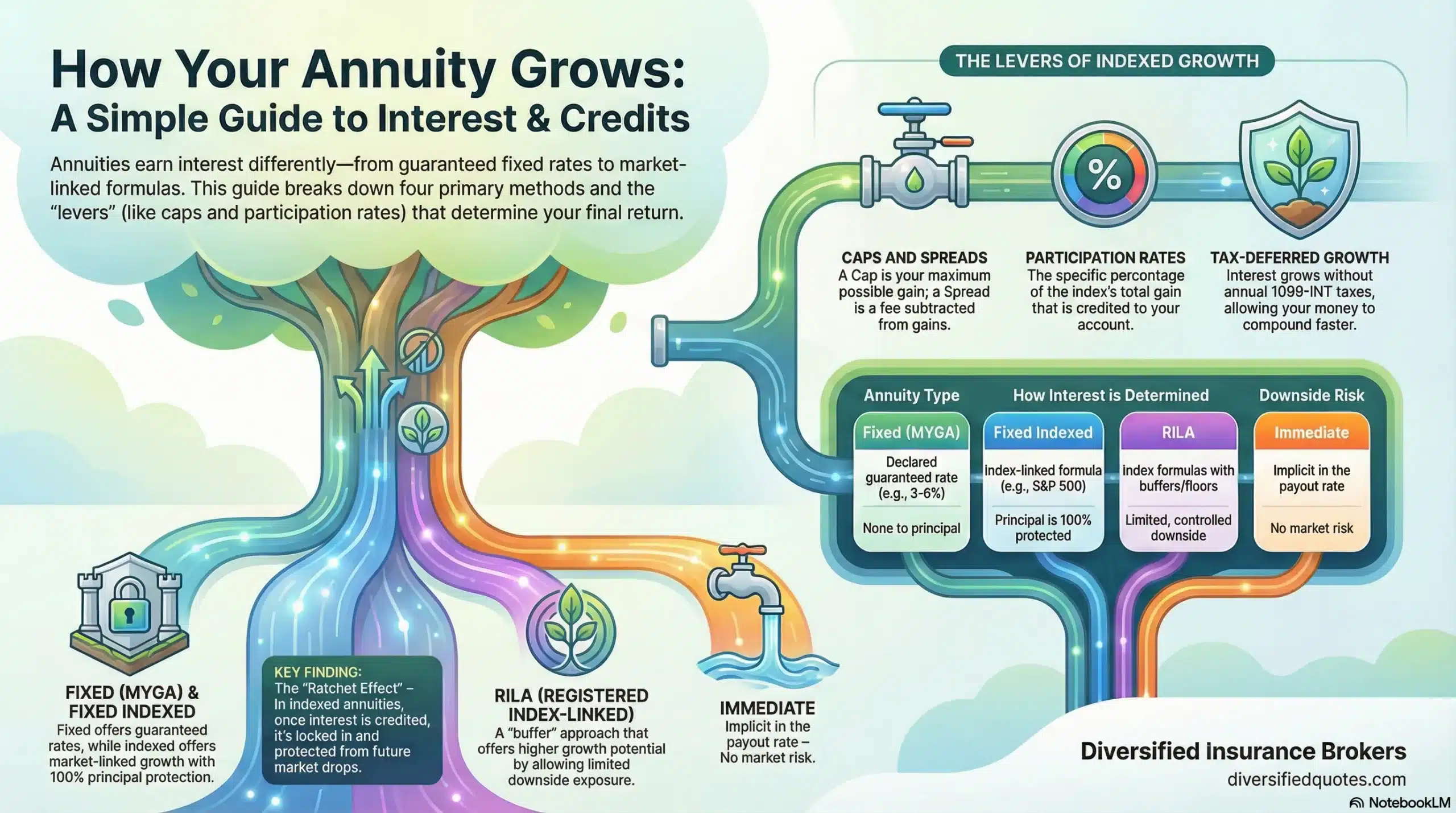
When evaluating annuities, it’s also helpful to understand how interest is credited. If you’re unsure how these contracts generate returns, reviewing how annuities earn interest can clarify the differences between fixed rates and indexed crediting strategies. The structure matters. Caps, participation rates, and spreads all influence performance in indexed contracts. That’s why independent comparisons are critical.
In addition, it’s important to compare annuities to other retirement vehicles honestly. If you’re weighing different asset classes, exploring the difference in stocks, bonds, and annuities can help frame expectations properly. Stocks provide growth with volatility. Bonds provide income with interest rate risk. Annuities provide contractual guarantees backed by the claims-paying ability of the issuing insurance company. Each has a place—depending on your risk tolerance and income needs.
Lifetime Income Calculator
Use our calculator to see how much guaranteed income your annuity can provide.
Related Pages
Financial Protection Essentials
Explore annuity interest examples across different investment sizes along with professional disability insurance options and long-term care planning resources.
Talk With an Advisor Today
Choose how you’d like to connect—call or message us, then book a time that works for you.
Schedule here:
calendly.com/jason-dibcompanies/diversified-quotes
Licensed in all 50 states • Fiduciary, family-owned since 1980
FAQs: The Truth About Annuities
What is the real purpose of an annuity?
Annuities are designed to provide guaranteed income, protect principal, and offer tax-deferred growth. They help retirees create predictable income that is not tied to market fluctuations.
Are annuities safe?
Annuities are backed by the financial strength of the issuing insurer and follow strict state regulations. While not FDIC-insured, fixed and indexed annuities provide contractual guarantees that protect principal.
Do all annuities have high fees?
No. Many fixed annuities, MYGAs, and fixed indexed annuities have no annual fees. Fees generally apply only when optional riders are added or in variable annuity products.
Can annuities lose money?
Fixed and fixed indexed annuities cannot lose principal due to market downturns. Variable annuities can lose value because they contain market-based investments.
Why do some people say annuities are bad?
Negative opinions usually stem from misunderstanding how annuities work, confusing them with high-fee variable annuities, or focusing on surrender periods without considering long-term guarantees.
Are annuities good for retirement income?
Yes. Many retirees use annuities to create lifetime income or stable interest-based growth. They provide a predictable stream of income that can supplement Social Security and pensions.
How long do surrender periods last?
Surrender periods generally range from 3 to 15 years depending on the product. Many contracts allow penalty-free withdrawals of up to 10% per year.
Can I leave money to beneficiaries with an annuity?
Yes. Most annuities include a death benefit that passes remaining value to your beneficiaries, avoiding probate in many cases.
Are annuities taxed?
Growth inside an annuity is tax-deferred. Withdrawals are taxed as ordinary income. If purchased with after-tax money, a portion of each withdrawal may be tax-free.
How do I compare annuities?
Compare interest rates, income payout options, surrender terms, financial strength ratings, and features such as caps, spreads, or income riders. Reviewing multiple carriers can help you find the best fit.
About the Author:
Jason Stolz, CLTC, CRPC and Chief Underwriter at Diversified Insurance Brokers (NPN 20471358), is a senior insurance and retirement professional with more than two decades of real-world experience helping individuals, families, and business owners protect their income, assets, and long-term financial stability. As a long-time partner of the nationally licensed independent agency Diversified Insurance Brokers, Jason provides trusted guidance across multiple specialties—including fixed and indexed annuities, long-term care planning, personal and business disability insurance, life insurance solutions, Group Health, and short-term health coverage. Diversified Insurance Brokers maintains active contracts with over 100 highly rated insurance carriers, ensuring clients have access to a broad and competitive marketplace.
His practical, education-first approach has earned recognition in publications such as VoyageATL, highlighting his commitment to financial clarity and client-focused planning. Drawing on deep product knowledge and years of hands-on field experience, Jason helps clients evaluate carriers, compare strategies, and build retirement and protection plans that are both secure and cost-efficient. Visitors who want to explore current annuity rates and compare options across multiple insurers can also use this annuity quote and comparison tool.
