
Travel Medical and Evacuation from Colombia

Jason Stolz CLTC, CRPC
For travelers and families spending time in Colombia, having travel medical and evacuation insurance is one of the simplest ways to reduce risk and avoid expensive surprises. Colombia has many modern cities and well-developed private hospitals, but the moment you move outside major metro areas—or you plan excursions into mountainous, jungle, coastal, or rural regions—the practical reality changes. Access to advanced care can become inconsistent, and in a serious medical event the “right” solution may be transport to a larger city, a regional medical hub, or (in rare cases) another country. Travel medical insurance helps cover emergency treatment, while evacuation benefits help solve the logistics and cost of getting you to appropriate care when local options aren’t enough.
At Diversified Insurance Brokers, we help travelers, digital nomads, students, expats, mission teams, and business travelers compare plans built for medical-first protection. The goal is not to cover inconveniences. The goal is to protect you from high-cost emergencies—hospitalization, surgery, diagnostics, emergency prescriptions, and coordinated evacuation—so you don’t have to figure everything out while you’re sick, injured, or trying to manage a crisis from a remote region.
Many travelers assume “travel insurance” automatically includes meaningful medical coverage and evacuation. In reality, some packages focus heavily on trip cancellation and baggage, with medical limits that can be too small for a real emergency. A better approach is to make sure your plan is structured around what matters most: emergency care, higher medical limits, strong evacuation benefits, and a 24/7 assistance team that can coordinate care quickly.
If you’re also traveling through other higher-risk regions, you may want to compare how coverage works across destinations. Here’s a related guide on travel medical and evacuation from Algeria, which explains how limits and evacuation rules can become more important when local access and stability vary by region.
Travel Medical & Evacuation Coverage for Colombia
Apply online for travel medical coverage that includes strong emergency treatment benefits and coordinated evacuation support.
Why Colombia Travelers Prioritize Medical + Evacuation Coverage
Colombia is a country where your experience can vary dramatically depending on your itinerary. In cities like Bogotá, Medellín, and Cartagena, many private facilities can handle routine emergencies, diagnostics, and common urgent care needs. But if you’re hiking, visiting coffee regions, traveling through coastal areas, moving between smaller towns, or spending time in more remote communities, the gap between “available care” and “appropriate care” becomes the real issue. Travel medical coverage helps with treatment costs, but evacuation coverage addresses what happens when the best medical decision requires transport.
Evacuation is not just a plane ride. It can involve coordination between local providers, the insurer’s medical team, receiving hospitals, and transportation providers—plus documentation, approvals, and routing decisions. When plans include a strong assistance component, you’re not left trying to coordinate an international medical transfer from a hotel room or a rural clinic.
Another reason Colombia travelers choose stronger coverage is that emergencies don’t always happen in predictable settings. A motor vehicle accident, a fall, a sudden illness, or an infection can require immediate decisions. Having the right plan means your decisions are based on medical need—not on whether you can afford an air ambulance or an expensive private hospital bill out of pocket.
What “Travel Medical and Evacuation Insurance” Typically Covers
Coverage varies by carrier and plan, but travel medical and evacuation policies are designed to handle urgent and unexpected events. For Colombia travel, that usually means emergency medical treatment for covered illness or injury, hospitalization, imaging and diagnostics, physician services, emergency prescriptions, and medically necessary follow-up care while you’re still abroad. If the situation requires it, evacuation benefits may arrange transport to the nearest adequate facility, which could be within Colombia or outside the country depending on medical necessity and local capabilities.
Most plans also include a 24/7 assistance line that helps with case management, coordination of care, and guidance on where to go for treatment. This becomes especially important if you’re dealing with language barriers, local payment requirements, or uncertainty about which facility is appropriate for the severity of the situation.
Some plans include additional benefits that matter in real life, such as coverage for emergency dental (accidents), local ambulance transport, or repatriation of remains. What matters most is not just whether a benefit exists, but how it is triggered, what approvals are required, what limitations apply, and whether the plan coordinates services directly or simply reimburses after the fact.
When Evacuation Becomes the Real Financial Risk
In many destinations, evacuation is the single largest exposure because of how quickly costs escalate. The expense depends on distance, urgency, aircraft type, whether a medical escort is required, and where you need to be transported. Evacuation can also be complicated by geography. Colombia’s mountains, rural regions, and distance between certain communities can make ground transport slower, and in some scenarios that changes the decision-making process.
A strong plan doesn’t just “cover evacuation.” It usually requires you to follow the insurer’s assistance process so the evacuation is authorized and arranged properly. This is one of the most important practical details travelers overlook. If you want a deeper explanation of how medical evacuation works and what to watch for in plan language, our guide on emergency medical evacuation insurance breaks down what evacuation typically includes, how approvals work, and why benefit limits matter.
Natural Disasters, Civil Unrest, and “Security Evacuation” Reality
Travelers sometimes assume a policy that includes “evacuation” will automatically cover extraction during civil unrest or natural disasters. That is not always true. Medical evacuation is usually tied to medical necessity. Security evacuation is different, and it’s not included in every plan. When it is included, it often has specific triggers and rules about who coordinates the extraction and where you can be transported.
For Colombia, most travelers are focused on medical events, but depending on your itinerary—especially for contractors, journalists, or extended stays—some people also evaluate whether a plan includes additional assistance services that can help during disruptions. The key is to read what the policy actually defines as a covered event and how the assistance team is involved. This is another reason we help clients compare plan language instead of relying on assumptions.
Pre-Existing Conditions and Why the Details Matter
Pre-existing conditions are one of the most common reasons for claim confusion. Some plans exclude them entirely. Others offer limited protection only for “acute onset” events, and even that term can be defined narrowly. If you take medication, have a chronic condition, or you’re traveling with a known medical history, the right move is to confirm exactly how the plan defines and treats pre-existing conditions before you leave.
Even when a plan offers some pre-existing condition protection, it may require stability for a period of time before travel or limit coverage to sudden and unexpected flare-ups. This does not mean you can’t get good coverage—it means you need to match the policy to your situation so you’re not relying on vague assumptions during a medical event.
Who This Coverage Fits Best
Travel medical and evacuation coverage is a strong fit for travelers who want protection for serious events, not minor inconveniences. In Colombia, that includes business travelers who move between cities, students and families staying for semesters or extended periods, digital nomads living in multiple regions, volunteer groups traveling outside major tourist corridors, and travelers planning excursions that involve hiking, long drives, or rural itineraries.
It can also be valuable for travelers who simply want the peace of mind that if something happens, they have a structured response plan and a team to coordinate care. When you’re abroad, the “who do I call” and “where do I go” questions matter as much as the benefit limit.
How Pricing Typically Works
Travel medical and evacuation plans are usually priced based on age, trip length, destination, selected medical maximum, evacuation benefits, and deductible options. Higher limits and longer durations typically increase premium, but they also reduce exposure if a serious event occurs. Because travel medical plans are built for temporary coverage, most travelers find them affordable compared to the potential cost of a single emergency abroad.
Choosing limits should be practical. If you’re taking short city-based trips, your needs can look different than someone spending weeks moving between regions, visiting remote areas, or doing physically demanding travel. We typically focus on selecting a medical maximum that can handle hospitalization and escalation of care, plus an evacuation structure that assumes transport might be necessary in a serious scenario.
How to Use Your Coverage During a Real Emergency
When something happens abroad, the best outcomes usually occur when you follow the plan’s assistance process early. Many policies have a global assistance number, and contacting them quickly allows the insurer to coordinate care, confirm eligibility, direct you to appropriate facilities, and arrange transportation if needed. If you wait until after services are rendered, you may lose access to coordination benefits and you may create unnecessary reimbursement friction.
It also helps to keep documentation organized: medical reports, receipts, discharge instructions, and any communications from local providers. If evacuation is needed, the assistance team will often coordinate receiving facilities and transport, but they will still need medical documentation to support medical necessity.
If you’re looking for longer-stay options beyond a typical short trip plan, it can also be worth comparing international health insurance solutions. Our international health insurance guide explains the difference between travel medical coverage and longer-term international medical plans, which can be a better fit for expats, retirees abroad, and extended stays.
Why Diversified Insurance Brokers
Travel medical insurance is full of small differences that become big differences during a claim. Limits, definitions, approvals, exclusions, and assistance quality all matter. Since 1980, Diversified Insurance Brokers has helped clients compare coverage options with a focus on suitability and real-world outcomes, not just marketing language. For Colombia travel, that means helping you choose a plan that emphasizes emergency medical protection and reliable evacuation support.
When clients already have a travel insurance product through a credit card or a bundled package, we often help them identify gaps and decide whether adding a medical-focused plan is the right move. The goal is not to over-insure. The goal is to insure the risks that can actually create financial damage when you’re abroad.
Get Covered Before You Travel to Colombia
Apply online in minutes to secure travel medical coverage with evacuation support for Colombia.
Related Travel Medical & Evacuation Pages
Emergency Medical Evacuation Insurance
How evacuation works, approvals, and why limits matter.
View PageTravel Medical & Evacuation from Morocco
A useful comparison for regional care + evacuation planning.
View PageHigh Risk Travel Insurance
Coverage built for unstable regions and complex itineraries.
See Coverage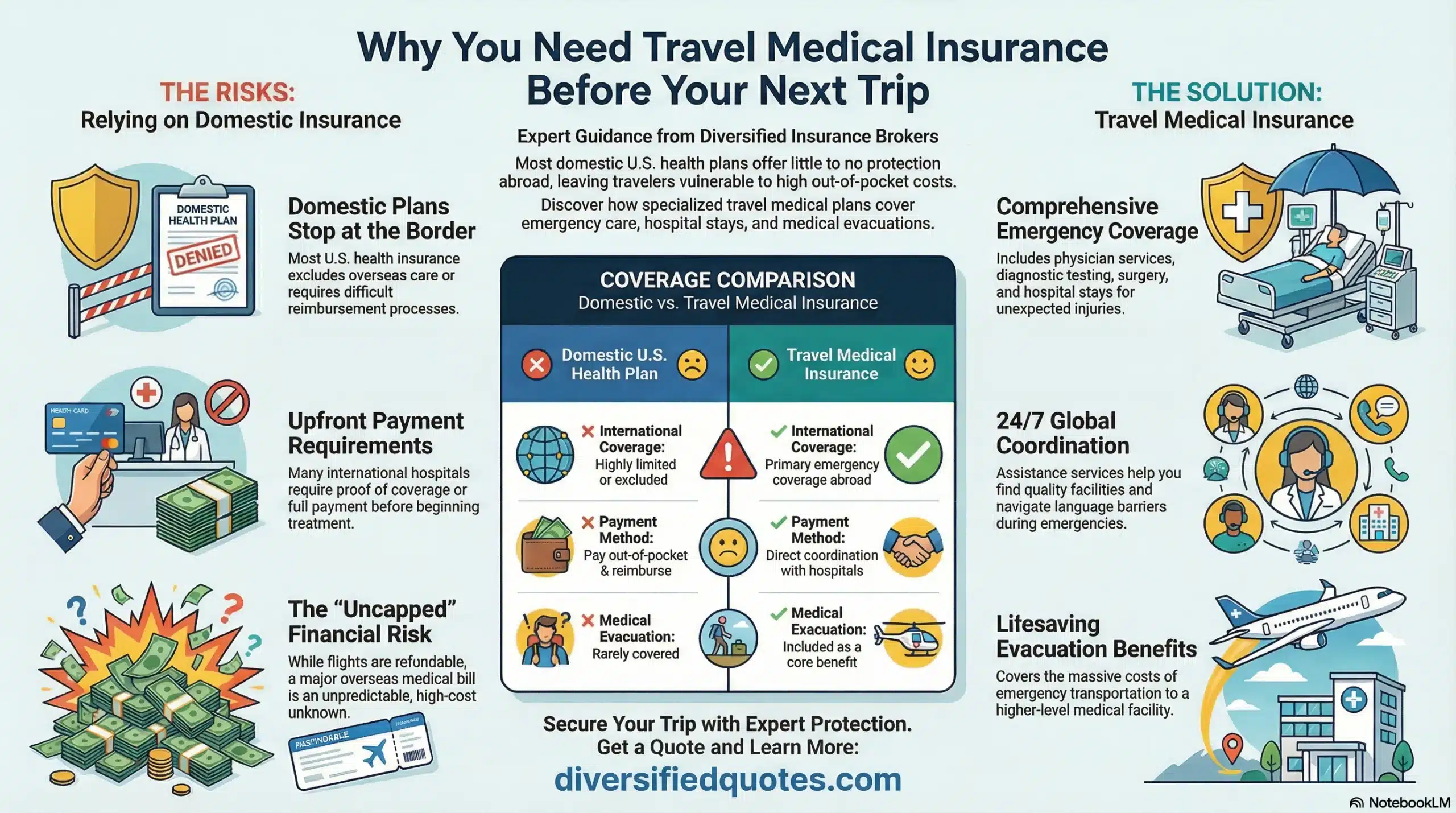
Talk With an Advisor Today
Choose how you’d like to connect—call or message us, then book a time that works for you.
Schedule here:
calendly.com/jason-dibcompanies/diversified-quotes
Licensed in all 50 states • Fiduciary, family-owned since 1980
Travel Medical & Evacuation from Colombia — FAQs
What does travel medical and evacuation insurance for Colombia cover?
Why might evacuation be necessary in Colombia?
Are pre-existing conditions covered?
What exclusions or limitations should I watch for?
How are premiums determined for Colombia coverage?
What should I do if I need help during a medical emergency?
Will evacuation take me within Colombia or out of the country?
Is travel medical and evacuation coverage required for Colombia?
Does the plan cover air evacuation?
About the Author:
Jason Stolz, CLTC, CRPC and Chief Underwriter at Diversified Insurance Brokers (NPN 20471358), is a senior insurance and retirement professional with more than two decades of real-world experience helping individuals, families, and business owners protect their income, assets, and long-term financial stability. As a long-time partner of the nationally licensed independent agency Diversified Insurance Brokers, Jason provides trusted guidance across multiple specialties—including fixed and indexed annuities, long-term care planning, personal and business disability insurance, life insurance solutions, Group Health, and short-term health coverage. Diversified Insurance Brokers maintains active contracts with over 100 highly rated insurance carriers, ensuring clients have access to a broad and competitive marketplace.
His practical, education-first approach has earned recognition in publications such as VoyageATL, highlighting his commitment to financial clarity and client-focused planning. Drawing on deep product knowledge and years of hands-on field experience, Jason helps clients evaluate carriers, compare strategies, and build retirement and protection plans that are both secure and cost-efficient. Visitors who want to explore current annuity rates and compare options across multiple insurers can also use this annuity quote and comparison tool.
