
Travel Medical and Evacuation from Cuba

Jason Stolz CLTC, CRPC
For travelers, students, families, and professionals spending time in Cuba, securing travel medical and evacuation insurance from Cuba is one of the most practical decisions you can make before you leave home. Even though Cuba is often discussed as having strong healthcare outcomes for residents, visitors can still run into real issues that have nothing to do with “quality” and everything to do with access, availability, payment logistics, and coordination. In a stressful moment, what matters is how quickly you can get appropriate treatment, how the bills are handled, and whether a coordinated plan exists if you need to be moved to a higher-capability facility outside the country.
At Diversified Insurance Brokers, we help travelers compare plans designed for real-world emergencies—not just small reimbursements. When you’re abroad, the biggest risk is often not the initial clinic visit. It’s what happens when the case escalates, the facility requires deposits, the situation needs an urgent specialist, or the most appropriate care requires a transfer. That’s why we focus on coverage that includes emergency medical benefits plus coordinated medical evacuation support, backed by a 24/7 assistance team that can manage the logistics when you can’t.
It’s also important to separate “trip protection” from “medical protection.” Credit-card trip benefits often focus on delays, baggage, or trip cancellation, but they don’t solve the core risk in Cuba: emergency treatment costs and the possibility of needing an international transfer. If you want the simplest baseline explanation of what these plans are built to do, start with our guide on Medical Travel Insurance, then compare how evacuation functions on our Emergency Medical Evacuation Insurance page. If your itinerary involves higher exposure (remote travel, complex routes, or elevated personal medical concerns), you can also review High Risk Travel Insurance to see how plan design changes when the stakes are higher.
Travel Medical & Evacuation Coverage for Cuba
Apply online for travel medical insurance that includes emergency care and evacuation coordination for Cuba travel and extended stays.
Why Medical Coverage in Cuba Can Become a Logistics Problem
Most travelers don’t plan for medical care because they assume the worst-case scenario is unlikely. The problem is that when something serious happens, the challenge is rarely “Can I find a doctor?” The challenge becomes “Can I access the right level of care quickly, and can I do it without payment delays or coordination chaos?” In Cuba, visitors may face practical barriers that are less visible during normal travel: limited availability of certain medications, variability in hospital resources by location, communication friction, and administrative steps that can slow down care when you need speed.
Even when you’re in a major area like Havana, you can still have situations where the best next step is specialized testing, advanced imaging, a certain type of specialist, or a higher-acuity facility than what’s accessible in the moment. In those cases, the decision shifts from medical-only to medical-plus-logistics: where should you be treated, how quickly can you get there, and who coordinates the transfer? That is exactly where travel medical coverage with evacuation support earns its value. It’s not just about paying a bill. It’s about making the next step possible when the case escalates.
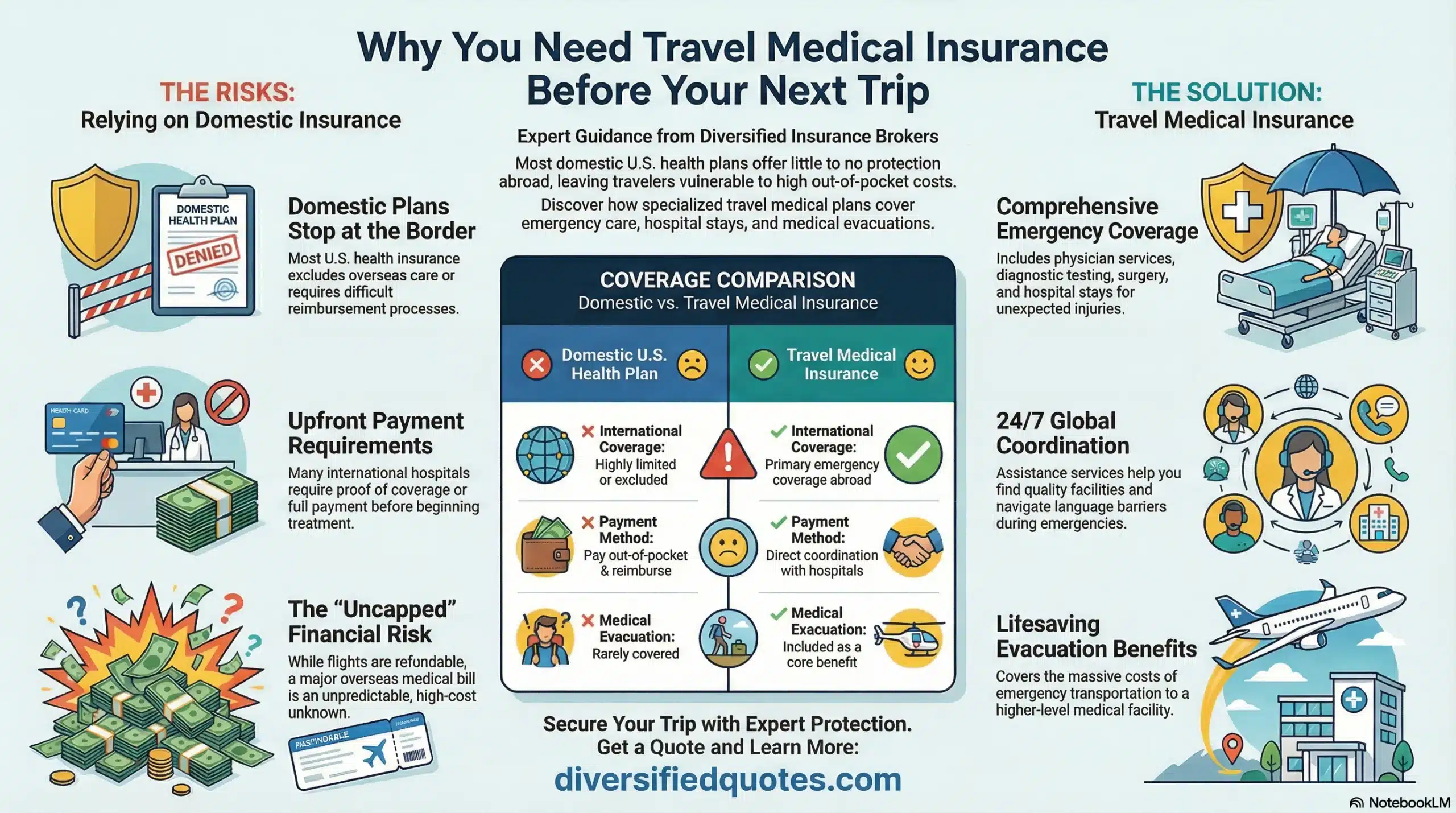
Travelers also underestimate how often “payment logistics” can complicate a medical event. You might be asked for cash deposits, payment guarantees, or immediate arrangements that are hard to execute from a hotel, a clinic, or an unfamiliar system. A well-structured travel medical plan can reduce that friction and give you a support team to coordinate steps that would otherwise fall on you or your travel companion during a crisis.
What Travel Medical & Evacuation Insurance Is Designed to Cover
Travel medical and evacuation insurance is designed for unexpected, urgent situations while you are outside your home healthcare system. In the simplest terms, it targets two big risks: (1) the cost of emergency medical treatment and (2) the cost and complexity of getting to appropriate care when local resources aren’t enough. The first risk is the immediate treatment—hospitalization, ER care, diagnostic tests, physician fees, eligible prescriptions, and medically necessary procedures. The second risk is escalation—transport, coordination, approvals, and routing to a facility that can handle the case.
Emergency medical benefits typically focus on sudden illness or injury, not elective care. That means a true emergency situation like a serious infection, trauma, acute gastrointestinal illness with dehydration, a respiratory emergency, a cardiac event, or a neurological issue that needs urgent evaluation. Even a “routine” incident can become expensive quickly when it requires imaging, inpatient monitoring, or specialist care. These plans exist so you don’t have to choose between getting treated and protecting your finances.
Evacuation benefits exist because the most expensive part of many international claims is not the initial emergency care. It’s the transport when you need a higher-capability facility. Evacuation can include ground ambulance transfers, commercial flights with medical escort, or air ambulance depending on severity and stability. The right transport method is a medical decision, not a convenience decision, and a strong plan helps ensure that decision is supported by an assistance team that can execute it quickly and correctly.
If you are comparing short-term travel medical coverage versus a longer-stay structure that behaves more like major medical while abroad, you may also want to review International Health Insurance. That category can be a better fit for extended stays, long assignments, or travelers who want broader day-to-day coverage while still keeping evacuation as a backstop.
Medical Evacuation: What “Evacuation Included” Actually Means
Many travelers assume evacuation is a single, simple event—like “I get flown home.” In reality, medical evacuation is a coordinated medical transport decision driven by medical necessity and local capability. A good plan’s assistance team helps confirm whether the current facility can provide appropriate care, identifies a receiving facility that can accept you, coordinates approvals, and arranges the correct level of transport. The “evacuation benefit” is often as much about coordination as it is about dollars.
This matters because evacuation is typically the highest-cost part of a serious claim. If the case requires medically staffed transport, costs can increase quickly based on distance, urgency, staffing, and routing. Many policies also require that evacuation be coordinated or authorized by the assistance team for coverage to apply, except in extreme circumstances where contact is impossible. That requirement exists because evacuation is complex and the plan needs to manage medical necessity, routing, and safety. The practical takeaway is simple: in a serious event, you want a plan that makes it easy to contact and activate the assistance team immediately.
Another important detail is how policies define the destination of evacuation. Some plans cover transport to the “nearest adequate facility.” Others may include repatriation to your home country once stabilized, depending on the policy language. For some travelers, the nearest adequate facility is the right answer because it emphasizes speed. For others, repatriation matters because it returns them to familiar providers and systems. The best plan is the one that matches your trip length, your support network, and the type of travel you’re doing.
If you want a deeper breakdown of how evacuation benefits work and what to watch for, use our dedicated guide on Emergency Medical Evacuation Insurance. It’s the fastest way to clarify the difference between “evacuation as a headline” and “evacuation as a usable benefit in the real world.”
Why Assistance Services Are Often the Real Value
People shop for travel coverage by looking at benefit limits, but in Cuba the assistance infrastructure behind the plan can matter just as much as the dollar amount. In a real emergency, you may need help locating an appropriate facility, coordinating admission, arranging payments where possible, managing documentation, and planning transfers. Those steps are hard to execute quickly when you are sick or injured, and even harder if a family member back home is trying to coordinate from another country.
A strong assistance team can help reduce confusion and speed up action. They can coordinate case management, communicate with providers, help confirm what the plan requires for approval, and arrange transport. That’s why we emphasize plan designs that are built around emergency coordination, not just reimbursement. A plan that only reimburses you after the fact can still leave you exposed to up-front deposit requirements or delays when timing matters.
Assistance services also matter because they help keep the claim “clean.” Many high-cost services like evacuation require documentation, medical necessity confirmation, and procedural steps. When the assistance team is involved early, the process is simpler. When travelers improvise and try to document everything later, that’s when disputes and frustrations are more likely to happen.
Example Scenarios: How a Cuba Emergency Can Escalate
Consider a traveler in Havana who experiences severe chest pain and shortness of breath. Initial evaluation may be available, but the case might require advanced cardiac testing, specialist management, and potentially higher-acuity monitoring. Depending on the clinical findings and local capacity, the most appropriate plan could be transfer to another country with broader specialty resources and a clearer care pathway for the specific condition. Without travel medical and evacuation insurance, you may be facing immediate medical bills plus the much larger cost of transport and coordination.
Or consider a family traveling outside major city centers when one traveler experiences a serious injury from a fall. The first facility may stabilize the patient, but follow-up imaging, surgical capability, or specialist orthopedics could require moving to a different facility. In that scenario, the “medical” problem becomes a coordination problem quickly: where to go, how to get there safely, and how to manage payment logistics while also taking care of the rest of the family.
These situations are exactly why we describe travel medical insurance as a system, not just a bill. The coverage helps pay eligible expenses, but the assistance and evacuation coordination help ensure you can actually access the right care in time, without trying to solve logistics in the middle of a crisis.
Who Should Consider Travel Medical & Evacuation Coverage for Cuba
This coverage is valuable for almost anyone traveling to Cuba, but it becomes especially important when the consequences of disruption are high. That includes business travelers who cannot afford delays, students who may be living abroad without family nearby, retirees exploring longer stays, families traveling with children, and travelers who have any medical concerns where access to the “next level” of care matters. It also applies to travelers who want a predictable plan rather than improvisation if something serious happens.
If your travel includes multiple stops or a broader regional route, travel medical coverage can also help maintain continuity across destinations. Travelers sometimes underestimate how quickly plans can become misaligned when they move across countries. In those cases, it can help to compare destination pages and confirm your plan is built for the most demanding part of your itinerary, not just the easiest part.
Travelers who are doing higher-exposure travel—remote routes, heavy activity, long drives, or more complex travel logistics—should also compare plan designs that are built for escalation. That is where High Risk Travel Insurance can provide useful context about how carriers think about risk, exclusions, and higher-stakes coordination.
What to Look For in a Cuba Travel Medical Plan
Not every travel medical plan is built to perform the same way in a real claim. Some plans are fine for minor clinic visits but become less effective when a case turns serious. For Cuba, we generally prefer plans that have meaningful emergency medical maximums, strong evacuation limits, and a clear assistance process. You want to know that if local care is not sufficient, the plan can coordinate the next step without confusion or delay.
Pre-existing conditions are a major detail to understand before you buy. Many policies exclude pre-existing conditions, while others provide limited benefits under specific rules like “acute onset” definitions. If you have a known condition, the best approach is to assume plans differ and choose intentionally based on how the policy language treats your situation. You do not want to discover those limitations for the first time during a crisis.
Activity exclusions are another key point. Some plans limit coverage for certain activities unless you add specific coverage or riders. If your trip includes higher activity, excursions, water activities, or strenuous travel days, it’s worth ensuring the plan structure matches your itinerary.
Finally, evacuation coordination rules matter. Many plans require you to contact the assistance team for authorization before arranging evacuation (except in extreme situations where immediate action is required and contact is impossible). Knowing this upfront helps you avoid mistakes that can complicate a claim. The goal is simple: choose a plan that is easy to use correctly under stress.
Why Travelers Work With Diversified Insurance Brokers
Travel coverage often looks similar on the surface, but the differences show up when you need it. Diversified Insurance Brokers focuses on matching plan design to real travel risk so you’re not relying on assumptions. We help you think through what happens if the local facility can’t handle the case, how evacuation is coordinated, how approvals typically work for high-cost services, and what plan structure best fits your trip length and travel profile.
We also help travelers who assume their domestic health insurance will cover them abroad. Many plans either exclude international coverage or impose strict reimbursement rules that still leave you paying up front. Travel medical insurance is designed specifically for international emergencies, which is why it is often the cleaner solution for Cuba travel. The goal is not to overcomplicate the purchase. The goal is to remove the “unknowns” that become expensive when something serious happens.
Arrange Coverage Before You Travel (Timing Matters)
Coverage works best when it is arranged before departure. Travel medical plans are designed to be purchased in advance, and once an incident begins, you can’t retroactively fix gaps. Purchasing early also ensures you have access to your documents, policy numbers, and the assistance contact details that you’ll need if something happens while you’re in Cuba.
If you are traveling with family or as part of an organization, it also helps to make sure at least one other person knows where the documents are stored and how to contact the assistance team. Those small steps make it easier to activate coverage quickly in a real emergency.
Get Covered Before You Travel
Apply online now to secure travel medical and evacuation coverage for Cuba.
Related Travel Medical Pages
If you’re comparing plan types, limits, or how evacuation works, these pages help you align coverage design with real-world emergency needs.
Related Destination Pages
Use these destination pages to compare how coverage needs shift based on medical access, distance to advanced care, and travel logistics.
Talk With an Advisor Today
Choose how you’d like to connect—call or message us, then book a time that works for you.
Schedule here:
calendly.com/jason-dibcompanies/diversified-quotes
Licensed in all 50 states • Fiduciary, family-owned since 1980
Travel Medical & Evacuation from Cuba — FAQs
What is travel medical and evacuation insurance for Cuba?
Why do travelers need this coverage in Cuba?
Does this insurance cover emergencies only, or routine doctor visits too?
How does evacuation work if I’m injured or seriously ill?
Is evacuation always international, or can it be within the country?
Are pre-existing conditions covered?
What are common exclusions to watch for?
How much can a medical evacuation cost without insurance?
What should I check before buying a travel medical plan for Cuba?
About the Author:
Jason Stolz, CLTC, CRPC and Chief Underwriter at Diversified Insurance Brokers (NPN 20471358), is a senior insurance and retirement professional with more than two decades of real-world experience helping individuals, families, and business owners protect their income, assets, and long-term financial stability. As a long-time partner of the nationally licensed independent agency Diversified Insurance Brokers, Jason provides trusted guidance across multiple specialties—including fixed and indexed annuities, long-term care planning, personal and business disability insurance, life insurance solutions, Group Health, and short-term health coverage. Diversified Insurance Brokers maintains active contracts with over 100 highly rated insurance carriers, ensuring clients have access to a broad and competitive marketplace.
His practical, education-first approach has earned recognition in publications such as VoyageATL, highlighting his commitment to financial clarity and client-focused planning. Drawing on deep product knowledge and years of hands-on field experience, Jason helps clients evaluate carriers, compare strategies, and build retirement and protection plans that are both secure and cost-efficient. Visitors who want to explore current annuity rates and compare options across multiple insurers can also use this annuity quote and comparison tool.
