
Travel Medical and Evacuation from Ivory Coast

Jason Stolz CLTC, CRPC
Ivory Coast (Côte d’Ivoire) is one of West Africa’s most active hubs—especially around Abidjan—drawing business travelers, contractors, students, mission teams, and families living abroad. But when you travel outside your home health system, the biggest risk is often not getting sick or injured; it’s what happens next. That’s why travel medical and evacuation insurance from Ivory Coast matters. It helps pay for eligible emergency treatment and, when local care isn’t enough, it helps coordinate and cover evacuation to a facility that can properly manage the situation.
At Diversified Insurance Brokers, we help travelers compare international medical plans that include 24/7 assistance, practical hospital access, and clear evacuation terms—so you’re not trying to solve a crisis from a waiting room or a hotel bed. The goal is simple: if something goes wrong, you have a plan that responds quickly, organizes the logistics, and helps protect you from the kind of out-of-pocket costs that can hit hard and fast.
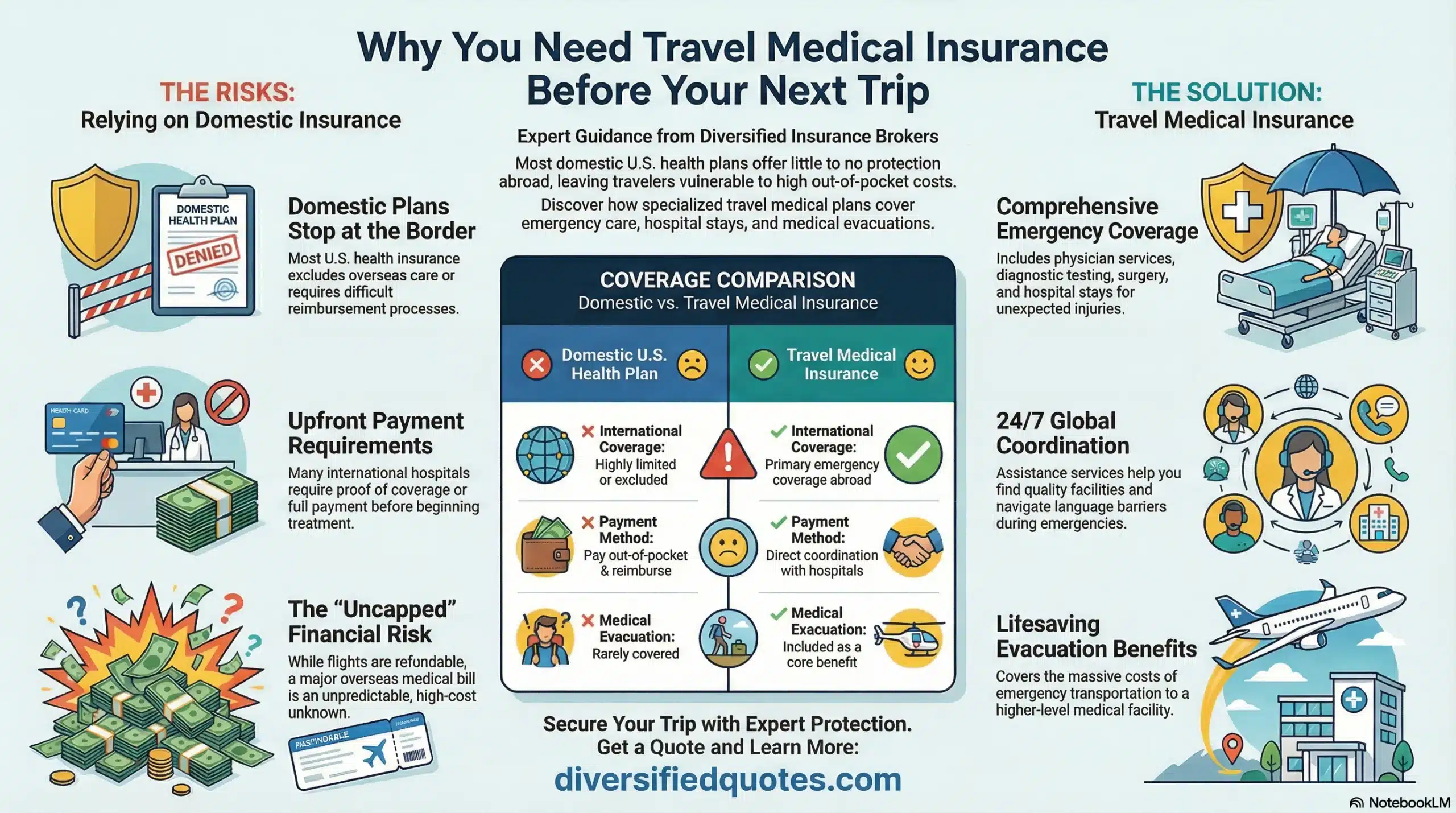
Many people assume “my credit card has coverage” or “I’ll just pay out of pocket and get reimbursed.” In real emergencies, that can break down quickly. Hospitals may require deposits. Transportation decisions may need to be made immediately. And if a case requires higher-level care, the cost is often not the ER visit—it’s the evacuation, the medical escort, and the coordination between facilities. If you’re comparing plan types, it also helps to understand the difference between short-trip travel coverage and longer-stay medical plans. Depending on your situation, you might review International Health Insurance for longer assignments, Medical Travel Insurance for shorter travel, and Travel and Medical Insurance for High Risk Travel if your itinerary includes remote areas or higher-risk work conditions.
Get Travel Medical & Evacuation Coverage for Ivory Coast
Apply online in minutes, or call us if you want help choosing limits that match your trip length, destination mix, and exposure level.
If you’re traveling outside major metro areas or on assignment, build limits assuming evacuation is a real possibility—not a rare one.
Why Travelers in Ivory Coast Prioritize Medical + Evacuation Coverage
Ivory Coast has strong areas of infrastructure, especially in and around Abidjan, but like many destinations, the quality and capability of care can vary by facility and by the type of medical event. A routine issue may be manageable locally. A serious trauma, neurologic event, cardiac symptoms, complicated infection, or pediatric emergency can change the equation—because the best next step may require higher-level resources, specialty teams, or ICU capability that is not always available where you are.
That’s why travelers often focus on two protections at the same time. First, the plan should help pay for eligible emergency medical care: physician services, diagnostics, imaging, hospital stays, surgery when needed, and prescription medication related to a covered emergency. Second, the plan should provide a clear path for evacuation when the treating facility cannot provide adequate care. In the real world, “evacuation coverage” is as much about coordination and decision-making as it is about the benefit number.
Another practical reason travelers value these plans is cash-flow protection. In some cases, facilities may require deposits. Specialized transport may need to be arranged quickly. If you’re trying to coordinate this yourself—or pay as you go—you can get forced into expensive choices on short notice. A well-structured plan reduces the chance that you’re making a five-figure decision while also dealing with a medical crisis.
What “Medical Evacuation” Actually Means (and What to Confirm)
Medical evacuation is often misunderstood as “an air ambulance back home.” In practice, it’s a coordinated medical transport decision driven by medical necessity and local capability. A good plan typically includes a 24/7 assistance center that confirms the situation, works with the treating provider, identifies an appropriate receiving facility, and coordinates the correct level of transport. That could be a ground ambulance to a higher-capability hospital in the region, a commercial flight with a medical escort when clinically appropriate, or an air ambulance when urgency and condition require it.
When comparing plans, the most important language is usually the destination standard. Some plans evacuate you to the nearest adequate facility. Others include evacuation to a facility of choice within a network, or repatriation to your home country after stabilization. “Nearest adequate” can be ideal for speed. Repatriation can be valuable for longer recovery and follow-up with familiar providers. The best choice depends on your travel duration, your home-base medical preferences, and how remote your itinerary is.
If your schedule includes multiple countries, frequent border crossings, or remote work sites, it’s also worth reviewing how your plan handles travel segments and transitions. Travelers who are layering coverage often compare International Health Insurance for extended stays with a more traditional Medical Travel Insurance plan structure for shorter trips—especially when evacuation remains the main “big-ticket” risk to protect against.
Security Evacuation vs Medical Evacuation
Security evacuation is different from medical evacuation. Medical evacuation is triggered by clinical necessity: you need care that isn’t available where you are. Security evacuation is triggered by safety necessity: civil unrest, escalating conflict, credible threats, or a destabilizing event that makes it unsafe to remain in place. Not every policy includes security evacuation, and when it is included, definitions vary—what events qualify, who determines eligibility, where you can be moved, and whether the plan covers transportation only or also short-term support.
If you are traveling for corporate work, government contracting, NGO missions, journalism, or extended stays outside major metro areas, it’s worth considering plan designs that clearly address security extraction and destination rules. The point isn’t fear. The point is clarity. In a crisis, you do not want to be reading fine print. You want to know who you call, how the event is evaluated, and what assistance actually happens next.
Common Real-World Scenarios Where Coverage Matters
Travel medical and evacuation coverage is designed for the moments when “I’ll figure it out” becomes expensive. Travelers in Ivory Coast often think about scenarios like severe gastrointestinal illness with dehydration, serious infections that need more advanced diagnostics, motor-vehicle accidents that require imaging and surgical capability, cardiac symptoms that require specialized monitoring, and injuries that occur outside major city corridors where transport can be slower.
Even when local treatment is possible, the assistance component is often the hidden value. A strong plan helps you identify appropriate facilities, navigate language barriers, coordinate care between providers, and reduce time lost in a system that may not function like your home country’s system. That coordination is often what keeps a stressful situation from becoming chaotic.
Coverage Highlights to Look For
When we help clients compare plans for Ivory Coast, we prioritize the features that matter most when something goes wrong. The plan should have a clear emergency assistance process, a meaningful medical maximum, and evacuation benefits that are designed for real distance and real logistics. It should also be easy to activate: a 24/7 hotline, clear instructions, and defined authorization steps for evacuation.
We also encourage travelers to verify details that affect real claims outcomes. How are pre-existing conditions handled? Does the plan have an “acute onset” definition, or is a waiver/rider needed? Are certain work activities or field operations excluded? Does the policy treat your travel duration correctly—short trip vs extended stay? These details don’t matter until they matter, and then they matter a lot.
If you want to keep coverage cost-efficient while still protecting the big risks, a traveler might compare plan structure against a budget option like Cheap Travel Insurance and then decide whether the evacuation limits and assistance features are strong enough for the specific itinerary. Saving money is fine—until the plan doesn’t respond the way you expect in a high-cost event.
Example Scenario: How Evacuation Decisions Happen
Imagine a contractor working outside Abidjan develops severe abdominal pain and fever. A local facility can do an initial evaluation, but advanced imaging availability, specialist coverage, and surgical capability can vary by time and location. If the case escalates and local options are limited, the medically appropriate decision may be a transfer to a higher-capability center. Without coverage, the traveler can be forced into immediate, expensive decisions—often involving deposits and coordination across multiple systems.
With the right travel medical and evacuation plan, the assistance team coordinates what happens next: confirms medical necessity, identifies an appropriate receiving facility, manages transport logistics, and helps align payment/approval steps according to policy terms. In many cases, the operational support is the true value, because it reduces delay, confusion, and the chance of making a costly mistake when the situation is already stressful.
Who Should Consider Travel Medical & Evacuation Insurance for Ivory Coast?
This coverage is most valuable for people who can’t afford for “plan B” to be improvisation. That includes business travelers and contractors on assignment, families living abroad, international students, field workers, NGO teams, journalists, and anyone whose itinerary includes travel beyond major city corridors where care access and transport options can change quickly.
It’s also especially relevant for travelers with more exposure risk: remote job sites, frequent regional travel, multiple-country routes, and work that is time-sensitive. If your stay is longer, many people compare a longer-duration plan approach using International Health Insurance rather than relying on a short-term product. If your stay is shorter but the itinerary is intense, you may focus on a plan structure that emphasizes evacuation and assistance responsiveness.
Common Limitations to Understand Before You Buy
Travel medical and evacuation coverage is powerful, but it is not “everything for anything.” Most plans require that evacuation be coordinated and approved through the assistance provider except in extreme circumstances where contact is truly impossible. Many policies exclude elective treatment, non-urgent care, certain high-risk activities unless specifically included, and pre-existing conditions unless the plan includes the right language and eligibility requirements are met.
The most practical way to shop is to match policy language to your travel reality. If you have medical history, pre-existing rules matter more. If you’re going remote, evacuation terms matter more. If you’re traveling for work with defined risks, benefit caps and security evacuation definitions matter more. A plan can look similar on a quote screen but behave very differently during a real claim.
Why Work With Diversified Insurance Brokers?
Diversified Insurance Brokers is a family-owned agency licensed nationwide. We help travelers apply correctly, choose realistic limits, and avoid common gaps—like assuming evacuation is the same across plans or assuming every insurer treats pre-existing conditions the same way. Our job is to help you set this up before you travel, so you’re not sorting it out later when the stakes are high and the time window is short.
Get Covered Before You Travel
Apply online now for Ivory Coast travel medical + evacuation coverage, or call if you want help selecting limits that match your itinerary.
Coverage and evacuation authorization rules vary by policy. In an emergency, contact the plan’s assistance center as early as possible.
Related Travel Medical Pages
If you’re comparing plan types or building a multi-country route, these pages help you match coverage design to real-world medical access and evacuation needs.
Related Destination Pages
Use these destination pages to compare how coverage needs can change with infrastructure, distance to care, and evacuation logistics.
Talk With an Advisor Today
Choose how you’d like to connect—call or message us, then book a time that works for you.
Schedule here:
calendly.com/jason-dibcompanies/diversified-quotes
Licensed in all 50 states • Fiduciary, family-owned since 1980
Travel Medical & Evacuation from Ivory Coast — FAQs
What exactly is travel medical and evacuation insurance for Ivory Coast?
It’s coverage designed to help pay for eligible emergency medical care while you’re outside your home country, and it can also coordinate and pay for evacuation to a facility that can properly treat you when local care is not adequate. Many plans include 24/7 assistance for hospital coordination and travel logistics.
Why do I need this if I’m staying in Abidjan?
Even in major cities, specialized care can vary by facility and circumstance. If you need advanced imaging, complex surgery, ICU care, or certain specialists, a transfer may be recommended. Evacuation coverage helps manage the logistics and the cost of getting to appropriate care quickly.
What does “medical evacuation” typically cover?
Medical evacuation benefits generally cover medically necessary transport (ground ambulance, commercial flight with medical escort, or air ambulance) to the nearest adequate facility, and sometimes repatriation once stabilized. Coverage details depend on the plan’s definition and approval requirements.
What is “security evacuation,” and is it included?
Security evacuation refers to extraction to a safer location during certain destabilizing events (for example, civil unrest or credible threats). Not all policies include security evacuation, and the triggers vary, so it’s important to confirm whether it is included and how events are defined.
Do I need receipts to use travel medical coverage?
Many plans require documentation of the medical event and itemized bills, and some providers may require upfront payment. The assistance team can often help coordinate where and how care is accessed. Claims requirements vary by insurer and plan structure.
What exclusions or limitations are common?
Common limitations include pre-existing condition rules (unless covered by waiver/rider), elective or non-emergency care, certain high-risk activities, and evacuations that are not coordinated/approved through the plan’s assistance provider (except in true emergencies where contact is not possible).
How do I choose between short-term travel coverage and longer-stay international medical?
If you’re traveling for a trip, a short-term travel medical plan with strong evacuation can be sufficient. If you’re living abroad for months or longer, a longer-stay international medical plan may provide broader day-to-day coverage while still including evacuation benefits. The right choice depends on trip duration, budget, and health needs.
About the Author:
Jason Stolz, CLTC, CRPC and Chief Underwriter at Diversified Insurance Brokers, is a senior insurance and retirement professional with more than two decades of real-world experience helping individuals, families, and business owners protect their income, assets, and long-term financial stability. As a long-time partner of the nationally licensed independent agency Diversified Insurance Brokers, Jason provides trusted guidance across multiple specialties—including fixed and indexed annuities, long-term care planning, personal and business disability insurance, life insurance solutions, and short-term health coverage. Diversified Insurance Brokers maintains active contracts with over 100 highly rated insurance carriers, ensuring clients have access to a broad and competitive marketplace.
His practical, education-first approach has earned recognition in publications such as VoyageATL, highlighting his commitment to financial clarity and client-focused planning. Drawing on deep product knowledge and years of hands-on field experience, Jason helps clients evaluate carriers, compare strategies, and build retirement and protection plans that are both secure and cost-efficient.
