
Travel Medical and Evacuation from Libya

Jason Stolz CLTC, CRPC
Libya sits at a strategic crossroads in North Africa, but for travelers, contractors, journalists, and organizations operating in-country, the risk profile is very different from a typical tourism destination. The two biggest issues are simple: access to dependable medical care can be limited and unpredictable, and in a serious emergency the most realistic “next step” is often leaving the country for treatment. That is why travel medical and evacuation insurance from Libya matters. The right coverage is designed to help pay for eligible emergency treatment and, just as importantly, coordinate medically necessary evacuation when local care is not adequate for the situation.
At Diversified Insurance Brokers, we help travelers compare international medical options that are built for real-world escalation. Many people assume they can “pay out of pocket and submit receipts later,” but that approach can break down fast in an urgent situation where decisions must be made quickly, deposits are required, or the right facility is not nearby. A strong plan is not only about reimbursement. It is about coordination, approvals, and logistics—because when a case requires transfer, the evacuation component and the assistance team behind the policy are often the most valuable parts of the coverage.
If you’re comparing options and want to understand the differences between short-term travel medical plans, longer-stay international medical coverage, and evacuation-focused protection, these pages provide a helpful baseline: Travel Medical Insurance, International Health Insurance, and Emergency Medical Evacuation Insurance. If your itinerary includes remote travel, higher-risk work sites, or complex routing, it can also help to review High Risk Travel Insurance so you are matching the plan design to what you’re actually doing on the ground.
Travel Medical & Evacuation Coverage for Libya
Apply online for travel medical insurance that includes emergency care and evacuation coordination for higher-risk destinations.
Why Medical Coverage and Evacuation Planning Matter More in Libya
In many countries, a medical emergency is primarily a healthcare question: you locate a capable hospital and get treatment. In Libya, an emergency can become a logistics question almost immediately. If the nearest facility cannot provide the required level of care, the next step may involve coordinating a transfer to a higher-capability location, which could mean moving across borders. That is exactly what medical evacuation coverage is designed to address. It gives you a defined process, a 24/7 assistance team, and financial protection for transport decisions that can otherwise become overwhelming.
Even if your travel is centered in major population areas, the real issue is consistency of access and capability at the moment you need it. A situation that requires advanced imaging, specialty procedures, ICU monitoring, or a complex surgical response may call for a level of capability that is not reliably available. When time matters, you do not want to be negotiating transport, routing, or approvals without a plan already in place.
For organizations, the value is also operational. If you have personnel in Libya, it is not enough to “hope nothing happens.” You need a coverage structure that can respond quickly, coordinate next steps, and reduce the chances that a medical event turns into a mission-critical interruption. For individual travelers, the value is peace of mind: if something goes wrong, you have both coverage and a process for what comes next.
What Travel Medical and Evacuation Insurance Is Built to Do
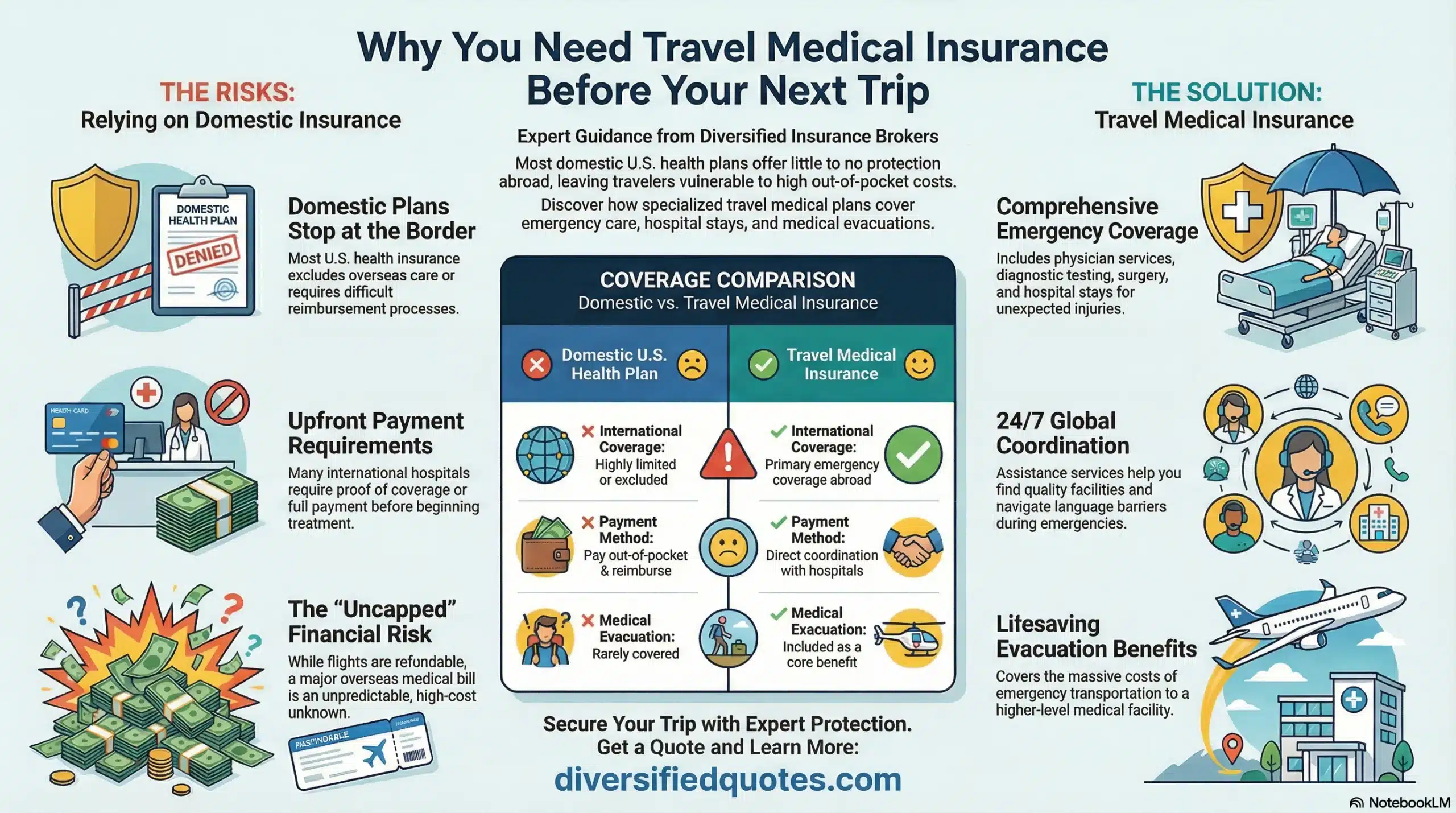
Travel medical coverage is designed for unexpected, urgent situations while you are outside your home health system. In practical terms, it can help pay for eligible emergency doctor services, emergency room care, hospitalization, diagnostic testing, imaging, surgeries, and medically necessary prescriptions. The point is not to replace long-term healthcare, but to provide a financial backstop and a clear structure for emergencies that happen while you are abroad.
Evacuation coverage is designed to solve the escalation problem. If local care is not appropriate for your condition, the plan may cover medically necessary transport to the nearest facility that can provide the required level of care. This is why evacuation is often the highest-cost component of a serious claim. The expense can include specialized transport, medical staffing, routing constraints, and coordination between facilities. Without coverage, those costs can come due immediately and can easily grow beyond what most travelers can comfortably absorb.
Assistance services are the “engine” behind the coverage. Strong plans include a 24/7 assistance team that can help guide hospital selection, coordinate admission, communicate with providers, document approvals, and arrange transportation when evacuation is medically necessary. In most policies, evacuation must be coordinated or authorized through the assistance provider to be eligible for coverage. That is why it’s so important to choose a plan with a robust assistance infrastructure rather than focusing only on a headline benefit number.
What “Medical Evacuation” Actually Means in Real Life
Many people hear “evacuation” and assume it means an air ambulance straight home. In reality, evacuation is a medically-driven transport decision. The assistance team, treating providers, and policy terms work together to determine what is medically necessary and where care can be delivered appropriately. Sometimes that means a short ground transfer to a better-equipped facility. Sometimes it means a commercial flight with a medical escort. Sometimes it means a dedicated air ambulance because that is the only safe option.
Another key detail is that many policies define evacuation as transport to the nearest appropriate facility, not necessarily your home country. Some plans include repatriation once you are stabilized, but that depends on policy language. The right plan for Libya is usually the plan that treats evacuation as a realistic need and provides clear coordination rules, meaningful limits, and a practical path to higher-capability care when the local option is not sufficient.
If you want a deeper overview of evacuation design and what to compare between plans, this guide explains the concept clearly: Emergency Medical Evacuation Insurance.
Example Scenario: Why Coverage Must Be Designed for Escalation
Consider a contractor or journalist operating in Libya who experiences a sudden, serious medical event—such as a trauma injury, neurologic symptoms, severe infection, or a cardiac issue. Initial evaluation might be possible locally, but if the recommended treatment requires specialty intervention, advanced diagnostics, or higher-acuity monitoring, the treating provider may recommend transfer. In that moment, the challenge is not just “What does it cost?” It is “Where can we go, how quickly can we get there, and who coordinates it?”
Without evacuation coverage and a coordinated assistance team, the traveler and their organization may be forced into rapid decisions under stress and financial pressure. With a strong travel medical and evacuation plan, the assistance team can help coordinate the receiving facility, the correct transport method, and the authorization process so the claim stays on track and the traveler gets to the appropriate level of care quickly.
Who Typically Needs This Coverage for Libya
Travel medical and evacuation coverage is most valuable when you cannot rely on “easy access” to advanced care and when the consequences of an emergency are high. That includes contractors, business travelers, security teams, journalists, engineers, consultants, and aid workers. It can also be important for family members joining a spouse or relative for a temporary stay, because a medical event involving a dependent can be even more stressful if coverage and coordination are not already in place.
It’s also a strong fit for travelers whose itinerary includes remote travel, interior routing, or complicated transportation constraints. The farther you are from a high-capability facility, the more important evacuation planning becomes. When you combine distance, time sensitivity, and limited local options, the right coverage is less about convenience and more about financial protection and structured response.
Common Limitations to Understand Before You Buy
Travel medical insurance is powerful, but it is not designed to cover every situation without conditions. Most plans focus on unexpected, urgent medical needs and define specific requirements for high-cost services like evacuation. In many cases, evacuation must be coordinated through the assistance provider except in truly impossible-to-contact scenarios. That one rule alone can determine whether a claim is smooth or difficult, which is why travelers should save the assistance number and understand the process before departure.
Pre-existing conditions also matter. Some policies exclude them entirely. Others offer limited coverage or specific definitions for “acute onset” situations. If you have a known medical history, you should treat plan selection as a design decision, not a checkbox. The same is true for higher-risk activities. If your travel involves off-road routing, rugged work sites, or remote areas, you should confirm whether your coverage requires any riders or excludes certain activities.
The practical approach is to match policy language to your Libya itinerary. If you are traveling for high-risk work, you want clarity on medical maximums, evacuation limits, approval requirements, and how the plan defines “appropriate facility.” If you are traveling for a shorter stay but want strong emergency protection, you still want a plan that can respond quickly and coordinate escalation without confusion.
Why Travelers Use Diversified Insurance Brokers
Travel medical plans can look similar until you actually need them. The differences usually show up in the evacuation framework, the assistance team’s coordination capabilities, and the policy rules that control high-cost services. At Diversified Insurance Brokers, we help you choose coverage that matches how you’re traveling and what risks you realistically face in Libya. Our goal is simple: if something happens, you have a plan that can respond quickly, coordinate care, and protect you from the out-of-pocket shock that can follow a serious emergency.
If you are traveling to Libya for work, assignment travel, or extended stays, the best time to arrange coverage is before you depart. Once an incident starts, coverage gaps cannot be fixed retroactively. Putting your policy in place early means you have your documents, assistance contacts, and a structured plan you can rely on if the unexpected happens.
Get Covered Before You Travel
Apply online now to secure travel medical and evacuation coverage for Libya.
Related Travel Medical Pages
Use these pages to compare plan structures, understand evacuation rules, and match coverage to higher-risk travel and extended stays.
Related Destination Pages
Compare how medical access and evacuation needs change by destination, infrastructure, and distance to advanced care.
Talk With an Advisor Today
Choose how you’d like to connect—call or message us, then book a time that works for you.
Schedule here:
calendly.com/jason-dibcompanies/diversified-quotes
Licensed in all 50 states • Fiduciary, family-owned since 1980
Travel Medical & Evacuation from Libya — FAQs
Do I really need travel medical and evacuation insurance for Libya?
What does “medical evacuation” usually mean under these policies?
Does evacuation automatically mean “back to my home country”?
Do I have to call the assistance team before arranging evacuation?
What medical expenses are typically covered in an emergency?
How much medical and evacuation coverage should I consider for Libya?
Are pre-existing conditions covered?
Is security or political evacuation included?
What should I keep accessible if an emergency happens?
How do I start a claim or get help quickly?
About the Author:
Jason Stolz, CLTC, CRPC and Chief Underwriter at Diversified Insurance Brokers (NPN 20471358), is a senior insurance and retirement professional with more than two decades of real-world experience helping individuals, families, and business owners protect their income, assets, and long-term financial stability. As a long-time partner of the nationally licensed independent agency Diversified Insurance Brokers, Jason provides trusted guidance across multiple specialties—including fixed and indexed annuities, long-term care planning, personal and business disability insurance, life insurance solutions, Group Health, and short-term health coverage. Diversified Insurance Brokers maintains active contracts with over 100 highly rated insurance carriers, ensuring clients have access to a broad and competitive marketplace.
His practical, education-first approach has earned recognition in publications such as VoyageATL, highlighting his commitment to financial clarity and client-focused planning. Drawing on deep product knowledge and years of hands-on field experience, Jason helps clients evaluate carriers, compare strategies, and build retirement and protection plans that are both secure and cost-efficient. Visitors who want to explore current annuity rates and compare options across multiple insurers can also use this annuity quote and comparison tool.
