
Travel Medical Insurance for Studying Abroad

Jason Stolz CLTC, CRPC
Studying abroad is one of the most meaningful experiences a student can have, but it is also one of the easiest times for families to underestimate medical risk. The moment a student lives in another country—even for a single semester—healthcare becomes more complicated. Provider networks do not follow you, billing rules are different, and many clinics require payment up front. Even in countries with strong public systems, international students may not qualify immediately, may not have the same access as residents, or may face delays for non-urgent care. When something unexpected happens, the issue is rarely just “Where do we go?” It is also “How do we navigate a system we do not know, in a stressful moment, without creating a major financial problem?”
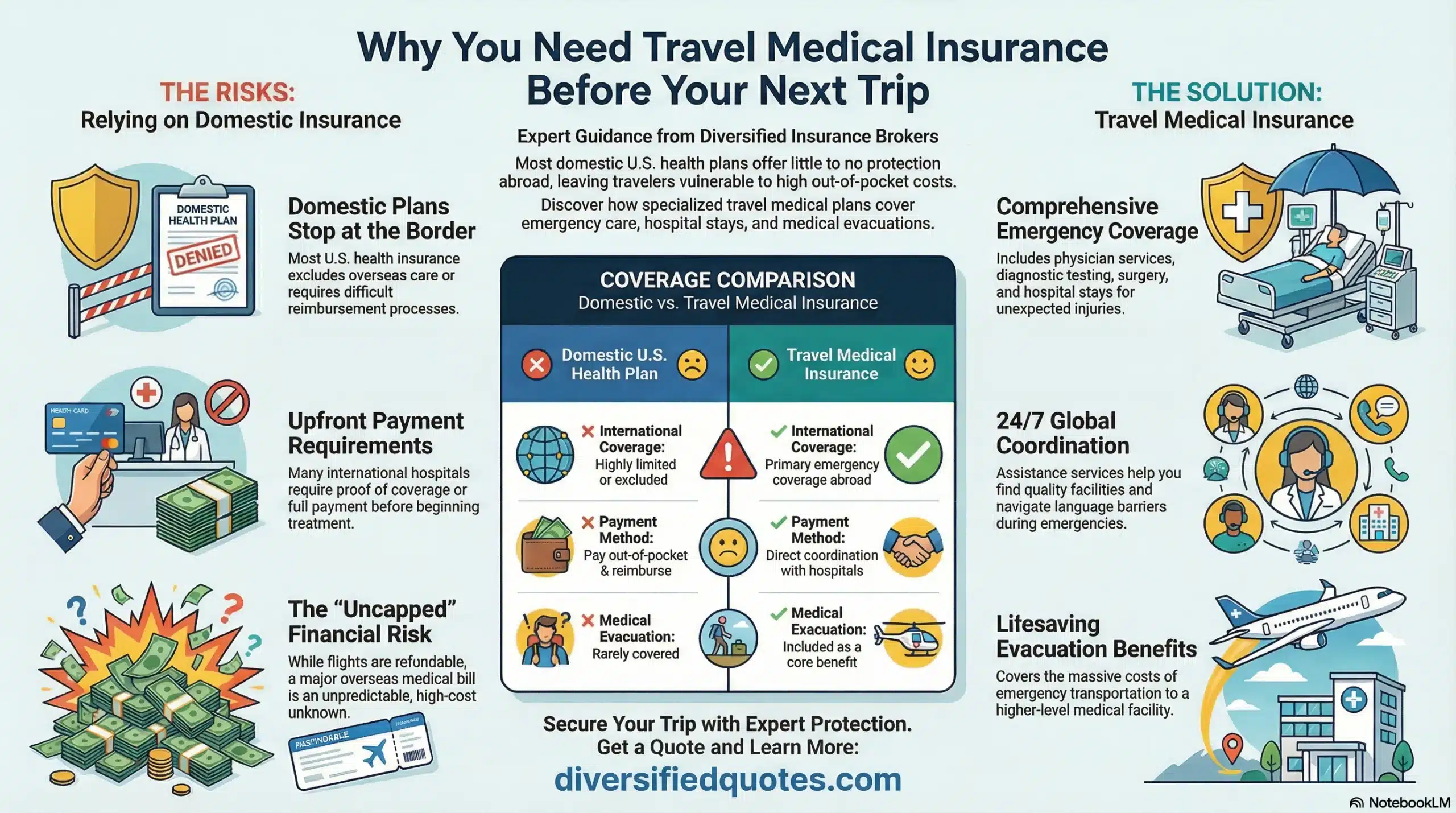
Travel medical insurance for studying abroad is designed to solve that problem. It provides medical coverage for illness and injury while the student is outside their home country, helps reduce out-of-pocket exposure, and often includes assistance services that make it easier to locate appropriate care. The right plan can also include emergency medical evacuation, which is one of the most important benefits for students traveling far from home—especially if the student is outside a major medical hub, traveling during weekends and breaks, or participating in programs that include fieldwork.
At Diversified Insurance Brokers, we help students, parents, and study abroad coordinators compare options and choose coverage that fits the program length, destination, activity level, and any school requirements. This guide explains what travel medical insurance typically covers, how it differs from broader international health plans, what to watch for in the fine print, and how to structure protection that matches real-world student travel—not just a checklist.
Get Study Abroad Travel Medical Options
We’ll help you compare plans, confirm what’s covered, and align coverage with your school’s requirements and travel dates.
Why Travel Medical Insurance Matters for Study Abroad
When students travel, the most common issues are not dramatic emergencies. They are everyday problems that still require care: food-borne illness, strep throat, a sprained ankle, minor infections, allergic reactions, a fever that turns into an urgent visit, or an injury during a weekend trip. Without coverage, these are paid out of pocket, and the total cost can be surprisingly high—especially in major international cities, private clinics, or destinations where non-residents are charged higher rates.
Then there are the serious events families never plan for: appendicitis, a broken bone, severe dehydration, pneumonia, a bad reaction to medication, or hospitalization after an accident. These situations happen every year to students abroad, and they are the exact reason travel medical coverage exists. It is not just “insurance” in the abstract. It is a practical way to access care faster, reduce financial disruption, and avoid turning a medical event into a logistical crisis.
Many study abroad programs also require proof of medical coverage. Some universities provide a school-sponsored plan, while others allow third-party plans if they meet defined minimums. Even when a program has a default plan, families should still confirm what matters most in real life: Does it include emergency medical evacuation? Does it cover travel outside the host country during weekends and breaks? How does it treat sports and activities? What support exists for mental health needs? What do we do first if the student needs care?
If you want a quick baseline on how these policies work overall, start with our overview of Travel Medical Insurance, then use the rest of this page to tailor the decision to a study abroad program.
What Travel Medical Insurance for Studying Abroad Typically Covers
Most student travel medical plans focus on medical care tied to illness or injury that occurs while the student is abroad. Coverage details vary by plan, but the intent is consistent: help pay for treatment, reduce out-of-pocket exposure, and provide support services that make care easier to access.
Core benefits commonly include eligible physician visits, urgent care, emergency room services, hospital stays, outpatient treatment, diagnostic testing (labs and imaging), and prescription medication related to a covered condition. Some plans also include limited follow-up care after an injury when it is medically necessary, and some provide additional services like telemedicine, translation support, or help finding English-speaking providers.
For many families, the most important “big benefit” for study abroad is emergency medical evacuation. If adequate treatment is not available locally, evacuation coverage can help coordinate and pay for transportation to the nearest appropriate facility. That might mean moving the student to a major regional hospital, transferring to another city, or in certain cases coordinating a return to the home country if that is medically necessary and supported by the plan. The coordination element matters because evacuation is not just a flight—it is a medically managed process that often requires clinical handoffs and receiving-facility arrangements.
To understand this benefit in more detail, review Emergency Medical Evacuation Insurance and pay special attention to evacuation limits, how the plan defines “medically necessary evacuation,” and whether the assistance team must coordinate the evacuation for coverage to apply.
Travel Medical vs. International Health Insurance for Students
Families often ask whether travel medical insurance is enough, or if they should look at a broader international health plan. The right answer depends on the length of stay, the destination, and the student’s realistic need for ongoing care.
Travel medical insurance is typically the right fit for semester programs, summer programs, internships, exchange programs, and year-long study abroad where the primary need is coverage for illness and injury plus meaningful evacuation protection. These plans tend to be cost-efficient, quick to purchase, and structured for temporary stays with clear dates.
International health insurance is often more comprehensive and may resemble a domestic-style health plan, including broader benefits that can be useful for longer stays or more consistent access needs. This can be a better fit for students relocating abroad for multiple years, pursuing full degree programs in another country, or needing more routine care access as part of life overseas. If your student’s situation leans in that direction, compare options on our International Health Insurance page so you can match the plan type to the student’s real lifestyle.
A practical way to decide is to ask this: is the student abroad for a defined program with a clear return date and the main goal is protection against unexpected medical costs? If yes, travel medical is often the correct category. If the student is relocating longer-term and will likely need broader ongoing care access, international health insurance may be worth evaluating.
Key Items Schools and Families Should Confirm
Students and parents should review plan details with the same seriousness they give to housing, tuition payments, travel logistics, and program requirements. When a student is abroad, a coverage gap becomes a real-world problem fast.
Coverage territory. If the student plans to travel outside the host country—weekend trips, holiday breaks, travel with classmates—confirm the coverage territory includes those destinations. Some plans provide worldwide coverage, while others have geographic restrictions or limitations.
Policy dates. Match the policy dates to the full travel window, not just class dates. Include arrival days, orientation, and a buffer for travel home. If the program is extended or the student decides to stay longer, confirm whether the plan can be extended without resetting terms or creating gaps.
Pre-existing conditions. Many travel medical plans limit coverage for pre-existing conditions. That does not mean you should skip coverage. It means you should understand the plan’s definition of a pre-existing condition, any look-back period, and whether “stable condition” rules apply. The goal is realistic expectations before travel, not surprises during a claim.
Mental health support. Studying abroad can be stressful and emotionally challenging. Not every travel plan provides meaningful mental health coverage, and benefits vary significantly. If this is important, choose a plan that addresses it clearly rather than assuming it will be included.
Sports and activities. Many students participate in recreational sports, hiking, biking, skiing, and activities that increase injury risk. Some plans exclude injuries tied to certain activities unless a rider is included. If the student will be participating in higher-risk activities, confirm coverage is aligned with that exposure. In those situations, families sometimes compare options under High Risk Travel Insurance or review the broader planning perspective in Travel and Medical Insurance for High Risk Travel.
Why Medical Evacuation Matters More Than Most Families Realize
In a true emergency, families want the student treated quickly and properly. The challenge is that “quickly and properly” may not be available in every location or for every type of condition. Even in many developed countries, access to certain specialists, advanced diagnostics, or rapid admission can vary. If a student is in a rural location, on an island, traveling frequently during the term, or participating in programs that move between cities, the right facility may not be nearby.
Emergency medical evacuation coverage is designed to remove the financial barrier to moving the student to the appropriate level of care. It also provides coordination support when the family is thousands of miles away trying to make decisions under stress. This is one of the benefits you hope you never use, but if it becomes necessary, it can be the difference between a manageable situation and a crisis that spirals.
We often tell families: if you are deciding between a slightly cheaper plan and a plan with stronger evacuation protection, make sure you understand what you are actually giving up. The difference in premium can feel meaningful, but the difference in protection can be enormous when an emergency happens overseas.
How to Think About “Cheap” Coverage Without Sacrificing Protection
Students and families naturally want to keep costs down. The key is to lower cost intelligently without stripping out benefits that matter most. A lower-cost plan can still be a strong plan when it is structured correctly for the destination and length of stay, with appropriate limits and realistic deductibles.
It can help to start with a baseline understanding of what “budget travel coverage” typically looks like and where tradeoffs occur. Our page on Cheap Travel Insurance is useful for understanding deductibles, coverage limits, and why the least expensive plan is not always the best value for a student studying abroad.
For many study abroad situations, the best cost strategy is selecting coverage limits that match the risk profile, choosing a deductible the family can comfortably absorb, and confirming evacuation benefits are meaningful and properly coordinated. That approach often delivers strong protection without paying for features the student is unlikely to use.
Study Abroad Program Structures and How Coverage Should Adapt
Not all study abroad experiences are the same. A semester in a major European city creates different medical realities than a summer program in a rural region, an internship that includes frequent travel, or a research semester that involves fieldwork. The right coverage should match what the student will actually be doing, not just the name of the program.
Programs with structured housing and local support staff can simplify access to care, but the student still needs coverage for off-campus needs, weekend travel, and unexpected events that fall outside program support. Programs involving travel between multiple countries increase the value of broad geographic coverage and strengthen the case for meaningful evacuation support.
If a school or organization is coordinating coverage for groups of students and wants consistency, it can also be helpful to understand how “group” approaches work at a high level. For broader context, see Group Medical Insurance.
How Diversified Insurance Brokers Helps Students and Families
Our role is to make travel medical planning easier and more predictable. We help families compare options, translate policy language into real-world outcomes, and select coverage that aligns with what the student will actually face abroad. We also help clarify what a school requires versus what a family may want for extra protection.
Sometimes the required plan is perfectly adequate. Other times, families add supplemental coverage to strengthen evacuation limits, broaden coverage territory, or address gaps in benefits that matter to them. The right answer depends on the destination, the length of stay, and the student’s personal situation. If you want to start comparing options, use the form above and we will help you identify the most practical fit for your study abroad plans.
Related Travel Medical Pages
Keep exploring to compare coverage structures, evacuation planning, and longer-stay international medical options.
Related Planning Pages
These pages add helpful context for families and coordinators planning coverage for student groups and longer travel windows.
Talk With an Advisor Today
Choose how you’d like to connect—call or message us, then book a time that works for you.
Schedule here:
calendly.com/jason-dibcompanies/diversified-quotes
Licensed in all 50 states • Fiduciary, family-owned since 1980
What is travel medical insurance for studying abroad?
It’s temporary medical coverage that helps pay for illness or injury treatment while a student is outside their home country.
Does travel medical insurance satisfy study abroad requirements?
Often yes, but requirements vary by school and country. Students should confirm coverage limits and benefits match the program’s minimums.
Does it cover emergency medical evacuation?
Many plans include evacuation benefits, but limits and rules vary. Evacuation is one of the most important benefits for students abroad.
Will it cover travel outside the host country?
Some plans cover multiple countries while others have geographic restrictions. If the student will travel during weekends or breaks, confirm territory coverage.
Are pre-existing conditions covered?
Coverage varies by plan and may be limited or excluded. Review how the plan defines pre-existing conditions and any waiting periods.
How long should the policy dates be?
Match the policy to the full travel window, including arrival, orientation, and a buffer at the end in case return travel changes.
Is travel medical insurance the same as international health insurance?
No. Travel medical typically focuses on temporary emergency and illness coverage, while international health insurance is broader and better for long-term relocation.
What if a student needs care and the clinic requires payment upfront?
Many travel medical plans include assistance services and reimbursement structures, but rules vary. Choosing a plan with strong support services can help in these situations.
About the Author:
Jason Stolz, CLTC, CRPC and Chief Underwriter at Diversified Insurance Brokers, is a senior insurance and retirement professional with more than two decades of real-world experience helping individuals, families, and business owners protect their income, assets, and long-term financial stability. As a long-time partner of the nationally licensed independent agency Diversified Insurance Brokers, Jason provides trusted guidance across multiple specialties—including fixed and indexed annuities, long-term care planning, personal and business disability insurance, life insurance solutions, and short-term health coverage. Diversified Insurance Brokers maintains active contracts with over 100 highly rated insurance carriers, ensuring clients have access to a broad and competitive marketplace.
His practical, education-first approach has earned recognition in publications such as VoyageATL, highlighting his commitment to financial clarity and client-focused planning. Drawing on deep product knowledge and years of hands-on field experience, Jason helps clients evaluate carriers, compare strategies, and build retirement and protection plans that are both secure and cost-efficient.
