
What is a NASDAQ Index in an Annuity

Jason Stolz CLTC, CRPC
What is a NASDAQ index in an annuity? In a fixed indexed annuity, a NASDAQ annuity index is usually a benchmark used to calculate interest credits—not an investment you own. If your annuity references a NASDAQ benchmark, you are not buying NASDAQ stocks, you are not purchasing a NASDAQ fund, and you do not hold shares of the companies in the index. Instead, the insurer uses NASDAQ index performance as an input inside a crediting formula, and the annuity credits interest under defined rules (like caps, spreads, or participation rates). This is the key distinction: a NASDAQ annuity index is a measuring tool inside the contract, while your account is typically protected from negative index returns under the strategy terms.
At Diversified Insurance Brokers, we help clients compare indexed annuities across multiple carriers because the index name alone does not tell you how the annuity will behave. When someone says, “This annuity uses NASDAQ,” the real questions are: what crediting method is used, what limits apply, when is interest credited, how do renewals work, what are the liquidity rules, and (if you want income) how do rider costs and rider rules change outcomes? If you want the cleanest foundation before you compare products, start with how annuities earn interest and then review annuity crediting methods. Those pages explain the moving parts that determine what a NASDAQ-based strategy can realistically credit.
A simple way to keep your expectations grounded is this: the NASDAQ annuity index affects how interest is calculated, but it does not turn your annuity into a brokerage account. You’re trading direct market ownership (and unlimited upside) for a contract structure that is designed to reduce downside stress and help retirement planning feel more predictable—especially when your time horizon and withdrawal behavior match the contract’s rules.
Compare Today’s Best Annuity Options
If you’re considering a NASDAQ annuity index strategy, it’s smart to compare it against guaranteed-rate and bonus designs so you can see the real tradeoffs in growth potential, liquidity, and income options.
Want the “mechanics” behind NASDAQ crediting? Start with annuity crediting methods.
What Does “NASDAQ” Usually Mean in Annuities?
In most fixed indexed annuities, “NASDAQ” refers to a benchmark that is used to help calculate interest credits. The most common consumer framing is “NASDAQ-100,” or a methodology closely connected to NASDAQ-100 behavior. That recognition matters because it’s a widely followed growth-oriented benchmark, but the name itself is not the strategy. In an annuity, the strategy is the NASDAQ annuity index plus the crediting method plus the contract limits—then filtered through the annuity’s term rules and renewal structure.
NASDAQ benchmarks are often associated with innovation and technology-heavy companies, which can create strong upside in certain environments and sharper drawdowns in others. That volatility is exactly why it’s important to understand the difference between owning a NASDAQ fund and using a NASDAQ annuity index strategy. In a brokerage account, volatility directly changes your account value every day. In an indexed annuity, volatility is translated into a credited-interest outcome under contract rules. Some periods credit interest (up to the contract’s limit). Some periods credit 0%. Your account does not “track NASDAQ” the same way a fund tracks NASDAQ.
If you want a clear baseline for how indexed annuities work before you focus on NASDAQ specifically, review how a fixed indexed annuity works. Once you understand the 0% floor concept and how crediting terms are applied, the NASDAQ annuity index becomes one index choice among several—not a magical shortcut to market returns.
What Is the NASDAQ Index?
Most people use “NASDAQ index” as shorthand for a widely followed growth benchmark (commonly the NASDAQ-100 concept), which is known for heavy representation from technology, consumer, and innovation-driven businesses. In a traditional investment account, buying a NASDAQ-based fund typically means your account value rises and falls with market pricing. In an indexed annuity, the insurer uses a NASDAQ annuity index as a reference point and may credit interest based on the benchmark’s movement over a defined period—while protecting principal from negative index returns under the annuity’s crediting terms.
That difference is critical for expectations. A NASDAQ annuity index strategy usually does not include dividends in the calculation because most indexed annuity crediting is based on price movement rather than total return. That’s not “hidden.” It’s part of how indexed annuity pricing supports guarantees. The tradeoff is that you generally receive a 0% floor in negative index periods (within the strategy), which many retirement-focused households prefer because it reduces the emotional pressure of market drawdowns.
So the best question is not “Is NASDAQ good?” The better question is: How does this annuity convert NASDAQ movement into credited interest? That is where caps, participation rates, spreads, and method design determine what you can actually receive.
How NASDAQ Is Used Inside a Fixed Indexed Annuity
Fixed indexed annuities credit interest over a defined crediting period—often one year. The contract measures the NASDAQ annuity index result using the method you select, then applies the annuity’s limits to determine your credited interest for that term. If the formula produces a positive result, interest is credited and locked in for that period. If the measured index result is negative, many strategies credit 0% for the period, so your account value typically does not decline due to the market’s movement.
This is why the method matters. A NASDAQ annuity index option is not “one thing.” It might be annual point-to-point. It might be a monthly average. It might be a monthly sum methodology. Each of those methods can behave differently in trending markets versus choppy markets. If you want to compare those structures without relying on marketing language, annuity crediting methods is the best reference point.
It’s also important to understand timing. The contract doesn’t generally credit interest every day. It credits based on a term measurement process. That structure can feel calmer than investing because you’re not watching daily losses, but it also means you must be comfortable with the idea that your credited interest is calculated in “chunks” based on the period rules. A NASDAQ annuity index strategy can be attractive when you want the potential benefits of equity benchmarking, without the day-to-day volatility experience of owning the market.
Cap Rates, Participation Rates, and Spreads: The Levers That Define NASDAQ Outcomes
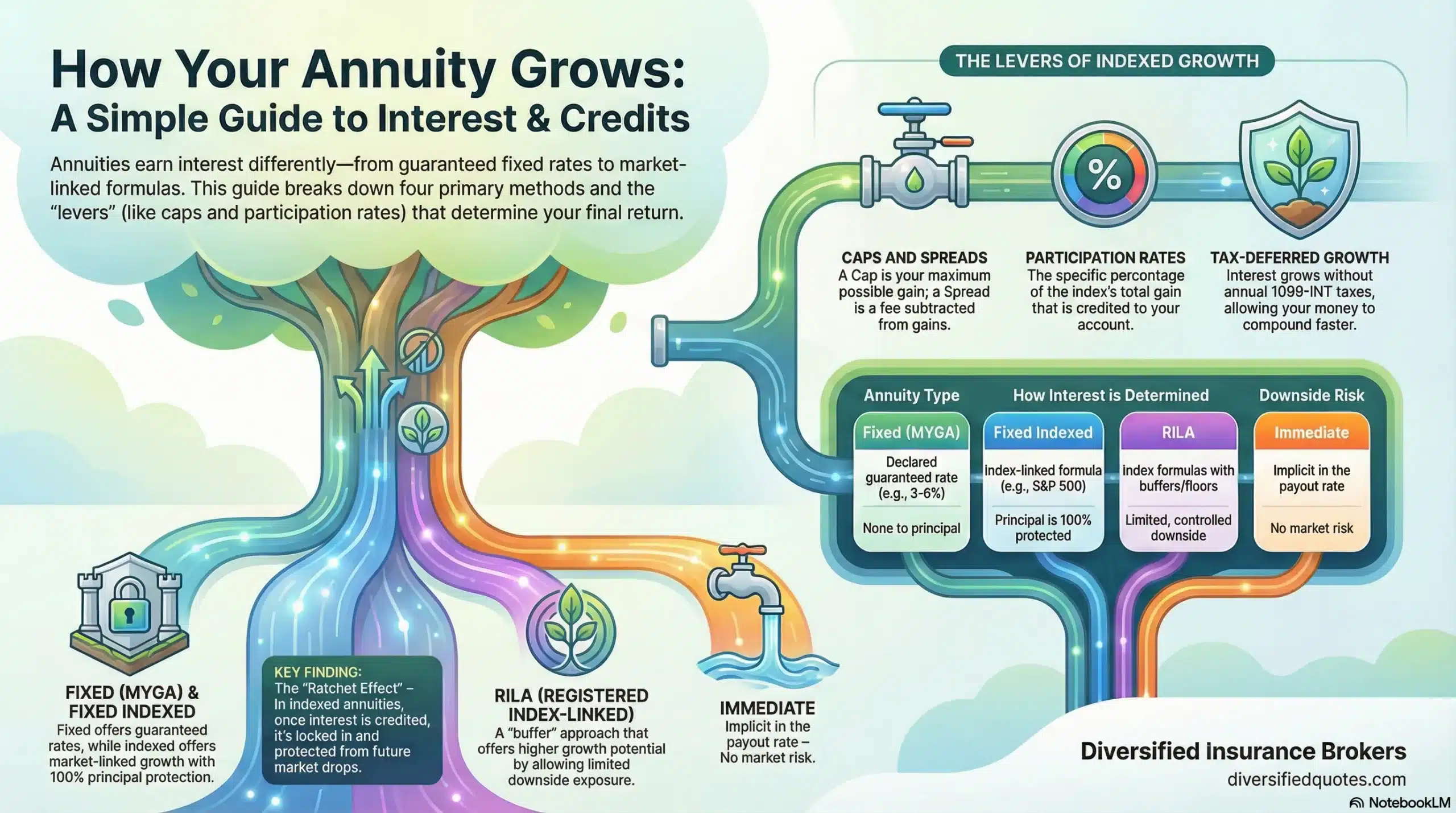
Most indexed annuities use one or more growth controls to translate benchmark movement into credited interest. The big three are caps, participation rates, and spreads. These controls exist because the insurer is designing a contract with principal protection features and predictable crediting mechanics. You can have a NASDAQ annuity index strategy and still have very different outcomes depending on which lever is used and where that lever is set.
A cap sets a maximum credited interest for the term. A participation rate credits a percentage of the measured gain. A spread subtracts a margin from the gain before interest is credited. If you want a clean explanation of cap mechanics (especially important for NASDAQ-linked strategies), review what an annuity cap rate is before you compare illustrations.
These levers can matter even more for a NASDAQ annuity index option because NASDAQ-style benchmarks are often more volatile than broad market measures. More volatility can create stronger positive periods, but it can also increase hedging costs for the insurer. When hedging costs rise, caps or participation rates can look different. That doesn’t mean NASDAQ is “bad.” It means you should interpret NASDAQ crediting as “NASDAQ movement filtered through contract limits,” not as “NASDAQ returns.”
When you compare two products that both reference a NASDAQ annuity index, keep the mindset simple: the index name is the headline; the levers are the reality. That’s why side-by-side comparisons are so important before you commit funds.
Common NASDAQ Crediting Methods in Annuities
Many NASDAQ annuity index options are built on annual point-to-point crediting, which compares the index level at the start of the term to the index level at the end of the term. The measured change is then credited under the contract’s cap, participation, or spread. This approach is straightforward, but it can be sensitive to “endpoint timing”—meaning a strong market that ends with a late-term drop can reduce the measured gain, even if the market was strong for much of the year.
Another common approach is monthly averaging. In many designs, the index level is recorded multiple times (often monthly) and then averaged, which can reduce the impact of a single end-of-term date. This type of approach can make a NASDAQ annuity index option feel smoother across certain market patterns, although the tradeoff can be different caps or different participation structures.
You may also see monthly sum methodologies, where monthly gains are added together (often with a monthly cap) while monthly losses may be limited or treated differently depending on the exact strategy rules. These structures can behave in unique ways when markets trend steadily versus when markets oscillate. This is why you should never assume “NASDAQ strategy” means “one style of crediting.” The method matters just as much as the benchmark name.
If you want a single anchor page to keep you grounded while you compare methods, return to annuity crediting methods. It’s the simplest way to see how a NASDAQ annuity index can be paired with very different measurement rules.
What a NASDAQ Index in an Annuity Does Not Do
A NASDAQ annuity index strategy is not stock ownership. You typically do not receive dividends from the companies in the benchmark. You do not own shares. You generally cannot trade underlying holdings. And you should not expect the annuity to deliver the same results as a NASDAQ fund during strong bull markets because indexed annuities are designed with caps, participation rates, spreads, and crediting methods that limit how much of the benchmark’s movement is converted into credited interest.
On the other side, you also generally do not experience negative benchmark periods as direct losses to your principal within the strategy terms. Many NASDAQ annuity index options credit 0% in a negative index period rather than decreasing your account value. This “floor” can be valuable for retirement-focused households that want to reduce the stress of market drawdowns, especially near the years where sequence-of-returns risk becomes more meaningful.
So the right framing is not “Is this a NASDAQ investment?” The right framing is “Is this a contract structure that uses a NASDAQ benchmark to calculate interest while controlling downside exposure from negative index terms?” That framing helps you evaluate whether the product matches your goal.
Why People Consider NASDAQ-Based Annuity Strategies
Most people are drawn to a NASDAQ annuity index option for one of two reasons. First, they like the idea of tying interest credits to a growth-oriented benchmark while still using a principal-protected contract structure. Second, they want a retirement tool that can potentially credit interest in strong periods without subjecting their account to direct market losses in negative periods under the strategy rules. For many pre-retirees, this isn’t about “beating the market.” It’s about building a plan that still works even if markets are rough early in retirement.
Another motivation is behavioral. Many households underspend in retirement because they are afraid of large portfolio drawdowns. A contract framework that uses a NASDAQ annuity index for upside potential, while limiting downside exposure from negative index terms, can make it easier to stay committed to a long-term plan. That doesn’t mean an indexed annuity replaces investing. It means an indexed annuity can stabilize one portion of the plan so other assets can be used more intentionally.
If you’re still deciding whether annuities fit your overall strategy, our broader page Are annuities worth it? can help you evaluate the tradeoffs in a planning-first way rather than an index-first way.
How NASDAQ Strategies Fit Into Retirement Income Planning
A NASDAQ annuity index strategy is often discussed as an accumulation concept, but many indexed annuities are purchased with income planning in mind. In many cases, the goal is to build an income floor later by using a rider that provides structured withdrawals. When income is part of the plan, the index choice is only one piece of the outcome. Rider rules—like how the income base grows, when step-ups occur, what payout percentages apply, and what fees apply—can have as much impact as the benchmark choice.
If income is your priority, it helps to understand what the income feature actually is. Start with what a GLWB is, then review how a GLWB works. Those pages explain how many riders calculate lifetime withdrawals using a benefit base and payout factors, which means the “income engine” can be driven by rider terms even when the account value is linked to a NASDAQ annuity index for credited interest.
For many households, this is the best mental model: your indexed strategy (NASDAQ-based or otherwise) influences credited interest and account value over time, while the rider (if chosen) influences the guaranteed withdrawal framework. The plan works best when those components match your timeline and your expected behavior—especially how much liquidity you will need and when you intend to start income.
Ensure you are receiving the absolute top rates
💡 Note: The calculator accepts premiums up to $2,000,000. If you’re investing more, results increase in direct proportion — for example, doubling your premium roughly doubles the guaranteed income at the same age and options.
NASDAQ vs. Other Index Choices Inside Annuities
When someone asks whether a NASDAQ annuity index is “better” than another index option, the honest answer is: it depends on the job the annuity is meant to do. If your goal is to tie credited interest to a growth-oriented benchmark and you’re comfortable with caps or participation limits, NASDAQ-based options can be appealing. If your goal is smoother crediting across a wider range of market patterns, another method or benchmark might feel more consistent. If your goal is maximum predictability, you might prefer comparing the indexed strategy against guaranteed-rate designs.
That’s why benchmarking is useful. If you want a conservative comparison point while evaluating a NASDAQ annuity index option, review current fixed annuity rates. If you want to understand how upfront incentives compare, review bonus annuity options. Those comparisons help you see whether NASDAQ-based crediting is the right fit—or whether a simpler structure fits the goal better.
It also helps to compare NASDAQ to other familiar annuity index discussions. For example, if you want a broader benchmark perspective, our page on what an S&P 500 index is in an annuity can help you see how the “index as a measuring tool” concept works across different benchmarks, not just NASDAQ.
Renewals, Strategy Changes, and Why the Index Name Isn’t Enough
One of the most important realities of any NASDAQ annuity index option is that the contract’s crediting terms can change over time within the product’s renewal framework. Many indexed annuities are designed with declared rates—caps, participation rates, and spreads—that can be reset for future terms. This doesn’t mean your annuity is unstable. It means you should evaluate the product as a long-term plan where the insurer can adjust terms within contractual ranges. The best strategy is choosing a design that still makes sense even if declared terms move over time.
That’s also why illustrations should be interpreted carefully. A strong hypothetical return assumption can make any benchmark look amazing. The practical question is what your annuity is likely to credit under a range of market outcomes given the cap/participation/spread structure, the method, and the renewal approach. This is where education matters more than the index label.
We encourage clients to focus on the “plan fit” rather than chasing a headline benchmark. A NASDAQ annuity index strategy can be great for the right timeline and the right role in a retirement plan. It can also be mismatched if you need high liquidity, if you expect to move funds quickly, or if you’re expecting NASDAQ fund-like behavior. The contract is doing something different—and it should be evaluated accordingly.
Who a NASDAQ-Linked Indexed Annuity May Be a Good Fit For
A NASDAQ annuity index option can be a fit for someone who wants the principal-protection framework of an indexed annuity while using a growth-oriented benchmark as one of the available crediting choices. This often includes pre-retirees who want to reduce the risk of a large drawdown as retirement approaches, and retirees who want some upside potential but do not want direct exposure to negative index years within the strategy.
This can also fit a “bucket” plan where the indexed annuity is intended to be a stable base layer—either as conservative accumulation, as future income planning (if paired with an income rider), or as a diversification tool alongside other assets. The fit is strongest when your liquidity needs and your time horizon align with the annuity’s surrender schedule and free-withdrawal rules.
If you want a broader orientation before you decide how to use NASDAQ-based options, our Annuities Hub is a helpful place to see the major annuity categories and typical use cases in one place.
What to Watch Before Choosing a NASDAQ Strategy
When you evaluate a NASDAQ annuity index option, pay attention to four practical areas. First is the crediting method: how is the benchmark measured over the term? Second is the growth control: is the option capped, participation-based, or spread-based (or some combination)? Third is liquidity: what are the surrender rules and free-withdrawal provisions, and how do they interact with your real life? Fourth is income design (if relevant): what rider costs apply and what rules govern withdrawals once income starts?
In many real retirement plans, the biggest disappointment isn’t the index itself—it’s a mismatch between expected behavior and contract mechanics. If you buy a NASDAQ annuity index option expecting equity-like results in every strong market year, caps may feel limiting. If you buy expecting maximum flexibility, surrender schedules may feel restrictive. If you buy primarily for income and you ignore rider details, you may miss the levers that matter most for the payout you actually care about. Clear expectations at the start prevent regret later.
That’s why we keep comparisons simple and side-by-side. The goal is to choose a strategy that still feels good when markets are strong and when markets are uncertain—not a strategy you second-guess based on headlines.
Why Work With Diversified Insurance Brokers
Since 1980, Diversified Insurance Brokers has helped families nationwide compare annuity strategies with a planning-first approach. We’re independent, which means we can compare a NASDAQ annuity index strategy against other index options, fixed-rate annuities, and bonus designs—so you can choose the structure that matches the goal (accumulation, income, or a blend) rather than getting stuck on an index label.
Our job is to help you understand what you’re buying in plain English: how the interest is credited, what the limits are, what renewals can change, what liquidity looks like, and what happens if you add income features. The goal isn’t to “pick the best index.” The goal is to build a retirement strategy that remains stable even when markets and rates change.
Request a Personalized NASDAQ Strategy Comparison
We’ll compare NASDAQ annuity index strategies alongside fixed-rate and bonus options, using your timeline and liquidity needs so the tradeoffs are clear.
Compare NASDAQ Strategies Against Fixed and Bonus Options
If you’re evaluating a NASDAQ annuity index strategy, we’ll compare real contract terms—crediting method, caps/participation/spreads, and liquidity—side by side with fixed-rate and bonus designs.
Talk With an Advisor Today
Choose how you’d like to connect—call or message us, then book a time that works for you.
Schedule here:
calendly.com/jason-dibcompanies/diversified-quotes
Licensed in all 50 states • Fiduciary, family-owned since 1980
FAQs: NASDAQ Index in an Annuity
Am I investing in NASDAQ if my annuity is linked to it?
No. In a fixed indexed annuity, NASDAQ is typically used only as a benchmark to calculate interest credits. You do not own NASDAQ stocks or funds inside the annuity, and your principal is not exposed to market losses from index declines under the terms of the strategy.
Do NASDAQ-linked annuities include dividends?
Most indexed annuity strategies credit interest based on a price index method and do not include dividends in the crediting calculation. The tradeoff is the principal-protection structure and defined crediting rules.
What happens if the NASDAQ index goes down?
In many indexed annuity strategies, a negative index period results in 0% credited interest for that term, not a negative return. Your account value is generally protected from market losses, subject to the contract’s terms and any withdrawals you take.
Why do NASDAQ strategies often have caps or participation limits?
Indexed annuities use caps, participation rates, or spreads to define the maximum credited interest or the portion of index gains you receive. NASDAQ-related benchmarks can be more volatile, and those controls help the insurer support the product’s guarantees and pricing over time.
Is NASDAQ better than the S&P 500 in an annuity?
Not automatically. The index name matters less than the crediting method and limits. A NASDAQ strategy with a tight cap may credit less than a different index strategy with stronger terms. The “best” choice depends on your goal—growth, stability, or income planning.
Can a NASDAQ-linked annuity be used for retirement income?
Yes. Many indexed annuities are designed to be paired with income riders that can provide guaranteed lifetime withdrawals. In those cases, index-linked crediting supports accumulation, while the rider rules determine how income is calculated and when it can begin.
How do I compare NASDAQ annuities to fixed-rate or bonus annuities?
Start by comparing goals and tradeoffs. Fixed-rate annuities focus on predictable declared rates, bonus annuities may emphasize upfront incentives, and NASDAQ-linked indexed annuities aim for market-linked growth with downside protection. The right choice depends on timeline, liquidity needs, and whether income is part of the plan.
About the Author:
Jason Stolz, CLTC, CRPC and Chief Underwriter at Diversified Insurance Brokers (NPN 20471358), is a senior insurance and retirement professional with more than two decades of real-world experience helping individuals, families, and business owners protect their income, assets, and long-term financial stability. As a long-time partner of the nationally licensed independent agency Diversified Insurance Brokers, Jason provides trusted guidance across multiple specialties—including fixed and indexed annuities, long-term care planning, personal and business disability insurance, life insurance solutions, Group Health, and short-term health coverage. Diversified Insurance Brokers maintains active contracts with over 100 highly rated insurance carriers, ensuring clients have access to a broad and competitive marketplace.
His practical, education-first approach has earned recognition in publications such as VoyageATL, highlighting his commitment to financial clarity and client-focused planning. Drawing on deep product knowledge and years of hands-on field experience, Jason helps clients evaluate carriers, compare strategies, and build retirement and protection plans that are both secure and cost-efficient. Visitors who want to explore current annuity rates and compare options across multiple insurers can also use this annuity quote and comparison tool.
