
What is Critical Illness Insurance

Jason Stolz CLTC, CRPC
Critical illness insurance is one of the most strategically underutilized forms of personal protection available today. While most people focus on health insurance, life insurance, or disability coverage, few fully understand the financial shock a serious diagnosis can create—even when traditional insurance is in place. A heart attack, stroke, invasive cancer diagnosis, or organ failure can trigger not only medical bills but also income disruption, travel expenses, home modification costs, and prolonged recovery time. Critical illness insurance was designed specifically to provide immediate liquidity at the moment of diagnosis, allowing individuals and families to focus on treatment and recovery rather than financial survival.
Unlike traditional health insurance, which reimburses hospitals and physicians according to negotiated fee schedules, critical illness insurance pays a lump sum benefit directly to you after confirmation of a covered diagnosis. The payment is not restricted to medical bills. It is not tied to receipts. It is not coordinated with deductibles. It is your money, delivered at one of the most financially vulnerable moments in your life. That distinction is what makes critical illness insurance fundamentally different from other coverage types.
Get a Personalized Critical Illness Quote
Compare benefit amounts, covered conditions, and pricing across top-rated carriers.
Start Your Quote ReviewWhy Financial Shock Is the Real Risk
When most people think about major illness, they think about survival rates and treatment protocols. They rarely think about liquidity. Yet liquidity is often the defining factor in how families navigate recovery. Even strong employer health plans can include deductibles in the thousands of dollars, co-insurance requirements, out-of-network penalties, and non-covered therapies. Travel for specialized treatment, childcare during hospital stays, unpaid time off work, and household support services create additional financial pressure.
For individuals enrolled in high-deductible health plans, exposure can be significant. Many families rely on emergency savings to absorb short-term disruptions, but a prolonged recovery can exhaust reserves quickly. Critical illness coverage transforms a medical crisis into a funded event. Instead of scrambling to cover mortgage payments or liquidating retirement accounts, policyholders receive an immediate cash infusion that stabilizes the household.
How Critical Illness Insurance Actually Works
The structure is straightforward. You select a benefit amount—often ranging from $10,000 to $100,000 or more. You pay a fixed premium. If you are diagnosed with a covered condition that meets the policy definition, the insurer pays the lump sum benefit directly to you. Most policies include a survival period requirement, typically 14 to 30 days after diagnosis, before benefits are payable. Once that requirement is met and documentation is reviewed, payment is generally issued within weeks.
Some modern policies offer partial benefits for less severe conditions or early-stage diagnoses. Others include recurrence benefits if the illness returns after a specified waiting period. The nuances matter. Definitions matter. That is why reviewing contract language—not just marketing summaries—is critical when selecting coverage.
Conditions Commonly Covered
Although coverage varies by carrier, most policies focus on illnesses statistically associated with high treatment costs and significant recovery time. Heart attack, stroke, and invasive cancer are foundational conditions across nearly all contracts. Many policies also include organ transplant, end-stage renal failure, major burns, paralysis, coma, and certain neurological disorders.
It is important to understand that definitions are clinical and precise. For example, a “heart attack” must meet specific enzyme elevation criteria. A “stroke” must result in measurable neurological deficit lasting a defined period. Cancer definitions may exclude certain early-stage or non-invasive forms. These details are not minor technicalities—they determine claim eligibility. Our advisors walk clients through these distinctions so expectations align with policy design.
The Tax Treatment of Benefits
In most cases, benefits paid from individually purchased critical illness policies are received income tax free, provided premiums were paid with after-tax dollars. This tax efficiency enhances the practical value of the coverage. Unlike withdrawals from retirement accounts—which may trigger taxation and potentially affect Medicare premiums—critical illness benefits typically arrive without erosion from federal income tax.
This distinction becomes particularly important for individuals nearing retirement who are carefully managing taxable income thresholds. For those already evaluating broader financial protection strategies such as life insurance cost comparisons or reviewing supplemental income options, tax treatment should always be factored into the planning conversation.
Critical Illness vs Disability Insurance
Critical illness insurance and disability insurance are often confused, yet they serve very different roles. Disability insurance replaces a portion of income if you cannot work due to illness or injury. Benefits are typically paid monthly and may continue for years. Critical illness insurance, by contrast, pays a single lump sum upon diagnosis of a qualifying condition, regardless of employment status.
For many households, the most effective protection strategy involves coordination between the two. Disability coverage addresses ongoing income replacement. Critical illness coverage provides immediate liquidity for upfront expenses and recovery-related disruptions. Clients frequently ask whether disability insurance is expensive compared to critical illness coverage. The answer depends on occupation, benefit period, and health status—but combining smaller amounts of each can create a balanced protection plan.
Build a Coordinated Protection Plan
We help integrate critical illness, disability, and life insurance into one structured strategy.
Request Strategy SessionCost Analysis and Affordability
Premiums are primarily determined by age, gender, tobacco use, health history, and benefit amount. Younger applicants typically secure extremely affordable rates. Even for individuals in their 40s or 50s, moderate benefit amounts often cost less than many monthly subscription services. The affordability factor is one reason critical illness coverage has grown in popularity among self-employed professionals and small business owners.
While average premiums for healthy adults may range from $15 to $50 per month for moderate coverage, pricing varies by carrier and underwriting classification. Unlike health insurance premiums—which can fluctuate annually—critical illness premiums are typically level for the life of the policy.
Standalone Policy or Rider?
Critical illness coverage can be purchased as a standalone policy or added as a rider to certain life insurance contracts. When attached to life insurance, it may accelerate a portion of the death benefit upon diagnosis of a qualifying illness. This design can be efficient, but it reduces the remaining death benefit. Standalone policies preserve life insurance protection while providing a separate pool of funds for living benefits.
Clients already reviewing term life quotes using tools such as a term life insurance calculator often ask whether adding a rider is sufficient. The answer depends on overall coverage objectives and risk tolerance. In many cases, combining standalone coverage with base life insurance creates greater flexibility.
Who Should Seriously Consider Critical Illness Coverage
Critical illness insurance is particularly valuable for individuals with high-deductible health plans, families dependent on a single income, self-employed professionals lacking employer-paid benefits, and households with limited emergency savings. It is also worth evaluating for individuals with a family history of cardiac disease or cancer, as well as those approaching retirement who want to protect accumulated assets from sudden medical withdrawal pressure.
For clients who already understand the cost realities of health insurance premiums and are evaluating broader protection layers such as long-term care insurance, critical illness fills a distinct short-to-mid-term gap.
Behavioral Finance and Recovery Stability
Financial strain amplifies stress during medical recovery. Studies consistently show that financial anxiety can slow rehabilitation and reduce overall well-being. Having a dedicated lump sum available immediately after diagnosis changes decision-making dynamics. It allows patients to seek second opinions, explore specialized treatment centers, reduce work obligations temporarily, and focus on health without immediate financial trade-offs.
How Diversified Insurance Brokers Structures Coverage
As an independent agency licensed nationwide, we compare multiple carriers and policy structures rather than pushing a single proprietary product. We analyze definitions, survival period requirements, recurrence benefits, premium guarantees, and underwriting criteria. We coordinate coverage with existing disability, accident, and life insurance plans to eliminate redundancy and avoid gaps.
Our role is advisory. We help clients evaluate whether coverage should be standalone or rider-based, determine appropriate benefit sizing, and assess affordability relative to overall financial objectives. We do not treat critical illness insurance as a sales add-on—it is positioned within a broader protection architecture.
Secure Financial Stability During Medical Crisis
Receive a customized critical illness insurance comparison tailored to your health and financial profile.
Get Your Personalized Quote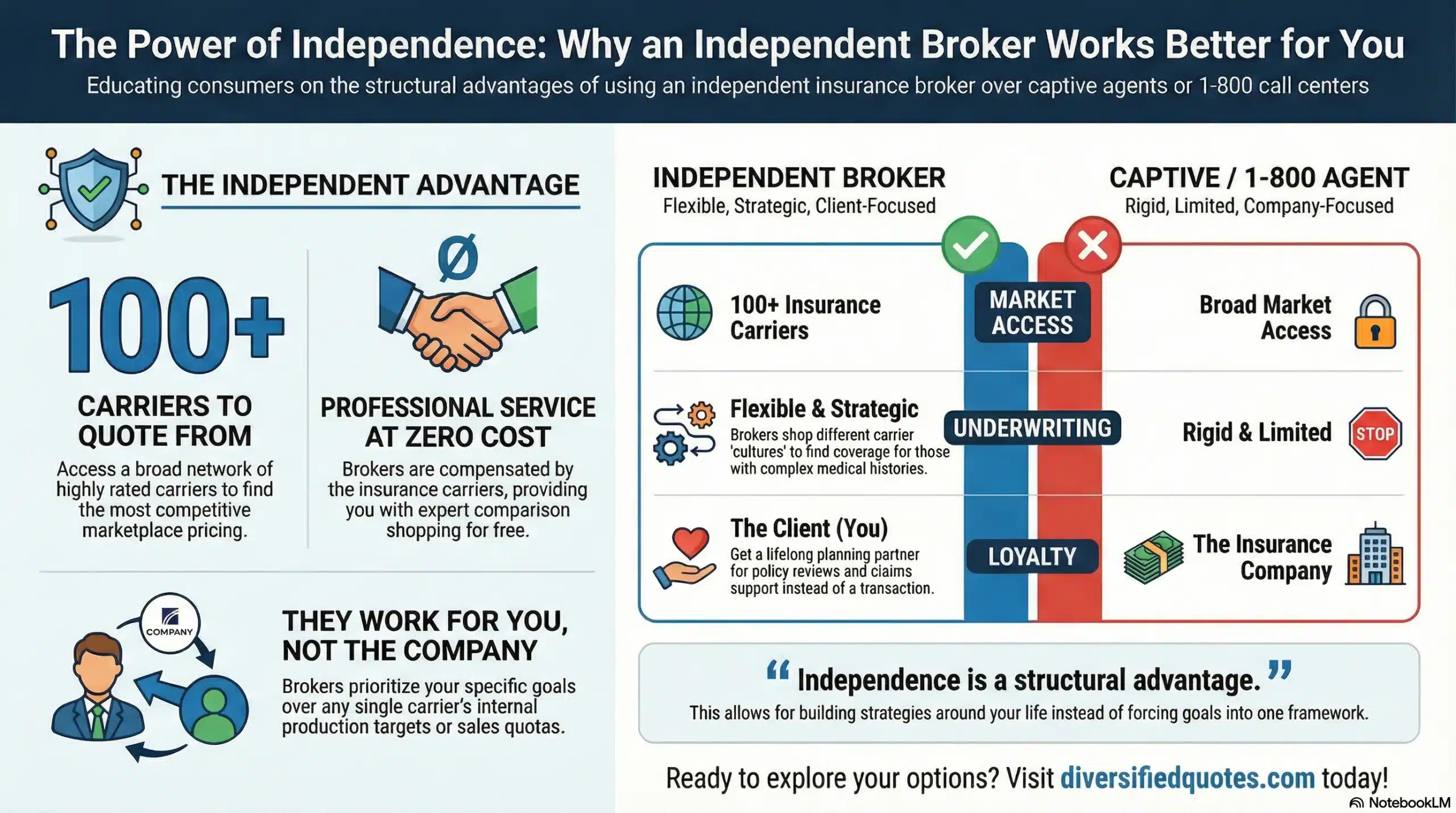
Talk With an Advisor Today
Choose how you’d like to connect—call or message us, then book a time that works for you.
Schedule here:
calendly.com/jason-dibcompanies/diversified-quotes
Licensed in all 50 states • Fiduciary, family-owned since 1980
FAQs: Critical Illness Insurance
What does critical illness insurance cover?
It covers serious health conditions such as heart attack, stroke, invasive cancer, or major organ failure—paying a lump sum directly to you.
How is critical illness insurance different from health insurance?
Health insurance pays medical providers. Critical illness coverage pays you a lump sum to spend however you wish—medical or personal expenses.
Can I have critical illness and disability insurance?
Yes. Many people pair them. Critical illness provides an upfront cash benefit; disability coverage provides monthly income replacement.
Is critical illness insurance expensive?
Not typically. Most healthy adults pay between $15–$50 per month depending on age, coverage, and medical history.
Who should consider critical illness coverage?
Anyone concerned about large out-of-pocket medical costs, income loss, or family financial protection after a serious diagnosis.
About the Author:
Jason Stolz, CLTC, CRPC and Chief Underwriter at Diversified Insurance Brokers (NPN 20471358), is a senior insurance and retirement professional with more than two decades of real-world experience helping individuals, families, and business owners protect their income, assets, and long-term financial stability. As a long-time partner of the nationally licensed independent agency Diversified Insurance Brokers, Jason provides trusted guidance across multiple specialties—including fixed and indexed annuities, long-term care planning, personal and business disability insurance, life insurance solutions, Group Health, and short-term health coverage. Diversified Insurance Brokers maintains active contracts with over 100 highly rated insurance carriers, ensuring clients have access to a broad and competitive marketplace.
His practical, education-first approach has earned recognition in publications such as VoyageATL, highlighting his commitment to financial clarity and client-focused planning. Drawing on deep product knowledge and years of hands-on field experience, Jason helps clients evaluate carriers, compare strategies, and build retirement and protection plans that are both secure and cost-efficient. Visitors who want to explore current annuity rates and compare options across multiple insurers can also use this annuity quote and comparison tool.
