
Why Bonus Annuities Could Be the Smartest Move for Your Retirement
Not all annuities are created equal—and bonus annuity rates are designed to reward you from the very beginning. Instead of starting at “zero” and waiting for interest credits to build value, a bonus annuity adds an upfront percentage credit to your contract (or to a defined value inside the contract). For retirees and pre-retirees who want guaranteed-style planning, the right bonus structure can improve long-term income projections, strengthen early value, or create a better long-run outcome than a non-bonus version of a similar annuity.

The most important thing to understand is that a bonus is not a “free gift.” It is part of the contract design. Some bonuses are applied to the value used to calculate lifetime income. Some are applied to the account value you can withdraw. Some are applied to a separate value that affects death benefit or rider math. And in many cases, a bonus is paired with trade-offs such as longer surrender schedules, different index crediting terms, or rider fees that must be evaluated alongside the bonus itself.
This page breaks down how bonus annuities work in real life, what questions to ask before you buy, and how to compare bonus annuity rates intelligently—so you’re choosing a contract that fits your retirement plan instead of chasing the biggest number on a marketing sheet.
Ensure You’re Receiving the Absolute Top Rates
Compare fixed and bonus annuity options, then model potential guaranteed income to see what design actually fits your retirement timeline.
Bonus Annuity Rates and Benefits You Should Know
A bonus annuity is an annuity contract that includes an upfront credit—typically expressed as a percentage of your premium—that increases a value inside the policy at or near issue. The purpose is simple: give your contract a head start that can improve projected outcomes over time, especially when the contract is held long enough for the design to do what it’s built to do.
Where people get into trouble is assuming every bonus works the same way. Two annuities can both advertise a “10% bonus,” yet the actual value you can access, the income it can generate, and the trade-offs you accept can be completely different. The smartest way to compare bonus annuity rates is not “highest bonus wins.” The smartest way is to identify the goal first—income, accumulation, or legacy—and then evaluate how the bonus interacts with the features that create that goal.
If you want the shortest “definition” possible, think of bonus annuities like this: you are trading something (usually time, surrender flexibility, or pricing mechanics) for an upfront boost in a contract value that is meaningful only if you use the contract as intended.
Where the Bonus Shows Up (Account Value vs Income Value vs Death Benefit)
When you see a bonus annuity rate advertised, your first job is to ask: Where does the bonus apply? In annuity design, different “values” can exist inside the same contract. One value might be used for withdrawals. Another might be used only to calculate lifetime income. Another might apply to beneficiary outcomes. The bonus may increase one value but not the others.
Account value (accumulation value) is the amount that typically determines what you can withdraw (subject to surrender rules) and what beneficiaries receive during the accumulation phase. If the bonus applies to the account value, that can be meaningful, but the design may still include surrender schedules and other mechanics that influence actual usable liquidity.
Income value (benefit base) is a separate number used to calculate guaranteed lifetime income when an income rider is turned on. This value is often not “cash,” and it usually cannot be withdrawn as a lump sum. Its purpose is to determine a future payout stream. If your goal is dependable income, a bonus applied to the income value may be the most relevant bonus of all—because it can raise the base used for your payout calculation.
Death benefit enhancements can also exist, depending on the contract structure. If your planning includes beneficiary outcomes, it helps to understand how annuity beneficiary rules work in general before you rely on a specific enhancement. You can explore that here: Annuity beneficiary death benefits.
A Simple Bonus Example (and Why the Details Matter)
Suppose you deposit $1,000,000 into a bonus annuity offering a 10% bonus. The contract may show an immediate additional credit of $100,000. That looks powerful—and sometimes it is. But your outcome depends on what the bonus affects and how the contract calculates growth and income.
If the bonus increases the income value, it may raise the future guaranteed payout because income is often calculated as a payout percentage applied to that base. In that case, the bonus can improve the lifetime income projection even if the account value grows differently. On the other hand, if the bonus increases an internal value but comes with a materially longer surrender schedule, you need to be comfortable holding the contract long enough to let that design work.
This is why “bonus annuity rates” must be evaluated alongside time horizon. If your plan is uncertain, and you may need liquidity beyond typical free withdrawal rules, a bonus can become a mismatch. If your plan is stable and income-focused, the bonus might be a legitimate advantage.
The Trade-Offs: Bonuses Aren’t Free (and That’s Okay)
The right bonus annuity can be genuinely useful, but it is always part of a trade. Most bonus designs are paired with one or more of the following: a longer surrender period, different index crediting features, rider fees, or contract mechanics that change how growth is credited. None of those trade-offs are automatically “bad.” They just need to match your goal.
A common example is a bonus fixed indexed annuity where the contract offers an upfront bonus to the income value, then uses specific crediting strategies or caps/spreads that differ from non-bonus versions of similar products. Another example is a bonus attached to an income rider that carries an annual fee. The rider fee might be worth it if it buys a higher guaranteed payout you actually plan to use.
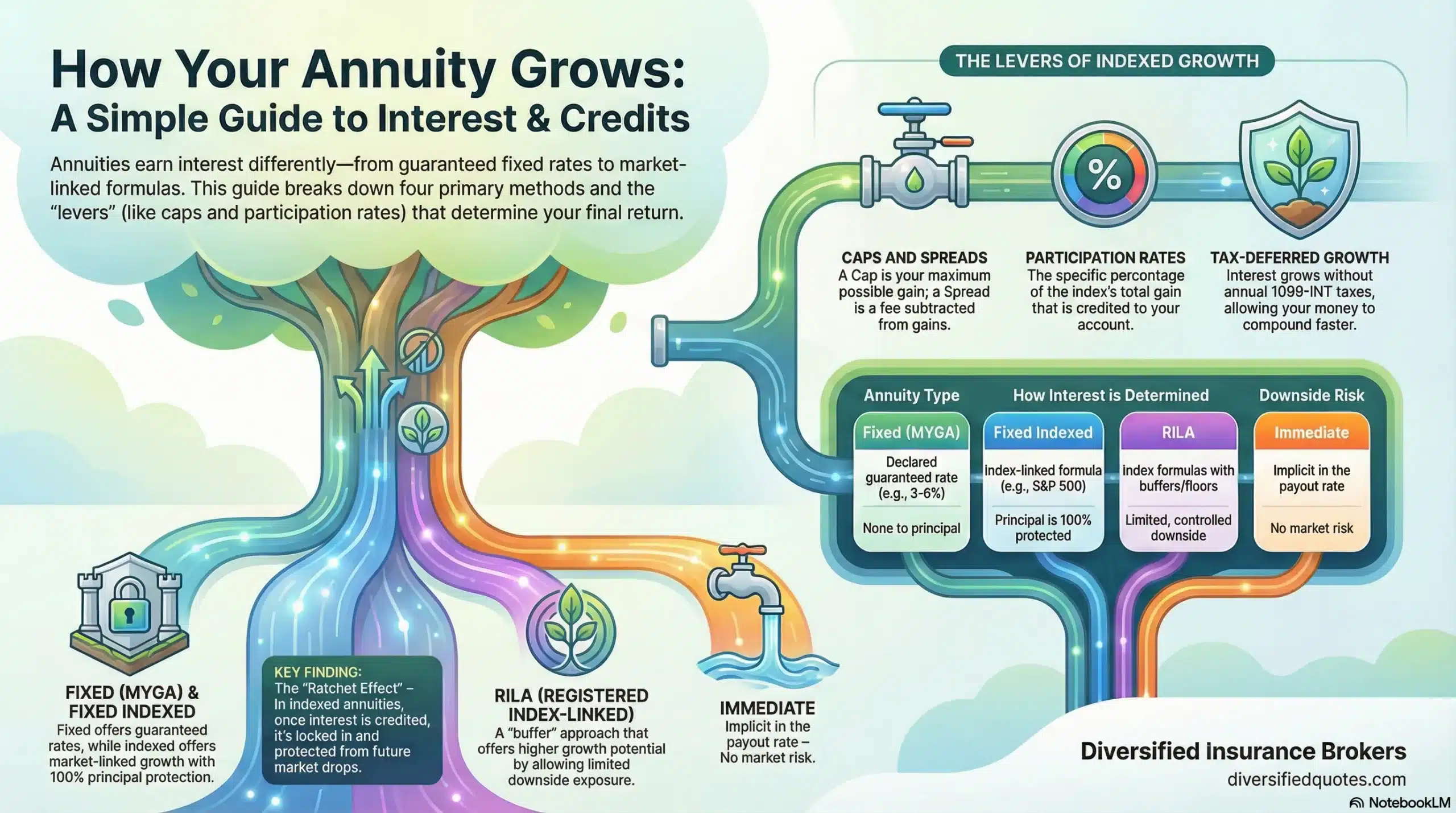
If you want a clearer understanding of one of the most common “behind the scenes” mechanics used in indexed annuities, this is a helpful explainer: What is an annuity spread rate?. The point isn’t that spreads are “good” or “bad”—the point is knowing what you’re trading for the bonus and how the long-run math tends to work.
Who Bonus Annuities Fit Best
Bonus annuities tend to fit best when you have a clear plan, a stable time horizon, and a reason to favor contract-based guarantees over market exposure for a portion of retirement assets. They can be especially relevant for people who want to create dependable income later, reduce sequence-of-returns risk, or structure retirement cash flow in a way that doesn’t depend on selling assets in down markets.
They can also be attractive when you have a defined income start date, because the bonus can increase the base used for payout calculations and potentially improve your long-run projected income stream. If you are building a plan around guaranteed income, it’s important to compare rider-based income designs carefully. A useful companion read is: How do annuity income riders work?.
On the other hand, if you know you will need large liquidity soon—or your timeline is uncertain—bonus annuities may not be the best fit because the bonus is usually paired with term commitment. In those cases, we often focus on structuring liquidity first, then using guarantees more selectively.
Liquidity and Free Withdrawal Rules (What You Can Access and When)
Bonus annuities often include the same general “free withdrawal” concept used across many deferred annuities, but the details matter. In many contracts, you may be able to withdraw up to a set percentage (often 10% annually) without surrender charges after the first contract year. That flexibility can be helpful for taxes, planned needs, and unexpected expenses. However, withdrawals beyond the free amount during the surrender period typically trigger surrender charges—and in some products, additional adjustments.
If you want a plain-English overview of what “free withdrawals” actually mean across annuities, this guide is the best starting point: Annuity free withdrawal rules. The practical takeaway is that “liquidity” in annuities is structured. The contract can be very consumer-friendly, but you must align it with your plan.
One more reality: bonus designs often assume you are holding long enough for the bonus and income mechanics to matter. If you pull money early, the contract isn’t being used as intended, and the “bonus benefit” can be reduced by trade-offs you accepted on day one.
Model Guaranteed Income and Compare Bonus Designs
Bonus annuities are often income-driven. Use the calculator below to estimate how premium size, age, and start date can impact projected guaranteed payouts.
💡 Note: The calculator accepts premiums up to $2,000,000. If you’re investing more, results increase in direct proportion — for example, doubling your premium roughly doubles the guaranteed income at the same age and options.
How to Compare Bonus Annuity Rates the Smart Way
If you want to compare bonus annuity rates like a professional, start with your objective. If the objective is income, you care most about how the bonus affects the income value, what payout factors apply at your income start date, what rider fee exists (if any), and what the contract requires for the income guarantee to be meaningful. If the objective is accumulation, you care about how interest is credited, what caps/spreads/participation rates look like, and whether the bonus is applied to a value you can actually access. If the objective is legacy, you care about beneficiary rules, death benefit provisions, and how withdrawals or income elections affect the remaining value.
Next, evaluate the time horizon honestly. A bonus design typically assumes you are holding through the surrender period and beyond. That doesn’t mean you can’t access any money, but it does mean the contract is built around a longer planning window. If your plan is “maybe I’ll need half of this next year,” a bonus annuity is usually a mismatch.
Then compare the contract structure against alternatives. Sometimes a “non-bonus” product with cleaner crediting terms produces a similar long-run result. Sometimes a bonus truly improves the outcome, especially for income-focused designs. The only reliable way to know is to compare illustrations under the same assumptions and time horizon—using the same premium, the same age, and the same income start date.
If you want a broader perspective on where annuities fit (and where they don’t), this is a helpful reality-check framing: Are annuities a good investment?.
Common Bonus Annuity Misconceptions (That Can Cost You)
One misconception is thinking the bonus is “extra cash” you can pull out immediately. In many designs, the bonus is most meaningful over time, or it is applied to a value that is not meant for lump-sum access. Another misconception is assuming the highest bonus automatically produces the highest income. Income is the result of the entire contract: income value, roll-up features (if present), payout factors, fees, and the time you hold before you start income.
Another misconception is thinking bonus annuities are “always better” than non-bonus versions. Sometimes they are, especially when the bonus aligns with your goal. Sometimes the bonus is simply one design choice among many, and the “best” answer depends on how you plan to use the annuity. If you want a broader myth-busting overview of fixed indexed annuities in general, this page is a strong read: Fixed indexed annuity myths debunked.
The safest approach is to compare designs with clarity: understand which value gets the bonus, what you are trading for it, and how the contract behaves if life changes.
Get a Side-by-Side Bonus Annuity Comparison
We’ll compare bonus annuity designs based on your timeline and goal (income vs accumulation), so you can see which contract performs best over time—not just on day one.
When a Bonus Annuity May Not Be the Right Tool
Bonus annuities are not a universal solution. If you need near-term liquidity beyond typical free withdrawal allowances, a bonus design can add complexity without a clear payoff. If you are highly rate-sensitive and want the simplest fixed-rate growth with minimal moving parts, a pure fixed annuity or MYGA approach may be cleaner for that portion of your plan.
Another reason a bonus can be a mismatch is if your goal is primarily short-term parking. A bonus design usually assumes a longer horizon. If the horizon is short, you may end up paying the “cost” of the bonus (in time commitment or design constraints) without realizing its benefit.
For people who want predictable, rate-driven planning, it often helps to compare bonus designs against fixed-rate options at the same time. Start here for the fixed side of the comparison: Current fixed annuity rates.
Compare Bonus vs Fixed Annuity Strategies (With Real Illustrations)
If you’re trying to decide between “highest rate,” “highest bonus,” or “best income,” the fastest way to clarity is a controlled, apples-to-apples comparison.
Related Pages to Explore
Keep learning with these guides on bonus designs, fixed-rate options, income planning mechanics, and annuity rules that affect real-life outcomes.
Financial Protection Essentials
Explore annuity interest examples across different investment sizes along with professional disability insurance options and long-term care planning resources.
Talk With an Advisor Today
Choose how you’d like to connect—call or message us, then book a time that works for you.
Schedule here:
calendly.com/jason-dibcompanies/diversified-quotes
Licensed in all 50 states • Fiduciary, family-owned since 1980
FAQs: Bonus Annuity Rates
About the Author:
Jason Stolz, CLTC, CRPC and Chief Underwriter at Diversified Insurance Brokers (NPN 20471358), is a senior insurance and retirement professional with more than two decades of real-world experience helping individuals, families, and business owners protect their income, assets, and long-term financial stability. As a long-time partner of the nationally licensed independent agency Diversified Insurance Brokers, Jason provides trusted guidance across multiple specialties—including fixed and indexed annuities, long-term care planning, personal and business disability insurance, life insurance solutions, and short-term health coverage. Diversified Insurance Brokers maintains active contracts with over 100 highly rated insurance carriers, ensuring clients have access to a broad and competitive marketplace.
His practical, education-first approach has earned recognition in publications such as VoyageATL, highlighting his commitment to financial clarity and client-focused planning. Drawing on deep product knowledge and years of hands-on field experience, Jason helps clients evaluate carriers, compare strategies, and build retirement and protection plans that are both secure and cost-efficient. Visitors who want to explore current annuity rates and compare options across multiple insurers can also use this annuity quote and comparison tool.
