
Why Fixed Annuities Are the Hidden Gem of Retirement Planning
When it comes to retirement planning, many investors focus heavily on stock market returns, dividend portfolios, or real estate appreciation. Yet for individuals who prioritize safety, predictability, and guaranteed income, fixed annuities offer a powerful—and often underrated—solution. In a world where markets can fluctuate dramatically and bond yields shift with interest rate cycles, fixed annuities provide something increasingly rare: contractual guarantees. With competitive interest rates, tax-deferred growth, and zero exposure to market losses, they can protect your retirement savings while delivering steady, dependable growth. For retirees and pre-retirees who want to reduce volatility without sacrificing return potential, fixed annuities have become an essential planning tool.

At Diversified Insurance Brokers, we help clients compare fixed annuity products from more than 75 top-rated insurance carriers nationwide. Because we are independent, we are not limited to one company’s rates or features. Instead, we shop the marketplace to ensure you receive competitive terms aligned with your timeline and goals. Many of our clients are surprised to discover that today’s fixed annuities can offer interest rates that compete with—or outperform—many traditional bank CDs, often reaching the 6% range depending on term and carrier. Unlike CDs, however, annuities offer tax-deferred compounding and flexible payout options that can be structured for lifetime income. If you want to see how current yields compare across the market, review our current fixed annuity rates page to evaluate available terms.
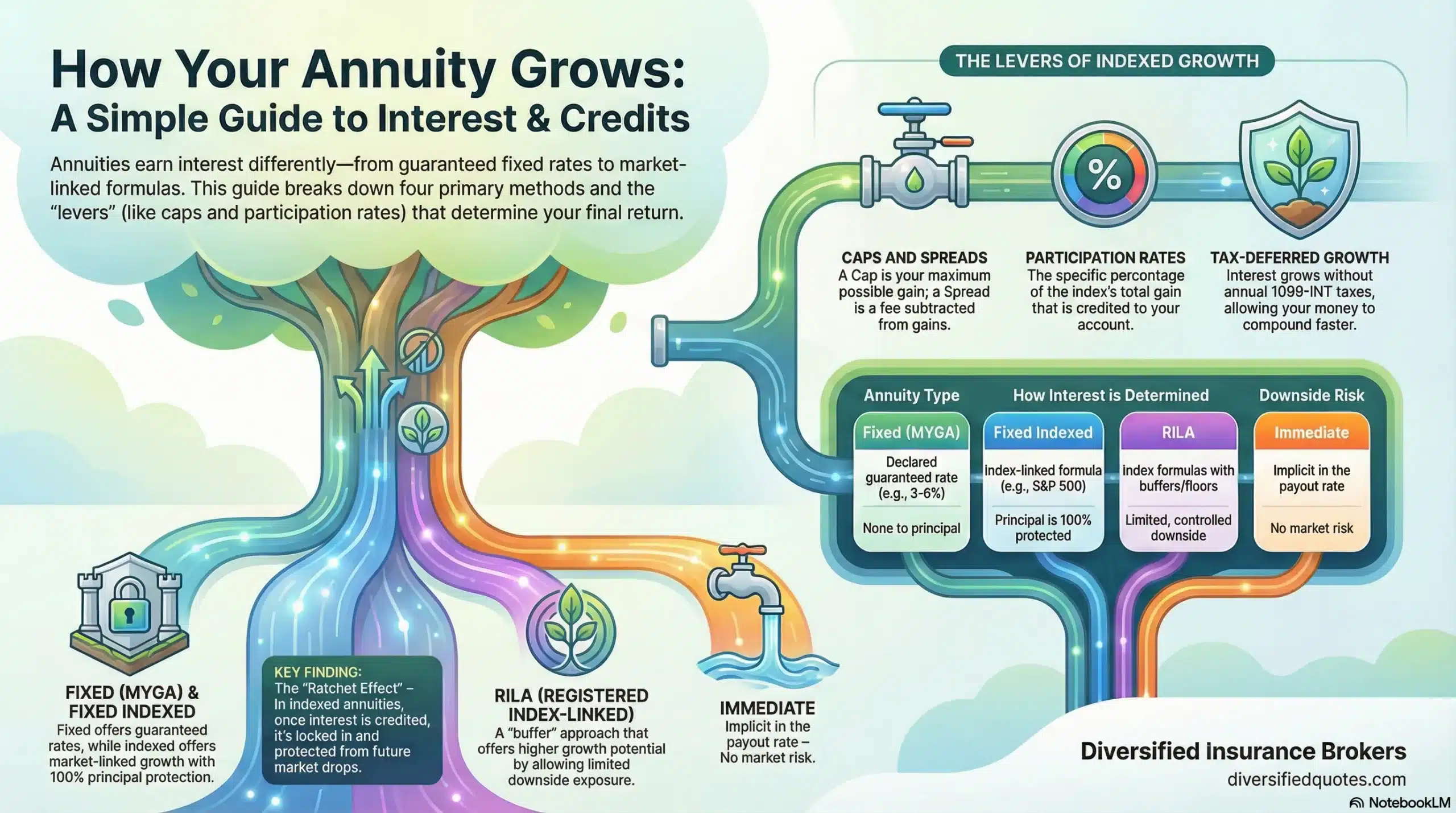
Fixed annuities are straightforward insurance contracts. You deposit funds for a selected term—commonly between one and ten years—and the insurance company guarantees a declared interest rate for that period. Your principal does not fluctuate with market conditions, and your credited interest is locked in annually. This predictability makes fixed annuities attractive for conservative investors who are approaching retirement or already drawing income. They also serve as a stabilizing component in diversified portfolios, helping offset volatility from equities or other risk assets. If you’re comparing multiple structures, exploring what a deferred annuity is can clarify how accumulation-focused contracts differ from immediate income options.
Tax deferral is one of the most overlooked advantages of fixed annuities. Interest compounds inside the contract without annual taxation. Instead of paying taxes on earnings each year—as you would with most bank accounts—you defer taxation until withdrawal. Over time, this can significantly increase compounding efficiency. For individuals rolling over IRA or 401(k) funds, the annuity continues tax deferral within a retirement account structure. For non-qualified funds, tax deferral can provide flexibility in managing annual income and minimizing taxable events.
Another powerful feature of fixed annuities is the ability to add optional lifetime income riders. These riders can convert your accumulated value into a predictable stream of income that you cannot outlive. Some include roll-up rates that increase an income base during the deferral period. While the income base differs from the cash value, it determines the payout amount when income begins. Understanding how annuities provide lifetime income is essential when evaluating whether income riders align with your retirement timeline.
Liquidity is also an important consideration. Most fixed annuities include annual free withdrawal provisions—commonly up to 10% of the contract value—without surrender penalties. This allows flexibility while preserving long-term guarantees. Reviewing annuity free withdrawal rules helps ensure your selected term and structure match your liquidity needs.
Ensure You Are Receiving the Absolute Top Rates
Current Fixed Annuity Rates
Compare today’s best fixed annuity rates from top carriers.
Current Bonus Annuity Rates
See which annuities offer the highest upfront bonus today.
Request an Annuity Quote
Submit our annuity request form to get personalized rate options.
Some retirees also combine fixed annuities with indexed strategies to create balance between guaranteed interest and market-linked growth. If you are evaluating those differences, our guide comparing fixed vs indexed annuities outlines how each structure works and when each may be appropriate. Fixed annuities prioritize stability and declared rates, while indexed annuities tie interest to market indices with downside protection. Both can play complementary roles within a retirement income strategy.
Interest rate cycles also influence strategy decisions. During periods of rising rates, some clients implement laddering—purchasing multiple fixed annuities with staggered maturities. This approach helps capture new rate opportunities as contracts mature while maintaining consistent yield. If that strategy interests you, explore laddering annuities to see how it can enhance flexibility and reduce reinvestment risk.
Lifetime Income Calculator
Use our calculator to see how much guaranteed income your annuity can provide.
Ultimately, fixed annuities are best suited for retirees seeking capital preservation, predictable returns, and structured income. They can serve as a core holding for conservative investors or as a stabilizing complement to more growth-oriented assets. The key is aligning contract terms, surrender schedules, and payout options with your broader retirement objectives. Because rates and features vary by carrier and term length, working with an independent advisor ensures you are comparing the full marketplace rather than a single company’s offerings.
At Diversified Insurance Brokers, we represent you—not one insurance carrier. Our team evaluates multiple illustrations, analyzes rate competitiveness, and designs strategies tailored to your timeline and risk tolerance. Whether your goal is safe accumulation, income generation, or portfolio diversification, we help you implement a strategy built on contractual guarantees and financial strength.
Related Pages
Financial Protection Essentials
Explore annuity interest examples and retirement planning insights to understand how different investment sizes can affect income potential.
Talk With an Advisor Today
Choose how you’d like to connect—call or message us, then book a time that works for you.
Schedule here:
calendly.com/jason-dibcompanies/diversified-quotes
Licensed in all 50 states • Fiduciary, family-owned since 1980
FAQs: Why Fixed Annuities Are the Hidden Gem of Retirement Planning
What is a fixed annuity?
A fixed annuity is an insurance contract that pays a guaranteed interest rate for a set period of time. Your principal is protected, and returns are not tied to market performance.
Why are fixed annuities often overlooked?
Many investors focus on market-based products and overlook fixed annuities because they don’t promise high upside. However, their stability, guarantees, and predictability make them valuable for retirement planning.
How do fixed annuities protect retirement savings?
Fixed annuities protect savings by eliminating market risk. Your account value does not decline due to market volatility, making them especially useful during retirement or in the years leading up to it.
Are fixed annuities better than CDs?
In many cases, yes. Fixed annuities often offer higher interest rates than CDs, tax-deferred growth, and longer guarantee periods—without FDIC limits, though they are backed by the insurer’s financial strength.
When do fixed annuities make the most sense?
They are especially useful for conservative investors, retirees seeking predictable income, or anyone looking to protect a portion of their portfolio from market losses.
Can fixed annuities provide income?
Yes. Fixed annuities can be converted into guaranteed income streams or used as stable accumulation vehicles that later support retirement income planning.
What are the main trade-offs of fixed annuities?
The primary trade-offs are limited liquidity during the surrender period and lower upside potential compared to market-based investments.
Why do planners use fixed annuities in retirement strategies?
They are often used as a foundation for retirement income, helping cover essential expenses while allowing other assets to pursue growth.
About the Author:
Jason Stolz, CLTC, CRPC and Chief Underwriter at Diversified Insurance Brokers (NPN 20471358), is a senior insurance and retirement professional with more than two decades of real-world experience helping individuals, families, and business owners protect their income, assets, and long-term financial stability. As a long-time partner of the nationally licensed independent agency Diversified Insurance Brokers, Jason provides trusted guidance across multiple specialties—including fixed and indexed annuities, long-term care planning, personal and business disability insurance, life insurance solutions, and short-term health coverage. Diversified Insurance Brokers maintains active contracts with over 100 highly rated insurance carriers, ensuring clients have access to a broad and competitive marketplace.
His practical, education-first approach has earned recognition in publications such as VoyageATL, highlighting his commitment to financial clarity and client-focused planning. Drawing on deep product knowledge and years of hands-on field experience, Jason helps clients evaluate carriers, compare strategies, and build retirement and protection plans that are both secure and cost-efficient. Visitors who want to explore current annuity rates and compare options across multiple insurers can also use this annuity quote and comparison tool.
