
Best 1 Year Annuity Rate

Jason Stolz CLTC, CRPC
Searching for the best 1-year annuity rate? A 1-year fixed annuity, commonly structured as a MYGA (Multi-Year Guaranteed Annuity), offers guaranteed principal protection, a locked-in interest rate, and full maturity flexibility after just 12 months. For conservative investors, retirees, and savers transitioning out of CDs or money market accounts, this short-term strategy provides safety without sacrificing yield. At Diversified Insurance Brokers, we compare more than 75 A-rated insurance carriers nationwide to help you identify the most competitive short-term annuity opportunities available today.
In today’s rate environment, flexibility matters. Many investors hesitate to commit to longer surrender schedules because they expect interest rates to move or anticipate reallocating funds into income strategies soon. A 1-year MYGA allows you to earn a guaranteed return while maintaining near-term access to capital. Unlike stocks or bond funds, there is no market exposure. Unlike CDs, growth compounds tax-deferred. And unlike longer-term annuities, your timeline remains short and controlled.
What Is a 1-Year Fixed Annuity?
A 1-year fixed annuity is an insurance contract that guarantees a specific interest rate for exactly one year. Your principal is protected from market loss, and the declared rate cannot change during the contract term. At the end of the 12-month period, you may withdraw your funds penalty-free, renew into another short-term annuity, or reposition into a longer-term contract. This built-in flexibility is one of the primary reasons 1-year annuities have gained popularity.
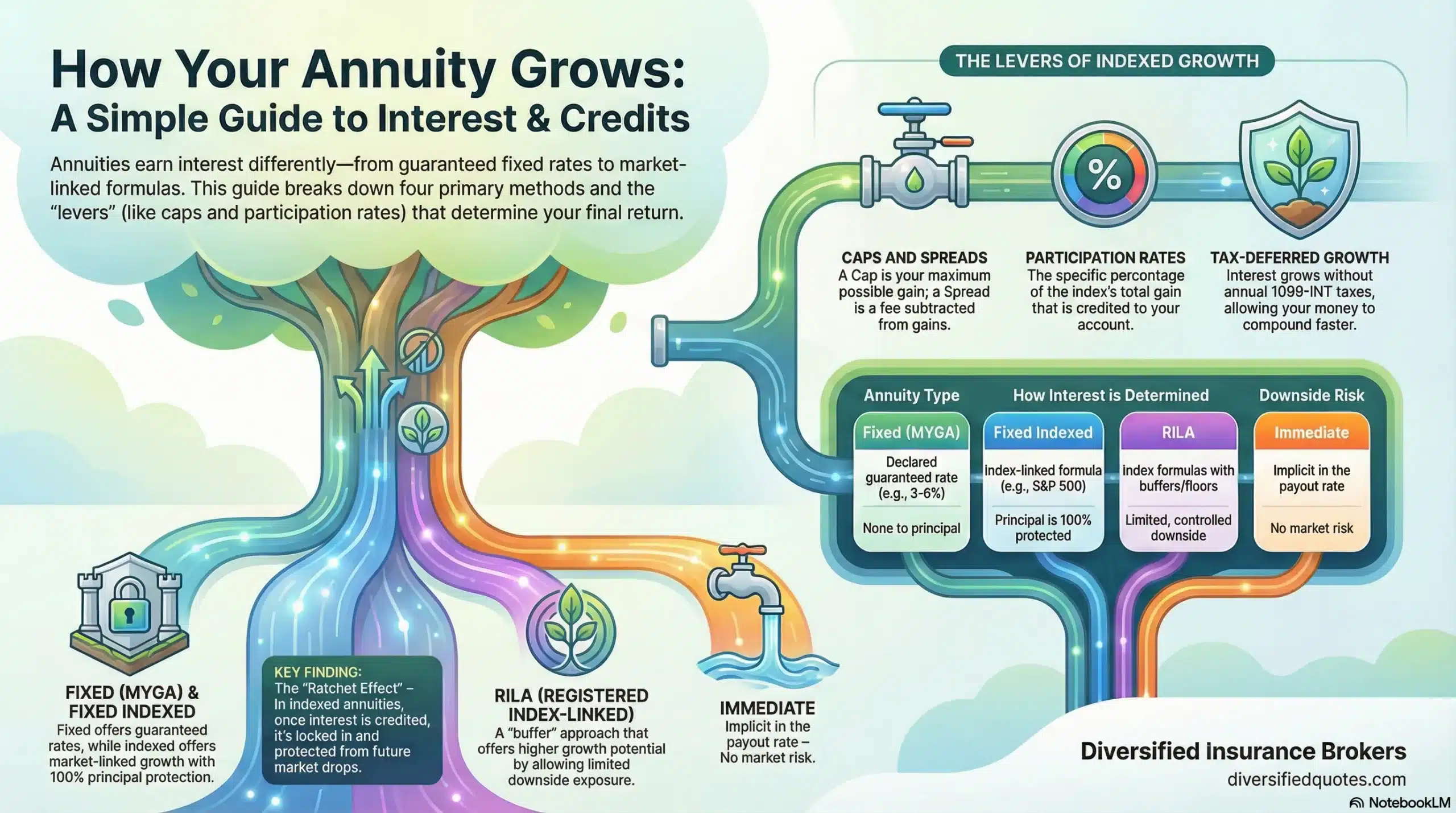
Unlike a bank CD, which generates taxable interest annually, annuity growth is tax-deferred. Interest compounds inside the contract without triggering a 1099 until funds are withdrawn. Over time, this deferral can enhance total accumulation — especially for higher-income individuals seeking to reduce current taxable income.
See Today’s Highest Fixed Annuity Rates
Compare current 1-year and multi-year fixed annuity rates from top-rated carriers.
View Current Fixed RatesWhy Investors Use 1-Year MYGAs
The most common reason investors select a 1-year annuity is flexibility. Rather than locking funds away for five or seven years, they preserve liquidity while still earning more competitive yields than many savings vehicles. This approach is particularly useful in environments where interest rates are volatile or expected to rise.
Many retirees also use short-term annuities as a holding strategy before activating lifetime income. For example, a client nearing retirement may park funds in a 1-year MYGA before rolling into a fixed indexed annuity with a lifetime income rider once they are ready to begin guaranteed withdrawals.
Additionally, investors implementing ladder strategies often combine 1-year annuities with longer contracts such as a 3-year annuity or 5-year annuity to create staggered maturities and annual liquidity windows.
Key Benefits of a 1-Year Annuity
The advantages of a short-term MYGA extend beyond its maturity period. First, principal protection ensures that market volatility cannot erode savings. Second, interest is declared upfront and guaranteed. Third, many contracts allow up to 10% annual withdrawals without surrender penalties. And finally, renewal flexibility allows you to reassess interest rates every year.
Understanding surrender provisions is critical. Some contracts include market value adjustments, which may impact withdrawals before maturity. For a detailed breakdown, review our guide on Market Value Adjustments Explained.
1-Year MYGA vs. Bank CD
Although similar on the surface, annuities and CDs operate under different regulatory structures. CDs are backed by the FDIC, while annuities are backed by the financial strength of the issuing insurance company and supported by state guaranty associations. The major difference lies in taxation. CD interest is taxable annually. Annuity interest grows tax-deferred until distribution.
For individuals who do not need immediate access to interest income, tax deferral often creates superior net growth over time.
Strategic Uses for a 1-Year Annuity
A 1-year annuity works especially well in transitional financial planning stages. Investors who have recently sold property, received an inheritance, or rolled funds from a 401(k) may temporarily park funds in a short-term annuity while designing a long-term strategy. Others use it as a defensive allocation during stock market volatility.
It can also serve as an entry point into broader annuity planning. After the first year, funds can be repositioned into products offering premium bonuses or enhanced income riders. To compare those options, visit our Current Annuity Rates page.
Compare Bonus & Indexed Annuity Offers
See how premium bonuses and indexed strategies compare to short-term fixed rates.
View Bonus RatesIncome Planning Considerations
While 1-year annuities are accumulation-focused, they often lead to income discussions. Before selecting a short-term contract, it can be helpful to understand how funds may convert into guaranteed lifetime withdrawals later. Use the calculator below to estimate income potential based on age and deposit amount.
Request a Personalized Rate Comparison
Receive side-by-side quotes from top-rated carriers based on your deposit and timeline.
Get My Annuity QuoteCompare Annuity Rates by Term Length
Related Pages
Explore additional annuity planning resources:
Talk With an Advisor Today
Choose how you’d like to connect—call or message us, then book a time that works for you.
Schedule here:
calendly.com/jason-dibcompanies/diversified-quotes
Licensed in all 50 states • Fiduciary, family-owned since 1980
FAQs: Best 1-Year Annuity Rate
What is a 1-year fixed annuity?
A 1-year fixed annuity, or MYGA, guarantees a set interest rate for one year. It’s ideal for short-term savings and principal protection.
Are 1-year annuities better than CDs?
They can be. MYGAs often offer higher rates and tax-deferred growth, while CDs are taxed annually and may yield less.
Can I withdraw money early?
Most 1-year MYGAs allow penalty-free withdrawals at maturity, and many include a 10% annual free withdrawal feature.
Is my money safe in a fixed annuity?
Yes. Fixed annuities are backed by the issuing insurance company and supported by state guaranty associations.
What happens after the first year?
At the end of the term, you can renew at a new rate, roll into a longer MYGA, or withdraw your funds with no penalty.
Do I pay taxes on annuity growth?
No taxes are due until you withdraw funds. Earnings grow tax-deferred, helping your savings compound faster.
Can I roll my 1-year annuity into a longer-term option?
Absolutely. Many clients roll into 3-, 5-, or 7-year MYGAs for higher rates after the first year.
About the Author:
Jason Stolz, CLTC, CRPC and Chief Underwriter at Diversified Insurance Brokers, is a senior insurance and retirement professional with more than two decades of real-world experience helping individuals, families, and business owners protect their income, assets, and long-term financial stability. As a long-time partner of the nationally licensed independent agency Diversified Insurance Brokers, Jason provides trusted guidance across multiple specialties—including fixed and indexed annuities, long-term care planning, personal and business disability insurance, life insurance solutions, and short-term health coverage. Diversified Insurance Brokers maintains active contracts with over 100 highly rated insurance carriers, ensuring clients have access to a broad and competitive marketplace.
His practical, education-first approach has earned recognition in publications such as VoyageATL, highlighting his commitment to financial clarity and client-focused planning. Drawing on deep product knowledge and years of hands-on field experience, Jason helps clients evaluate carriers, compare strategies, and build retirement and protection plans that are both secure and cost-efficient.
