
Best Burial Insurance with Immediate Coverage

Jason Stolz CLTC, CRPC
Last updated: February 2026
No waiting periods. No delays. Day-one protection. If you’re shopping for burial insurance with immediate coverage, you’re focused on one thing that matters more than anything else: when your family needs the policy, it should pay the full death benefit right away. Not “premiums back plus interest.” Not a partial percentage. Not a benefit that slowly increases over two years. You want a straightforward final expense policy that starts protecting your family from the start.
At Diversified Insurance Brokers, we help seniors and families compare burial insurance options that offer immediate (level) coverage—often with no medical exam—so you can secure the strongest benefit structure that fits your health profile and budget. Many people don’t realize that “no exam” does not automatically mean “no waiting period.” A policy can be no-exam and still have a graded or modified benefit period. If your goal is day-one protection, the underwriting path and the carrier rules matter as much as the price.
This page explains what immediate coverage really means, how to qualify, how to keep premiums affordable long-term, and how to avoid the common mistakes that cause families to buy the wrong type of burial insurance policy.
Get Immediate Burial Coverage Options—Today
We’ll compare policies that offer day-one level benefits and match you to the best underwriting fit.
Prefer a call? Call 800-533-5969
What burial insurance with immediate coverage really means
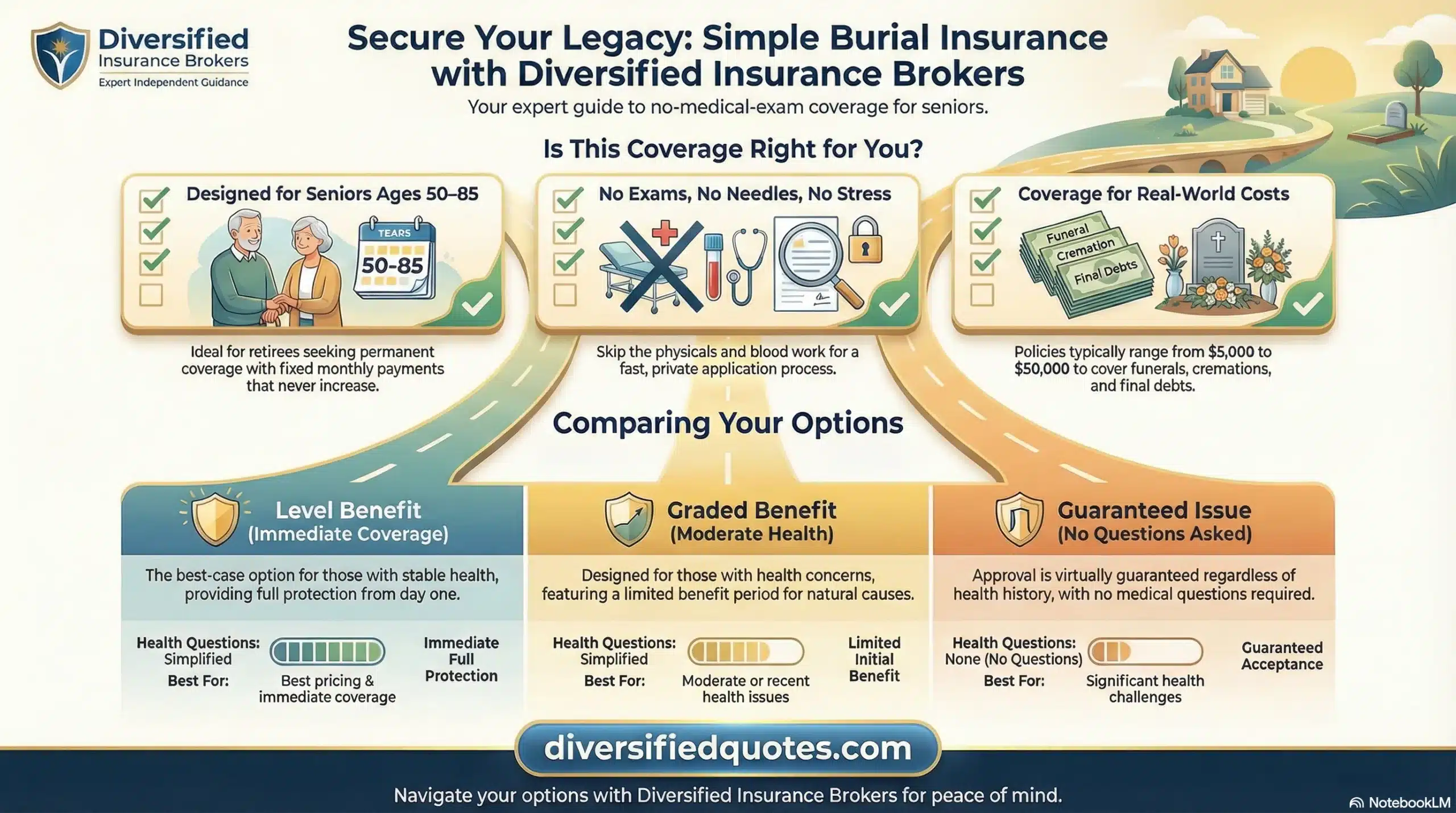
“Immediate coverage” is also commonly called level benefit coverage. It means that once the policy is active and the first premium is paid, the policy pays the full death benefit for covered causes of death—starting right away. When families ask for “immediate burial insurance,” what they’re really asking is, “If something happens soon, will the policy do what it’s supposed to do?”
This matters because many burial insurance policies on the market—especially policies designed for applicants with significant health challenges—use graded or modified benefit structures. Those policies usually limit what is paid for death from natural causes during the first one to two years. Some return premiums paid plus interest. Some pay a percentage that increases over time. Accidental death is often covered immediately, but the details and definitions vary by carrier and product.
Immediate coverage is typically available through simplified issue burial insurance. Simplified issue policies generally use a short health questionnaire instead of a full medical exam. The underwriter’s goal is to quickly identify whether you qualify for day-one level benefits based on recent medical history, current treatments, and overall stability. If simplified issue is available to you, it often delivers the best combination of affordability, speed, and day-one protection.
If you want a broader overview of burial insurance and how it’s designed, start here: Final Expense Life Insurance. If you want to begin with a service-level overview of how we shop and place these policies, you can also see: Burial Insurance Services.
Why immediate coverage matters for real families
Final expenses tend to hit fast. Funeral homes often require payment up front or within a short window. Families may also face travel costs, medical balances, and a sudden gap in household cash flow while accounts are settled. Even if a family has savings, timing matters. If money is tied up in retirement accounts, waiting on estate processes, or simply difficult to access quickly during an emotional period, financial pressure can compound stress.
That’s why families who are focused on immediate coverage often aren’t “shopping for insurance.” They’re trying to prevent a specific problem: loved ones being forced to borrow, delay decisions, or pay out-of-pocket when they’re grieving. A day-one burial policy can remove that burden by providing a predictable benefit payable directly to the beneficiary.
Coverage selection also becomes clearer when you understand the cost realities you want the policy to cover. Funeral and cremation expenses vary widely by location and preferences, but even “simple” arrangements can cost more than families expect. Two useful planning references are How Much Does a Funeral Cost? and How Much Does It Cost to Be Cremated?. Once you have a baseline, many families add a buffer for final medical bills, a bit of household continuity, and travel costs.
Who qualifies for immediate burial coverage
Immediate coverage is most often available to applicants who can qualify for simplified issue underwriting. The specific health questions vary by carrier, but the theme is consistent: carriers are looking for stability. They want to see that major medical events are not recent, that conditions are reasonably controlled, and that there aren’t red flags that imply high near-term risk.
Many seniors assume they won’t qualify because they have “a lot going on.” In reality, many common conditions can still qualify for simplified issue when they’re stable and well managed. Blood pressure and cholesterol medications are common. Controlled diabetes can sometimes work depending on details. A history of a procedure years ago can be acceptable if follow-ups are stable and there have been no recent complications. The details matter, and so does the carrier choice, because underwriting appetite varies widely.
That’s why “best burial insurance” is rarely a single company or a single policy. It’s the best match between your profile and the carriers whose rules align with your situation. If you want to see how burial insurance works specifically for older age bands, this resource can help: Burial Insurance for Seniors.
If simplified issue is not available, you still have options. In those cases, we often compare graded or guaranteed issue policies so you can put permanent coverage in place. That might not meet the “day-one full benefit” goal, but it may still be the best and most realistic outcome for a given underwriting reality. The key is making the trade-offs clear before you buy, so the policy behaves the way the family expects.
Immediate (level) benefits vs. graded benefits: what you’re really choosing
When someone says they want “burial insurance with immediate coverage,” they’re usually comparing level benefits against a graded or modified structure—whether they realize it or not. A level benefit policy typically pays the full death benefit once coverage is active and premiums are current. A graded benefit policy typically limits what’s paid for natural causes during an initial period, commonly the first one to two years.
Graded benefit designs exist because they make coverage possible for people who might otherwise be uninsurable through simplified underwriting. In exchange for easier acceptance, the carrier uses a benefit limitation during the early years. Many graded policies return premiums plus interest for natural causes during the graded window, and then transition to full benefits after the waiting period ends.
From a planning perspective, the question is not “Is graded coverage bad?” The question is “Does the family understand the benefit rules during the early years, and is the policy sized and structured to still solve the problem?” For many seniors with serious health histories, graded coverage can still be the most responsible way to put permanent protection in place—especially when the alternative is having no coverage at all.
If your priority is immediate day-one protection, the path is usually simplified issue with a carrier that offers level benefits. That’s why eligibility matters, and why the application approach matters. We aim to position the application to the carriers that are most likely to approve level benefits for the specific profile, rather than forcing a one-size-fits-all plan.
What affects the price of immediate burial insurance
The price of burial insurance with immediate coverage is typically driven by four main factors: your age, the benefit amount, tobacco status, and underwriting class determined by your health answers. Unlike term insurance, burial insurance is usually structured as a permanent (whole life) policy. That means premiums are generally level and coverage does not expire as long as premiums are paid on time.
Age is a straightforward driver. As age increases, premiums rise. Benefit amount is also straightforward. Higher face amounts cost more. Tobacco use often increases cost significantly and can limit carrier options. Health history and medications can affect which tier you qualify for—especially with simplified issue underwriting—and can determine whether level benefits are available.
Carrier differences also matter more than most people expect. Two carriers can look similar on the surface, but one might be more favorable to a certain condition, a certain medication profile, or a certain build range. That’s why shopping matters. If you want a deeper planning lens for “how much coverage should I choose,” the most practical guide is here: How Much Burial Insurance Do I Need?.
And if affordability is a primary concern, it can help to explore condition-based burial insurance education. For example, these pages explain how underwriting and pricing commonly work for specific common situations: burial insurance for smokers, burial insurance for overweight people, and burial insurance for people with high blood pressure.
How to get the best burial insurance with immediate coverage (without wasting time)
The best way to secure immediate coverage is to approach the process strategically. “No exam” does not mean “no underwriting.” Simplified issue policies still rely on health questions and electronic checks. The goal is to match your profile to carriers that are most likely to approve day-one level benefits at a competitive price.
One of the most common mistakes is applying blindly to multiple carriers. That can create inconsistent answers, delays, and confusion. It can also lead to a quick decline when the application is positioned incorrectly, even if other carriers would have approved the case. Another common mistake is assuming guaranteed issue is the only option because of a medical history that might still qualify for simplified issue with the right carrier.
We typically begin with a simple set of facts: age, state, tobacco status, desired benefit amount, and a clear snapshot of health history and medications. Then we determine whether simplified issue level benefit coverage is realistic. If it is, we focus the comparison on carriers offering day-one benefits. If it’s not, we compare graded and guaranteed issue options so the client still has a clear path to permanent coverage.
For families who want to understand how underwriting works more broadly, this resource can help explain what carriers look for in traditional coverage: What Is a Life Insurance Exam?. Many people don’t need a full exam for burial insurance, but understanding the difference can clarify why simplified issue decisions are made so quickly.
Instant Quote Tool
Use the calculator below to see real-time rates. Then we’ll confirm which options are eligible for day-one level benefits.
After you see pricing, we’ll help you compare level-benefit vs graded-benefit outcomes so there are no surprises.
Case examples: how immediate coverage burial insurance works in the real world
Example A: Day-one coverage for a common, controlled condition. A 76-year-old applicant with controlled blood pressure and stable medications wants a $15,000 policy to cover funeral costs and create a small buffer for family travel. Because the health profile is stable, simplified issue underwriting is often a strong fit. The outcome is a policy with level benefits from day one, no medical exam, and a predictable premium that stays level for life.
Example B: Finding the right carrier when one says “graded only.” A senior applies for burial insurance and is offered a graded benefit due to a medical detail that one carrier views conservatively. Another carrier may view the same detail more favorably, resulting in a level-benefit policy—especially if the condition is stable and follow-up documentation is clear. This is one of the biggest reasons shopping matters, because underwriting appetite varies widely.
Example C: When graded coverage is the responsible option. A senior has recent hospitalizations or an advanced condition that makes simplified issue unlikely. In that situation, guaranteed issue coverage can still be the best solution because it creates permanent coverage without the risk of repeated declines. While the graded period may apply, the policy still accomplishes the core purpose: putting a plan in place so the family is not left without options.
If you want a broader overview of what “best burial insurance” looks like across a range of needs, this resource can help: Best Burial Insurance. It’s a helpful companion to this page because it covers how families compare policy types and features beyond just “immediate coverage.”
Why work with Diversified Insurance Brokers?
Burial insurance is designed to be simple, but it’s not “one size fits all.” The difference between a policy that truly protects a family and a policy that disappoints often comes down to details—especially graded versus level benefits, underwriting eligibility, and carrier rules that aren’t obvious in a quick quote.
Diversified Insurance Brokers is a family-owned, fiduciary insurance agency licensed nationwide. Since 1980, we’ve helped families make insurance decisions with clarity and confidence. Because we’re independent, we can compare multiple carriers and match clients to the best fit for their profile and budget, prioritizing immediate coverage whenever it’s realistically available.
If you’re starting from scratch and want a simple overview of how burial insurance works, begin here: Burial Insurance Services. If you already know you want final expense coverage and want to understand how it behaves, this guide is helpful: Final Expense Life Insurance.
Secure Day-One Burial Protection
Skip the waiting periods when possible. We’ll find the best immediate-coverage options for your health and budget.
Questions now? Call 800-533-5969
Talk With an Advisor Today
Choose how you’d like to connect—call or message us, then book a time that works for you.
Schedule here:
calendly.com/jason-dibcompanies/diversified-quotes
Licensed in all 50 states • Fiduciary, family-owned since 1980
FAQs: Best Burial Insurance with Immediate Coverage
What does “immediate coverage” mean?
Immediate coverage means the full death benefit is available for natural and accidental causes on day one—no graded waiting period.
Who qualifies for day-one burial coverage?
Applicants who can pass simplified-issue health questions typically qualify. Guaranteed-issue policies usually do not offer day-one natural-cause coverage.
What if I can’t pass the health questions?
You can apply for guaranteed-issue burial insurance. It accepts most applicants but has a graded period for natural causes (often 2–3 years).
Is accidental death covered immediately on all plans?
Yes, accidental death is typically covered from day one on both simplified-issue and guaranteed-issue burial policies.
What ages are eligible for immediate coverage?
Many carriers accept ages 50–80 (some to 85). Availability, benefits, and pricing vary by age, state, and health history.
How much coverage can I get with day-one benefits?
Common face amounts range from $5,000 to $25,000, with some carriers allowing higher benefits depending on age and underwriting.
Do premiums ever increase or expire?
Final-expense whole life policies generally have level premiums that never increase and lifetime coverage that does not expire if paid on time.
Are there waiting periods with immediate-coverage policies?
No graded wait for natural causes. Standard contestability and suicide clauses (often two years) still apply per policy terms.
Will smoking or health conditions affect eligibility?
Yes. Tobacco and certain conditions can affect approval and price. Some applicants still qualify for day-one benefits at tobacco or rated classes.
Can an adult child own and pay for the policy?
Yes. With consent, a family member can be owner and payer and name or update beneficiaries to help keep the policy in good standing.
How fast can immediate-coverage policies be approved?
Many simplified-issue applications return decisions in minutes to a few days, with coverage effective upon issue and first payment.
Will replacing an old policy impact immediate coverage?
It can. Replacements may reset contestability. Compare benefits, premiums, and any waiting rules before switching policies.
About the Author:
Jason Stolz, CLTC, CRPC and Chief Underwriter at Diversified Insurance Brokers, is a senior insurance and retirement professional with more than two decades of real-world experience helping individuals, families, and business owners protect their income, assets, and long-term financial stability. As a long-time partner of the nationally licensed independent agency Diversified Insurance Brokers, Jason provides trusted guidance across multiple specialties—including fixed and indexed annuities, long-term care planning, personal and business disability insurance, life insurance solutions, and short-term health coverage. Diversified Insurance Brokers maintains active contracts with over 100 highly rated insurance carriers, ensuring clients have access to a broad and competitive marketplace.
His practical, education-first approach has earned recognition in publications such as VoyageATL, highlighting his commitment to financial clarity and client-focused planning. Drawing on deep product knowledge and years of hands-on field experience, Jason helps clients evaluate carriers, compare strategies, and build retirement and protection plans that are both secure and cost-efficient.
