
Best Fixed Indexed Annuities for Income

Jason Stolz CLTC, CRPC
When you think about retirement, the real question isn’t just “How much have I saved?”—it’s “How much reliable income can my savings produce every month for the rest of my life?” That’s where fixed indexed annuities (FIAs) built for income come in. The best FIAs for income are designed to turn a portion of your nest egg into a predictable paycheck you can’t outlive, while still protecting your principal from market losses.
Unlike variable annuities or direct stock market investing, fixed indexed annuities combine downside protection with upside potential. When configured with an income rider or built-in lifetime withdrawal benefit, they can provide guaranteed income for life—either now or at a future date you choose. But not all FIAs are created equal, and choosing the wrong contract can lock you into lower income, higher fees, or less flexibility.
At Diversified Insurance Brokers, we work with dozens of top annuity carriers to help clients identify the best fixed indexed annuities for income based on their age, timeline, and goals. This page walks through how these contracts work, what makes one “better” than another for income, and how to compare options before you commit.
Want to See Today’s Best Income-Focused FIA Options?
We compare income-focused fixed indexed annuities from multiple carriers to show you the strongest guaranteed payout options for your situation.
What Makes a Fixed Indexed Annuity Good for Income?
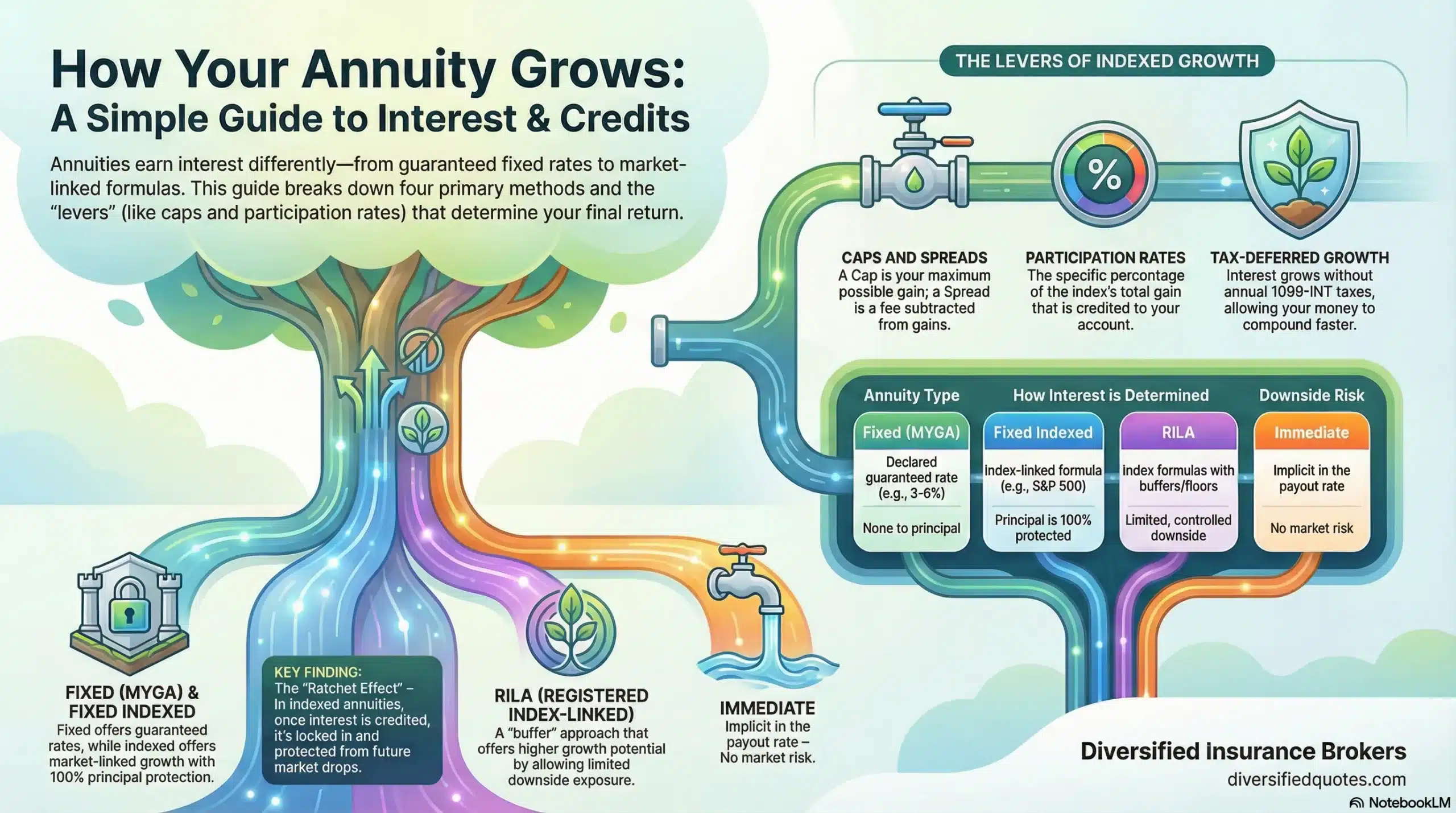
A fixed indexed annuity is simply a contract with an insurance company. Your money is protected from market losses, and your growth is tied in part to an external index (such as the S&P 500) using tools like participation rates, caps, or spreads. When you add an income rider or elect a lifetime payout option later, the annuity becomes an engine for guaranteed income.
The “best” fixed indexed annuities for income share a few key traits:
First, they offer competitive lifetime payout percentages at your age. For example, a retiree beginning income at 65 might see a guaranteed lifetime withdrawal percentage that’s higher than what a 60-year-old would receive. The same contract may increase payouts if you delay income for a few years, rewarding you for waiting.
Second, they balance payout rates with reasonable rider costs. Many income riders charge an annual fee based on the benefit base. The best income-focused FIAs use that fee to provide real value—higher payout percentages, joint-life options, or enhanced benefits for chronic illness—rather than just marketing sizzle. You want a contract where the rider cost is clearly offset by the guarantees it provides.
Finally, strong income-focused FIAs come from financially solid carriers with good track records of honoring guarantees and maintaining competitive renewal rates. You are buying a long-term promise, so the insurer behind that promise matters just as much as the payout numbers on the illustration.
If you’d like a refresher on how these products work in general, it’s worth revisiting the concepts in your broader planning: how a fixed indexed annuity protects your principal and how lifetime income can shape your retirement cash flow.
How Income Riders Turn Your FIA into a Paycheck
Most of the best fixed indexed annuities for income use an income rider (sometimes called a guaranteed lifetime withdrawal benefit). When you add the rider, the contract tracks two values:
The first is the account value, which reflects your premium plus any indexed interest credits, minus withdrawals and fees. This is the amount you could walk away with if you surrender or take a lump sum, subject to any surrender charges.
The second is the benefit base, which is a separate “shadow value” used only to calculate guaranteed lifetime income. The benefit base may grow by a set roll-up rate, bonuses, or a combination of index credits and guarantees. When you decide to start income, the carrier multiplies the benefit base by a payout percentage based on your age (and sometimes whether it’s single-life or joint-life coverage) to determine your annual guaranteed income.
For example, suppose you place $300,000 into an income-focused FIA. Over several years, the benefit base might grow to $450,000 due to roll-ups and bonuses. At age 67, the payout percentage might be 5.5%. That would generate a guaranteed lifetime income of $24,750 per year, even if your actual account value is lower. The account value still matters for liquidity and death benefits, but the income promise is driven by the benefit base.
This separation between account value and benefit base is why comparing the best fixed indexed annuities for income is more than just comparing interest rates. You need to look at how the benefit base grows, what payout percentage is available at your planned income age, and how rider costs impact long-term value.
Comparing Income Options: Single vs. Joint Lifetime Income
For many couples, the “best” FIA for income is the one that can support two lifetimes, not just one. Joint lifetime income options allow payments to continue as long as either spouse is alive. The trade-off is that joint-life payout percentages are usually lower than single-life percentages at the same age.
Choosing between single-life and joint-life income is a personal decision. Some retirees want to maximize income on the first life and use life insurance, other assets, or Social Security benefits to protect the surviving spouse. Others prefer the simplicity of a joint lifetime income annuity that automatically continues income for the survivor, even if markets are down or other accounts have been spent.
When comparing fixed indexed annuities for income, it’s important to run illustrations both ways—single-life and joint-life—so you can see how much income you would give up for survivor protection and whether that trade-off fits your priorities.
How Much Can an Income-Focused FIA Pay?
How much a fixed indexed annuity can pay in guaranteed lifetime income depends on your age, the size of your premium, the rider structure, and how long you wait before starting income. Many retirees like to see concrete examples of how different premium levels translate into monthly checks.
That’s why we’ve built a series of pages that show how much income various annuity sizes can produce. You can explore those examples here:
Income From Smaller Annuities
See how modest premiums can still deliver meaningful guaranteed income.
Income From Mid-Sized Annuities
Explore guaranteed income for commonly used premium amounts.
Income From Larger Annuities
See how substantial rollovers can create powerful guaranteed income.
Reality Check on Withdrawal Rates
Compare guaranteed income strategies with traditional withdrawal rules of thumb.
Lifetime Income Calculator
Numbers are powerful when you can see them applied to your situation. Use the calculator below to estimate how much guaranteed lifetime income a fixed indexed annuity or other income-focused annuity could provide at different ages and start dates.
💡 Note: The calculator accepts premiums up to $2,000,000. If you’re investing more, results increase in direct proportion — for example, doubling your premium roughly doubles the guaranteed income at the same age and options.
Balancing Growth Potential, Fees, and Flexibility
It’s easy to focus only on the highest payout percentage when shopping for the best fixed indexed annuities for income. But payout rates are just one piece of the puzzle. You also want to understand how the contract credits interest before and after income starts, how rider fees are charged, and what flexibility you retain over time.
Some FIAs keep your account value growing alongside the income rider, which can preserve more liquidity and leave a larger death benefit for beneficiaries. Others emphasize the income guarantees and place less emphasis on accumulation after income begins. Certain contracts allow you to stop and start income or adjust withdrawal amounts within limits; others are more rigid once you elect your lifetime benefit.
Because of these trade-offs, it’s important to look beyond the marketing brochure. A good comparison includes side-by-side illustrations that show income at your target start age, how long it lasts, how fees impact the benefit base, and what happens to remaining principal under different market conditions.
How to Decide if an FIA Is the Right Tool for Your Income Plan
An FIA designed for income is not the right fit for every dollar you’ve saved, but it can be a powerful tool for the portion of your assets dedicated to covering non-negotiable expenses—housing, food, utilities, healthcare, and core lifestyle costs. Many retirees like to build a “floor” of guaranteed income using Social Security and annuities, then use market-based investments for growth and discretionary spending.
When deciding whether to use a fixed indexed annuity for income, it helps to think through a few questions:
What percentage of your monthly expenses do you want guaranteed for life? How comfortable are you with market volatility in the years before and after retirement? Do you value joint-life protections for a spouse, or are you more focused on maximizing income on the first life? And how important is legacy value compared to lifetime income?
The answers to these questions will guide not only whether an FIA makes sense, but also which annuity designs are truly the “best” for you—not just on paper, but in real life.
Get a Personalized Fixed Indexed Annuity Income Review
Share your age, retirement timeline, and approximate rollover amount, and we’ll compare leading income-focused FIAs to show you how much guaranteed income they can provide.
Related Pages
Financial Protection Essentials
Core strategies to protect retirement income, prepare for healthcare costs, and build long-term financial stability.
Talk With an Advisor Today
Choose how you’d like to connect—call or message us, then book a time that works for you.
Schedule here:
calendly.com/jason-dibcompanies/diversified-quotes
Licensed in all 50 states • Fiduciary, family-owned since 1980
FAQs: Best Fixed Indexed Annuities for Income
What makes a fixed indexed annuity good for income?
The best fixed indexed annuities for income combine strong lifetime payout percentages, reasonable rider costs, principal protection, and solid carrier strength. They use an income rider or lifetime withdrawal feature to convert your benefit base into guaranteed income you can’t outlive.
How is income from a fixed indexed annuity calculated?
Income is usually based on a separate benefit base value multiplied by a payout percentage tied to your age and whether you choose single or joint lifetime income. The benefit base may grow by roll-ups, bonuses, or index credits before you start income.
Can a fixed indexed annuity provide income for both spouses?
Yes. Many income-focused FIAs offer a joint lifetime income option that pays as long as either spouse is alive. The payout percentage is typically lower than single-life income at the same age, but it can provide important protection for the surviving spouse.
Are income riders on FIAs expensive?
Income riders generally charge an annual fee based on the benefit base. The cost can be well worth it when it delivers higher guaranteed income, joint-life coverage, or enhanced benefits. The key is to compare rider fees and benefits side-by-side across multiple contracts.
Can I still access my money if I add an income rider?
In most cases, yes. Your account value remains available for withdrawals or surrender, subject to contract rules and surrender charges. The guaranteed income is tied to the benefit base, but you still have access to the account value for emergencies or legacy goals.
Is income from a fixed indexed annuity affected by market downturns?
Once your guaranteed lifetime income is set under the rider or payout option, it is not reduced due to market losses. That’s one of the main reasons retirees use FIAs for income: they want a paycheck that continues regardless of stock market performance.
When should I consider adding an income-focused FIA to my plan?
Many people begin evaluating income-focused annuities in the five to ten years before retirement. That window allows time for benefit bases to grow and for you to coordinate annuity income with Social Security and withdrawals from other accounts.
Can a fixed indexed annuity replace a pension?
While it isn’t a pension in the legal sense, an income-focused fixed indexed annuity can mimic the effect of a personal pension by turning a lump sum into guaranteed lifetime income. This can be especially useful for retirees without a traditional employer pension.
How do I compare different fixed indexed annuities for income?
A good comparison looks at benefit base growth, payout percentages at your planned income age, rider fees, liquidity features, joint-life options, and the financial strength of the insurer. Side-by-side illustrations make it easier to see which contracts provide the strongest long-term income for your situation.
About the Author:
Jason Stolz, CLTC, CRPC and Chief Underwriter at Diversified Insurance Brokers (NPN 20471358), is a senior insurance and retirement professional with more than two decades of real-world experience helping individuals, families, and business owners protect their income, assets, and long-term financial stability. As a long-time partner of the nationally licensed independent agency Diversified Insurance Brokers, Jason provides trusted guidance across multiple specialties—including fixed and indexed annuities, long-term care planning, personal and business disability insurance, life insurance solutions, Group Health, and short-term health coverage. Diversified Insurance Brokers maintains active contracts with over 100 highly rated insurance carriers, ensuring clients have access to a broad and competitive marketplace.
His practical, education-first approach has earned recognition in publications such as VoyageATL, highlighting his commitment to financial clarity and client-focused planning. Drawing on deep product knowledge and years of hands-on field experience, Jason helps clients evaluate carriers, compare strategies, and build retirement and protection plans that are both secure and cost-efficient. Visitors who want to explore current annuity rates and compare options across multiple insurers can also use this annuity quote and comparison tool.
