
Best Group Health Insurance Options for 2-Person Businesses

Jason Stolz CLTC, CRPC
Best group health insurance options for 2-person businesses can be surprisingly strong when the business is structured correctly and the documentation is clean. Many owners assume they are “too small” for group health coverage or that carriers will automatically decline a two-person team. In reality, many carriers will consider micro-groups when the company can prove it is a legitimate business with eligible employees, consistent payroll, and a contribution strategy that meets participation rules. The real challenge is not that group coverage does not exist for very small teams. The challenge is that micro-group eligibility rules can be nuanced, and small mistakes in setup can derail underwriting.
At Diversified Insurance Brokers, being an independent group health broker, we help employers nationwide evaluate the best group health insurance options for 2-person businesses by confirming eligibility first, then comparing plan structures that match the company’s goals. For some teams, the best answer is a traditional fully insured small-group plan with stable monthly costs. For other teams, the best answer is a level-funded design that preserves predictable payments while introducing self-funded mechanics and potential surplus credits when claims run favorably. The goal is not to overcomplicate the decision. The goal is to help a very small company choose a group plan structure that is realistic to qualify for, manageable to administer, and sustainable at renewal.
This page is written for two-person teams who want the truth about what carriers require, how underwriting typically works, which plan structures are most realistic, and how to compare the total cost of each option. It also covers documentation checklists, common roadblocks, and planning steps that reduce surprises during issuance.
Confirm Eligibility and Compare 2-Person Group Options
We’ll verify documentation requirements and compare fully insured and level-funded designs for your two-person business.
Request InformationWhat You’ll Learn on This Page
Two-person group coverage is not a one-size-fits-all product. The “best” plan is the plan you can actually qualify for, keep in force, and renew without constant disruption. This guide focuses on practical issues that matter most in a two-person situation, including eligibility definitions, payroll and documentation requirements, plan structures that carriers commonly approve, and how to evaluate cost beyond the first-month premium.
You will learn how carriers typically define a two-person group, why certain owner-only or spouse-only arrangements are treated differently, how participation and contribution rules influence approval, and why documentation and timing often matter as much as plan design. You will also learn how level-funded designs differ from fully insured plans, what stop-loss protection does in a micro-group, and how to compare “predictability” in a way that makes sense for a very small business budget.
How Two-Person Group Eligibility Typically Works
Carriers issue group coverage for bona fide employees. In a two-person business, this usually means you must show that both people meet the carrier’s definition of eligible employees, that the business is legitimate and active, and that minimum participation and employer contribution requirements are being met. While the exact rules vary by carrier and state, the underwriting pattern is consistent: carriers want to confirm that the group is real, that the employees are real, and that the company is not attempting to create a short-lived group solely to access a pricing advantage without meeting normal employer responsibilities.
Most carriers expect payroll documentation that supports W-2 employment. In some states, there are nuances around whether owners count, whether spouses count, and whether the carrier allows an owner-and-spouse-only group. In other situations, carriers want to see at least one non-owner employee. None of those rules are universal, which is why eligibility confirmation should happen before quoting becomes the main focus. A quote is not useful if the structure will not be approved.
Eligibility can also intersect with how “creditable coverage” and employer size rules apply in certain contexts. If you want a clearer view of how size rules can influence participation requirements and employer obligations, review creditable coverage by employer size. It provides context that helps many micro-groups understand why carriers ask for specific proofs even when the group is very small.
For two-person businesses, eligibility is often more about documentation quality than it is about the business’s industry or revenue size. Clean paperwork, consistent payroll reporting, and a clear contribution strategy can make underwriting much smoother. When those items are unclear, carriers often stall, request repeated follow-up documents, or decline the application altogether.
The Documentation Carriers Commonly Require
The fastest way to get approved is to assume documentation will be required and prepare it in advance. Carriers may ask for business formation documents such as articles of organization, proof of EIN, business bank verification, payroll summaries, wage reports, or other documentation that supports active operations. In many cases, carriers will ask for a census that lists the eligible employees, their dates of hire, and confirmation of full-time status. Carriers also commonly require confirmation of employer contribution levels and participation percentages.
Many two-person groups stumble because they try to provide incomplete payroll records or because the ownership structure is not well explained. If the company is an S-Corp and owners are taking distributions without W-2 wages, eligibility can become complicated. If the company is a partnership and compensation records are inconsistent, the carrier may not consider the individuals to meet “employee” definitions. These situations do not always mean coverage is impossible. They simply mean the group must be structured carefully before the carrier will approve it.
Documentation is also connected to timing. Carriers may want recent payroll records. If a business has only just started payroll last week, underwriting may take more scrutiny than if the company has a consistent payroll history. This is why planning a start date around clean payroll periods often helps issuance move faster.
Core Plan Types for Two-Person Groups
When looking for the best group health insurance options for 2-person businesses, most groups are comparing two primary plan structures: fully insured small-group plans and level-funded designs. A third “category” is really a layer within level funding: stop-loss protection. Understanding how these pieces fit together is what allows a two-person business to compare options intelligently instead of relying on marketing language.
1) Fully Insured Small-Group Plans
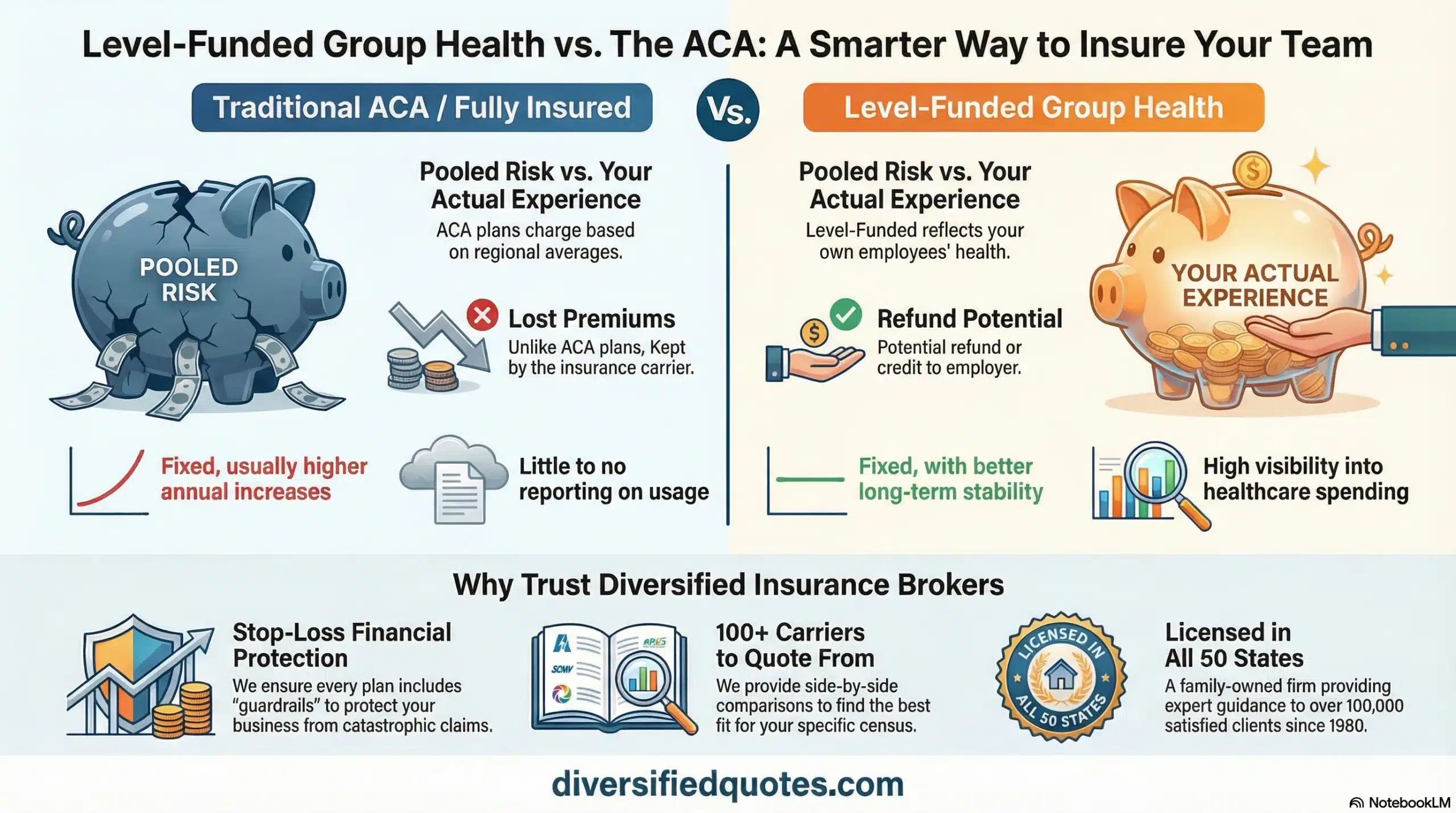
Fully insured plans are the simplest micro-group option. The company pays a fixed monthly premium. The carrier assumes claim risk. The plan is easier to administer because the employer is not directly participating in claims funding mechanics. For many two-person businesses, the biggest advantage is predictability. Month-to-month costs are known, and the employer can budget around that number.
The tradeoff is that fully insured plans are often priced with carrier margin and risk pooling assumptions built into the premium. The company does not typically receive a surplus credit if claims are low. In other words, a fully insured plan behaves like a traditional insurance arrangement: you are paying for the transfer of risk to the carrier, and the carrier keeps upside when utilization is favorable. That can still be a worthwhile trade for companies that prioritize simplicity above all else.
Fully insured plans can be especially useful in year one, when a company is still building consistent payroll documentation and wants the simplest administration. Some two-person businesses intentionally begin fully insured and then re-evaluate level-funded options at renewal once participation and payroll records are clearly established.
2) Level-Funded Plans
Level-funded designs often appeal to two-person groups that want predictable monthly payments but also want the possibility of benefiting from favorable claims experience. A level-funded plan typically includes administrative costs, stop-loss premiums, and an estimated claims funding component. Claims are paid from a designated account. If claims run lower than expected, many plans provide a surplus credit or refund based on plan terms.
For owners who are evaluating level funding, the decision usually comes down to two questions. First, what is the fixed monthly cost compared to fully insured options? Second, how realistic is the upside compared to the complexity of the arrangement? While every plan is different, level funding can provide value by separating claims costs from carrier profit, by improving transparency, and by allowing the employer to participate in favorable experience outcomes.
Tax treatment can also influence how attractive level funding feels, particularly when employer contributions are structured intentionally. If you want deeper context on how funding method and tax treatment can align with business structure, review level-funded health insurance tax benefits explained. It helps employers think beyond the premium alone and focus on total net cost.
3) Understanding Stop-Loss in Level-Funded Designs
Stop-loss is the protection layer that makes level funding feasible for small employers. It limits exposure from large claims and caps total plan-year claims above defined thresholds. Even though a level-funded plan can feel like “a premium,” the employer is still participating in claims funding mechanics under the hood. Stop-loss is the mechanism that prevents a catastrophic claim from turning that participation into an unacceptable financial event.
For micro-groups, stop-loss terms matter. The employer chooses attachment points that balance premium cost against risk tolerance. The plan can also include contract provisions around run-out claims and reimbursement timing. If you want a straightforward explanation of how these mechanics work, review understanding stop-loss insurance in level-funded plans. It covers the concepts that most two-person owners need to understand before choosing a level-funded design.
When Two-Person Groups May Qualify and Common Roadblocks
Two-person groups can qualify when the business and employees meet the carrier’s definitions and the group meets contribution and participation rules. The most common problems occur when the company tries to count people who do not meet eligibility definitions, such as non-employee owners in certain structures or contractors. Another common issue is missing employer contribution minimums. Carriers often require the employer to contribute a minimum portion of the premium. If the employer expects to contribute very little, underwriting may not approve the group plan structure.
Contractor labor is one of the biggest misconceptions. Many business owners assume that a 1099 contractor can “count” as a second person for group eligibility. In most cases, that is not how carriers view eligibility. If your team includes contractor roles and you want to avoid qualification pitfalls, review can 1099s get group level funding. Understanding this nuance early can save a business from spending time on quotes that will never be issuable.
Another roadblock is payroll consistency. If one person is on payroll and the other is paid irregularly, carriers may not treat both as eligible full-time employees. This is why many two-person businesses adjust payroll strategy before applying. The goal is to create a clean and consistent record that matches the carrier’s eligibility definitions.
How to Compare Options for a Two-Person Team
Comparing options for a two-person group is less about chasing the lowest premium and more about choosing the structure that is sustainable at renewal. A plan that looks good in month one can become painful if the renewal is unstable or if administration is unclear. The best comparison approach focuses on budget stability, risk tolerance, plan design fit, and the employer’s willingness to manage a more engaged strategy over time.
Fully insured plans often win on simplicity. You pay the premium and the carrier assumes risk. Level-funded plans can win on transparency and upside potential. But level-funded designs require the employer to understand stop-loss thresholds and plan mechanics. This is why the best comparison includes a realistic discussion of “predictability.” Fully insured predictability is straightforward. Level-funded predictability comes from the monthly payment, while upside or volatility depends on how the claims account performs relative to projections and how stop-loss terms are structured.
Many micro-group owners also ask about refunds or surplus credits. While these outcomes are never guaranteed, understanding the mechanics matters. A helpful overview is can small groups get health insurance refunds, which explains how these arrangements usually treat unused claims funding in certain level-funded designs.
Employers also want to understand whether a funding model is designed for long-term sustainability. For a broader explanation of why some employers choose level funding as a multi-year strategy rather than a one-year experiment, review why choose group level funding.
Docs and Timing: Getting Issued Without Headaches
The underwriting process for two-person groups goes smoother when the company treats documentation as part of the strategy rather than a last-minute scramble. Carriers often request proof of payroll and eligibility, business filings, and a clean census. When these items are organized and consistent, the carrier can focus on issuing coverage rather than questioning the legitimacy of the group structure.
Timing can also influence underwriting ease. Many employers choose effective dates that align with clean payroll cycles. They also consider whether there are upcoming business changes such as new hires, partnership transitions, or shifts in compensation structure. Aligning enrollment with these changes can reduce documentation confusion and participation problems.
If you want a practical primer on common employer questions that come up during quoting and issuance, review top questions employers ask about group health insurance. Many two-person groups find it useful because it addresses the concerns that frequently cause delays when questions are not answered early.
Realistic Scenarios: How Two-Person Businesses Choose Plans
Scenario A: Two co-owners on W-2 payroll. In this case, both owners meet the carrier’s definition of eligible employees. The group compares fully insured versus level-funded. The company chooses a level-funded design with conservative stop-loss thresholds to balance monthly cost against claim volatility. The employer understands that any year-end surplus is plan-dependent and not guaranteed, but values the transparency and long-term cost control framework.
Scenario B: One owner and one full-time employee. The owner and employee meet eligibility and contribution requirements. The company chooses a fully insured plan in year one because the owner wants maximum simplicity and predictable monthly cost. At renewal, the company re-evaluates level-funded designs after building a cleaner payroll and participation track record.
Scenario C: One owner plus contractor labor. The business attempts to qualify by counting a contractor as the second person. The carrier does not treat the contractor as eligible. The business either restructures the role into W-2 employment or decides that a group plan is not feasible under current staffing. This is why understanding contractor eligibility early is critical.
Get a Side-by-Side Comparison for Your 2-Person Business
Tell us your goals and structure. We’ll compare fully insured and level-funded designs that are realistic to qualify for.
Request a ComparisonHow a Two-Person Plan Fits into Long-Term Business Strategy
For very small businesses, group health is not only a benefit. It is a business planning tool. When structured correctly, the employer contribution can be positioned as part of compensation strategy, and the plan can become a stabilizing force during growth or transition periods. The two-person group stage is often the beginning of a longer benefits journey. Choosing a plan structure that renews smoothly is often more important than squeezing the last dollar out of premium in year one.
Two-person teams also tend to experience the cost of healthcare more personally. If one person has a large claim event, the group feels it. That is why stop-loss structure and plan design choices matter. Predictability is not only about the premium. Predictability is also about out-of-pocket exposure, network access, and the employer’s ability to make decisions proactively rather than reactively.
Level funding can help certain groups create a more strategic framework, but fully insured can be the right answer when simplicity is the priority. The key is not forcing a plan type. The key is matching the plan structure to the company’s reality.
How Diversified Insurance Brokers Helps Two-Person Businesses
We help micro-groups by starting with eligibility and documentation. That prevents wasted time and avoids the frustration of choosing a plan that cannot be issued. We then compare realistic options across carriers and funding models, focusing on total cost, plan design fit, risk tolerance, and renewal sustainability.
We also help two-person businesses understand what carriers are likely to request so the underwriting process stays smooth. Our goal as an independent group health broker, is to make the decision clear and to create a plan that the business can keep long term rather than rebuilding the strategy every year.
Build a Sustainable Group Plan for Your Two-Person Team
Get a realistic plan comparison, eligibility confirmation, and next steps you can actually execute.
Start HereRelated Group Health Pages
Continue exploring micro-group eligibility, funding models, and employer planning questions.
Financial Protection Essentials
Core strategies to protect retirement income, prepare for healthcare costs, and build long-term financial stability.
Talk With an Advisor Today
Choose how you’d like to connect—call or message us, then book a time that works for you.
Schedule here:
calendly.com/jason-dibcompanies/diversified-quotes
Licensed in all 50 states • Fiduciary, family-owned since 1980
FAQs: Best Group Health Insurance Options for 2-Person Businesses
Can a 2-person business really qualify for group health insurance?
Often yes, but eligibility depends on state rules and carrier definitions of “eligible employee.” In many cases, both individuals need to be bona fide employees (commonly W-2), the business must be active and legitimate, and minimum participation and employer contribution rules must be met.
Do spouses count as the second employee for a two-person group plan?
Sometimes, but it’s carrier- and state-specific. Some carriers accept owner/spouse payroll groups if both are on W-2 payroll and the entity and documentation support it. Other carriers require at least one non-owner employee. Eligibility should be confirmed before quoting.
Can 1099 contractors count toward the “two people” requirement?
Usually no. Most carriers require eligible employees, which typically means W-2 employees. If your staffing is contractor-heavy, you may need a different strategy or a staffing restructure to qualify.
What are the best group health plan types for a 2-person business?
The most common options are fully insured small-group plans (simple, fixed premiums) and level-funded plans (predictable monthly payments with self-funded mechanics and potential surplus credits depending on plan terms). The best fit depends on budget stability, risk tolerance, and eligibility.
Is level-funded health insurance realistic for only two employees?
It can be, if carriers in your state offer micro-group level funding and your documentation and participation requirements are met. The stop-loss structure is critical because it limits volatility from higher-cost claims.
What documents do carriers typically require for two-person group coverage?
Common requests include proof of business legitimacy (EIN and formation documents), current payroll records, a clean employee census, and confirmation of employer contribution and participation. Some carriers may request wage reports or other proof of active operations.
How much does the employer have to contribute for a two-person group plan?
Many carriers require the employer to contribute a minimum percentage of the employee premium (often around 50%), but the exact requirement varies. If contribution minimums are not met, the plan may not be eligible for issuance.
Can a two-person group receive refunds or surplus credits?
Fully insured plans generally do not provide refunds tied to claims experience. Some level-funded plans may provide surplus credits or refunds if claims run below projections, subject to plan rules and contract terms.
How do we choose between fully insured and level-funded plans?
Fully insured plans prioritize simplicity and fixed premiums. Level-funded plans can add transparency and potential upside but require understanding stop-loss thresholds, plan mechanics, and renewal behavior. The “best” choice is the one you can qualify for, administer, and renew comfortably.
What is the biggest reason two-person group applications get delayed or declined?
The most common issues are unclear employee eligibility (owner-only or contractor scenarios), inconsistent payroll documentation, missing contribution requirements, or incomplete business verification. Confirming eligibility and documentation upfront usually prevents the biggest problems.
About the Author:
Jason Stolz, CLTC, CRPC and Chief Underwriter at Diversified Insurance Brokers (NPN 20471358), is a senior insurance and retirement professional with more than two decades of real-world experience helping individuals, families, and business owners protect their income, assets, and long-term financial stability. As a long-time partner of the nationally licensed independent agency Diversified Insurance Brokers, Jason provides trusted guidance across multiple specialties—including fixed and indexed annuities, long-term care planning, personal and business disability insurance, life insurance solutions, Group Health, and short-term health coverage. Diversified Insurance Brokers maintains active contracts with over 100 highly rated insurance carriers, ensuring clients have access to a broad and competitive marketplace.
His practical, education-first approach has earned recognition in publications such as VoyageATL, highlighting his commitment to financial clarity and client-focused planning. Drawing on deep product knowledge and years of hands-on field experience, Jason helps clients evaluate carriers, compare strategies, and build retirement and protection plans that are both secure and cost-efficient. Visitors who want to explore current annuity rates and compare options across multiple insurers can also use this annuity quote and comparison tool.
