
Disability Income Insurance for Doctors and Physicians

Jason Stolz CLTC, CRPC
Disability income insurance for doctors and physicians is one of the most important protections a medical professional can own, because your income is tied to your ability to perform specialized clinical duties at a high level. A hand injury, chronic back issue, neurological condition, burnout-related health event, or even an unexpected illness can change a physician’s earning power overnight. And unlike many careers, medicine often doesn’t offer a simple “lighter duty” path that preserves the same compensation—especially for specialists whose income is procedure-driven.
At Diversified Insurance Brokers, we specialize in helping physicians, surgeons, and high-earning medical professionals secure own-occupation disability coverage that is designed around the realities of medical practice. The objective is not just “a policy.” It’s a plan that protects your lifestyle, your financial goals, and your ability to make decisions based on what is best for your health—without being forced back into clinical work too soon.
Compare Physician Disability Income Options
We’ll compare true own-occupation definitions, benefit amounts, and riders across multiple top-rated carriers.
Request Physician Disability Quotes
Prefer to talk first? Call 800-533-5969.
Why Physicians Need Disability Income Insurance
Physicians spend years building an income stream that is unusually “skill-specific.” Your training, board certification, credentialing, and reputation are valuable because they allow you to perform duties most people cannot. That same specialization is what creates risk: if an illness or injury prevents you from performing your clinical duties, your earnings can fall sharply—even if you can still work in some capacity.
Many physicians first encounter disability coverage through an employer plan or a hospital group benefit. Those plans can be useful, but they often have limits that matter in practice. Benefit caps may cover only a portion of physician income, especially for specialists. Definitions may shift from “own occupation” to “any occupation” after a period of time. And when an employer pays the premium, benefits may not be as favorable as expected. The result is a gap: a physician can be “covered” and still be under-protected.
An individually owned disability policy is designed to fill that gap with stronger contract language, portability, and plan design choices that match your career stage. Many physicians choose private coverage to lock in a definition that protects their specialty and to secure benefit levels that remain meaningful even as income rises.
What Makes Own-Occupation Coverage Essential for Doctors
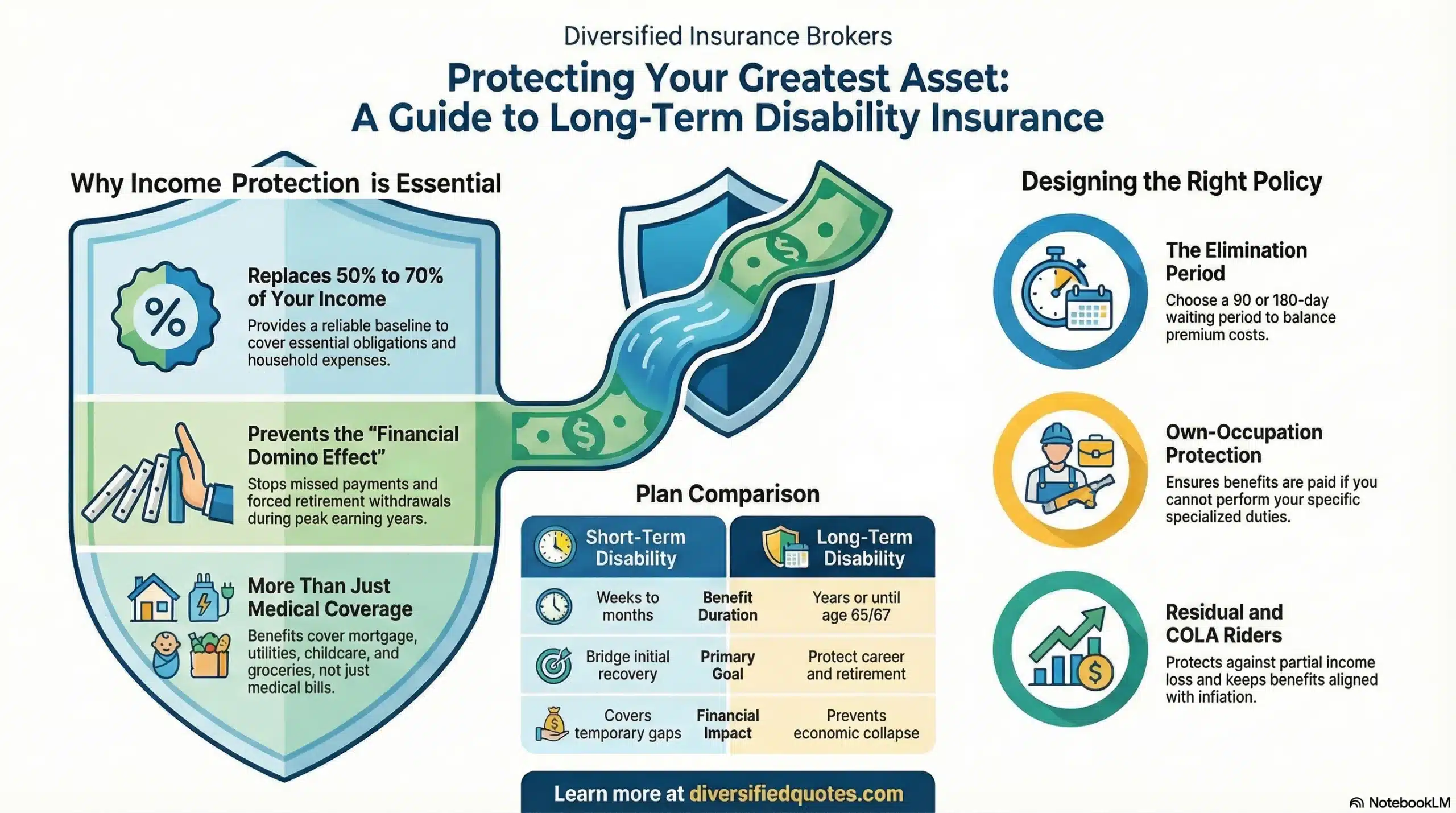
For physicians, “own-occupation” is not a buzzword—it’s the core of what makes disability insurance work the way doctors need it to work. A strong own-occupation definition is designed to pay benefits if you cannot perform the substantial and material duties of your occupation or specialty, even if you are able to work elsewhere.
That matters because medicine offers plenty of roles that a disabled physician might be able to do—teaching, consulting, utilization review, administrative leadership, expert witness work—but those roles can pay substantially less than clinical practice. An own-occupation policy is designed so you are not forced into a lower-paying role just to avoid being considered “not disabled.”
Example: A surgeon develops a hand tremor and can no longer operate safely. With a strong own-occupation contract, the surgeon can still receive disability benefits even if they later teach, consult, or work in a non-surgical medical capacity. The policy is protecting the surgical occupation, not a generic definition of employability.
Because carriers vary in how they define own-occupation and how they treat specialty language, we help physicians compare definitions side-by-side so you know exactly what you are buying. When the wording is right, the policy protects professional independence and reduces the financial pressure that can lead physicians to work through serious conditions.
How Physician Disability Insurance Is Priced
Disability pricing is driven by a few primary factors: age, health history, specialty/occupation class, income, state of residence, and policy design. Physicians often receive favorable occupational classes relative to many other professions, but pricing still varies by specialty and duties. For example, a surgeon’s risk profile can differ from an internist’s because of procedure-based duties, physical demands, and hand-use reliance.
Health history also matters. Insurers may review medical records, prescriptions, and past diagnoses. Even “routine” physician issues—prior back pain, sports injuries, anxiety treatment, sleep apnea, elevated labs—can change pricing or result in exclusions. Many doctors are surprised by how underwriting treats things that feel manageable in day-to-day life. The practical planning takeaway is simple: locking coverage in earlier, while you are healthy, often preserves broader coverage options and better pricing.
Benefit Amounts and the “Coverage Gap” for High Earners
Physicians often earn beyond what standard group plans or basic individual policies will cover. If your group benefit replaces 60% of base salary but caps out at a fixed monthly amount, the replacement percentage can be far lower than it looks—especially once bonus, productivity, and partnership distributions are considered. That gap is where individual and high-limit planning becomes important.
High Income Disability Insurance is designed to supplement standard coverage when earnings exceed typical limits. The objective is usually to protect a realistic portion of total compensation (often targeting a combined range that supports lifestyle continuity), rather than relying on a capped plan that leaves you exposed.
For many specialists, the goal is to protect the “earning engine” you’ve built—so an unexpected disability does not force liquidation of retirement savings, sale of a practice under pressure, or large lifestyle resets that derail long-term plans.
Key Design Choices: Elimination Period and Benefit Duration
Physician disability coverage is not one-size-fits-all. Two of the most important design choices are the elimination period (waiting period) and the benefit period (how long benefits can last). The elimination period is commonly selected based on savings and cash flow. A physician with strong reserves may choose 90 or 180 days to reduce premium. Others choose shorter elimination periods when monthly obligations are high or when they want coverage to begin sooner in the event of disability.
The benefit period is where long-term protection shows up. Some policies pay for a fixed number of years, while others pay to an age such as 65 or 67. Physicians often choose longer benefit periods because the long-duration risk is what creates the biggest financial impact. A short-term injury can be managed with reserves. A long-lasting disability can disrupt decades of earning power.
We help physicians think about plan design in a practical way: how long could you reasonably self-fund a loss of income, and what level of long-duration protection would preserve your family and financial plans if you cannot return to your specialty?
Residual and Partial Disability: A Key Feature for Physicians
Many disability claims are not “all or nothing.” A physician may return to work with restrictions, reduced hours, or modified duties. Income can drop because the physician cannot perform procedures, cannot take call, cannot sustain a full schedule, or must shift to lower-revenue work. This is where residual or partial disability benefits can be crucial.
A well-designed residual benefit is intended to help replace lost income when you can still work, but your capacity is reduced and earnings decline. For physicians whose income is tied to productivity, residual coverage can be one of the most meaningful features in the policy because it aligns with how medical careers and recoveries actually work.
Tax Treatment for Physicians and Practice Owners
Tax treatment often depends on who pays the premium and how the policy is owned. Physicians who pay premiums personally typically want clarity on how benefits would be received in a claim scenario. Practice owners may have additional options depending on entity structure, compensation method, and how coverage is being coordinated with the practice.
For practice owners, disability planning sometimes extends beyond personal income replacement. If the practice has staff payroll, lease obligations, equipment payments, and fixed monthly overhead, it may be appropriate to pair personal disability coverage with Business Overhead Expense (BOE) disability insurance. BOE is designed to reimburse eligible overhead expenses so the practice can keep operating during a disability, protecting staff, patients, and business value.
In some physician partnerships and closely held practice groups, disability risk can also impact ownership continuity. Depending on structure and goals, physicians may explore guaranteed issue disability opportunities in group settings, or other continuity planning tools when multiple partners want consistent coverage terms.
Specialized Plans for Surgeons, Dentists, and Healthcare Professionals
Physicians are not a single category. A surgeon, anesthesiologist, radiologist, ER physician, and hospitalist can have very different duties, risk profiles, and compensation structures. That is why carrier selection and wording matters. Our process focuses on matching policy design to your specialty and how you earn income.
We also help medical professionals in adjacent roles who have unique needs, such as dentists and nurses. If you want to explore specialty pages, you may find these helpful:
Disability Insurance for Dentists
Disability Income Insurance for Nurses
Disability Income Insurance for Law Enforcement
Common Riders Physicians Consider
Riders can add meaningful value when chosen intentionally. The goal is not to attach every option available. The goal is to select features that align with how your income changes over time and how disability events commonly unfold in medicine.
Residual/partial disability. Helps replace income when you can still work but at reduced capacity and reduced earnings.
Future increase option. Helps you increase coverage later as income rises, often without repeating full medical underwriting.
COLA (cost-of-living adjustment). Helps benefits keep pace over time during longer disabilities.
Catastrophic disability. Adds an additional benefit for severe disabilities that significantly limit activities of daily living.
For many physicians, the first two—residual and future increase—are especially important because physician income typically grows substantially over time, and many disability events involve reduced capacity rather than complete inability to work.
How Diversified Insurance Brokers Helps Physicians Get Better Coverage
Physician disability is not a “quick quote” purchase if the goal is to protect your specialty and your earnings. Our job is to make the process clear and practical. We start by looking at your specialty, duties, income structure, existing group benefits, and what you want protected (household cash flow, practice stability, or both). Then we compare carriers and designs to identify where definitions, residual wording, benefit periods, and riders create better real-world protection.
We also help physicians avoid the most common mismatch: a policy that looks fine in a summary but has wording that is less favorable for specialty disability scenarios. When contract language is strong, you protect career independence and reduce the financial pressure that can compromise recovery decisions.
Get Expert Help Comparing Physician Disability Plans
If you want a clear comparison of physician disability options—including own-occupation definitions, benefit amounts, and riders—our team can help you narrow choices quickly and design coverage that fits your specialty and your financial priorities.
Request a Physician Disability Income Quote
Protect your medical career with own-occupation coverage designed for doctors, surgeons, and specialists.
Related Topics to Explore
Explore other disability strategies and physician-adjacent coverage options.
Talk With an Advisor Today
Choose how you’d like to connect—call or message us, then book a time that works for you.
Schedule here:
calendly.com/jason-dibcompanies/diversified-quotes
Licensed in all 50 states • Fiduciary, family-owned since 1980
FAQs: Disability Income Insurance for Doctors and Physicians
- What is own-occupation disability coverage?
It pays benefits if you can’t perform the duties of your specific medical specialty, even if you’re able to work in another field. - Are disability insurance benefits taxable for physicians?
If you pay premiums personally with after-tax dollars, your benefits are generally tax-free. If your employer pays, they may be taxable. - How much coverage do doctors typically need?
Most physicians aim to replace 60–70% of their gross income, especially those with large fixed expenses or families. - Can I get disability coverage as a resident or fellow?
Yes. Many carriers offer discounted rates and future increase options for medical residents and fellows. - What if I already have group coverage?
Group plans often have low caps and limited definitions. A personal or high-limit policy ensures full income replacement and flexibility.
About the Author:
Jason Stolz, CLTC, CRPC and Chief Underwriter at Diversified Insurance Brokers, is a senior insurance and retirement professional with more than two decades of real-world experience helping individuals, families, and business owners protect their income, assets, and long-term financial stability. As a long-time partner of the nationally licensed independent agency Diversified Insurance Brokers, Jason provides trusted guidance across multiple specialties—including fixed and indexed annuities, long-term care planning, personal and business disability insurance, life insurance solutions, and short-term health coverage. Diversified Insurance Brokers maintains active contracts with over 100 highly rated insurance carriers, ensuring clients have access to a broad and competitive marketplace.
His practical, education-first approach has earned recognition in publications such as VoyageATL, highlighting his commitment to financial clarity and client-focused planning. Drawing on deep product knowledge and years of hands-on field experience, Jason helps clients evaluate carriers, compare strategies, and build retirement and protection plans that are both secure and cost-efficient.
