
Disability Income Insurance for General Contractors

Jason Stolz CLTC, CRPC
General contractors build, manage, and coordinate the projects that shape communities. From residential construction to commercial developments, contractors oversee crews, manage timelines, coordinate suppliers, and ensure that projects meet safety and structural standards. While this work can be financially rewarding, it also carries significant risk. Injuries, medical conditions, and physical strain can quickly interrupt the ability to work and generate income.
Disability income insurance for general contractors is designed to protect against this financial vulnerability. If illness or injury prevents a contractor from performing the duties required to operate their business or manage projects, disability insurance can replace a portion of lost income. This type of protection can help maintain financial stability while the contractor focuses on recovery.
Construction professionals often face a unique combination of financial exposure. Many contractors are self-employed or operate their own businesses. Income may fluctuate depending on project schedules, economic cycles, and construction demand. When income depends on active involvement in projects, an unexpected disability can quickly disrupt both personal finances and business operations.
Many contractors who evaluate income protection begin by examining their overall financial risk exposure. Tools such as investment risk analysis can help individuals understand how financial disruptions might impact their long-term financial stability. Disability income insurance is often one of the most important protections for professionals whose income depends on their ability to work.
Protect Your Income With Disability Insurance
Request Disability Insurance Options
Submit our form to compare disability income insurance options designed for contractors and business owners.
Request Disability Insurance QuotesWhy Disability Insurance Matters for Contractors
Construction professionals face higher occupational risk than many other professions. Even contractors who primarily supervise projects still spend time visiting job sites, inspecting work, climbing ladders, or reviewing structural elements. These physical exposures increase the risk of injuries that could interrupt the ability to work.
Unlike employees who receive employer-sponsored disability benefits, many general contractors must secure income protection independently. Without disability insurance, a medical condition could eliminate income while financial obligations such as mortgages, equipment payments, and business expenses continue.
For business owners, the impact of disability can extend beyond personal income. A contractor who cannot supervise projects may struggle to maintain business operations. Delays, missed contracts, or the inability to secure new projects can create financial challenges even after recovery.
Because of these risks, many contractors evaluate disability protection alongside other financial planning strategies such as key person disability insurance to ensure that both personal income and business continuity are protected.
Income Risks Contractors Face
The financial structure of the construction industry makes disability protection particularly important. Contractors often rely on project-based income rather than consistent salaries. If a contractor cannot actively participate in managing projects, revenue may slow or stop entirely.
Several factors contribute to this financial exposure.
Physical work environments increase the likelihood of injuries. Construction professionals may encounter risks such as falls, heavy equipment accidents, and repetitive physical strain. Even injuries that occur outside of work can prevent a contractor from performing job site responsibilities.
Income variability is another challenge. Many contractors earn strong income during active construction cycles but may experience seasonal or project-based fluctuations. This makes maintaining financial stability during periods of disability even more important.
Contractors who operate their own businesses also carry the responsibility of managing employees, subcontractors, and project obligations. When the owner becomes disabled, business operations can become difficult to maintain.
Because of these factors, contractors often view disability insurance as one of the most critical forms of financial protection available.
How Disability Income Insurance Works
Disability income insurance provides monthly payments if a medical condition prevents the insured from working. These benefits are designed to replace a portion of the income that would normally be earned through work.
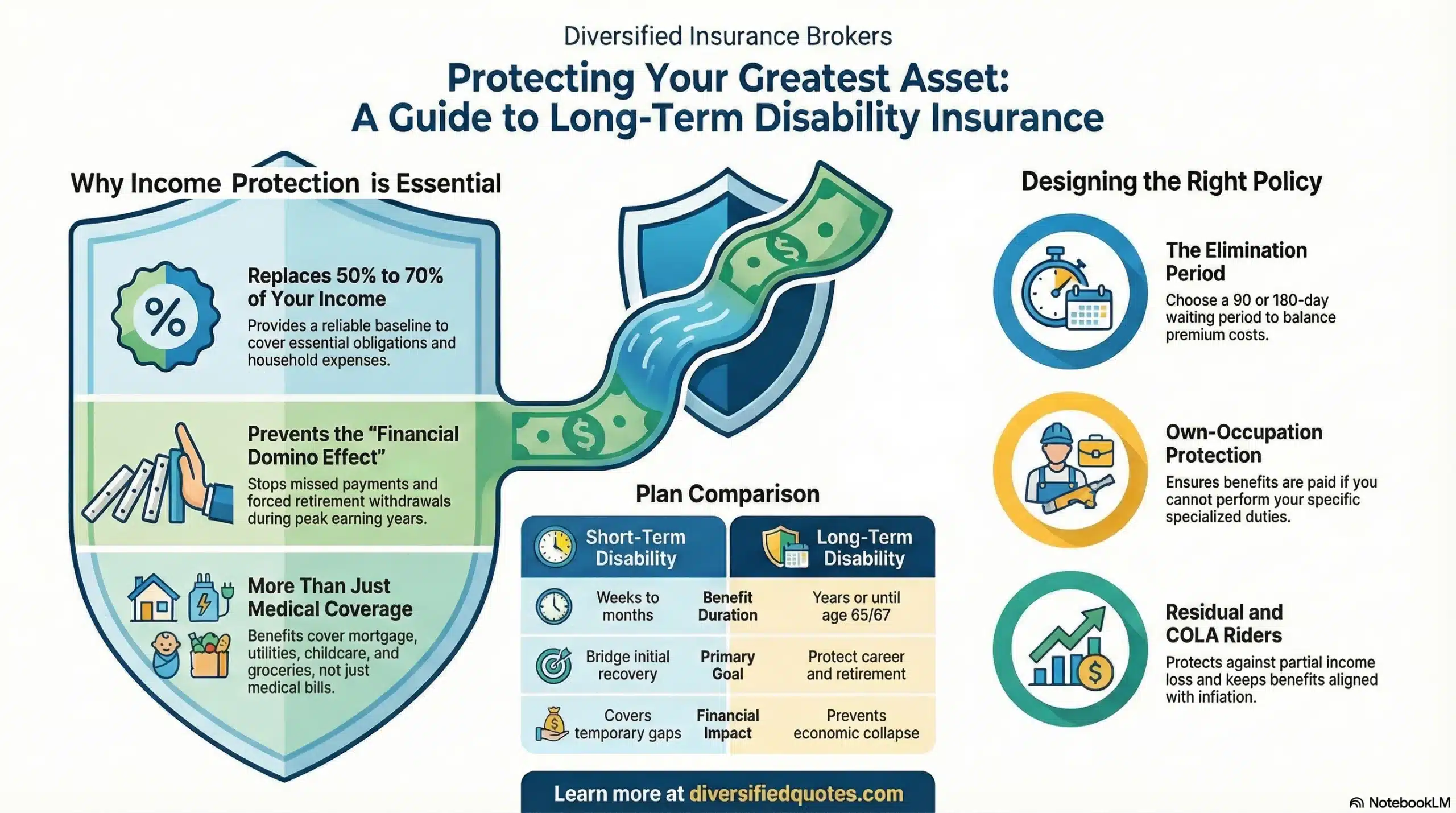
Most disability policies replace between 50 percent and 70 percent of income. The exact benefit depends on factors such as income history, policy design, and underwriting guidelines.
Policies also include an elimination period, which is the waiting period before benefits begin. Many contractors choose elimination periods around 90 days. This structure allows the policy to provide long-term protection while keeping premiums manageable.
Benefit periods vary depending on the policy selected. Some policies provide benefits for several years, while others can continue paying benefits until retirement age if the disability prevents the insured from returning to work.
Professionals who are evaluating disability coverage often compare options alongside broader insurance planning topics such as disability insurance for physicians and other occupation-specific policies that illustrate how coverage structures can vary depending on occupational risk.
The Importance of Residual Disability Coverage
Residual disability coverage is one of the most valuable features for contractors. Not all disabilities completely prevent someone from working. In many cases, a contractor may still be able to supervise projects but may not be able to perform physical work or maintain the same workload.
Residual disability benefits help replace lost income when earnings decline due to a medical condition. This feature is especially important for contractors whose income depends on completing projects or maintaining consistent client activity.
For example, a contractor recovering from a serious injury may only be able to oversee limited work while delegating physical tasks to others. Even though the contractor can still perform some duties, overall income may decline significantly. Residual disability coverage helps address this situation.
Policy Features Contractors Should Consider
Several policy features are particularly important when designing disability coverage for contractors.
The definition of disability determines how benefits are triggered. Some policies provide benefits when the insured cannot perform the duties of their own occupation, while others may require that the insured cannot work in any occupation.
Benefit period length also matters. Contractors who rely heavily on their income often choose benefit periods that extend until retirement age to ensure long-term protection.
Additional riders may also enhance coverage. Catastrophic disability benefits may provide additional income if the insured experiences a severe disability that requires assistance with daily activities.
Benefit increase options may allow policyholders to expand coverage over time as income grows.
When evaluating coverage, contractors often compare disability protection with other long-term financial planning strategies such as life insurance with living benefits to build a comprehensive protection strategy.
Financial Planning for Contractors
Disability insurance is only one component of financial planning for construction professionals. Contractors must often manage multiple financial responsibilities including business operations, employee payroll, equipment purchases, and personal household expenses.
Because construction income can fluctuate, financial planning often focuses on building stability and protecting against unexpected disruptions. Disability insurance helps protect income during periods when a contractor cannot work.
Many professionals also evaluate strategies for retirement income planning, tax efficiency, and long-term financial protection. Resources such as 72(t) distribution planning and retirement income strategies can help contractors understand how income planning fits into their broader financial goals.
Why Contractors Choose Disability Insurance
The primary reason contractors purchase disability income insurance is simple: protecting the ability to generate income. Construction professionals rely on their health, mobility, and decision-making abilities to manage projects and maintain business operations.
When a disability occurs, income can disappear quickly. Disability insurance provides a financial safety net that allows contractors to focus on recovery without the immediate pressure of lost income.
For many contractors, this protection provides peace of mind knowing that their financial responsibilities can continue to be met even during unexpected medical events.
Request Disability Insurance Options
Related Pages
Financial Protection Essentials
Talk With an Advisor Today
Choose how you’d like to connect—call or message us, then book a time that works for you.
Schedule here:
calendly.com/jason-dibcompanies/diversified-quotes
Licensed in all 50 states • Fiduciary, family-owned since 1980
General contractors often depend on their ability to manage projects, oversee crews, inspect job sites, and coordinate construction timelines. If an illness or injury prevents them from performing these duties, income can quickly decline or stop. Disability income insurance helps replace a portion of lost earnings while the contractor recovers.
Yes. Many general contractors are self-employed or operate as business owners. Insurance companies typically evaluate tax returns, financial statements, and business income history to determine the amount of monthly disability benefits that may be available.
Most disability insurance policies replace between 50% and 70% of income. Contractors typically choose coverage that helps protect essential expenses such as mortgage payments, family living costs, and business obligations if they are unable to work.
Construction professionals face a higher risk of injuries compared with many office occupations. Back injuries, joint damage, falls, fractures, and repetitive stress injuries can prevent a contractor from safely supervising job sites or performing physical work.
Residual disability coverage provides partial benefits if a contractor can still work but experiences reduced income due to illness or injury. This can be important for business owners who may still supervise projects but cannot perform all of their normal responsibilities.
The benefit period depends on the policy selected. Some policies provide income replacement for several years, while others can continue paying benefits until retirement age if a long-term disability prevents the insured from returning to work.
Most comprehensive disability insurance policies cover both accidents and illnesses. This means benefits may be payable whether a contractor is injured on or off the job or develops a medical condition that prevents them from working.
About the Author:
Jason Stolz, CLTC, CRPC and Chief Underwriter at Diversified Insurance Brokers (NPN 20471358), is a senior insurance and retirement professional with more than two decades of real-world experience helping individuals, families, and business owners protect their income, assets, and long-term financial stability. As a long-time partner of the nationally licensed independent agency Diversified Insurance Brokers, Jason provides trusted guidance across multiple specialties—including fixed and indexed annuities, long-term care planning, personal and business disability insurance, life insurance solutions, and short-term health coverage. Diversified Insurance Brokers maintains active contracts with over 100 highly rated insurance carriers, ensuring clients have access to a broad and competitive marketplace.
His practical, education-first approach has earned recognition in publications such as VoyageATL, highlighting his commitment to financial clarity and client-focused planning. Drawing on deep product knowledge and years of hands-on field experience, Jason helps clients evaluate carriers, compare strategies, and build retirement and protection plans that are both secure and cost-efficient. Visitors who want to explore current annuity rates and compare options across multiple insurers can also use this annuity quote and comparison tool.
