
Disability Insurance for 1099 Workers

Jason Stolz CLTC, CRPC
Disability insurance for 1099 workers is one of the most important types of protection a self-employed person can put in place, because your income is not guaranteed by an employer and your bills do not stop if you cannot work. When you earn money as an independent contractor, freelancer, consultant, gig worker, or commission-based professional, your ability to produce is the entire foundation of your financial plan. You may have built a great business, a strong pipeline, and a steady client base, but even one unexpected medical issue can interrupt your income in a way that is hard to recover from quickly. For many 1099 workers, that risk is even higher because there is typically no paid sick leave, no employer-funded long-term disability benefit, and no “safety net” system supporting payroll when you are out of work.
At Diversified Insurance Brokers, we help 1099 workers nationwide design disability income insurance that fits how contractors actually earn money. That includes professionals with stable self-employed income, as well as people with commission-based income, irregular revenue, seasonal fluctuations, and growing businesses. Our advisors compare multiple top-rated carriers and policy structures to help you protect your paycheck with the right monthly benefit, a strong definition of disability, and the rider options that matter most for self-employed professionals. Whether you are a 1099 salesperson, an independent medical provider, a realtor, a high-income consultant, a tradesperson, or a business owner, the purpose is the same: create a predictable stream of replacement income if sickness or injury takes you out of work.
Get Disability Options Built for 1099 Income
Compare individual DI designs for contractors, freelancers, and commission-based earners—nationwide.
Request a DI Quote Prefer a call? 800-533-5969
Why disability insurance matters more for 1099 workers than W-2 employees. One of the biggest differences between 1099 workers and W-2 employees is benefits access. Many W-2 employees receive at least some employer-sponsored disability coverage, usually in the form of group long-term disability insurance. Even though group LTD often has limitations, the existence of that coverage can provide a base level of protection. When you are a 1099 worker, you typically start from zero. No group plan. No company-funded monthly benefit. No HR department helping you file a claim. That means you are responsible for building your own income protection plan from the ground up.
Another major difference is how quickly income can fall off for contractors. When you are self-employed, it is common for income to be tied to active production. If you stop producing, you stop earning. A salaried employee might continue receiving income during sick time, PTO, or a short employer leave program. A 1099 worker often has none of that. Even if you have a strong book of business, client renewals, or recurring revenue, a personal health issue can still create major financial disruption because you may be unable to manage relationships, close deals, perform physical work, or meet deadlines. Disability insurance for 1099 workers exists to replace a portion of that income so you can keep your life stable while you recover.
We also see many self-employed people underestimate the ripple effects of disability. A disability does not always mean a permanent loss of work capacity. Many times it is temporary. Surgery recovery, an injury, chronic pain flare-ups, complications from an illness, mental health issues, or a long-term condition can reduce work ability for months. For independent contractors, that can create lost clients, lost referrals, and a longer-term decline in momentum even after you return. The right disability policy can protect your financial stability and prevent a short-term health situation from becoming a permanent financial setback.
\
What disability insurance for 1099 workers actually covers. Disability income insurance is designed to pay a monthly benefit if you cannot work due to sickness or injury. That benefit helps replace your income during the period of disability, subject to the policy’s elimination period, definition of disability, and benefit period. It is important to understand that disability insurance is not the same as health insurance, and it is not the same as workers’ compensation. Health insurance helps cover medical expenses. Workers’ comp applies to job-related injuries in many situations and may not apply for independent contractors the same way it applies to employees. Disability income insurance is built specifically to replace earned income when you are unable to perform your work duties.
For 1099 workers, the most common type of coverage is individual disability insurance, sometimes called individual DI. This is a personal policy you own and control, not something tied to your employer. That matters because it follows you even if you change careers, change clients, relocate, or restructure your business. It also means you get to design the policy around your needs instead of accepting a one-size-fits-all group plan. In many situations, a properly designed individual disability policy can be the most reliable safety net available to contractors.
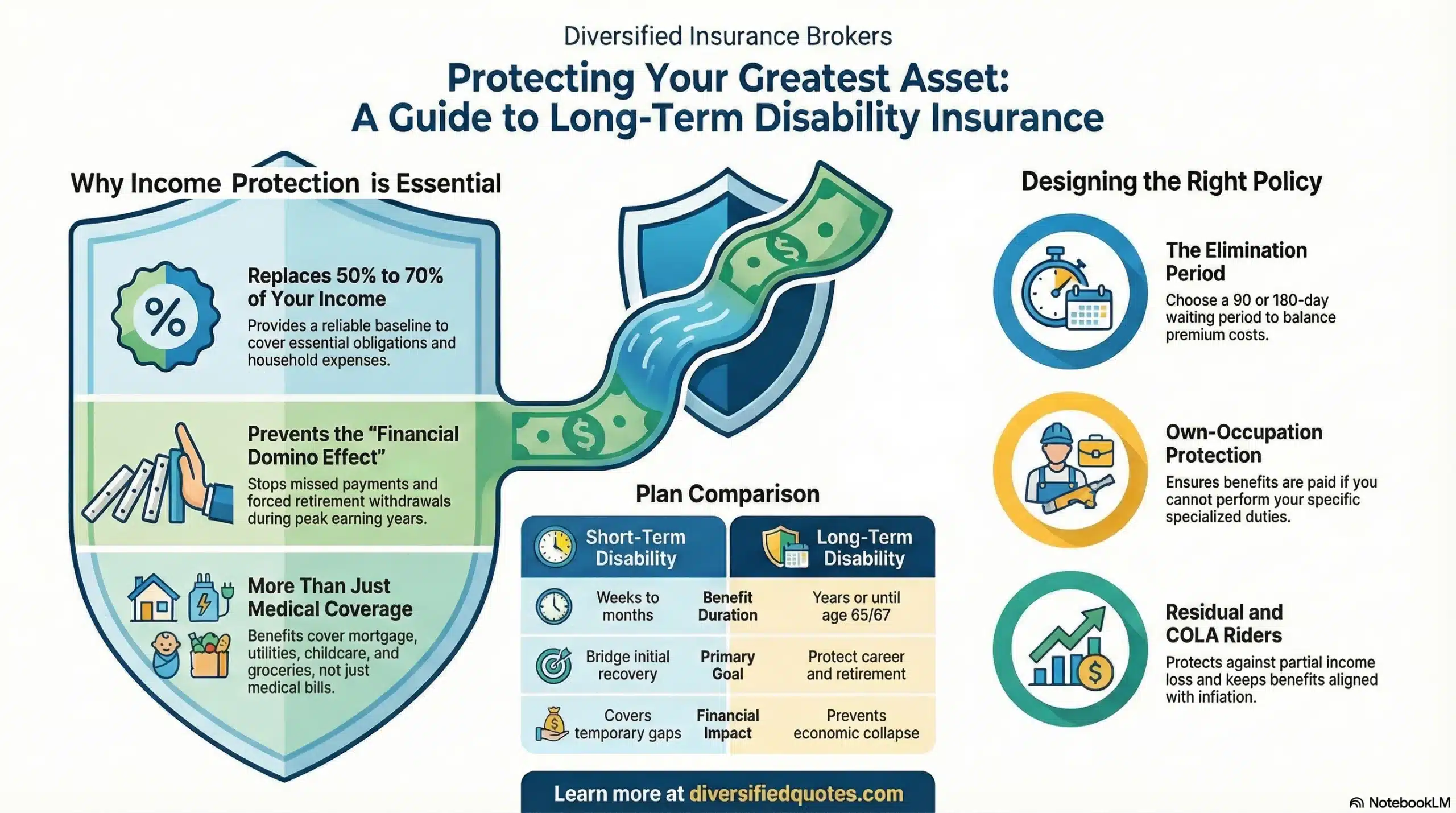
The benefit amount is typically based on your documented income and is meant to replace a portion of what you earn, often around 50% to 70% depending on the carrier and your occupation class. The reason it is not usually 100% is because disability benefits are meant to protect financial stability without creating a financial incentive to stay disabled. However, through smart planning, riders, and benefit design, many 1099 workers can create strong income replacement that covers the expenses that truly matter.
Who should consider disability insurance as a 1099 contractor? If your lifestyle depends on your ability to work, you should strongly consider disability coverage. That may sound obvious, but many self-employed professionals overlook disability insurance because it feels less urgent than life insurance, health insurance, or business liability coverage. The reality is that disability is often the risk that happens in the middle of life when income is high and financial responsibilities are expanding. We commonly help 1099 workers in industries where income is strong but benefits are limited, including real estate agents, mortgage professionals, insurance agents, independent financial advisors, consultants, independent IT professionals, marketing professionals, sales professionals, attorneys, independent healthcare practitioners, and contractors in trades or service businesses.
We also frequently work with higher earners who need more advanced disability planning, including layered benefit structures and stronger policy language. If your income is above $250,000 and you are concerned about benefit limits, you may also want to review our page on high income disability insurance, because many 1099 professionals fall into the category where traditional limits are not enough.
For business owners and independent professionals who have ongoing overhead costs, disability planning can become even more important. When you are self-employed, your household income is only part of the risk. Your business may have rent, payroll, software subscriptions, marketing expenses, and ongoing fixed costs that don’t pause when you are injured. That is where pairing personal disability insurance with business overhead expense disability insurance (BOE) can create a complete strategy that protects both your personal finances and the business infrastructure you’ve built.
Not Sure If You’ll Qualify (or How Much You Can Get)?
We’ll estimate realistic monthly benefits based on your tax returns and occupation class—then show you the strongest contract options.
The 1099 income documentation challenge (and how to design around it). One of the most important differences with disability insurance underwriting for 1099 workers is that your income is verified differently than a W-2 salary. If you are a salaried employee, underwriting can often confirm income through pay stubs and employer verification. If you are self-employed, income is typically confirmed through tax returns, profit-and-loss statements, and other financial documentation. Most carriers will look at a two-year average of earned income, although rules vary depending on the carrier, occupation, and how stable your business income is.
This is where many contractors get surprised. If your tax return shows low net income because you are taking large deductions, your disability benefit eligibility may be lower than you expected. That does not necessarily mean you are “doing taxes wrong.” It simply means that disability insurance is based on documented net earnings. If you are trying to reduce taxable income aggressively, your disability insurance coverage limits may shrink. This is why we help 1099 workers think about disability insurance as part of a bigger financial strategy. The goal is not to change your tax strategy just to buy insurance. The goal is to understand how income documentation impacts underwriting and then choose a policy design that fits the reality of your situation.
Many high-performing contractors also have year-to-year income growth. If you are early in your self-employed career or rapidly increasing earnings, you may not want your disability coverage stuck at last year’s income level. That is why future increase options and policy flexibility are so important for 1099 workers. With the right riders, you may be able to increase coverage in future years as income grows without repeating full medical underwriting. That can be a game-changer for entrepreneurs and independent professionals who are building momentum.
How much disability insurance should a 1099 worker carry? There is no single perfect number that applies to everyone, but the right starting point is usually your baseline “must-have” expenses. That often includes housing costs, utilities, food, transportation, insurance premiums, debt payments, childcare costs, and minimum savings needs. Many contractors also need to plan for the fact that their business may still have expenses during disability, even if production stops. When we help 1099 workers design coverage, we focus on practical replacement income, not theoretical numbers.
In many cases, a 1099 worker’s target replacement income is around 60% to 70% of gross earnings, but what matters most is after-tax spendable income. Some disability benefits are taxable, and some are not, depending on how premiums are paid and how the policy is structured. If your benefits are tax-free, the net replacement can feel more like a higher percentage of income. If benefits are taxable, you may need a larger benefit amount to keep net income stable. We help clients design coverage with the goal of protecting real spending power, not just hitting a percentage on paper.
If you are a higher earner, you may also face monthly benefit limits that make it difficult to replace a meaningful percentage of income. That is where high-limit coverage strategies can apply, and why some contractors may need a plan similar to what we outline in our high income disability insurance page. A contractor earning $400,000 or $700,000 per year has the same monthly bills risk as anyone else, but the coverage solution requires more planning.
Find Your “Real” Replacement Target
We’ll size coverage around after-tax spending power, not just a generic percentage.
Choosing the right elimination period as a self-employed worker. The elimination period is the amount of time you must be disabled before benefits begin. Common elimination periods include 30 days, 60 days, 90 days, and 180 days. For 1099 workers, this choice is not just about price—it is about cash flow management. A shorter elimination period means your policy pays sooner, but premiums are higher. A longer elimination period reduces premium cost, but you must be able to cover expenses during the waiting period through savings or alternative resources.
Many contractors choose a 90-day elimination period because it provides a balance between affordability and practical protection. However, if your income is highly variable or you have limited emergency reserves, a shorter elimination period may provide more stability. On the other hand, if you have a large savings cushion or investment liquidity, you may prefer a longer elimination period to keep premium costs down. The correct answer depends on your overall financial structure and how easily you can withstand income interruption.
We help clients evaluate elimination periods based on what happens in real life. If you have a short disability event, would you truly be fine covering expenses for 90 days? Would you be forced to liquidate investments at the wrong time, drain business capital, or fall behind on obligations? Disability insurance is meant to protect stability, so the elimination period should match how your finances operate, not just the cheapest quote.
Benefit period choices for 1099 disability insurance. The benefit period is how long the disability insurance policy can pay benefits if you remain disabled. Common benefit periods include 2 years, 5 years, 10 years, and to-age-65 or to-age-67. For many self-employed professionals, a longer benefit period is an important form of long-term protection because there is no employer pension, no guaranteed salary, and often no strong safety net if a disability becomes long-term.
We see many 1099 workers choose a benefit period that aligns with their life stage and responsibilities. A younger contractor with a growing family and a long runway to retirement may benefit from a longer benefit period. A contractor closer to retirement may prefer a shorter benefit period combined with other assets. The right choice is personal, but the principle is consistent: disability income insurance should protect the most valuable asset you have, which is your ability to earn over the years you still plan to work.
Own occupation vs any occupation definitions. One of the most important policy details is the definition of disability. A strong “own occupation” definition typically means the policy can pay benefits if you cannot perform the duties of your specific occupation. This matters for self-employed professionals because your occupation is often specialized. You may have built a business around skills, client relationships, physical capability, or high-performance output. If a policy uses a weaker definition, you could find that the carrier argues you can still work in another job, even if you can’t perform your real work duties at your usual income level.
For 1099 workers who have specialized work, an own-occupation definition can be one of the most valuable contract features. This is especially true for professional services, medical-related work, sales roles, and client-facing work where a physical limitation or cognitive limitation can reduce earning ability even if you are not completely unable to work. Strong policy language is what turns disability coverage into real protection.
Residual and partial disability benefits for contractors. Many people think disability insurance only matters if you are completely unable to work. In reality, a large portion of real-world disability claims involve partial work capacity. You may be able to work fewer hours, reduce production, stop travel, cut back on physical activity, or stop performing the most income-producing parts of your job. For 1099 workers, this is extremely common because self-employed income is often linked to output. If output drops, income drops.
This is why residual disability riders can be so important. Residual benefits can pay a portion of the monthly disability benefit based on your percentage of income loss. That means if you experience a partial disability and your income drops by 40%, you may receive a benefit designed to fill part of that gap. This creates a smoother financial transition, supports recovery, and helps you avoid the pressure to “push through” work demands when your health needs time.
Residual benefits are also important for high-earning contractors because income losses can be significant even with a partial limitation. If you are a high producer and lose the ability to work at your previous pace, the financial impact can be severe. Designing the residual benefit properly is one of the best ways to protect contractor income in realistic scenarios.
No exam disability insurance options for 1099 workers. Many independent contractors are busy and want to reduce the friction of applying for coverage. While some disability insurance policies still require full medical underwriting, some carriers offer streamlined programs in qualifying situations. These may reduce medical exam requirements or speed up the underwriting process, depending on income, occupation class, age, and other factors. If you want to explore that possibility, visit our page on no exam disability insurance for a deeper overview of when simplified underwriting may apply.
Even when a policy requires underwriting, the process can often be managed efficiently when it is planned correctly. The most important part is submitting clean income documentation and making sure the benefit structure matches carrier guidelines. Many delays happen when there is confusion about income proof, business structure, or what counts as earned income for disability insurance purposes. Our advisors help contractors package the application correctly so the underwriting process moves smoothly.
Guaranteed issue disability programs for contractor groups. Some 1099 workers operate within larger contractor networks, agencies, firms, and practices. In those cases, it may be possible to create disability benefits that operate more like a group plan. When participation requirements are met, guaranteed issue disability insurance programs can be offered with limited or no medical questions, and potentially discounted pricing. These programs can be an excellent solution for contractor groups that want to provide a meaningful benefit without making each individual contractor go through full underwriting.
If you want to understand how those programs typically work, you can review our page on guaranteed-issue disability insurance. Not all contractor groups qualify for these arrangements, but when they do, it can be one of the best ways to improve participation and secure protection for a wider range of workers.
Business owners and 1099 workers: don’t ignore overhead risk. Many 1099 workers are also business owners, even if they do not think of themselves that way. If you have expenses tied to your work—office rent, equipment leases, staff, software, advertising, licensing fees, professional dues, or other fixed costs—you may have business overhead exposure. If you cannot work, those expenses can continue even while revenue drops. This is especially true for service businesses and professional practices where the owner is the primary income generator.
That is why we often recommend a complete planning approach that includes personal disability income insurance plus business overhead expense disability insurance. Personal disability insurance replaces income to support your household. BOE coverage helps reimburse business expenses so you do not drain savings or shut down operations during recovery. This dual-layer approach can protect not just your paycheck, but the business asset you have spent years building.
Common claim scenarios for self-employed workers. Disability insurance is not only for catastrophic accidents. Many claims come from conditions that are more common than people expect. Orthopedic injuries, surgeries, chronic back pain, joint problems, illness recovery, cardiovascular events, neurological conditions, and mental health-related disabilities can all create significant work interruptions. For independent contractors, the problem is not just the medical diagnosis. The problem is the income interruption and the loss of the ability to maintain consistent client work.
We also see disability risk increase when workers are under constant pressure to produce. Many 1099 workers operate in high-stress environments where income volatility is common and workloads are heavy. Disability coverage provides an important form of stability that protects both your family and your long-term financial trajectory.
Common mistakes 1099 workers make when buying disability insurance. One major mistake is assuming that disability insurance is only necessary if you have dependents. Even if you are single, your income still supports your lifestyle, housing, financial goals, and future opportunities. A disability can force you to take on debt or liquidate assets, which creates long-term financial consequences. Another mistake is choosing a low monthly benefit simply to reduce premium cost, only to realize later that the benefit does not actually protect your expenses.
We also see contractors purchase coverage that does not match their occupation or income structure. If your income is commission-based, you need a policy that underwrites and pays claims in a way that reflects how you earn. If your occupation is specialized, you need the right definition of disability. If your income is high, you may need layered benefits similar to high-income disability strategies. Buying disability insurance without planning can lead to disappointment in claim scenarios. Building it correctly upfront creates protection that works.
Another mistake is waiting too long. Disability insurance is typically easiest to qualify for when you are healthy. If you wait until you have a health condition or warning signs, you may face higher premiums, exclusions, or limited options. The best time to explore coverage is when you do not “need it,” because that is when the best underwriting outcomes are available.
Get a Disability Quote for 1099 Work
Compare contractor-friendly designs with strong definitions, residual benefits, and smart underwriting pathways.
Request a Quote Or call 800-533-5969
Related Disability Pages
Explore adjacent disability topics that commonly apply to contractors and self-employed earners.
Related Business Protection Pages
If your 1099 income is tied to a business, these pages help complete the protection plan.
Financial Protection Essentials
Education-sector group health planning, ACA transition strategies, and disability coverage customization resources.
Talk With an Advisor Today
Choose how you’d like to connect—call or message us, then book a time that works for you.
Schedule here:
calendly.com/jason-dibcompanies/diversified-quotes
Licensed in all 50 states • Fiduciary, family-owned since 1980
Disability Insurance for 1099 Workers FAQs
Can 1099 workers get disability insurance?
Yes. Most 1099 workers qualify for individual disability income insurance, which can replace a portion of your income if you can’t work due to sickness or injury.
How is disability insurance different for 1099 workers compared to W-2 employees?
Most 1099 workers don’t have employer-provided disability benefits, so coverage is usually built with an individual policy based on documented self-employed income.
How much disability insurance can a 1099 worker qualify for?
It depends on your documented income, occupation class, and carrier limits. In many cases, disability insurance can replace roughly 50% to 70% of your eligible earnings.
Do disability insurance carriers use gross income or net income for 1099 workers?
Most carriers base benefits on net earned income after business expenses, typically verified through tax returns and sometimes a profit-and-loss statement.
What income documents are required for disability insurance underwriting?
Most carriers request the last 1–2 years of tax returns. Depending on the case, they may also request a year-to-date profit-and-loss statement or CPA verification.
What is an elimination period in disability insurance?
The elimination period is the waiting time before benefits start, commonly 30, 60, 90, or 180 days. Longer elimination periods typically lower the premium.
What is the best elimination period for a 1099 worker?
The best elimination period depends on your savings and cash flow. Many contractors choose 90 days, but shorter or longer options may fit better depending on your budget.
What does “own occupation” disability insurance mean for contractors?
Own-occupation coverage may pay benefits if you cannot perform the main duties of your specific occupation, even if you can still work in another job or role.
Does disability insurance cover partial disability for 1099 workers?
Many policies offer residual or partial disability benefits that can pay a proportional benefit if your income drops due to reduced work capacity, even if you’re not totally disabled.
Should self-employed workers also consider business overhead expense coverage?
Yes, if your business has ongoing expenses like rent, payroll, or loan payments. BOE insurance helps reimburse business costs during a disability, while personal DI replaces your income.
About the Author:
Jason Stolz, CLTC, CRPC and Chief Underwriter at Diversified Insurance Brokers (NPN 20471358), is a senior insurance and retirement professional with more than two decades of real-world experience helping individuals, families, and business owners protect their income, assets, and long-term financial stability. As a long-time partner of the nationally licensed independent agency Diversified Insurance Brokers, Jason provides trusted guidance across multiple specialties—including fixed and indexed annuities, long-term care planning, personal and business disability insurance, life insurance solutions, Group Health, and short-term health coverage. Diversified Insurance Brokers maintains active contracts with over 100 highly rated insurance carriers, ensuring clients have access to a broad and competitive marketplace.
His practical, education-first approach has earned recognition in publications such as VoyageATL, highlighting his commitment to financial clarity and client-focused planning. Drawing on deep product knowledge and years of hands-on field experience, Jason helps clients evaluate carriers, compare strategies, and build retirement and protection plans that are both secure and cost-efficient. Visitors who want to explore current annuity rates and compare options across multiple insurers can also use this annuity quote and comparison tool.
