
How To Apply For Social Security

How to apply for Social Security sounds straightforward until you’re staring at a decision that affects your income for decades. The filing process itself can be simple, but the timing, the benefit type, and the supporting documents are where people run into delays, avoidable reductions, or missed opportunities. That’s especially true if you’re still working, coordinating with a spouse, applying as a divorced spouse, or trying to line up Medicare at the same time.
At Diversified Insurance Brokers, our advisors help families nationwide build a clean, confident plan before filing—so you know which benefit you’re applying for, when it should start, and how it affects taxes, Medicare, and household cash flow. This guide gives you a step-by-step filing roadmap, the most important timelines, a documents checklist, and a planning-first way to avoid common mistakes. If you’re also balancing work income, start here as well:
Social Security income limits.
Talk with a Social Security Expert
We’ll confirm which benefit(s) you qualify for, map the best filing month, and help you avoid delays and penalty risks.
🎥 Why Families Choose Us
Quick overview of our nationwide planning approach and how we help families compare options and make confident decisions.
What are you applying for?
“Social Security” is a general term, but the application process depends on which benefit type you’re claiming. The most common filing problems happen when people choose the wrong path (for example, applying as a retired worker when they should be filing as a spouse or survivor), or when they assume one filing automatically triggers another (for example, assuming Medicare enrollment happens automatically when it doesn’t).
A planning-first approach starts by naming the benefit you’re actually claiming and the person whose earnings record the benefit is based on. Even if you’re confident, it helps to sanity-check the category before you begin the application—because the questions, documents, and processing path can be very different.
Major benefit categories most families deal with:
- Retirement benefits (often available starting at 62; amount depends on earnings record and filing age)
- Spousal benefits (based on a living spouse’s record; rules vary by age and coordination)
- Divorced-spousal benefits (based on an ex-spouse’s record if marriage/eligibility rules are met)
- Survivor benefits (widow/widower or divorced survivor benefits on a deceased spouse’s record)
- Disability benefits (SSDI) (requires medical eligibility and work credit requirements)
- Medicare enrollment (often coordinated around 65; connected to Social Security sometimes, but not always)
If you’re trying to choose between claiming early and building a longer-term plan, this guide pairs well with:
How to maximize Social Security benefits.
When should you apply?
A simple rule of thumb: if you want benefits to begin in a specific month, apply about 2–3 months ahead of time. Retirement claims are often straightforward, but survivor and disability cases can take longer, and claims involving multiple marriages or divorce history can require more documentation review.
Timing decisions are not just about “when you want the check.” They can affect your monthly amount permanently, determine whether an earnings test applies, and influence how Medicare costs and premium withholding work if you’re approaching 65. The goal is to choose a start month that matches your retirement plan, then file early enough to avoid administrative stress.
Key timing checkpoints to know
These checkpoints help you orient your options and avoid filing traps that show up later:
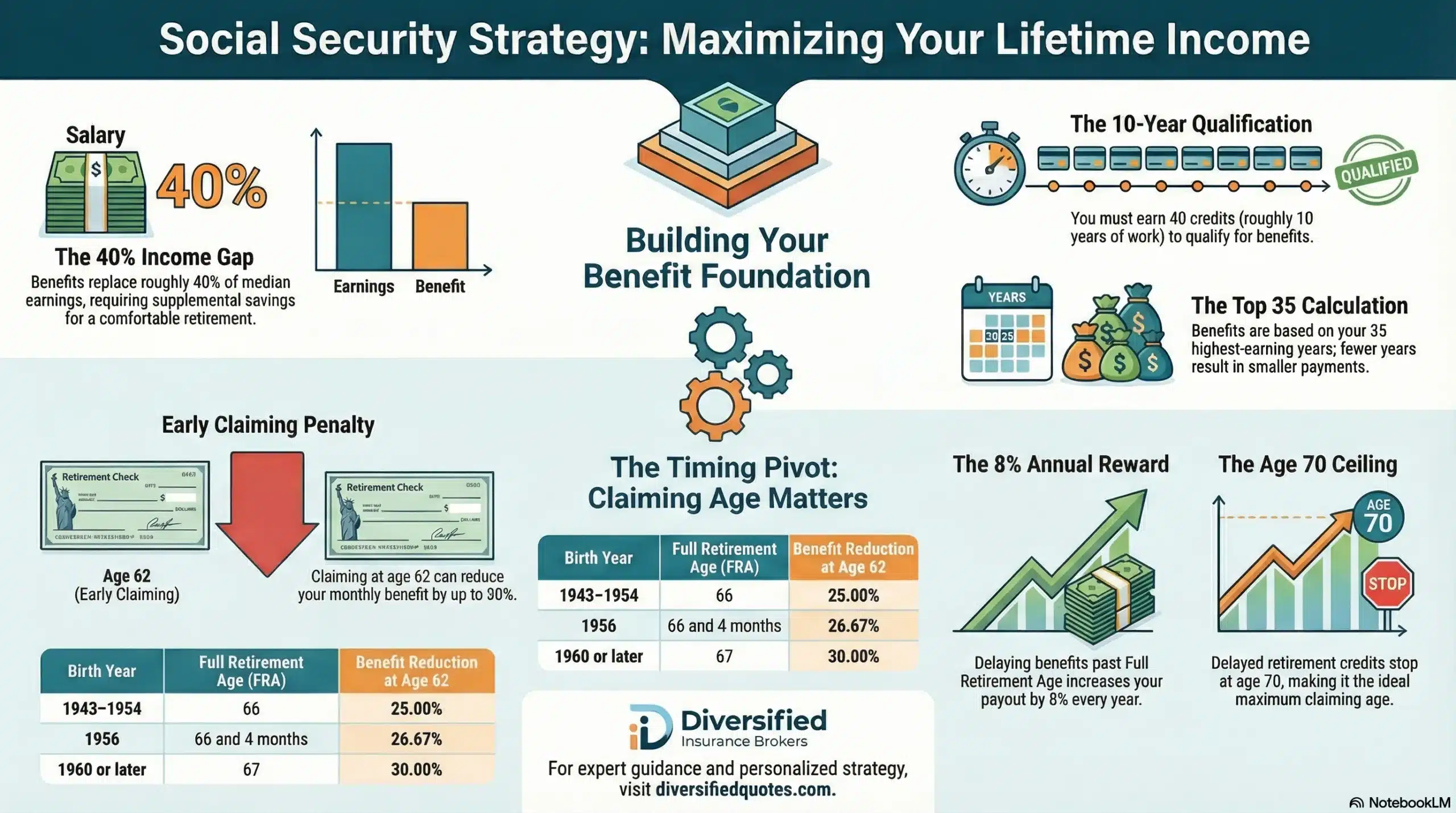
- Age 62: earliest retirement filing age (reduced benefit vs. Full Retirement Age)
- Full Retirement Age (FRA): the age your “full” retirement amount is based on (varies by birth year)
- Age 70: latest age to gain delayed retirement credits on your own retirement benefit
- Age 65: Medicare eligibility timing becomes a major planning variable for many families
If you’re still working and thinking about filing, income limits can matter before FRA:
Social Security income limits.
Before you apply: a 10-minute prep checklist
Filing is easier when you do a quick prep pass first. The goal is to avoid the two biggest causes of processing delays: missing documents and inconsistent history (name changes, marriage history, or earnings record issues). A short prep step often saves weeks and reduces the odds of follow-up letters that pause your claim.
Think of the prep checklist as a “claim quality check.” You’re not trying to overcomplicate it—you’re making sure the basics match your situation so you can submit once and move on with confidence.
- Confirm your benefit type: retired worker vs. spouse vs. survivor vs. divorced spouse vs. disability
- Pick your target start month: when you want entitlement to begin
- Review your earnings record: missing years can change your benefit estimate
- Gather core identity documents: ID + proof of birth + banking info
- Gather marriage/divorce documentation if any spousal or survivor path is involved
- List any pensions from government or non-covered work (can affect some benefit types)
- Check work income expectations if you’re filing before FRA
If Medicare timing is also on your radar, review the broader coordination topic here:
How Medicare and Social Security work together.
How to apply for Social Security (step by step)
Most retirement applications can be completed online, while certain survivor and disability cases may be handled by phone or appointment depending on your situation. The process is much smoother when you approach it as a sequence rather than trying to do everything at once.
The “right way” to file is the way that matches your benefit type and gets your start month correct without triggering avoidable follow-ups. If you’re filing as a spouse, divorced spouse, or survivor, you’re often filing on someone else’s record—and that changes the questions and the documents needed.
- Create or sign in to your “my Social Security” account. This is where you can review earnings history, see benefit estimates, and track claim progress after submission.
- Confirm your filing month and start date. Decide the month you want benefits to begin. This choice affects your monthly amount and may affect earnings-test rules if you’re working and under FRA.
- Select the correct application path. Retirement, spouse, survivor, divorced spouse, or disability each has different questions and document requirements.
- Complete the application carefully. Provide accurate employment history, marital history, and any pension details if asked. Mismatches can trigger follow-up requests.
- Submit documents promptly. If proof documents are requested, respond quickly. Delays here are one of the most common reasons benefits start later than expected.
- Set up direct deposit. Benefits are paid electronically; confirm routing/account numbers carefully.
- Track your claim and respond fast. Monitor updates, watch for mailed notices, and answer requests quickly to keep the timeline moving.
Filing decisions often require coordinating multiple moving parts (work income, Medicare, spouse timing). If you want a planning-first approach before you click submit, start here:
Social Security Planning Services.
Documents checklist (by benefit type)
Having the right documents ready is the fastest way to prevent delays. Some items are universal for most claims (identity + proof of birth + banking), while others depend on whether you’re filing as a spouse, divorced spouse, survivor, or disability claimant.
The best mindset is to assume SSA will need verification, and to make it easy for them to verify quickly. If your documents are consistent and complete, your claim has fewer reasons to pause.
Core documents most applicants need
- Government-issued photo ID
- Social Security number
- Birth certificate or acceptable proof of birth
- Bank account information for direct deposit
- Recent W-2s or self-employment tax returns (as applicable)
If you’re filing for spouse or divorced-spouse benefits
- Marriage certificate(s)
- Divorce decree(s) if divorced spouse benefits are part of your history
- Information about the worker’s record (as requested in the application)
If you’re filing for survivor benefits
- Death certificate
- Marriage verification (and divorce documentation if applicable)
- Any prior name-change documentation if names differ across records
If you’re filing for disability (SSDI)
- Medical provider list and contact information
- Medical records and key diagnosis details
- Work history and job duties information (often more detailed than expected)
- Medication list and treatment timeline
Working while filing: income limits and the earnings test
Working while applying (or working after filing) is one of the most common reasons people get confused about Social Security. The key is to separate two ideas: the benefit amount you qualify for based on your record, and the rules that may temporarily withhold benefits if you’re under Full Retirement Age and your earnings are above certain limits.
If you are filing before FRA and you continue working, Social Security’s earnings rules may withhold part of your benefits depending on your earnings level. Many people interpret this as “I’m not eligible,” but it’s often a timing and cash-flow issue that needs to be modeled so you understand how net income will work in the real world.
If this applies to you, this guide is the best place to start:
Social Security income limits.
Spousal and divorced-spousal claims: how to file the right way
Spousal benefits and divorced-spousal benefits are commonly misunderstood because they feel similar, but they operate under different eligibility rules. In many situations, filing the “wrong way” doesn’t mean you committed fraud—it simply means SSA may need more documentation, which can slow the process or trigger follow-up requests.
If you’re filing as a spouse, the application generally focuses on your current marriage and your spouse’s record. If you’re filing as a divorced spouse, documentation and eligibility requirements (including marriage duration) can matter more, and being currently unmarried can be a key requirement depending on benefit type.
If you’re trying to coordinate claiming decisions as a household, start with:
How to maximize Social Security benefits.
Survivor benefits: filing and documentation tips
Survivor claims often have more moving pieces than a standard retirement claim. The reason is simple: the claim relies on a deceased spouse’s record, and SSA needs proof documents (especially the death certificate and marriage verification). If there is divorce history, name changes, or multiple marriages, the documentation checklist becomes even more important.
Survivor benefits are also one of the easiest places to accidentally make a timing mistake. Some people claim a survivor benefit first and later switch to their own retirement benefit, while others do the reverse. The “best” sequence depends on the household situation, the benefit sizes, and the long-term plan.
The best approach is to gather documents first, then file through the most appropriate channel based on SSA’s instructions for your situation. If you want to reduce delays, the most important step is responding quickly to any document request after filing.
Disability (SSDI): how the process differs from retirement filing
Disability claims are different from retirement claims because SSA must evaluate medical eligibility and work history credits. This can take longer, and it typically involves more documentation and more follow-up questions. If you’re applying for SSDI, it’s especially important to prepare your medical timeline, provider information, and work history details in advance.
Many people focus on “approval” and stop there, but the planning side matters too. SSDI can affect Medicare timing, household budgeting, and later retirement decisions. It’s worth mapping the disability-to-retirement timeline so you understand what changes automatically and what requires action.
Many SSDI recipients later need help coordinating the transition to retirement benefits and Medicare timing. If you’re planning around that intersection, we can help you map the timeline and avoid gaps through:
Social Security planning services.
Medicare timing: the most common filing trap
Many people assume Medicare “just happens” when they apply for Social Security. Sometimes it does—especially when someone is already receiving benefits and transitions into Medicare eligibility—but not always. Medicare has its own enrollment windows, and missing them can create coverage gaps or late penalties depending on your coverage situation.
If you are approaching 65, treat Medicare planning as a separate step that must be coordinated with Social Security filing decisions. This is especially important if you’re still working, covered under an employer plan, or trying to delay Part B under specific rules. A Medicare enrollment mistake can be far more expensive than a filing mistake, because penalties and gaps can follow you.
For a fast cost-and-coverage starting point, use:
Medicare Cost Calculator.
For the broader coordination picture, review:
How Medicare & Social Security work together.
Common filing mistakes that cause delays (and how to avoid them)
Most Social Security filing problems aren’t caused by complicated rules—they’re caused by people filing without checking how the rules stack together. A clean filing plan is usually just a short review of dates, benefit types, work income expectations, and Medicare timing.
Another common issue is focusing only on “getting the application done,” without thinking about what happens next. You’re not just submitting a form—you’re starting a benefit that may last decades. The most valuable “mistake prevention” is a short modeling step: confirm the start month, confirm the benefit category, and verify Medicare timing.
- Filing too early without modeling impact: early filing can permanently reduce monthly income, which is hard to reverse later.
- Choosing the wrong benefit type: spouse vs. survivor vs. divorced spouse benefits follow different paths and document rules.
- Missing Medicare windows: the Medicare clock can move whether or not you file for Social Security.
- Ignoring work income limits before FRA: the earnings test can change net cash flow and create confusion.
- Slow document response: many delays come down to not responding quickly to SSA requests.
- Inconsistent identity or name history: name changes across documents can cause verification delays if not provided up front.
If you want a plan-first approach to avoid these traps, start with:
Social Security Planning Services.
After you apply: what happens next
After submission, the most important thing you can do is track your claim and respond quickly to any requests. Retirement claims are often processed in weeks, but timelines vary by situation and by benefit type. Survivor and disability claims often take longer, especially if additional evidence is required.
The most common frustration we see is when a person assumes “no news is good news,” and misses a request letter or an online message. Claims don’t usually fail because SSA is trying to deny people—claims slow down because verification pauses until the missing piece is supplied. Staying responsive is the simplest way to keep your start month on track.
What you can expect
- Processing timeline: retirement claims are often faster; survivor and disability claims often require more review.
- Award information: you’ll receive confirmation of benefit amount and start date once finalized.
- Direct deposit: benefits are typically paid electronically; confirm account info is correct.
- Tax planning: Social Security can be taxable depending on total income—plan withholding if appropriate.
- Change-of-mind window: there is a limited window in some situations to adjust or reset the filing decision, but it’s narrow and case-specific.
If your filing decision is tied to household strategy, this guide helps you step back and evaluate the bigger picture:
How to maximize Social Security benefits.
Financial Protection Essentials
Retirement account mechanics, disability impact planning, carrier evaluations, and specialized insurance education.
Schedule an Appointment with a Social Security Expert
We’ll confirm your best filing month, verify which benefit type you should claim, and coordinate your plan with work income and Medicare timing.
FAQs: How to Apply for Social Security
What’s the best time to apply?
Many people apply about 2–3 months before they want benefits to begin. The best timing depends on your Full Retirement Age, whether you’re working, and whether you are filing for retirement, spousal, survivor, or disability benefits.
How do I apply—online, by phone, or in person?
Retirement claims are commonly filed online. Some survivor and disability claims may require phone support or an appointment depending on circumstances. The “right” method is usually the one that matches your benefit type and documentation needs.
What documents do I need most often?
Common requirements include a photo ID, Social Security number, proof of birth, direct deposit banking information, and (if applicable) marriage/divorce/death documentation or medical records for disability claims.
Can I work while collecting Social Security?
Yes, but if you file before Full Retirement Age, income limits can apply and part of the benefit may be withheld depending on earnings. Reviewing expected income before filing helps prevent surprises.
Do I need to apply for Medicare separately?
Often, yes. Medicare has its own enrollment windows. Many people coordinate Medicare enrollment around age 65, and those still working may have special enrollment rules depending on employer coverage.
How long until I receive my first payment?
Timelines vary by benefit type and documentation. Retirement claims can be faster, while survivor and disability claims often take longer due to additional review and supporting evidence requirements.
What if I realize I filed too early?
There are limited options depending on how long you’ve been entitled and whether benefits have been paid. This is why we recommend confirming the filing month and strategy before submitting the application.
Are Social Security benefits taxable?
They can be, depending on your combined income from other sources (work, pensions, investments, and withdrawals). Planning ahead helps you avoid unexpected tax impacts.
About the Author:
Jason Stolz, CLTC, CRPC and Chief Underwriter at Diversified Insurance Brokers (NPN 20471358), is a senior insurance and retirement professional with more than two decades of real-world experience helping individuals, families, and business owners protect their income, assets, and long-term financial stability. As a long-time partner of the nationally licensed independent agency Diversified Insurance Brokers, Jason provides trusted guidance across multiple specialties—including fixed and indexed annuities, long-term care planning, personal and business disability insurance, life insurance solutions, and short-term health coverage. Diversified Insurance Brokers maintains active contracts with over 100 highly rated insurance carriers, ensuring clients have access to a broad and competitive marketplace.
His practical, education-first approach has earned recognition in publications such as VoyageATL, highlighting his commitment to financial clarity and client-focused planning. Drawing on deep product knowledge and years of hands-on field experience, Jason helps clients evaluate carriers, compare strategies, and build retirement and protection plans that are both secure and cost-efficient. Visitors who want to explore current annuity rates and compare options across multiple insurers can also use this annuity quote and comparison tool.
