
Lawsuit Funding – Fast Legal Cash Advances

Jason Stolz CLTC, CRPC
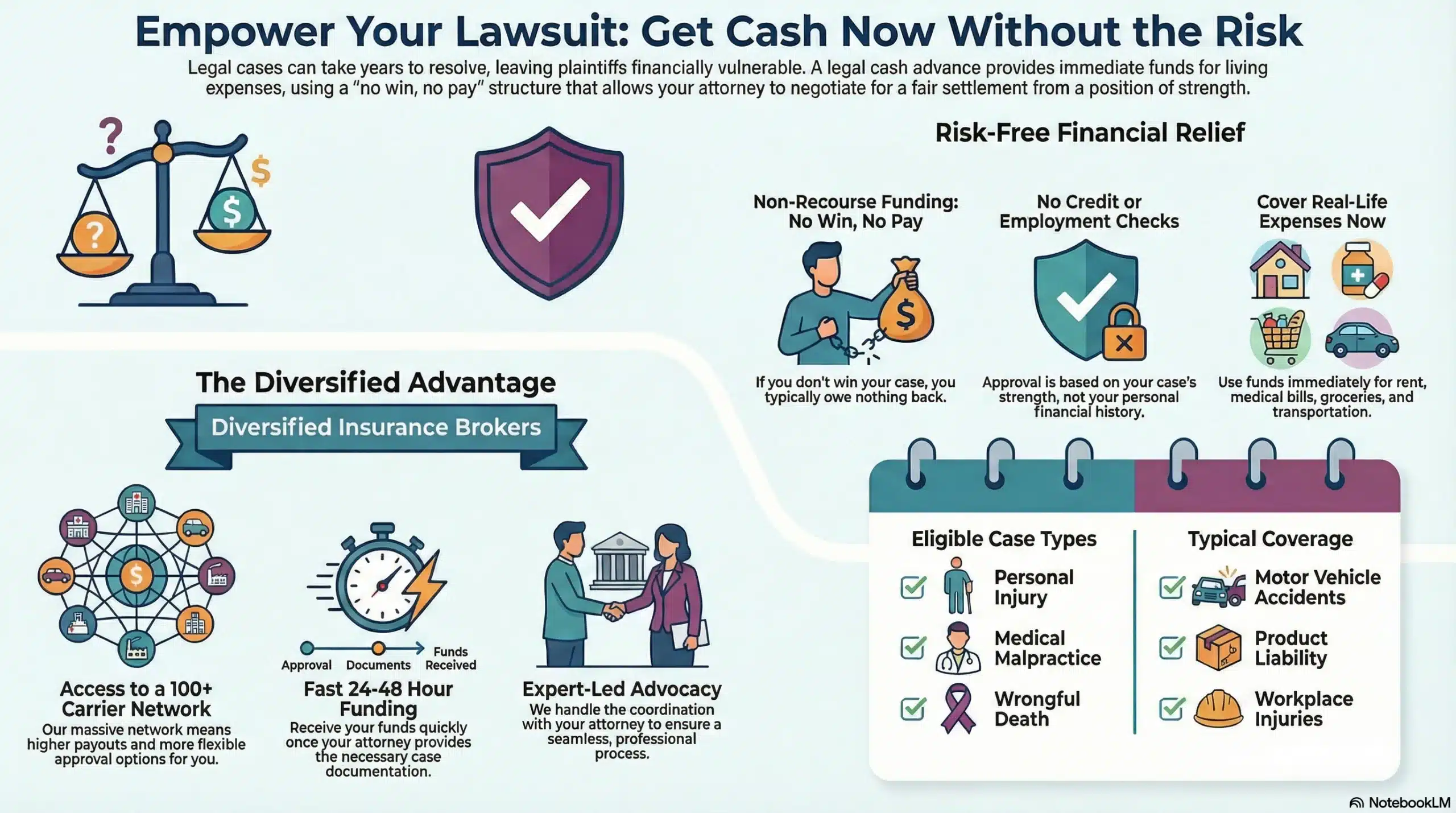
When you’re pursuing a legal case, bills and living expenses don’t stop. Rent, groceries, utilities, transportation, and medical costs can pile up fast—especially if an injury limits your ability to work. Lawsuit funding is designed to provide cash before your case settles so you can stay financially stable while your attorney focuses on getting the best outcome. Unlike traditional loans, lawsuit funding is typically structured as a non-recourse cash advance, which means repayment usually comes only from your settlement or judgment if your case results in a recovery.
Many plaintiffs feel pressured to accept low offers simply because they need money now. Insurance companies understand that time and financial stress often work against injured people. The right funding arrangement can reduce that pressure by giving you a financial bridge—so you can keep up with essentials while your case moves forward. The goal is not to “spend against your settlement,” but to avoid financial decisions that could weaken your negotiating position.
We coordinate directly with your attorney to keep the process smooth and attorney-friendly. In most situations, the funding decision is based on case fundamentals—liability, documented damages, insurance coverage, and expected timeline—rather than your credit score or employment history. That’s a key difference between lawsuit funding and typical borrowing.
Apply for Lawsuit Funding Now
Get approved fast and receive funds in as little as 24 hours.
What Is Lawsuit Funding?
Lawsuit funding—often referred to as pre-settlement funding—is a financial option that provides immediate cash to plaintiffs who have a pending legal claim. The advance is secured by the potential proceeds of your case, and repayment typically happens only if your case resolves with a settlement or judgment. This structure is commonly described as “non-recourse,” meaning the funder assumes the risk of non-payment if there is no recovery.
Because repayment is tied to the outcome, lawsuit funding is not underwritten like a bank loan. Providers generally look at whether fault can be established, whether the injuries and damages are well documented, whether there is adequate insurance coverage or collectible defendants, and whether the case is represented by an attorney. Attorney cooperation is essential because your law firm is the source of verification, documentation, and settlement disbursement.
If you’re exploring different “cash now” options, it can help to understand how this differs from other approaches like borrowing from family, using high-interest credit cards, or taking payday-style loans. Lawsuit funding can be a better fit when you need money for essentials but don’t want monthly payments while your case is still pending.
Why Plaintiffs Use Lawsuit Funding
Most people do not plan for a lengthy legal timeline. Even straightforward claims can take months to resolve, and more complex injury cases can take longer—especially when medical treatment is ongoing or liability is disputed. During that time, everyday expenses continue. Lawsuit funding is commonly used to:
Stay current on essential living costs such as rent or mortgage payments, utilities, groceries, transportation, child care, and basic household expenses. When you remove “survival pressure,” you can make clearer decisions.
Cover injury-related costs that are difficult to delay, including out-of-pocket medical expenses, prescriptions, rehabilitation, travel to appointments, and other related expenses that may not be fully covered in the moment.
Reduce pressure to accept low offers simply to get cash now. When a plaintiff is financially stable, attorneys often have the time and leverage they need to negotiate properly rather than settling early due to urgent bills.
Why Choose Us for This Type of Funding?
We work through a broad network of legal funding sources to help match qualified plaintiffs with competitive options. The advantage of a larger network is that you are not locked into a single offer structure. The goal is to secure a responsible advance amount with clear terms, so you understand the impact on your net proceeds before you sign.
Clients choose our process because we focus on speed, transparency, and attorney coordination. That means fewer surprises, fewer delays, and a more streamlined experience from application through disbursement.
- Competitive options through a broad funding network
- Fast approvals in many cases once attorney verification is received
- No monthly payments while the case is pending
- Attorney-friendly coordination and documentation handling
- Clear terms disclosed before you accept any offer
Cases We Fund
Lawsuit funding may be available for many attorney-represented civil claims, especially cases where damages are documented and recovery is reasonably expected. Common case types include:
- Personal injury claims
- Car and truck accidents
- Slip and fall / premises liability
- Medical malpractice
- Workplace injuries (including third-party claims)
- Other qualifying civil cases
Eligibility ultimately depends on the facts of the case, available coverage, the estimated value of damages, and the ability to verify details through your attorney. If you’re unsure whether your case qualifies, applying is often the fastest way to confirm.
How Lawsuit Funding Works
The process is designed to be straightforward and attorney-led. Here’s how it typically works:
- Apply online with basic case and attorney information.
- Attorney verification confirms representation and provides supporting case details.
- Case review evaluates liability, damages, coverage, and expected timeline.
- Offer presented with advance amount and payoff structure.
- Funds disbursed after acceptance—often by wire or ACH.
In many cases, the timeline comes down to how quickly documentation can be verified with the law firm. Straightforward claims with responsive attorney verification can move quickly. More complex matters may take longer.
Why Lawsuit Funding Is Different From a Traditional Loan
The biggest difference is the repayment source and structure. With a traditional loan, you typically make monthly payments and repayment is required regardless of what happens in your case. With lawsuit funding, repayment is generally tied to the outcome and is typically made from settlement proceeds through your attorney’s trust account if there is a recovery.
Because the provider’s repayment depends on a successful case resolution, providers underwrite the claim itself rather than your credit history. That’s why most lawsuit funding arrangements do not involve employment verification or the same “credit-and-income” underwriting used by banks.
Costs, Timing, and Responsible Use
It’s important to understand that lawsuit funding can be more expensive than traditional borrowing. Costs and fee structures vary, and the payoff can increase over time—especially if the case lasts longer than expected. That doesn’t mean the option is wrong; it means it should be used intentionally.
The most responsible approach is to take the minimum amount needed for essentials, request a written payoff schedule, and have your attorney review the agreement. That way, you can see how the payoff changes at different timeframes and understand the net effect on your proceeds.
Many plaintiffs use funding to stabilize their household while waiting. Others also choose to strengthen their broader financial safety net during this period. Depending on your situation, it can be helpful to consider protections like disability insurance, short-term health insurance, or life insurance so you are not relying on case timing alone for financial stability.
Secure the Funds You Need While You Wait
Legal cases can take time, but your day-to-day life doesn’t pause. Lawsuit funding can give you breathing room, reduce financial stress, and support a more patient negotiation strategy. If you decide to explore funding, the key is clarity: understand the terms, confirm the payoff schedule, and make sure the advance amount is sized responsibly for your needs.
Start Your Lawsuit Funding Application
Apply now and get cash in as little as 24 hours—risk-free.
Related Pages
Explore settlement advances, funding costs, and ways to get cash while a case is pending.
Talk With an Advisor Today
Choose how you’d like to connect—call or message us, then book a time that works for you.
Schedule here:
calendly.com/jason-dibcompanies/diversified-quotes
Licensed in all 50 states • Fiduciary, family-owned since 1980
FAQs: Lawsuit Funding & Fast Legal Cash Advances
What is lawsuit funding (or a legal cash advance)?
Lawsuit funding (often called pre-settlement funding) is typically a non-recourse cash advance based on your expected settlement. Repayment generally comes from case proceeds if there is a recovery.
How do I apply for lawsuit funding?
You submit a short request with basic case and attorney information. The next step is attorney verification and case review. If approved, funds can be disbursed quickly once documents are confirmed.
Who typically qualifies?
Most approvals require attorney representation and a case with documented damages and a reasonable expectation of recovery. Eligibility depends on case strength, liability, coverage, and other factors.
What are the costs and fees?
Costs vary by provider and may increase over time. Before signing, request a written payoff schedule and have your attorney review the agreement so you understand the net impact at settlement.
What happens if I lose my case?
In a true non-recourse structure, you typically do not repay the advance if there is no recovery. Confirm this in the written agreement.
Does lawsuit funding affect my credit score?
Most providers do not use traditional credit underwriting because approval is based on case merits. Processes can vary, so confirm what verification steps apply to your situation.
What should I ask before choosing a funding company?
Ask for transparent pricing, a payoff schedule, whether fees compound, how repayment is handled at settlement, and what documentation your attorney must provide.
Note: Terms, amounts, and availability vary by state and case facts. Review any agreement with your attorney.
About the Author:
Jason Stolz, CLTC, CRPC and Chief Underwriter at Diversified Insurance Brokers, is a senior insurance and retirement professional with more than two decades of real-world experience helping individuals, families, and business owners protect their income, assets, and long-term financial stability. As a long-time partner of the nationally licensed independent agency Diversified Insurance Brokers, Jason provides trusted guidance across multiple specialties—including fixed and indexed annuities, long-term care planning, personal and business disability insurance, life insurance solutions, and short-term health coverage. Diversified Insurance Brokers maintains active contracts with over 100 highly rated insurance carriers, ensuring clients have access to a broad and competitive marketplace.
His practical, education-first approach has earned recognition in publications such as VoyageATL, highlighting his commitment to financial clarity and client-focused planning. Drawing on deep product knowledge and years of hands-on field experience, Jason helps clients evaluate carriers, compare strategies, and build retirement and protection plans that are both secure and cost-efficient.
