
Legal Funding – Fast Pre-Settlement Cash Advances

Jason Stolz CLTC, CRPC
When you’re in the middle of a lawsuit, bills and expenses don’t stop. Rent is still due. Utility bills still come in. Groceries, gas, and everyday life keep moving forward—even when your case timeline doesn’t. Legal funding can provide cash now, before your case settles, so you can cover essential expenses without feeling pressured into accepting a quick, low offer just to make ends meet.
At Diversified Insurance Brokers, we help plaintiffs explore attorney-coordinated legal funding options through a broad network of funding sources. That matters because funding offers can vary widely depending on how a provider underwrites risk, how much capital they can deploy, and how they price costs over time. Instead of being limited to one company’s rules, we can review multiple options to help you pursue a structure that’s clear, competitive, and realistic for your case. The goal is simple: get you the financial breathing room you need while your attorney focuses on maximizing your outcome.
Legal funding is also commonly referred to as pre-settlement funding, legal cash advances, or a cash advance on a lawsuit settlement. While the name changes, the core purpose stays the same: access part of the expected value of your claim early so you can stay stable while the legal process unfolds. The strongest funding experience is one that is transparent, attorney-friendly, and sized appropriately—so it solves a problem today without creating a bigger one when your case finally resolves.
Apply for Legal Funding Today
Get cash in as little as 24 hours with competitive offers and an attorney-friendly process.
How Legal Funding Works
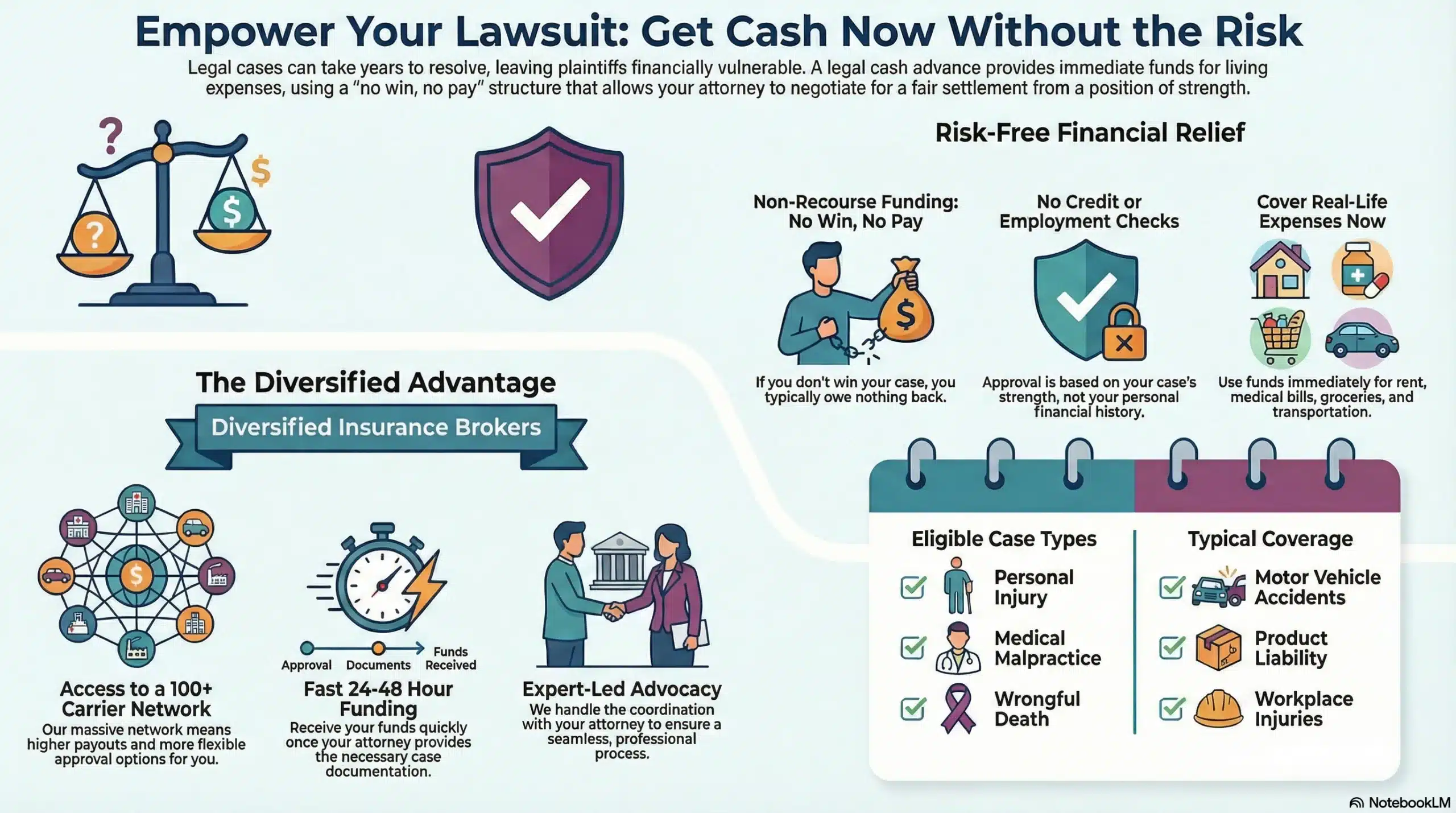
Legal funding is typically structured as a non-recourse cash advance on your pending settlement. “Non-recourse” means repayment generally comes from the settlement proceeds if you recover money in the case. In most situations, you do not make monthly payments while your case is pending, and approval is usually based on case strength—not your credit score, income, or employment history.
Here’s the practical flow: you submit a request, your attorney confirms key details and provides supporting documentation, and underwriting evaluates the claim’s likelihood of recovery and projected value. If approved, you receive an offer that outlines how repayment is calculated and what you may owe if the case resolves at different times. When your case settles, repayment is typically handled from settlement proceeds during the attorney’s disbursement process.
Because legal funding decisions are case-based, attorney involvement is usually required. A legitimate funding provider needs to verify the lawsuit is real, confirm representation, review liability and damages, and understand the expected timeline. If a company claims they can fund a large amount without speaking with your attorney or reviewing documentation, that’s a red flag. The safest and cleanest funding experience is the one that is properly documented and coordinated through counsel.
What Legal Funding Is (And What It Is Not)
People often call this a “lawsuit loan,” but legal funding is usually not a traditional loan in the banking sense. With a standard loan, you repay regardless of what happens. With non-recourse legal funding, repayment generally depends on a successful outcome—meaning a settlement or award that creates proceeds to repay the advance.
That difference matters because it explains why legal funding can be priced differently than bank lending. The provider takes on the risk of loss if you do not recover. That risk is part of the cost structure, and it’s why reviewing your payoff schedule and agreement terms is so important before you accept funds. The best choice is not always the “largest offer.” It’s the offer that solves the problem you have now while still leaving you comfortable with what you keep at settlement.
Why Plaintiffs Use Legal Funding
Most people do not plan for a lawsuit to disrupt their finances. But many cases involve injuries, missed work, medical treatment, transportation issues, and household stress. Even a strong claim can take time to resolve due to the realities of the legal process—insurance negotiations, discovery, medical documentation, scheduling, and court backlogs. During that time, financial pressure can push people into decisions they wouldn’t otherwise make.
Legal funding can help cover essential needs like:
- Rent or mortgage payments
- Utilities and household bills
- Groceries and everyday living costs
- Medical bills, prescriptions, and copays
- Transportation expenses and vehicle payments
- Childcare and family obligations
- Preventing eviction, repossession, or other emergencies
One of the most important benefits is psychological and strategic: when you’re no longer forced to settle quickly due to financial stress, you and your attorney can often negotiate from a stronger position. The goal is not to “borrow big.” The goal is to keep you stable while the case develops properly.
Why Choose Us for Legal Funding
Legal funding is not one-size-fits-all. Some providers are conservative with case types. Others limit advances based on internal rules. Some move slowly due to process bottlenecks. And some are simply not transparent about how costs grow if your case takes longer than expected.
Our approach is built around access and clarity. Because we can work across a broad funding network, we can often compare options and help you find an offer that balances three things: approval likelihood, advance size, and payoff structure. That “fit” matters, especially when you’re already under stress and want to avoid surprises later.
- Access to a large funding network (more options than a single-provider shop)
- Competitive offers through comparison across providers
- Fast approvals when attorney documentation is submitted promptly
- Non-recourse structure (repayment typically only if you recover)
- Attorney-friendly coordination to reduce friction and delays
- Transparent disclosures so you understand terms before you accept
Types of Cases We Fund
Legal funding is most common in civil cases where there is a realistic expectation of settlement or judgment and a legitimate damages claim. Eligibility always depends on the specifics, but many case categories can qualify, including:
- Personal injury claims
- Motor vehicle accidents (car, truck, motorcycle)
- Slip and fall and premises liability claims
- Workplace injury cases (depending on structure and jurisdiction)
- Medical malpractice lawsuits
- Wrongful death claims
- Product liability cases
Not sure whether your claim qualifies? That’s normal. Funding decisions are made based on liability, documented damages, insurance coverage, and where the case is in the timeline. The fastest path to clarity is usually an attorney-coordinated review.
How Much Can You Receive?
Advance amounts typically depend on the estimated settlement value, the strength of liability, available insurance coverage, and known obligations that must be paid from proceeds (attorney fees, case costs, medical liens, and other deductions). Providers generally fund a portion of the projected recovery because the settlement needs to cover more than just the advance.
You’ll sometimes see broad rules online (like “10% to 20% of expected settlement”), but real approvals are more nuanced. A case early in the process may qualify for less until damages are documented. A case with strong liability and clear medical documentation may qualify for more. The goal is usually to solve a cash-flow problem, not to maximize the advance at the expense of the final net proceeds.
The best funding decisions are conservative and intentional. Borrowing only what you need for essentials is often the smartest move, because it reduces the chance that repayment meaningfully impacts what you take home later.
What Your Attorney Will Need to Provide
Attorney participation is a normal part of legitimate legal funding. Providers need to verify the claim and evaluate its strength using real documentation. Exact requirements vary, but common items include:
- Signed authorization allowing review of the case
- Basic incident details and claim status
- Insurance carrier and available coverage (as applicable)
- Medical treatment summaries and documentation of injuries
- Known liens or obligations that could reduce net proceeds
- Any settlement demand, offers, or negotiation updates (if available)
In many cases, the speed of funding depends less on underwriting and more on how quickly the requested documentation is provided. If your attorney can respond promptly, approvals can often move quickly.
Understanding Costs Before You Accept Funding
The most important thing to understand before you accept any legal funding offer is how repayment is calculated. A reputable offer should make it easy to answer a simple question: “If my case resolves in 3 months, 6 months, 9 months, or 12 months—what will I owe?”
Before signing, you should understand:
- How charges accrue (monthly, quarterly, or another schedule)
- Whether pricing is simple or compounding (compounding can increase payoff faster over time)
- Whether fees are deducted up front (which reduces the amount you actually receive)
- What happens if the case timeline extends beyond the expected range
- Whether the agreement contains caps or other constraints (varies by provider/state)
We encourage plaintiffs to size funding responsibly. The goal is to cover essential expenses and remove pressure—not to take an amount that creates frustration later when you see the net proceeds after attorney fees, liens, and funding repayment are all handled.
Get the Most Money Possible (The Right Way)
Speed matters, but so does structure. The “best” funding is not just a fast wire. It’s an offer that makes sense given your case value, your timeline, and what you need the money to accomplish. Because we can access multiple funding sources, we aim to help you secure a strong offer while still emphasizing clarity and responsible sizing.
That’s also why many plaintiffs use this time to tighten other parts of their financial safety net—especially if an injury impacts work or creates uncertainty. Depending on your situation, you may consider exploring protection options like disability insurance, short-term health insurance, or life insurance so you’re covered from multiple angles while your case progresses.
If you want to learn more about how funding is structured in similar situations, see our overview on legal cash advances.
Start Your Legal Funding Application
Get an attorney-friendly review and a competitive funding offer—fast.
Related Pages
More on legal funding, settlement advances, and tools that help you stay financially stable while your case is pending.
Talk With an Advisor Today
Choose how you’d like to connect—call or message us, then book a time that works for you.
Schedule here:
calendly.com/jason-dibcompanies/diversified-quotes
Licensed in all 50 states • Fiduciary, family-owned since 1980
FAQs: Legal Funding (Pre-Settlement Cash Advance)
What is legal funding (pre-settlement cash advance)?
Legal funding (also called pre-settlement funding, lawsuit advance, or cash advance on settlement) is a non-recourse advance against your expected lawsuit settlement. You receive funds up front to help cover expenses and typically only repay if your case wins or settles. If you lose, you generally owe nothing.
How do I qualify for legal funding?
You typically need a pending lawsuit (commonly personal injury, medical malpractice, etc.), representation by an attorney, evidence supporting expected settlement value, and sufficient case strength. Credit score and employment status usually are not required.
How much can I receive in advance?
Advances are commonly about 10% to 20% of expected settlement value. The exact amount depends on case strength, estimated settlement size, attorney fees and liens, and state regulations.
What are the costs, fees, and interest?
Legal funding companies usually charge fees and interest. Interest may be simple or compound, and some providers charge origination or administrative fees. Because repayment only happens if you win, costs are typically higher than traditional loans. Always review how interest accrues and total repayment scenarios.
What happens if I lose my case?
With non-recourse funding, if your case is unsuccessful, you typically do not repay the advance. The funding company assumes the risk. Always review contract terms carefully for any exceptions.
How fast does funding arrive?
Many providers can fund within 24–48 hours after case approval, attorney verification, and required document submission. Timing depends on documentation speed and provider process.
Are there restrictions on how I can use the funds?
Funds are usually unrestricted and commonly used for living expenses, medical bills, rent or mortgage, utilities, and transportation. Always confirm if your specific agreement has any usage limitations.
About the Author:
Jason Stolz, CLTC, CRPC and Chief Underwriter at Diversified Insurance Brokers, is a senior insurance and retirement professional with more than two decades of real-world experience helping individuals, families, and business owners protect their income, assets, and long-term financial stability. As a long-time partner of the nationally licensed independent agency Diversified Insurance Brokers, Jason provides trusted guidance across multiple specialties—including fixed and indexed annuities, long-term care planning, personal and business disability insurance, life insurance solutions, and short-term health coverage. Diversified Insurance Brokers maintains active contracts with over 100 highly rated insurance carriers, ensuring clients have access to a broad and competitive marketplace.
His practical, education-first approach has earned recognition in publications such as VoyageATL, highlighting his commitment to financial clarity and client-focused planning. Drawing on deep product knowledge and years of hands-on field experience, Jason helps clients evaluate carriers, compare strategies, and build retirement and protection plans that are both secure and cost-efficient.
