
Long Term Care Planning Strategies

Jason Stolz CLTC, CRPC
Planning ahead for long term care is one of the most important steps retirees can take to protect their savings, their independence, and their families. The costs of home health care, assisted living, and nursing facilities continue to rise every year, and many retirees underestimate both the likelihood of needing care and the financial impact it can create. With the right long term care planning strategies, you can ensure that your retirement income, assets, and legacy are safeguarded while still receiving the quality of care you deserve.
At Diversified Insurance Brokers, we help families turn a broad concern—“What happens if I need care?”—into an actual plan. That plan usually includes three parts: (1) how care might realistically start (often at home), (2) how costs could escalate if needs increase (assisted living, memory care, skilled nursing), and (3) how to protect the household budget and retirement accounts if care lasts longer than expected. The point is not to predict the future perfectly. The point is to remove the “financial surprise” so care decisions can be made based on safety and dignity instead of panic and price.
Get a Long Term Care Planning Quote
Compare traditional LTC, hybrid plans, and annuity-based options from top carriers—side by side.
Request a Quote Explore LTC InsuranceWhy Long Term Care Planning Matters
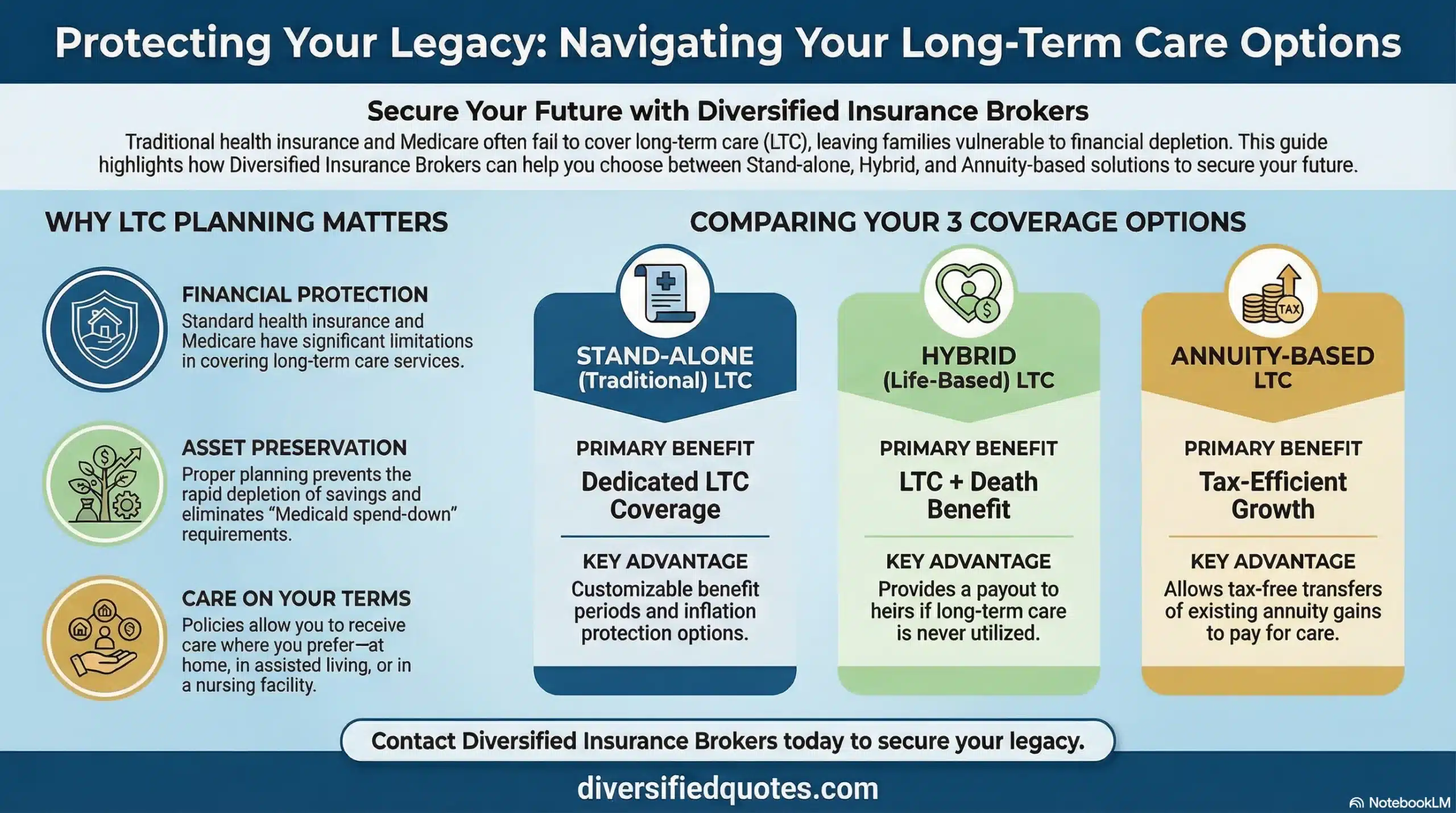
Long term care planning is about keeping control. When people don’t plan, they often get forced into decisions: spending down faster than expected, choosing a facility based on availability rather than fit, or asking family members to step into caregiving roles without the time, training, or financial support to do it sustainably. With a strategy in place, you can fund care in a way that protects your spouse, preserves retirement income, and reduces stress for adult children who may otherwise be forced to coordinate everything during a crisis.
Care also tends to arrive in stages. Many people picture “nursing home care” as the default, but a large portion of care starts with help at home: meal prep, bathing assistance, medication management, and supervision. For some families, that support stays modest. For others, needs escalate into assisted living or memory care. Planning matters because it’s easier to fund a staged care journey when you’ve built flexibility into the strategy from the start.
One of the biggest mistakes retirees make is assuming Medicare will handle most of these costs. Medicare can cover certain short, medically necessary skilled services in limited situations, but it generally is not designed to cover extended custodial long term care. That’s why long term care planning strategies are typically built around insurance leverage, asset repositioning, and “cash flow protection” rather than relying on Medicare as the primary solution.
Core Long Term Care Planning Strategies
1. Traditional Long Term Care Insurance
Traditional long term care insurance is a standalone policy designed specifically to reimburse (or in some designs, pay) for qualified long term care services once you meet the policy’s claim triggers. Most policies begin paying benefits when you need help with at least two Activities of Daily Living or you have a qualifying cognitive impairment that requires supervision for safety.
The key planning advantage of traditional LTC insurance is leverage. You are transferring a large, uncertain financial risk to an insurance pool. In return, you typically gain access to a structured monthly benefit, a defined benefit pool (or benefit period), and the ability to use benefits across multiple settings depending on policy language. Traditional LTC can be one of the most cost-efficient ways to buy a large amount of potential coverage per premium dollar—especially when purchased earlier while health is stronger.
Traditional LTC plans are also highly customizable. Benefit amount, benefit period, elimination period, and inflation protection can usually be tailored. That customization matters because not every household wants the same outcome. Some households want maximum catastrophic protection. Others want a smaller plan that covers “most” of expected costs so retirement accounts don’t get drained quickly.
2. Hybrid Life Insurance with LTC Benefits
Hybrid policies combine permanent life insurance with long term care benefits. If you need care, the policy can accelerate the death benefit to pay for qualified expenses or provide structured LTC benefits depending on the design. If you never need care, beneficiaries typically receive a death benefit instead. Many retirees like hybrids because they reduce the emotional objection of “use it or lose it.” Instead of paying premiums for a benefit you might not use, you’re funding a policy that can deliver value in multiple future scenarios.
Another reason hybrids are popular is premium structure. Many hybrid designs have premium schedules that are designed to be stable and predictable. For retirees who worry about budget strain in later years, a premium structure that feels “locked” can be comforting. Some hybrid designs also include return-of-premium options, which can add flexibility if your plan changes later.
Hybrids can be particularly attractive for households that care about legacy planning. If a couple’s plan includes leaving assets to heirs, a hybrid design can provide care funding without automatically sacrificing the legacy goal if care is never needed. The trade-off is that hybrids often require more funding upfront compared to traditional LTC, and the right design depends on budget, desired benefit size, and whether the household wants to fund with a lump sum or ongoing premiums.
3. Annuities with Long Term Care Riders
Some annuity-based solutions include long term care multipliers or enhanced benefit features that increase available dollars for qualified care expenses. In plain English: you reposition assets into a contract, and if care is needed later, the contract can expand the available benefit pool for a defined period of time or up to a defined maximum.
For retirees who have significant savings sitting in low-yield accounts, annuity/LTC strategies can be compelling because they often preserve principal while creating a “second use” for the dollars if care becomes necessary. In many designs, if care is never needed, the value remains for the account owner or beneficiaries (depending on contract structure). This approach can be especially attractive for people who are hesitant to commit to a standalone LTC premium stream but still want leverage and planning structure.
If you’re exploring this style of planning, our non-qualified long term care annuity page can help you understand how repositioning strategies work and what trade-offs to evaluate.
4. Self-Funding or “Pay-As-You-Go”
Self-funding means you earmark assets—cash, brokerage accounts, or other reserves—to pay for care out of pocket if it becomes necessary. This strategy can be appropriate for higher-net-worth households that can absorb large care costs without jeopardizing lifestyle, spouse security, or legacy goals.
The challenge is that self-funding has no leverage. A long duration claim can drain assets faster than most retirees expect, and the timing is often inconvenient. A care event can also coincide with market volatility or other retirement expenses. That’s why self-funding, when used thoughtfully, is often paired with other planning tools rather than used as the only strategy. Even a partial insurance layer can reduce the risk of “rapid depletion” and preserve household stability.
5. Medicaid Planning
Medicaid is a safety net program that can provide long term care coverage after assets have been significantly spent down and other eligibility conditions are met. For many households, Medicaid planning is not the preferred “primary” strategy because it can limit facility choice and create planning restrictions. However, it is still an important topic because it is the default outcome for many families who don’t plan earlier.
For households considering Medicaid as part of their long-term plan, the key issue is that strategies must be implemented carefully and often far in advance. Medicaid rules can be complex, and planning is typically coordinated with legal guidance. The planning goal is usually to protect a healthy spouse and preserve some assets for heirs while still ensuring the household can access appropriate care options if needed.
Compare Traditional, Hybrid, and Annuity-Based LTC Options
We’ll map benefits, elimination periods, inflation options, and “what if I never use it?” outcomes so you can choose confidently.
Request My Comparison Explore LTC InsuranceComparison: LTC Strategies at a Glance
Most families don’t choose a strategy based on theory. They choose based on trade-offs: cost, flexibility, underwriting, and what happens if care is never needed. The table below summarizes the major themes, but the real decision is usually made after you match the strategy to your assets, cash flow, and timeline.
| Strategy | Pros | Cons | Best For |
|---|---|---|---|
| Traditional LTC Insurance | Broad protection; tax-favored benefits; strong leverage | Underwriting required; premiums can vary by carrier and design | Healthy planners, often age 50–65 |
| Hybrid Life + LTC | Value if no claim; legacy-friendly; often predictable premium design | Higher funding requirement; design differences matter | Retirees wanting “either way it pays” structure |
| Annuity + LTC Features | Repositions assets; may preserve principal; creates care leverage | Funds are in a contract structure; best fit depends on goals | Retirees with existing assets seeking structured care pool |
| Self-Funding | Maximum flexibility; no underwriting | No leverage; high risk of rapid depletion in long claims | Higher-net-worth households |
| Medicaid Planning | Safety net coverage when assets are limited | Rules/eligibility; potential facility limits; planning constraints | Crisis planning or limited-asset households |
Case Example
Consider a 62-year-old couple with $750,000 in retirement savings. Concerned about Alzheimer’s on one side of the family, they compare three approaches. A traditional long term care policy provides a defined benefit pool for each spouse with a manageable annual premium and strong flexibility across care settings. A hybrid life/LTC policy uses a lump-sum funding approach and creates both an LTC pool and a legacy outcome if care is never needed. An annuity/LTC strategy repositions assets to create enhanced benefits for qualified care while preserving the possibility that value remains if care is never used.
After reviewing how each plan behaves under different outcomes—short home-care need, longer memory care journey, and “no claim ever”—the couple chooses the structure that best aligns with their priorities: protecting spouse security, reducing “unknown” out-of-pocket exposure, and preserving legacy value if care is never needed. The point is not that one option is always better. The point is that the right option depends on what risk the household is trying to solve.
Who Benefits Most From LTC Planning Strategies?
Long term care planning helps almost every household, but it is especially valuable when care costs would meaningfully disrupt retirement income or require a spouse to drastically change lifestyle. Families also benefit when planning reduces the burden on adult children who may otherwise be forced to coordinate care and finances under stress.
In practical terms, planning tends to be most valuable for retirees in their 50s and 60s who want access to more plan designs and better underwriting outcomes, couples who want to protect each other with coordinated benefits, and households with a family history of chronic illness or dementia that increases concern about longer-duration claims.
Why Work With Diversified Insurance Brokers?
Diversified Insurance Brokers helps families design long term care strategies that fit a real retirement plan, not just a product illustration. As an independent brokerage, we compare options across multiple carriers and explain the differences that actually change outcomes: what triggers benefits, how the elimination period is counted, which settings are covered, and how inflation protection affects future purchasing power.
We also help you avoid common planning mistakes, like under-sizing benefits relative to the level of care you’re likely to use first, ignoring elimination period cash needs, or choosing a plan structure that conflicts with your legacy goals. If you want to start with the basics and see common policy structures, you can review our long term care insurance overview page.
Common Pitfalls (and How We Help You Avoid Them)
The biggest pitfalls usually come from mismatched assumptions. People assume care will start in a facility when it often starts at home. They assume Medicare will pay for extended care when it generally isn’t designed to. They choose benefit amounts without anchoring them to realistic costs. Or they pick a strategy that feels “cheap” today but creates gaps later when care needs don’t follow the original plan.
We help you avoid those outcomes by comparing strategies the way you’ll actually experience them: what happens if you need modest care for a short period, what happens if a cognitive claim lasts years, and what happens if you never claim at all. That three-scenario approach is often what turns an “I’m not sure” household into a confident decision.
Start Planning for Long Term Care Today
Explore strategies that protect retirement savings, reduce family stress, and keep care choices flexible.
Request Your Quote Explore LTC InsuranceRelated Pages
Additional resources that often pair well with long term care planning conversations.
Talk With an Advisor Today
Choose how you’d like to connect—call or message us, then book a time that works for you.
Schedule here:
calendly.com/jason-dibcompanies/diversified-quotes
Licensed in all 50 states • Fiduciary, family-owned since 1980
FAQs: Long-Term Care Planning Strategies
What are the main strategies for funding long-term care?
The most common approaches include traditional long-term care insurance, hybrid life + LTC policies, and annuity-based LTC solutions that reposition assets to create an enhanced care pool. The right fit depends on health, age, budget, and whether you want a “use it or legacy” outcome.
How do traditional LTC policies differ from hybrid ones?
Traditional LTC is designed primarily to pay for care when you qualify. Hybrid designs combine LTC benefits with another value path—often a life insurance death benefit—so the policy can still provide value if care is never needed. Premium structure and funding style also differ by design.
What is an “annuity + LTC” solution?
An annuity + LTC strategy typically uses a fixed annuity structure with enhanced benefits for qualified care needs. In many designs, a care event can increase the available benefit pool or monthly benefit for a defined period, while still preserving contract value if care is never required.
When should I start planning for long-term care?
Many people plan in their 50s or early 60s while health is stronger and more options are available. Planning earlier can improve underwriting outcomes, broaden design choices, and make inflation protection more effective over time.
What factors affect the cost of long-term care planning strategies?
Age and health are major drivers. Benefit size (daily/monthly), benefit period or pool size, elimination period, inflation protection, and optional riders also strongly affect pricing. The “best” plan is usually the one you can keep long term without budget strain.
What is the benefit period and how does it impact planning?
The benefit period (or benefit pool) is how long benefits can be paid once a claim begins. Longer periods increase protection but also increase cost. Many families choose a design that targets longer-duration risk without trying to insure every possible dollar.
How does inflation protection work and do I need it?
Inflation protection increases your benefits over time to help keep pace with rising care costs. It can be especially important for people buying coverage earlier, when care may begin many years in the future.
What underwriting or health factors matter most?
Carriers typically evaluate chronic conditions, medications, mobility, cognitive screening, and functional ability. Stable, well-controlled health histories often have more options than recent or unstable conditions.
Can I combine or layer different LTC strategies?
Yes. Many households layer a partial insurance strategy with dedicated savings for early out-of-pocket exposure, or combine a hybrid or annuity-based solution with other retirement income tools to stabilize the household budget.
What should I look for in a good LTC plan?
Focus on the contract mechanics: what triggers benefits, which settings are covered, how the elimination period is counted, how benefits pay (reimbursement vs cash-style designs), inflation options, and whether the premium structure aligns with your long-term budget.
How do LTC decisions impact retirement and estate planning?
Long term care planning affects cash flow, asset protection, spouse security, and legacy outcomes. A strong plan reduces the chance that a prolonged care event forces portfolio liquidation or changes a surviving spouse’s lifestyle.
About the Author:
Jason Stolz, CLTC, CRPC and Chief Underwriter at Diversified Insurance Brokers (NPN 20471358), is a senior insurance and retirement professional with more than two decades of real-world experience helping individuals, families, and business owners protect their income, assets, and long-term financial stability. As a long-time partner of the nationally licensed independent agency Diversified Insurance Brokers, Jason provides trusted guidance across multiple specialties—including fixed and indexed annuities, long-term care planning, personal and business disability insurance, life insurance solutions, Group Health, and short-term health coverage. Diversified Insurance Brokers maintains active contracts with over 100 highly rated insurance carriers, ensuring clients have access to a broad and competitive marketplace.
His practical, education-first approach has earned recognition in publications such as VoyageATL, highlighting his commitment to financial clarity and client-focused planning. Drawing on deep product knowledge and years of hands-on field experience, Jason helps clients evaluate carriers, compare strategies, and build retirement and protection plans that are both secure and cost-efficient. Visitors who want to explore current annuity rates and compare options across multiple insurers can also use this annuity quote and comparison tool.
