
Minimum Employees for Group Health Insurance

Jason Stolz CLTC, CRPC
Minimum employees for group health insurance is one of the most common — and most misunderstood — questions small business owners ask when exploring benefits. In most states, the standard requirement is two W-2 employees not married to each other. That means a true employer-employee relationship must exist, and carriers will require documentation such as payroll reports or IRS filings to confirm eligibility. If you are a sole owner with no W-2 staff, you generally do not qualify for traditional small group coverage and would instead use individual health insurance options. However, once you add a second legitimate employee, the door opens to group health insurance, tax advantages, stronger networks, and potentially lower overall premium costs. Understanding exactly how insurers define “employee,” how participation requirements work, and how your business structure affects eligibility is critical before applying.
Group health insurance rules exist to protect the integrity of the risk pool. Insurance carriers want to ensure that a group truly represents an employer offering benefits — not a single individual trying to access group pricing. That’s why married couples usually count as one, not two, and why documentation matters. Whether you operate as a sole proprietorship, LLC, S-Corporation, partnership, or C-Corporation, your structure affects how owners are classified and whether they count toward the minimum. If you are exploring eligibility for a very small team, you may want to review our detailed explanation of 2-person group health insurance, which outlines documentation standards and participation rules in greater depth.
See If Your Business Qualifies for Group Health Insurance
We’ll review your payroll, ownership structure, and state requirements to confirm eligibility and compare carriers.
Request a Group Health ConsultationThe two-employee minimum applies in most states’ small group markets, but there are nuances. Carriers typically require both employees to be W-2 wage earners working a minimum number of hours — often 30 hours per week for full-time classification, though some insurers allow 20–29 hours depending on plan design. Employers must also meet contribution standards, commonly paying at least 50% of the employee-only premium. In addition, participation requirements generally mandate that around 70% of eligible employees enroll in the plan. Employees who waive coverage because they have other credible insurance (such as through a spouse) typically do not count against participation, but rules vary slightly by carrier and state.
For business owners operating as sole proprietors, you cannot qualify alone. You must hire at least one legitimate W-2 employee who is not your spouse. In partnerships and LLCs, partners may count toward eligibility if they are active in the business and compensated appropriately, but carriers will require documentation such as Schedule K-1 filings or guaranteed payment records. In S-Corporations, shareholders owning more than 2% are treated as self-employed for tax purposes, but they may still be covered under the group plan as long as at least one unrelated W-2 employee participates. C-Corporations typically have the most flexibility because all full-time W-2 employees, including owners, qualify without special classification issues.
If your company is growing, understanding these structural distinctions can help you strategically plan hiring and payroll to qualify for benefits. Many small employers review our overview of small employer group health insurance to compare plan types, network differences, and cost structures before committing to a carrier.
Another important factor is timing. Small group coverage can typically begin on the first of any month, but underwriting documentation must be submitted in advance. Carriers will often require recent payroll reports, state filings, and sometimes business bank statements to confirm active operations. If participation requirements are not met during standard enrollment, employers may still qualify during the annual special enrollment window (often November–December), when participation thresholds may be temporarily relaxed. Planning ahead prevents costly delays or denials.
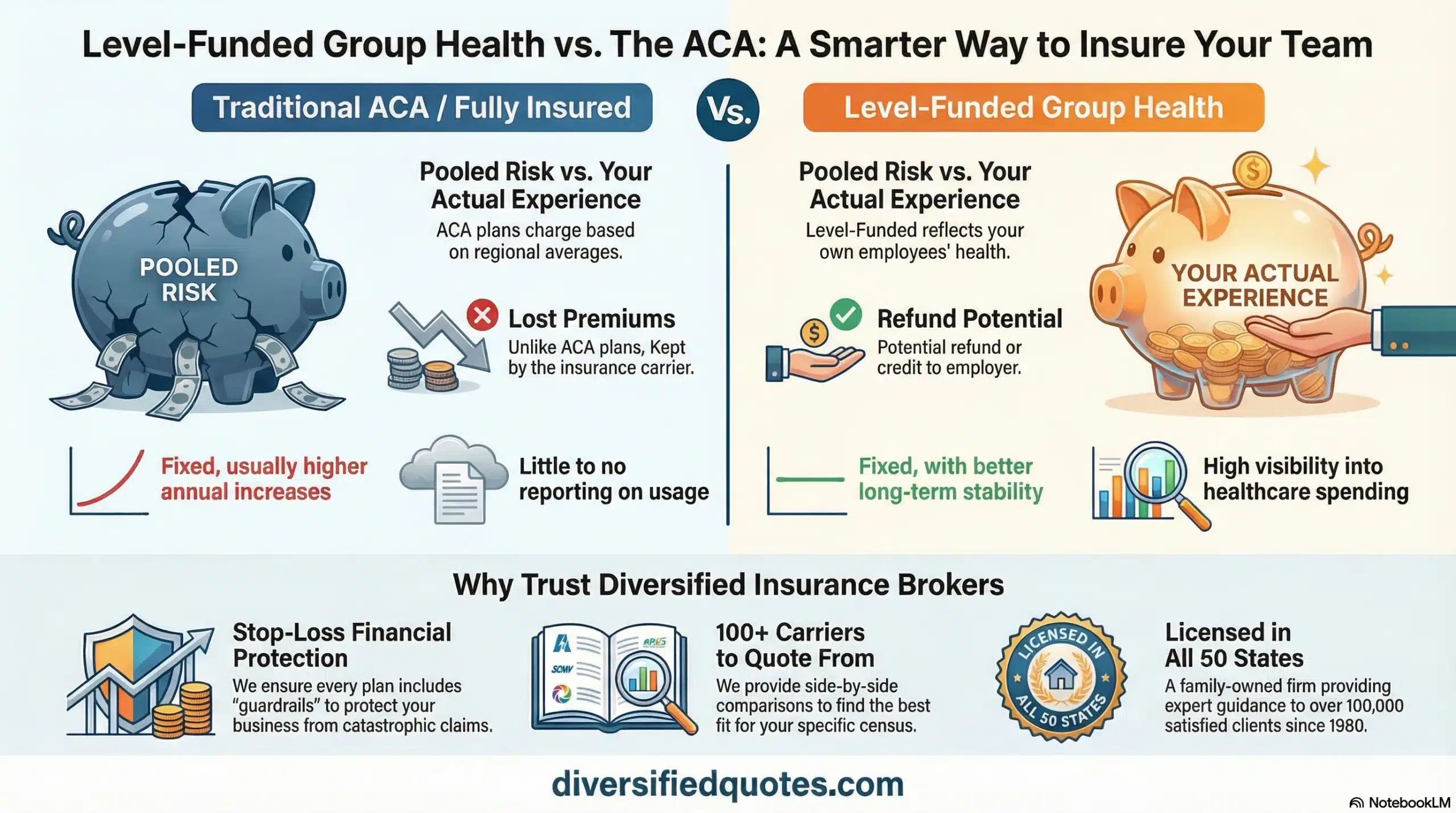
Employers also benefit from understanding the broader financial impact of group health insurance. Premiums paid by the company are generally tax-deductible as a business expense. Employer contributions are excluded from employees’ taxable income, making health insurance one of the most tax-efficient forms of compensation available. In competitive hiring markets, offering benefits dramatically improves retention and recruitment outcomes. For employers considering alternative funding arrangements, you can explore what is self-funded group health insurance to see how level-funded and partially self-insured plans compare to fully insured options.
It is also important to distinguish group health insurance from individual coverage. Individual plans are purchased directly through the ACA marketplace or private carriers and are priced primarily based on age, geography, and tobacco use. Group plans, by contrast, spread risk across enrolled employees and are not medically underwritten in the traditional sense for small groups. This can create more predictable pricing and often broader provider networks. However, the employer assumes responsibility for compliance with federal and state regulations, including ERISA documentation and summary plan descriptions.
When evaluating whether you meet the minimum employee requirement, consider not only your current headcount but also projected growth. Hiring one additional full-time employee may open eligibility and provide long-term tax advantages that outweigh the marginal payroll increase. Many small businesses strategically plan onboarding to align with their intended group coverage effective date. Reviewing payroll timing, W-2 status, and documented compensation ahead of time ensures smooth carrier approval.
Employers sometimes ask whether family members can count toward the two-employee minimum. In most states, spouses do not count as separate eligible employees if they jointly own the company. Children or other relatives who are legitimate W-2 employees performing real job duties may qualify, but carriers scrutinize documentation carefully to prevent misuse. The safest path is always to maintain clear payroll records and bona fide employment relationships.
Cost considerations also play a central role. Small group premiums vary by state, age mix, industry, and carrier. While minimum participation and contribution rules must be met, employers retain flexibility in choosing plan metallic levels (Bronze, Silver, Gold, Platinum), deductible structures, and network types such as HMO or PPO. Comparing multiple carriers ensures you balance affordability with coverage strength. For deeper insight into plan design differences, reviewing educational resources like what insurance companies do with your money can help clarify how insurers price and manage risk.
Ultimately, qualifying for group health insurance is about more than meeting a simple numerical threshold. It requires understanding documentation, compliance, participation, contribution strategy, and long-term business planning. Employers who approach the process proactively tend to secure more competitive rates and avoid underwriting complications. Working with a licensed nationwide brokerage ensures you interpret your state’s specific rules accurately and structure your payroll appropriately before submitting an application.
Confirm Your Employee Count & Compare Rates
Our advisors will verify eligibility, explain participation rules, and provide side-by-side group health quotes.
Get Group Health Plan OptionsIf you are unsure whether your business qualifies today, a quick eligibility review can provide clarity. In many cases, employers are closer to qualification than they realize. By aligning payroll structure, contribution strategy, and enrollment timing, small businesses can successfully meet carrier standards and unlock the advantages of group coverage. The key is understanding the minimum employee requirement in context — not as an obstacle, but as a planning benchmark.
Related Pages
Talk With an Advisor Today
Choose how you’d like to connect—call or message us, then book a time that works for you.
Schedule here:
calendly.com/jason-dibcompanies/diversified-quotes
Licensed in all 50 states • Fiduciary, family-owned since 1980
FAQs: Minimum Employees for Group Health Insurance
What is the minimum number of employees needed for group health insurance?
Most states require at least two full-time, unrelated W-2 employees to qualify for group health insurance coverage.
Can a husband and wife qualify as a group?
No. Married couples are considered one unit under most insurance rules. You’ll need at least one unrelated employee.
Are 1099 contractors counted as employees?
No. Only full-time W-2 employees count toward the minimum employee requirement for group health insurance.
Can part-time employees be included?
Some carriers allow part-time staff if they meet a minimum hours threshold, often 20–30 hours weekly.
Can an owner-only business get group coverage?
No. Sole proprietors or single-member LLCs must add an employee to qualify for a group plan.
How do carriers verify employees?
Most insurers request recent payroll or tax filings (like IRS Form 941) to confirm employee eligibility.
About the Author:
Jason Stolz, CLTC, CRPC and Chief Underwriter at Diversified Insurance Brokers (NPN 20471358), is a senior insurance and retirement professional with more than two decades of real-world experience helping individuals, families, and business owners protect their income, assets, and long-term financial stability. As a long-time partner of the nationally licensed independent agency Diversified Insurance Brokers, Jason provides trusted guidance across multiple specialties—including fixed and indexed annuities, long-term care planning, personal and business disability insurance, life insurance solutions, Group Health, and short-term health coverage. Diversified Insurance Brokers maintains active contracts with over 100 highly rated insurance carriers, ensuring clients have access to a broad and competitive marketplace.
His practical, education-first approach has earned recognition in publications such as VoyageATL, highlighting his commitment to financial clarity and client-focused planning. Drawing on deep product knowledge and years of hands-on field experience, Jason helps clients evaluate carriers, compare strategies, and build retirement and protection plans that are both secure and cost-efficient. Visitors who want to explore current annuity rates and compare options across multiple insurers can also use this annuity quote and comparison tool.
