
Travel, Lodging & Pet Care Benefits Explained.

Jason Stolz CLTC, CRPC
Cash for Travel, Lodging & Pet Care During Treatment
Add riders that pay you cash for long-distance care—helping with trips to specialists, hotel stays for you or a companion, and pet boarding while you’re away.
Travel, lodging, and pet care benefits are some of the most overlooked “quality of life” add-ons available on certain supplemental health plans—especially hospital indemnity plans. When care pulls you away from home, the costs that hurt most often aren’t the big hospital bill you expected to see; it’s the stream of practical expenses that show up immediately and keep showing up until life feels normal again. Gas and mileage, tolls and parking, rideshare and meals, a hotel close to a facility, a place for a spouse to stay, and a plan for pets when you’re admitted unexpectedly can create pressure at the exact moment you’re trying to focus on recovery. Travel, lodging, and pet care riders are built to address that reality by paying fixed cash benefits directly to you, under plan-defined rules.
These riders are particularly popular for people who may travel to a center of excellence, see out-of-town specialists, or want a financial buffer when a hospital event disrupts normal life. In practice, “travel for care” doesn’t always mean a dramatic cross-country trip. It can mean driving to a larger hospital system one county over because that’s where the specialist is, staying overnight because an early-morning procedure requires you to arrive before dawn, or making repeated trips for testing, follow-up visits, rehab sessions, and monitoring after the main event has passed. A plan that recognizes those real patterns can create a smoother financial experience during a stressful time.
At Diversified Insurance Brokers, we design these riders so they match how you’d actually use them. That starts with the benefit structure and state-specific rules, and then continues with sizing travel, lodging, and pet-care amounts so they complement other riders like ER, observation, daily hospital confinement, outpatient surgery, skilled nursing, therapy, and recovery benefits. If you want the “big picture” of how these plans work, start with Hospital Indemnity Insurance: What It Covers & Costs. If you already understand the basics, this page will help you design the travel, lodging, and pet-care portion correctly so it feels useful in real life and not like a confusing add-on you never use.
A common misunderstanding is thinking travel and lodging riders are “reimbursement.” Most of these benefits are not reimbursements that require you to itemize every expense. They are fixed cash benefits that pay when a qualifying event occurs and the plan’s triggers are met. That distinction matters because reimbursements are often restrictive and paperwork-heavy, while fixed cash benefits tend to be simpler: you prove the qualifying event occurred, and the benefit pays according to the plan’s schedule. That flexibility is exactly what families want when they’re dealing with the messy reality of care, scheduling, and logistics.
Another misunderstanding is that these riders only matter for major surgeries. In reality, the travel and lodging burden often increases during the weeks around care, not just on the day of a procedure. Consults, imaging, lab work, pre-op clearance, post-op visits, therapy appointments, and specialist follow-ups can create repeated travel. When you layer travel, lodging, and pet care benefits with riders that pay for ER, observation, inpatient stays, outpatient procedures, and rehab services, you build a more complete cash safety net that can reduce the need to use credit cards during a healthcare disruption. If you want a clear explanation of how “what happened” affects how cash benefits pay, Observation vs. Inpatient: How Cash Benefits Pay is a helpful primer because it shows how the care setting can change benefit triggers.
It also helps to think in terms of what actually happens during a typical episode of care. Many events start with symptoms and uncertainty. You go to urgent care or the ER, then you might be kept under observation, then you might be admitted, then you might have a procedure, then you might be discharged to recover at home or to a rehab setting. The “medical” part is only half the story. The rest is transportation, timing, family coordination, and support costs. A hospital indemnity plan can cover parts of the medical event with fixed cash benefits, but travel, lodging, and pet-care benefits cover the real-world edges—the practical costs that don’t feel optional when you’re in the middle of it.
People also underestimate how often a companion is involved. Even when you’re medically stable, it can be difficult or unsafe to travel alone after sedation, anesthesia, or a significant event. A spouse or family member might drive, stay overnight, coordinate check-in and discharge, and help at home afterward. Companion lodging benefits exist because real care often requires real support. When structured correctly, the combination of travel and lodging benefits can make it much easier for a family member to participate without the trip turning into an unexpected financial strain.
Before we talk about rider design, it’s important to understand that carriers define “qualifying events” and “distance triggers” differently. Some plans require care to occur a certain distance from your home, often expressed as a mileage threshold. Some require the treatment to be related to a covered event like an inpatient admission or outpatient procedure. Others pay when you use certain facilities or when your care meets a defined category. None of this is “bad,” but it means you want the rider that matches your likely usage pattern, not the rider that sounds good in a brochure but is difficult to trigger in the real world.
Distance triggers are the most common source of confusion. A plan might define eligibility as treatment occurring beyond a set mileage radius from the insured’s residence. That radius can make the benefit incredibly valuable for rural families who routinely drive to a larger hospital system, and less useful for someone who lives near a major medical hub. However, even for urban households, certain specialties and centers of excellence can be outside the immediate area, and that’s where the rider becomes practical. The key is matching the rider’s trigger to your reality. If your likely “out-of-town care” is an hour away, you want a plan that recognizes that kind of travel. If your likely care is within a short drive, a smaller travel benefit or no travel rider at all may be more appropriate.
Travel benefits can be structured in different ways. Some pay per trip. Some pay per day. Some pay per episode. What matters is how often you’d need the benefit during an event. If your pattern is “one trip there and back,” a per-trip structure can feel clean. If your pattern is “multiple days of treatment requiring multiple nights,” a per-day approach can be more aligned. If you anticipate repeating treatment cycles, you want to understand whether the plan caps the travel benefit per incident or per year, because caps can determine whether the benefit remains meaningful after the first event.
Documentation expectations matter, but they usually aren’t complicated if the plan is selected correctly. Most carriers simply want confirmation that a qualifying visit, procedure, or admission occurred at an eligible location and that the dates align with the benefit. That’s very different from reimbursement models where you submit gas receipts, hotel invoices, and itemized mileage logs. Fixed benefits are generally designed to be more user-friendly than that. Your job is to pick a plan whose triggers are easy to meet and easy to prove, because the best benefit is the one you can actually claim without friction.
From a design standpoint, travel benefits should be sized realistically. A small travel benefit can still be helpful because cash is flexible. It can cover tolls, parking, and meals. It can offset the cost of rideshare or a family member’s time. But if you anticipate frequent long-distance consults or specialty treatment, a higher travel benefit may be appropriate. The reason is simple: repeated travel compounds. Even when a single trip is “manageable,” the repetition over multiple appointments can create financial fatigue. A properly sized travel benefit can prevent that fatigue from becoming a financial problem.
Lodging benefits are the next piece, and they are often the most intuitive. When care requires you to be near a facility overnight, hotels are an obvious out-of-pocket cost. Lodging riders pay a fixed cash amount for eligible nights, often with a cap per incident and/or per year. Some plans also include companion lodging benefits, recognizing that a caregiver or spouse might need a place to stay as well. That companion benefit can matter in cases involving surgery, sedation, complex procedures, or simply situations where it’s safer to have support.
Lodging benefits work best when you think about the reason for the overnight stay. Sometimes the overnight need is purely logistical, like an early appointment that makes it impractical to drive in the morning. Sometimes it’s medical, like being discharged later in the day after a procedure where travel is not advisable. Sometimes it’s supportive, like staying near a facility while a loved one is receiving treatment. Because these reasons differ, it matters whether your plan’s lodging benefit is tied to a covered event or can trigger around qualifying treatment in a broader way. We align lodging rules with likely scenarios so the rider pays when you’d actually need it.
It’s also important to understand how lodging coordinates with the rest of the plan. Lodging riders can feel modest on their own, but they become meaningful when paired with benefits that pay for the underlying event. If your plan includes an ER benefit, an observation benefit, an inpatient daily benefit, or an outpatient procedure benefit, the lodging rider can cover the external costs while the other riders cover the clinical event. The result is a more complete “cash picture” that supports both the care and the logistics around the care. For example, if you want clarity on how ER-related benefits tend to function in hospital indemnity designs, ER & Urgent Care: When Hospital Indemnity Pays provides a practical overview.
Another major use case for lodging benefits is outpatient surgery. Many modern procedures are outpatient even when they feel “big.” That can be great for recovery at home, but it can create logistical challenges when your procedure facility is far away or requires early arrival and post-procedure monitoring. Outpatient-focused riders can coordinate with lodging benefits to create cash flow during the most disruptive part of the timeline. If you’re comparing how outpatient-related riders typically fit together, Outpatient Surgery & Rehab Riders: What to Know is a useful reference because it shows how these benefits often stack around common recovery pathways.
Pet care or pet boarding benefits may sound niche until you need them. Then they feel obvious. When you’re hospitalized unexpectedly or you need to travel for care, your pets still need daily support. Boarding, pet sitting, dog walking, feeding routines, and medication schedules can become urgent logistical problems. A pet care rider is designed to provide a fixed daily cash benefit for a limited number of days so you can quickly arrange care without scrambling. The benefit isn’t intended to replace pet insurance or long-term pet care planning. It’s intended to provide cash flexibility at the exact moment your life is disrupted.
Pet care riders also reduce reliance on “best case” assumptions. Many families assume a neighbor or family member will be available, but emergencies don’t always align with people’s schedules. A pet care benefit creates a financial backstop that allows you to solve the problem quickly. Even if a friend helps, the cash benefit can still be used for other recovery-related expenses because the benefit is fixed and paid to you under the plan’s rules.
Designing pet care benefits comes down to realism. If you have multiple pets or special needs animals, costs can be higher. If you have one pet and a strong support network, a modest benefit may be enough. The “right” daily amount is the one that helps you solve the immediate problem without overpaying for a benefit you’re unlikely to fully use. Some clients also prefer benefits that increase over time as costs rise. That “step-up” concept often appears in other benefit categories and can be part of broader plan design strategy. If you want to understand the logic of step-up structures in cash benefits, Increasing Daily Benefit Rider (5% Step-Ups) explains how step-ups can work in a simple, planning-focused way.
Now, the most important part: expectations. Most frustrations with travel, lodging, and pet-care riders come from mismatched expectations rather than bad benefits. These riders are straightforward once you understand triggers, caps, and definitions. That’s why our design process focuses on three things before anyone enrolls. First, we confirm exactly what qualifies and what the plan requires to trigger the benefit. Second, we identify whether caps apply per episode, per year, or both, and what that means over time. Third, we clarify any waiting periods, state-specific limitations, and plan coordination rules so you know what will happen if you actually use the rider.
From there, we build the rider package so it coordinates with how episodes actually unfold. Travel and lodging benefits pair naturally with outpatient surgery and rehab benefits for planned procedures. They also pair with ER, observation, and hospital daily benefits for unexpected events that create immediate logistical needs. If you anticipate skilled rehab after a hospital event, it’s also worth understanding how skilled nursing benefits fit into the broader “episode” picture. For that, Skilled Nursing Facility Rider Explained is helpful because it focuses on the post-hospital rehab phase where many families see extended disruption.
Another practical design issue is timing. Travel benefits may trigger based on appointment dates, procedure dates, or admission dates depending on the carrier. Lodging benefits may have a maximum number of nights tied to a single event. Pet care benefits may be tied to inpatient admission or travel-related triggers. When you see all three benefits together, it’s important they “line up” with the timeline you’d actually experience. A well-designed rider package feels cohesive. A poorly designed package feels like three separate benefits that don’t activate when you need them most.
Let’s talk through the kinds of real-life scenarios where these benefits are most useful, not as bullet points, but as planning frameworks. One common scenario is specialty care at a larger facility. Many people seek a second opinion, advanced imaging, complex testing, or specialist procedures at a system that is not local. The travel benefit helps with the repeated trips. The lodging benefit helps when the schedule requires an overnight stay. The pet care benefit helps if the trip is sudden, extended, or overlaps with a hospital admission. When those benefits are in place, specialty care decisions can be made based on quality and access rather than on the fear of “how expensive the logistics will be.”
Another common scenario is planned surgery away from home. This could be orthopedic, cardiac, or other specialty surgery at a higher-volume center. Even if the surgery itself is outpatient, the timeline can require you to arrive early, remain close to the facility, and attend follow-up visits quickly. Travel benefits help with transport. Lodging benefits help with the overnight stay for you and potentially a companion. Pet care benefits help during the trip and early recovery. When these riders are paired with outpatient procedure and rehab benefits, the plan can produce a meaningful amount of cash flow during the most disruptive window without relying on reimbursement or complex expense tracking.
There’s also the “unexpected” scenario where the value becomes obvious: an ER event becomes an observation stay, then becomes an admission, then becomes a transfer. Sometimes that transfer is to a larger hospital system because the local facility is not equipped for the level of care required. In those cases, travel and lodging benefits may be the only part of the plan that recognizes the family’s immediate logistical costs. A spouse might need a hotel near the facility. The family may need to travel back and forth. Pets may need boarding. These are the moments when fixed cash benefits can make the situation more manageable.
Even after discharge, travel continues. Follow-up visits, testing, therapy, and specialist monitoring can require repeated trips. Many families are surprised to realize that “the event” is not a single day. It’s a sequence. Designing travel and lodging benefits around that sequence is what separates a useful rider package from a frustrating one.
From a financial planning lens, these riders are often about protecting liquidity and protecting routine. Medical events can force people into short-term financial decisions that have long-term consequences, such as tapping retirement accounts, selling investments at the wrong time, or carrying high-interest credit card balances. Travel, lodging, and pet care benefits won’t cover every cost, and they aren’t intended to. They are intended to reduce the need for those reactive decisions by providing predictable cash support during disruption windows.
It’s also worth pointing out that these benefits are often easier to justify than people think because they solve a specific category of problems that traditional medical coverage doesn’t prioritize. Major medical insurance and Medicare are designed to pay providers for clinical services. They are not designed to pay for the life disruption that happens around care. Hospital indemnity plans—and especially travel, lodging, and pet care riders—exist precisely to address that mismatch.
When someone is deciding whether to include these riders, the best question isn’t “Will I definitely use it?” The better question is “If I needed to travel for care, would the logistics cost be disruptive?” If the answer is yes, then the rider’s purpose is clear. If the answer is no because your care is always local, your support network is strong, and your budget has plenty of flexibility, then the rider may be less necessary.
Another design principle is avoiding “over-insuring” logistics. It’s possible to buy too much benefit relative to realistic use. We prevent that by starting with your likely travel pattern, your local medical ecosystem, and your plan’s base benefits. Then we add travel, lodging, and pet-care amounts that fill gaps without duplicating what other riders already handle. The end result should feel balanced. The rider should be large enough to matter but not so large that you’re paying for benefit you’re unlikely to trigger.
For Medicare Advantage members, the conversation often ties back to cost-sharing patterns. Many Medicare Advantage plans involve copays for various services and settings. If a plan’s structure creates meaningful out-of-pocket exposure during episodes, fixed cash benefits can be used as a buffer. Travel and lodging riders are part of that buffer because they address costs that exist regardless of whether your plan’s copays are low or high. If you have to travel, you have to travel. These riders help you do it without turning your recovery period into a budgeting crisis.
For working households, these riders can also reduce the “hidden costs” of missing work. When a spouse has to travel to support care, they may miss income or use PTO. When repeated trips are required, scheduling becomes complicated. Fixed cash benefits can’t replace all of that, but they can help absorb the friction costs that pile up—fuel, parking, meals, hotels, pet care. That’s the category these riders are designed to address.
When you’re reviewing rider options, it also helps to see how certain condition-focused cash benefits can coordinate with logistics benefits. Some plans include event-specific riders that pay when certain major conditions occur. Those lump-sum style benefits can cover larger expenses or create general recovery cash, while travel and lodging benefits provide steady support for repeated appointments and out-of-town treatment cycles. If you want an example of how a condition-focused cash benefit rider concept is typically explained in planning terms, Heart Attack & Stroke Cash Benefit Rider is a good illustration of how event-based benefits can fit into an overall strategy.
The bottom line is that travel, lodging, and pet care benefits make a hospital indemnity plan feel more “real life.” They don’t just address what happens inside a hospital. They address what happens to your schedule, your household, your responsibilities, and your budget when care pulls you away from home. When designed correctly, they provide flexible cash at the moment it’s most useful, without the complexity of reimbursement or the uncertainty of “will my plan cover this practical cost?”
To design these riders properly, we typically review your likely care pathways, confirm the plan’s triggers and caps, then size the benefits to match your lifestyle. The goal is a rider package that feels easy to understand and easy to use if you ever need it. If you’re looking at this page because you already know travel for care is a possibility, this is exactly the category of protection these riders were built for.
Build a Travel & Lodging Rider That Fits Your Life
We’ll confirm distance rules, caps, and documentation expectations—then size benefits to your actual travel patterns.
One final planning point: these riders are often most valuable when you think about the full timeline of a care event, not just the day you enter a facility. Before care, you may travel for consults and testing. During care, you may need lodging close to the facility and pet boarding at home. After care, you may travel for follow-ups and therapy. That timeline-based view helps you choose benefit structures that won’t disappoint. A per-trip travel benefit may work well for consult-heavy situations. A per-day travel or lodging benefit may work better for multi-day treatment cycles. A pet care benefit may matter most during unplanned admission windows. When the benefit structure matches the timeline, the rider feels like it was designed for your life rather than for a generic scenario.
It’s also important to remember that these riders don’t have to be “perfect” to be helpful. The main value is reducing the stress of immediate out-of-pocket spending when life is disrupted. Even modest benefits can help because the money is flexible. The design goal is simply to avoid the common situation where families spend hundreds or thousands on logistics and then realize, too late, that their health plan was never intended to help with those categories.
If you want the most consistent results from these riders, the selection process matters. Choose a carrier and plan design with triggers that are realistic for your area and your habits. Choose caps that make sense for how you’d use the benefit. Choose amounts that reflect real lodging and travel costs without overbuying. And make sure the rider package fits the rest of the plan so you’re not paying twice for the same kind of exposure while leaving another gap unprotected.
Quote Travel, Lodging & Pet Care Riders
Clear options, state-specific rules confirmed, and benefits sized to your likely care path.
Related Hospital Indemnity Pages
Continue building a complete cash-benefit plan by understanding how common riders trigger and coordinate across an episode of care.
Hospital Indemnity Insurance: What It Covers & Costs Observation vs. Inpatient: How Cash Benefits Pay ER & Urgent Care: When Hospital Indemnity Pays Outpatient Surgery & Rehab Riders: What to KnowRelated Recovery & Rider Pages
If your plan design includes rehab or condition-focused benefits, these pages help you coordinate cash benefits across recovery timelines.
Skilled Nursing Facility Rider Explained Increasing Daily Benefit Rider (5% Step-Ups) Heart Attack & Stroke Cash Benefit Rider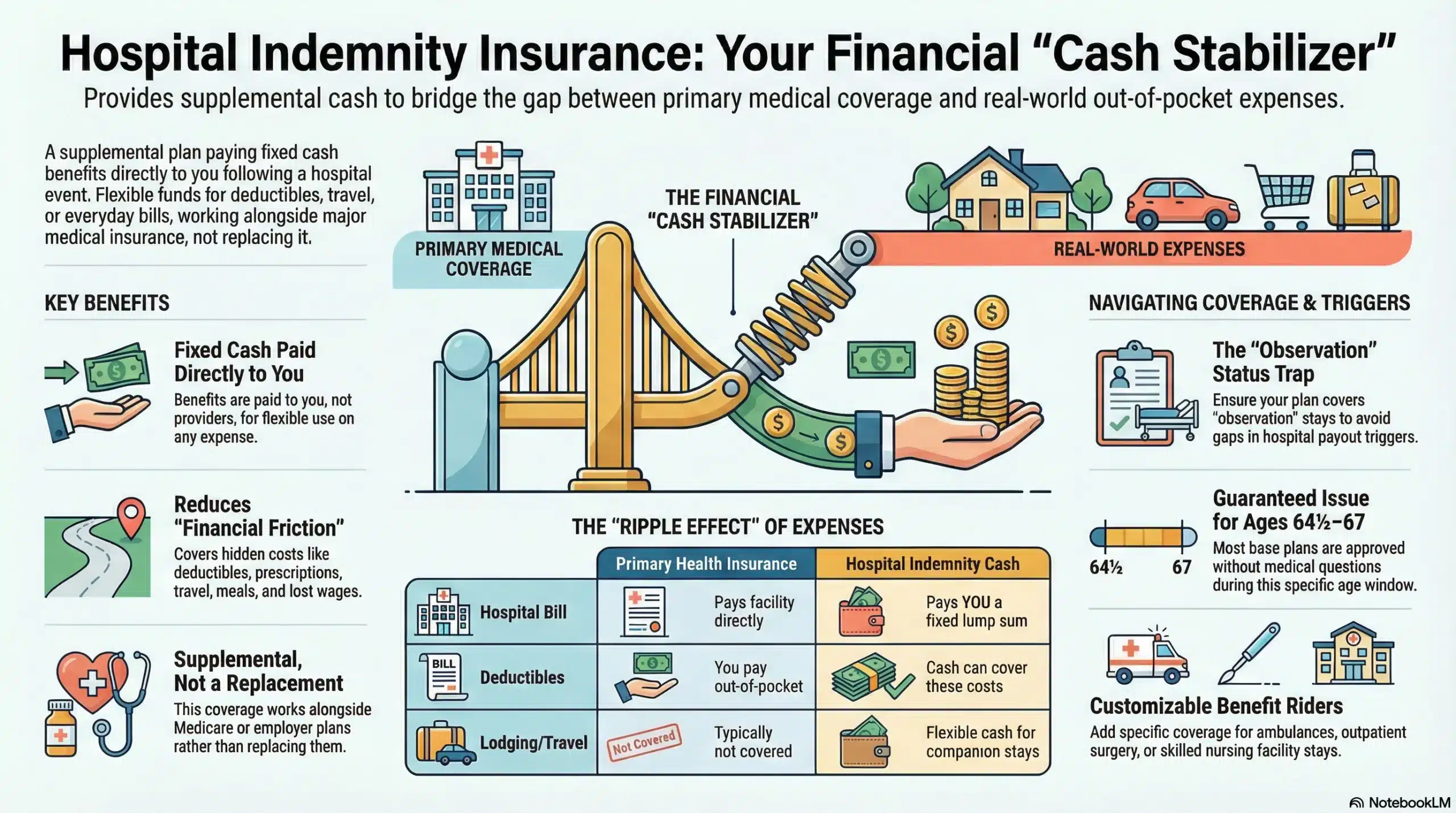
Talk With an Advisor Today
Choose how you’d like to connect—call or message us, then book a time that works for you.
Schedule here:
calendly.com/jason-dibcompanies/diversified-quotes
Licensed in all 50 states • Fiduciary, family-owned since 1980
FAQs
How far do I need to travel for benefits to pay?
Many plans require treatment a minimum distance from home (commonly around 50+ miles, but it varies by carrier and state). We confirm the exact distance trigger and how “home” is defined before enrollment.
Does lodging cover a companion or caregiver?
Often yes, depending on the plan design. Some riders pay a separate per-night amount for a companion when medically appropriate or specifically included in the rider language.
Do I need receipts to file a claim?
These are typically fixed cash benefits (not reimbursements), but the plan usually requires proof of the covered treatment and the dates/location that trigger the benefit. Receipts aren’t always required, but documentation rules vary by carrier.
How is the pet-care benefit paid—per day or per trip?
Most designs pay a fixed cash amount per day, usually with a per-incident cap and an annual maximum. We’ll outline the caps and how incidents are defined so expectations are clear.
Can these riders be added later?
Sometimes. Adding riders later may require a plan change, could restart waiting periods, or may not be available outside certain enrollment windows. It’s often simplest to include them at issue when you’re building the plan.
How do travel/lodging benefits interact with ER, observation, and hospital daily benefits?
They typically “stack” because they pay for different categories of impact. ER/observation/inpatient riders pay based on the clinical event, while travel/lodging/pet-care riders pay based on distance, lodging nights, or care disruption rules. The best results come from designing them together instead of picking riders in isolation.
About the Author:
Jason Stolz, CLTC, CRPC and Chief Underwriter at Diversified Insurance Brokers (NPN 20471358), is a senior insurance and retirement professional with more than two decades of real-world experience helping individuals, families, and business owners protect their income, assets, and long-term financial stability. As a long-time partner of the nationally licensed independent agency Diversified Insurance Brokers, Jason provides trusted guidance across multiple specialties—including fixed and indexed annuities, long-term care planning, personal and business disability insurance, life insurance solutions, Group Health, and short-term health coverage. Diversified Insurance Brokers maintains active contracts with over 100 highly rated insurance carriers, ensuring clients have access to a broad and competitive marketplace.
His practical, education-first approach has earned recognition in publications such as VoyageATL, highlighting his commitment to financial clarity and client-focused planning. Drawing on deep product knowledge and years of hands-on field experience, Jason helps clients evaluate carriers, compare strategies, and build retirement and protection plans that are both secure and cost-efficient. Visitors who want to explore current annuity rates and compare options across multiple insurers can also use this annuity quote and comparison tool.
