
Travel Medical and Evacuation from Algeria

Jason Stolz CLTC, CRPC
Travel medical and evacuation insurance from Algeria is built for one simple reality: when you’re outside your normal healthcare system, even a “routine” emergency can turn into a logistical and financial crisis fast. Whether you’re a visitor traveling to Algeria, an expat living there, a student enrolled in a program in Algiers, or someone traveling from Algeria to another country, the biggest risk isn’t just getting sick—it’s being forced to make high-stakes decisions without the right coverage, the right support team, or the ability to move to appropriate care.
For many travelers, Algeria is part of a broader itinerary that includes multiple countries, remote regions, or higher-risk areas where healthcare access can vary dramatically. That’s why “standard travel insurance” often falls short. Traditional trip protection policies may focus on baggage delays and cancellations, while travel medical and medical evacuation coverage focuses on what matters when something goes wrong: emergency treatment, hospital care, and coordinated transport to the nearest appropriate facility when local care isn’t enough.
At Diversified Insurance Brokers, we help travelers compare international medical plans that are designed for real-world scenarios: private hospital billing requirements, language barriers, long distances to specialty care, limited local resources in certain regions, and the need for organized evacuation when the medical situation demands more than what’s locally available. If you’re traveling through multiple countries or higher-risk regions, you may also want to review how coverage works across borders and remote areas, since the logistics of coordination can be just as important as the benefit limits. Many travelers planning multi-country routes also compare nearby pages like travel medical and evacuation from Egypt, travel medical and evacuation from Morocco, and travel medical and evacuation from Mali to understand how plan selection changes by destination and medical infrastructure.
Travel Medical + Evacuation Coverage (Algeria)
Compare international medical plans with emergency treatment and evacuation benefits for travel to, from, or within Algeria.
Why Travel Medical and Evacuation Coverage Matters in Algeria
When people think about travel risk, they often think of security headlines or worst-case scenarios. In practice, most claims start with something more ordinary: a sudden infection, dehydration complications, a fall, a stomach illness that escalates, a dental emergency, an asthma flare, or an unexpected need for imaging and hospitalization. The challenge is that even if you can access care quickly in a major city, you may still face cash-upfront billing, out-of-network restrictions, limited specialty options, or the need to transfer to a different facility for higher-level care.
That’s where evacuation coverage becomes the difference-maker. Medical evacuation isn’t just “a flight home.” It’s a coordinated transfer decision that is based on medical necessity and the availability of appropriate treatment. It can involve a ground ambulance, medical escort services, a commercial flight with medical supervision, or an air ambulance depending on the clinical situation and where you are located. The more remote your location—particularly if you are traveling outside major urban areas—the more important it becomes to have a plan that includes emergency assistance services with real operational capacity.
If you’re traveling through or beyond North Africa, you may also compare broader travel medical options on pages like medical travel insurance or destination-specific evacuation resources such as emergency medical evacuation insurance. Travelers who are concerned about elevated security or remote travel conditions sometimes also review high risk travel insurance alongside travel medical coverage to make sure the plan fits the actual nature of the trip.
What This Coverage Is Designed to Do
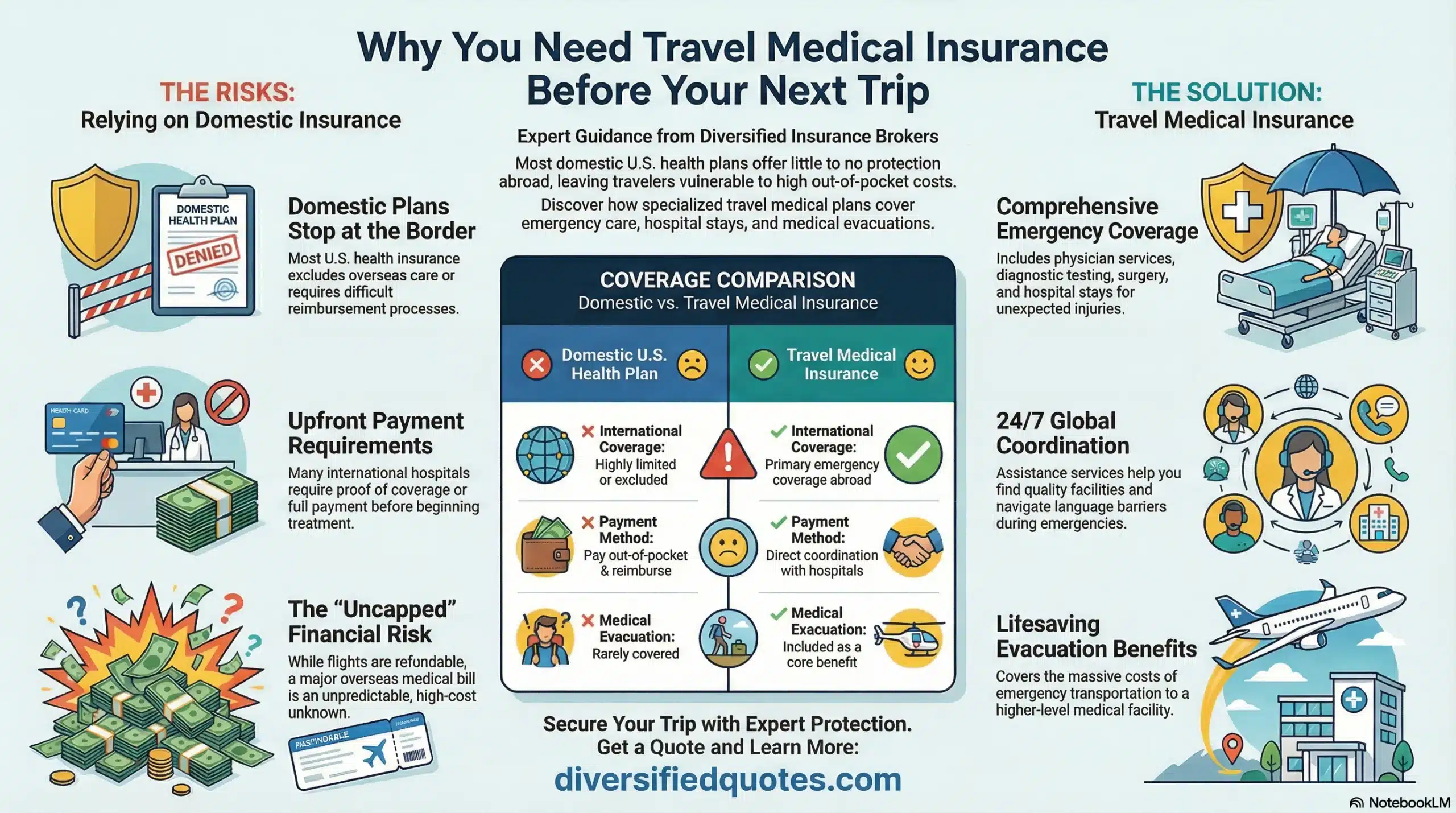
Travel medical and evacuation coverage is designed to solve three problems at once. First, it helps pay for unexpected medical care while you’re away from home—things like emergency treatment, hospital stays, physician services, imaging, lab work, and prescriptions that are medically necessary due to illness or injury during the covered travel period. Second, it provides access to a 24/7 assistance team that can coordinate care, locate appropriate facilities, and help you navigate the system when time matters. Third, it addresses the biggest financial exposure most travelers underestimate: emergency transport and evacuation when local care is not sufficient.
In Algeria, the need for coordination often matters as much as the benefit limit. If you are dealing with an urgent event, you don’t want to be calling multiple places trying to figure out where you can receive the right level of care. The goal is a plan that can help you quickly move from “problem” to “solution”: appropriate facility, appropriate specialist, and a clear path for treatment or transfer.
What Makes a Trip “Higher Risk” (Even If You’re Healthy)
A trip can be “higher risk” for insurance planning purposes even if the traveler is healthy. Risk goes up when travel includes remote regions, long drives between major cities, limited local medical infrastructure, language barriers that complicate care coordination, or travel patterns that make it difficult to return quickly if something changes. Risk can also increase when the traveler is working abroad, participating in aid missions, traveling for journalism or contracting roles, or staying longer than a typical vacation timeframe.
Algeria can involve several of these factors depending on where you will be. A short business trip concentrated in a major city looks very different from a long stay, remote travel, or repeated cross-border movement. That’s why it’s helpful to approach coverage the way we approach it with clients: start with your itinerary reality, then match coverage limits, evacuation benefits, and plan structure to that reality—not the other way around.
Example Scenario: The Cost of “Figure It Out Later”
Here’s a scenario that illustrates why travelers choose travel medical and evacuation insurance specifically for higher-risk or complex trips. Imagine an aid worker in Algeria who experiences a sudden medical emergency that requires hospital admission and specialized follow-up care. The initial emergency care is only the beginning. The bigger issue becomes where the appropriate specialty care is located, how quickly that care can be accessed, and what it takes to transfer if the case requires a facility with more advanced capabilities.
Without proper coverage, a traveler may face large out-of-pocket payments just to begin treatment, followed by a separate and potentially enormous bill for evacuation or transfer. Those costs can become life-changing quickly—especially if an air ambulance or cross-border transport is medically necessary. With a properly selected travel medical and evacuation plan, the goal is to shift the financial burden away from the traveler and to provide a coordinated path to care through the assistance team, rather than forcing you to manage a crisis on your own.
If your itinerary involves additional countries or neighboring regions, you may also benefit from reviewing how coverage varies across similar travel corridors. Travelers sometimes compare pages like travel medical and evacuation from Kenya and travel medical and evacuation from Jordan to see how plan selection changes when medical infrastructure, distance, and facility access vary.
Secure International Medical Coverage
Protect yourself and your family with travel medical and evacuation coverage for Algeria and multi-country itineraries.
How Medical Evacuation Works in Real Life
Medical evacuation benefits are often misunderstood because people picture one thing: a helicopter or private jet. In reality, evacuation and medical transport exist on a spectrum. Sometimes the safest and most cost-effective solution is a medically supervised commercial flight. Other times it’s a ground transfer to a different facility. And in serious cases—especially when the patient cannot travel on a standard flight—an air ambulance may be the only option.
The most important thing to understand is that evacuation is typically based on medical necessity and the availability of appropriate care. “Appropriate care” means the right level of care for the condition, not simply the closest facility. That’s why evacuation planning is both medical and logistical. The assistance team needs to evaluate medical status, facility options, timing, and transport requirements. Strong plans do more than reimburse—they coordinate.
If evacuation is the central reason you’re buying coverage, make sure you also understand how limits are structured. Some plans set a separate evacuation maximum. Others include evacuation within a broader medical maximum. Some require that the assistance team pre-authorize the evacuation for it to be covered as designed. These details matter, and they can determine whether coverage performs the way you expect in a real emergency.
What’s Typically Covered (And What You Should Confirm)
Most travel medical plans cover medically necessary treatment for new illness or injury during the trip. That typically includes emergency care, hospital services, physician charges, diagnostic testing, imaging, and prescription medication related to the covered event. Many plans also include emergency dental benefits when dental issues occur due to injury or acute pain that requires urgent treatment while traveling.
Beyond medical care, the “support layer” matters. A quality plan includes 24/7 assistance services that can help locate appropriate facilities, coordinate with doctors, arrange direct billing where available, and organize transportation when needed. In higher-risk or remote travel, the value of having a real assistance team can be just as important as the policy limits, because they can cut through friction when you’re in an unfamiliar system.
For travelers who want a broader context across plan types, it may help to compare this page with international health insurance, which is often a better fit for longer stays, expats, or people who need more comprehensive coverage beyond a trip window. Travel medical can be excellent for trips and defined travel periods, while international health insurance can be a better match when you’re effectively living abroad.
Pre-Existing Conditions: The Most Common “Surprise” in Travel Coverage
Pre-existing conditions are where travelers can get caught off guard, especially when the trip is higher-risk or longer. Some travel medical plans exclude pre-existing conditions entirely. Others include limited coverage for the acute onset of a pre-existing condition if certain criteria are met. Some offer optional upgrades or different plan designs that better address pre-existing concerns. The wording matters, and the differences between plans can be significant.
If you have a known condition—anything from asthma to heart history to diabetes to autoimmune conditions—the smartest approach is to assume that the policy will not “automatically” cover it and to confirm how the plan addresses it. For many travelers, the goal is not necessarily to have full “routine management” coverage while abroad. The goal is to ensure that if something acute happens, you have emergency care and transport coverage that performs the way you expect.
Choosing Limits: How Much Medical Coverage and Evacuation Is Enough?
This is one of the most practical questions travelers ask, and it’s where people can make an expensive mistake by selecting limits that are too low. A single hospital stay can burn through low medical caps quickly, especially if advanced imaging, specialist consults, or inpatient care are required. Evacuation can be even more expensive depending on the distance, aircraft type, staffing requirements, and clinical complexity.
Rather than guessing, it helps to work backward from risk. If your travel is urban-only, short duration, and you have a straightforward itinerary, you may select a moderate medical maximum with solid evacuation benefits. If you are traveling to remote areas, taking extended trips, doing multi-country travel, or operating in regions where appropriate specialty care may be limited, higher limits usually make sense because the downside risk is disproportionate to the premium difference.
It also matters whether you are traveling alone, traveling with family, or traveling in a group. Group travel can compound exposure because multiple travelers can have medical events or logistical complications, and coordination becomes more complex. If you are planning group travel, you may also want to compare group travel insurance options to understand how coverage is structured across multiple travelers.
How Claims and Assistance Typically Work Abroad
When something happens, the best outcome is usually achieved when you treat the plan like a support system, not a reimbursement card. In many situations, contacting the assistance team early improves the outcome because they can guide you to appropriate facilities, coordinate care, and document the event in a way that supports claim handling. In evacuation scenarios, early contact is often essential because pre-authorization requirements and medical coordination are part of how the benefit is designed to function.
In many countries, hospitals and clinics may request payment upfront, require deposits, or prefer direct settlement with the insurer where possible. The assistance team can sometimes facilitate direct billing or provide guidance on the fastest path to care. For higher-risk travel, the combination of “coverage” and “coordination” is what reduces the chance of delays and confusion.
What Travelers Should Watch for in Policy Details
The biggest gaps in travel medical and evacuation plans usually come from three areas: exclusions, definitions, and coordination requirements. Exclusions are items the plan does not cover (such as certain hazardous activities unless upgraded coverage applies). Definitions are how the plan defines key terms like emergency, medically necessary, pre-existing condition, and evacuation. Coordination requirements include steps like contacting the assistance team for evacuation arrangements, or using approved providers for certain services.
It’s also worth confirming how the plan treats travel to “higher-risk” regions. Some plans have restrictions or special language for certain geographies. If your itinerary includes areas that insurers classify differently from standard tourism travel, you want to confirm you are selecting a plan designed for the actual nature of your trip—not a plan that quietly limits coverage where you need it most.
If you’re building a broader travel protection strategy, some travelers start with a base travel medical plan and then compare additional protection on pages like cheap travel insurance for trip-related protection while keeping the medical side strong through a medical-first plan structure. The key is not to confuse “trip protection” with “medical protection.” They solve different problems.
Who This Coverage Is Most Useful For
Travel medical and evacuation insurance from Algeria is especially useful for business travelers and contractors who need reliable emergency coverage during short-to-medium trips, for expats and families who want protection during international movement, for students and study abroad programs, and for humanitarian workers or journalists operating in regions where access can change quickly. It’s also highly relevant for travelers doing remote excursions, long overland travel, or multi-country itineraries where the nearest appropriate care may not be close.
Even for relatively short travel, this coverage can matter because emergencies are unpredictable. A good plan is less about assuming something will happen and more about removing “financial and logistical panic” from the decision-making process if something does happen.
Why Diversified Insurance Brokers
Travel coverage looks similar on the surface until you need it. We focus on matching plan design to the actual risk profile of the trip, not just selecting the cheapest option. That means prioritizing medical maximums and evacuation features, confirming how the plan coordinates emergency care, and making sure the policy language aligns with your travel realities.
For travelers planning multiple destinations or comparing options across higher-risk regions, we also help you avoid “coverage mismatches,” where the plan technically exists but doesn’t perform well for the type of travel you’re doing. If you’re planning broader high-risk travel, you may also compare the structure of high risk travel insurance with the medical-first approach of travel medical and evacuation coverage, especially when medical access and transport are the top concern.
Get Covered Before You Travel
Travel medical and evacuation coverage is one of those decisions where timing matters. Once a medical issue occurs, coverage gaps can’t be fixed retroactively. The best approach is to set your plan up before departure, confirm your medical maximum and evacuation benefits, and understand how the assistance process works so you’re not learning it in the middle of a stressful event.
Get Covered Before You Travel
Apply online in minutes to secure travel medical and evacuation coverage for Algeria.
Related Travel Medical Pages
If you’re comparing destinations or planning multi-country routes, these pages help you match plan design to real-world medical access and evacuation needs.
Related Destination Pages
Use these destination pages to compare how coverage needs can change with infrastructure, distance to care, and travel logistics.
Talk With an Advisor Today
Choose how you’d like to connect—call or message us, then book a time that works for you.
Schedule here:
calendly.com/jason-dibcompanies/diversified-quotes
Licensed in all 50 states • Fiduciary, family-owned since 1980
Travel Medical & Evacuation from Algeria — FAQs
What is travel medical insurance with evacuation?
Why does evacuation coverage matter for Algeria?
Is this coverage for traveling to Algeria or traveling from Algeria?
Does travel medical insurance cover pre-existing conditions?
How do I use the policy if I need medical care abroad?
How are claims handled—do I pay upfront?
What should I look for when comparing plans?
About the Author:
Jason Stolz, CLTC, CRPC and Chief Underwriter at Diversified Insurance Brokers (NPN 20471358), is a senior insurance and retirement professional with more than two decades of real-world experience helping individuals, families, and business owners protect their income, assets, and long-term financial stability. As a long-time partner of the nationally licensed independent agency Diversified Insurance Brokers, Jason provides trusted guidance across multiple specialties—including fixed and indexed annuities, long-term care planning, personal and business disability insurance, life insurance solutions, Group Health, and short-term health coverage. Diversified Insurance Brokers maintains active contracts with over 100 highly rated insurance carriers, ensuring clients have access to a broad and competitive marketplace.
His practical, education-first approach has earned recognition in publications such as VoyageATL, highlighting his commitment to financial clarity and client-focused planning. Drawing on deep product knowledge and years of hands-on field experience, Jason helps clients evaluate carriers, compare strategies, and build retirement and protection plans that are both secure and cost-efficient. Visitors who want to explore current annuity rates and compare options across multiple insurers can also use this annuity quote and comparison tool.
