
Travel Medical and Evacuation from Democratic Republic of Congo

Jason Stolz CLTC, CRPC
For travelers, aid workers, and professionals spending time in the Democratic Republic of Congo (DRC), having travel medical and evacuation insurance is essential. The DRC can present real-world challenges that standard travel coverage often isn’t built to handle—limited access to advanced care outside major cities, long distances between capable facilities, and logistics that can slow down treatment when minutes matter. The goal of this coverage is straightforward: help you access appropriate medical treatment quickly and protect you from the out-of-pocket costs that can come with international hospitalization, specialist care, and medically necessary evacuation.
At Diversified Insurance Brokers, we help travelers choose plans that prioritize emergency medical benefits and coordinated evacuation support. When you’re far from home, it’s not just “does the plan reimburse?”—it’s “does the plan coordinate the right next step when local care isn’t enough?” That coordination piece is what separates stronger travel medical coverage from a basic policy that leaves you navigating the hardest parts on your own. If you want a broader starting point before deciding what fits the DRC, it can help to review Medical Travel Insurance and then compare how evacuation-focused plans differ on our Emergency Medical Evacuation Insurance guide.
Travel Medical & Evacuation Coverage for the DRC
Apply online for travel medical insurance that includes emergency care and evacuation coordination for higher-risk destinations.
Why the DRC Changes the “Normal” Travel Insurance Conversation
Many destinations allow travelers to think about travel insurance as an “extra” that might come in handy. The DRC is different because the practical risks are often about access, distance, and speed. Even if you are healthy and your trip is well planned, emergencies don’t schedule themselves around your itinerary. A severe infection, a traumatic injury, or an urgent surgical issue can trigger a chain of events where the most important problem becomes: where can you receive the right level of care, and how quickly can you get there?
In places where advanced facilities are concentrated in limited areas, the difference between “getting evaluated” and “getting treated appropriately” can be significant. A traveler might be able to get initial stabilization locally, but still need a higher-acuity center for imaging, specialist evaluation, ICU capability, surgical resources, or post-event monitoring. That’s where the evacuation component becomes a real planning tool rather than a hypothetical benefit. If you want to compare plan types for longer stays or repeated travel, it can also help to review International Health Insurance as a category that may better match extended assignments than a short-term travel medical policy.
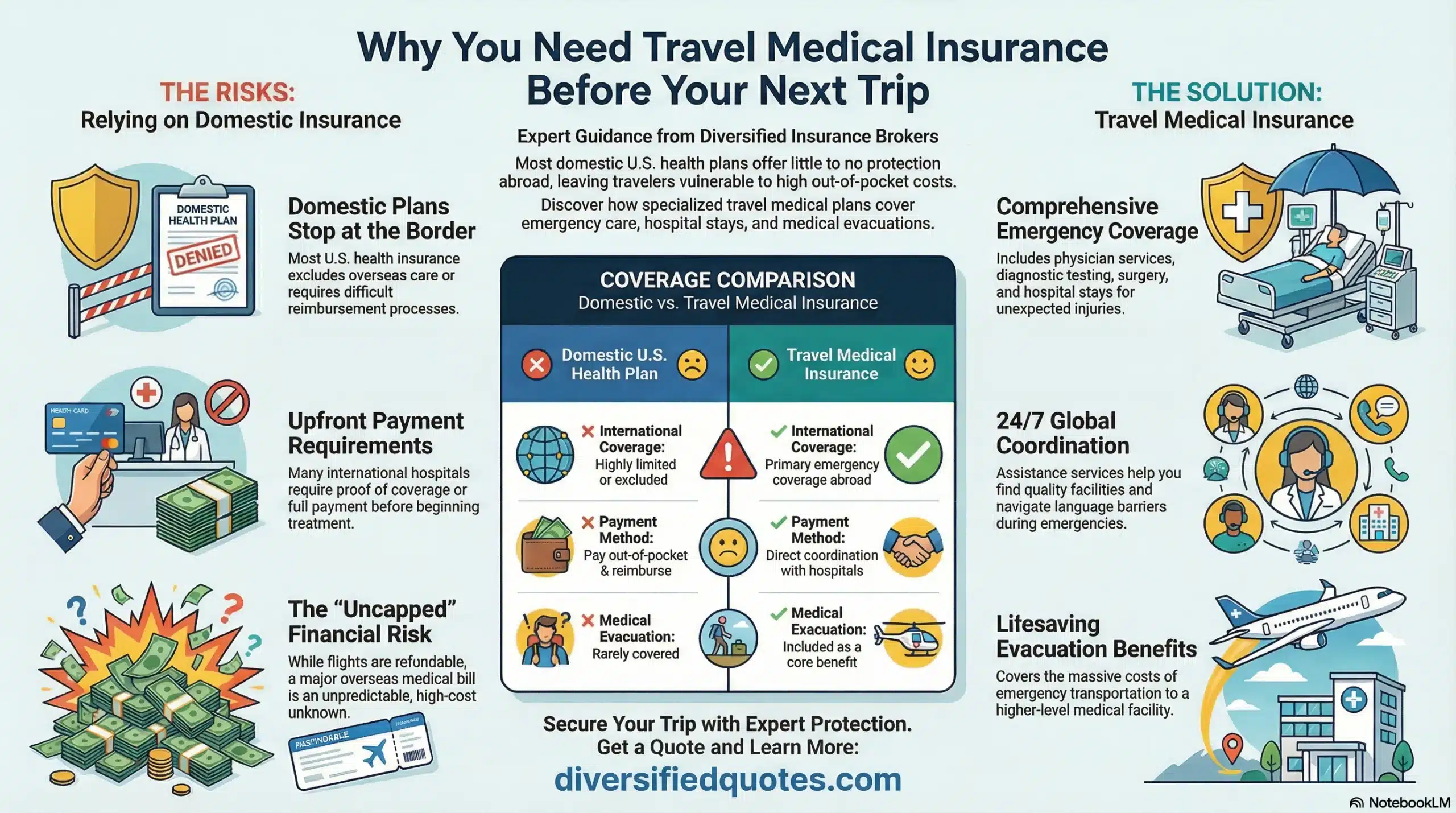
Travel medical and evacuation coverage is also about the reality of how payment works in a crisis. Travelers sometimes assume they can pay and “sort it out later.” In many emergency situations, especially when higher costs are involved, deposits and guarantees can become immediate obstacles. Coverage that includes a strong assistance infrastructure can help reduce the burden on you and your family when decisions are time-sensitive and the situation is stressful.
What This Coverage Is Designed to Do When Something Goes Wrong
Travel medical and evacuation insurance is built for unexpected, urgent situations while you are away from home. It’s not designed to be routine, elective, or open-ended coverage for every possible medical need. Instead, it focuses on what matters most in a crisis: emergency treatment, stabilization, and the ability to move you to appropriate care when local capacity is not sufficient.
Emergency medical benefits typically include hospital services, physician services, diagnostic testing, imaging, and medically necessary treatments related to an accident or sudden illness. In a real claim, that can mean anything from an ER evaluation to hospitalization, surgery, or specialist consultations, depending on what the case requires. The goal is to prevent a medical emergency from becoming a financial emergency while you’re dealing with travel complexity and unfamiliar healthcare systems.
Evacuation benefits exist because in many parts of the world the highest-cost step is not the first clinic visit—it’s the transport to where the right care can be delivered. Evacuation can involve ground transport to a better-equipped facility, a commercial flight with medical escort, or an air ambulance. The appropriate option depends on medical stability, distance, and what level of care is needed during transport. Many travelers hear “evacuation” and imagine only air ambulances, but the real value is coordinated escalation: getting you to the right place in the right way with the right approvals and documentation.
For higher-risk destinations, travelers often want a plan that pairs emergency medical coverage with structured support. This is where many policies look similar until you need to use them. A policy can have a high dollar limit, but if the process is unclear or the assistance response is weak, you can still end up stuck handling difficult logistics at the worst moment. That’s why we focus on plans that emphasize coordination—not just reimbursement.
Medical Evacuation: What It Actually Means (And Why It Matters)
Medical evacuation is best understood as a coordinated medical transport decision driven by medical necessity and local capability. In practical terms, evacuation happens when the treating facility cannot provide appropriate care, or when continued treatment requires resources that are not available locally. The assistance team typically helps confirm the medical need, identify a receiving facility, coordinate acceptance, and arrange transport at the appropriate level of support.
This is also why policy procedure matters. Many plans require evacuation to be coordinated or authorized through the assistance team in order to be covered, except in truly extreme circumstances where contact is impossible. That requirement isn’t just an administrative rule—it’s how the plan ensures that transport is medically necessary, properly staffed, and routed to a facility that can actually accept the patient. In real life, the “evacuation” benefit is a combination of medical judgment, logistics, and documentation, and you want a plan that makes that process easier rather than more complicated.
Another critical point is how the policy defines where you can be transported. Some plans refer to evacuation to the “nearest adequate facility.” Others may include repatriation once stabilized, depending on the terms of the policy. For many travelers, “nearest adequate facility” is ideal because it prioritizes speed. For others—especially longer recovery scenarios—repatriation to a home-country network can matter. Choosing the right plan often comes down to matching that evacuation definition to your reality: trip length, family situation, and how remote your itinerary is.
If you want a deeper reference point for how evacuation benefits are typically structured, review Emergency Medical Evacuation Insurance, and if your travel includes remote areas, fieldwork, or higher exposure profiles, compare the plan mindset on Travel and Medical Insurance for High Risk Travel.
Why Assistance Infrastructure Is the “Hidden” Benefit in Higher-Risk Regions
Most people shop for coverage by looking at benefit limits. Limits matter, but what often matters more in the DRC is the assistance infrastructure behind the plan. In an emergency, you are not just paying a bill; you are managing a sequence of decisions: where to go, who to see, how to stabilize, how to transfer if needed, and how to keep the claim process aligned with the policy rules. Strong assistance support helps you navigate that sequence.
A robust assistance team can help locate appropriate facilities, coordinate case management, communicate with providers, support documentation, and guide the approval process for higher-cost services like evacuation. This reduces the chance of delays caused by confusion, missing steps, or improvised arrangements that later become disputed in claims processing. For travelers with limited local familiarity, language barriers, or complex itineraries, assistance support is often the difference between a controlled response and chaos.
We also encourage travelers to keep the practical “activation plan” simple. Know where your policy documents are, keep the assistance number accessible, and understand that high-cost services usually require coordination. These steps sound basic, but they are exactly what helps the coverage function smoothly when you’re under pressure.
Common Travel Profiles We See for the DRC (And How Coverage Needs Shift)
Not everyone travels to the DRC for the same reason, and coverage needs change depending on how you will travel and where you will spend time. We commonly see three broad profiles: short-term visitors who want protection against unexpected illness or injury, longer-stay professionals and contractors who need coverage that matches extended assignments, and NGO or mission teams who travel beyond major city centers and require a plan designed for escalation.
Short-term travelers often want a straightforward emergency medical structure with strong evacuation support, because the goal is to manage what is unexpected without trying to replicate a full domestic health plan abroad. Longer-stay travelers sometimes need coverage that behaves more like ongoing international medical coverage, especially if the trip includes recurring travel, multiple regions, or a mix of work and personal time. In those cases, comparing International Health Insurance can help you determine whether a longer-duration structure is a better fit than a short-term travel medical policy.
NGO and field travelers often prioritize clarity of process and evacuation capability, because travel may be remote, schedules may be unpredictable, and emergency access can be less predictable. For these travelers, the plan is not about convenience—it’s about removing the financial and logistical barriers that can appear when something serious happens far from advanced care.
Pre-Existing Conditions: What Travelers Should Understand Before Buying
Pre-existing conditions can be one of the biggest sources of confusion in travel medical insurance, and they matter even more when traveling to destinations where escalation may be needed quickly. Some plans exclude pre-existing conditions entirely. Some include limited benefits under specific rules, such as “acute onset” definitions or tightly defined eligibility requirements. Others may allow a broader approach when certain purchase timing rules are met. The details vary, and the safest approach is to assume plans will not treat your history the same way until you verify the policy language.
If you have a known condition, the goal is not to “find a loophole.” The goal is to purchase coverage that fits reality. That includes understanding how the plan defines stability, what triggers a covered emergency vs. a non-covered flare-up, and what the assistance team expects you to do when symptoms begin. Pre-existing conditions are also a reason to prioritize policies with strong coordination support, because documentation and timing can matter in claims.
Even if you have no known conditions, it’s still wise to understand that travel medical insurance is designed for unexpected, urgent issues. It is not a replacement for comprehensive domestic coverage, and it is not a guarantee of coverage for every medical situation regardless of circumstances. The value is that it creates a defined structure for emergencies and escalation, which is exactly what many travelers need in destinations where access and logistics can be difficult.
Security Conditions and Non-Medical Disruptions: What This Coverage Can and Can’t Do
When people hear “evacuation,” they sometimes assume it includes all forms of evacuation for any reason. In reality, medical evacuation is triggered by medical necessity. Some plans also include forms of security support, but definitions and triggers vary widely. If your travel includes work that is inherently higher exposure—field operations, journalism, high-risk contracting, or movement outside major corridors—you want to be clear about what is included and what is not.
Even without focusing on labels, the practical planning point is this: medical issues can occur at the same time as logistical or security disruptions. A plan that provides strong assistance support is valuable because it helps coordinate medical decisions even when the environment is complicated. The coverage doesn’t eliminate risk. It reduces the cost exposure and creates a structured process for response.
What Claims and Coordination Look Like in a Real Emergency
In a serious emergency abroad, the process usually moves quickly. You seek immediate medical assistance first. As soon as it is safe and practical to do so, you (or a travel companion) contacts the policy’s assistance team. The assistance team can help align next steps with policy procedures, coordinate transfers, and guide documentation so your claim stays on track.
This is especially important for evacuation. Evacuation is typically the most expensive part of a claim, and it is also the part most likely to require authorization. When the assistance team is involved early, it becomes much easier to coordinate transport at the appropriate level of medical support and to route care to a facility that can accept the patient. If the assistance team is not involved until later, families sometimes find themselves trying to retroactively document decisions that were made under pressure.
We encourage travelers to think of the assistance team as part of the benefit, not as an afterthought. Your policy limit is the financial backstop. The assistance team is the operational engine that helps the benefit function in the real world.
How to Think About Limits for the DRC (Without Overcomplicating It)
For the DRC, we generally encourage travelers to treat evacuation as a realistic possibility, not a remote edge case. That doesn’t mean something will happen. It means that if something does happen, evacuation is one of the most likely reasons costs will escalate quickly. Limits should reflect that reality, and the plan should be structured to coordinate the process cleanly.
We also encourage travelers to match limits to travel complexity. The more remote your itinerary is, the more moving parts your trip includes, and the more time you will spend away from major corridors, the more important it becomes to have a plan that assumes escalation is possible. If you are comparing simpler travel medical options with lower costs, it can help to review Cheap Travel Insurance and compare whether the evacuation and assistance features still match what you need for a higher-risk region.
In practice, the goal is not to memorize every detail. The goal is to choose a plan that is built for emergencies, has a clear evacuation framework, and has an assistance system strong enough to coordinate care when the situation becomes complicated.
Why Travelers Work with Diversified Insurance Brokers
With travel medical coverage, a plan can look good on paper and still be frustrating in real life if the process is unclear. Diversified Insurance Brokers focuses on matching plan design to real travel risk, which is especially important in destinations like the DRC. We help you think through what happens if the local facility can’t manage the case, what transport might be required, how the plan handles approvals, and how assistance support functions when you need it.
We also help travelers who are unsure whether any existing coverage follows them internationally. Many travelers assume their domestic plan applies abroad, or that a credit card benefit will solve the worst-case scenario. In reality, those options often have limitations that show up quickly in serious medical events—especially when evacuation is involved. Our goal is to help you get coverage in place before you depart so you’re not trying to patch gaps after an incident begins.
Timing Matters: Why You Should Arrange Coverage Before Departure
The best time to arrange coverage is before you depart. Travel medical plans are designed to be purchased in advance, and once an incident starts, coverage gaps can’t be corrected retroactively. Purchasing early also ensures you have your documents, your policy numbers, and your assistance contacts ready before you travel, which is exactly what you want if something happens far from home.
If you are traveling as part of an organization or team, it’s also smart to align everyone on the basics: where the documents are stored, who will contact the assistance team in an emergency, and how the plan is activated. These small steps reduce confusion and speed up coordination when something urgent happens.
Get Covered Before You Travel
Apply online now to secure travel medical and evacuation coverage for the Democratic Republic of Congo.
Related Travel Medical Pages
If you’re comparing plan types or building a multi-country route, these pages help you line up coverage design with real-world medical access and evacuation needs.
Related Destination Pages
These destination pages help you compare how needs change based on infrastructure, distance to care, and travel logistics.
Talk With an Advisor Today
Choose how you’d like to connect—call or message us, then book a time that works for you.
Schedule here:
calendly.com/jason-dibcompanies/diversified-quotes
Licensed in all 50 states • Fiduciary, family-owned since 1980
Travel Medical & Evacuation from the DRC — FAQs
What does travel medical and evacuation insurance cover in the DRC?
Why is evacuation coverage so important for the Democratic Republic of Congo?
Does this type of insurance cover travel to remote regions inside the DRC?
Are pre-existing conditions covered?
What are common exclusions travelers should watch for?
How do I request medical evacuation if something happens?
Does evacuation always mean leaving the country?
How are premiums typically determined for DRC travel medical coverage?
What should I keep on hand to make a claim smoother?
About the Author:
Jason Stolz, CLTC, CRPC and Chief Underwriter at Diversified Insurance Brokers (NPN 20471358), is a senior insurance and retirement professional with more than two decades of real-world experience helping individuals, families, and business owners protect their income, assets, and long-term financial stability. As a long-time partner of the nationally licensed independent agency Diversified Insurance Brokers, Jason provides trusted guidance across multiple specialties—including fixed and indexed annuities, long-term care planning, personal and business disability insurance, life insurance solutions, Group Health, and short-term health coverage. Diversified Insurance Brokers maintains active contracts with over 100 highly rated insurance carriers, ensuring clients have access to a broad and competitive marketplace.
His practical, education-first approach has earned recognition in publications such as VoyageATL, highlighting his commitment to financial clarity and client-focused planning. Drawing on deep product knowledge and years of hands-on field experience, Jason helps clients evaluate carriers, compare strategies, and build retirement and protection plans that are both secure and cost-efficient. Visitors who want to explore current annuity rates and compare options across multiple insurers can also use this annuity quote and comparison tool.
