
Travel Medical and Evacuation from Italy

Jason Stolz CLTC, CRPC
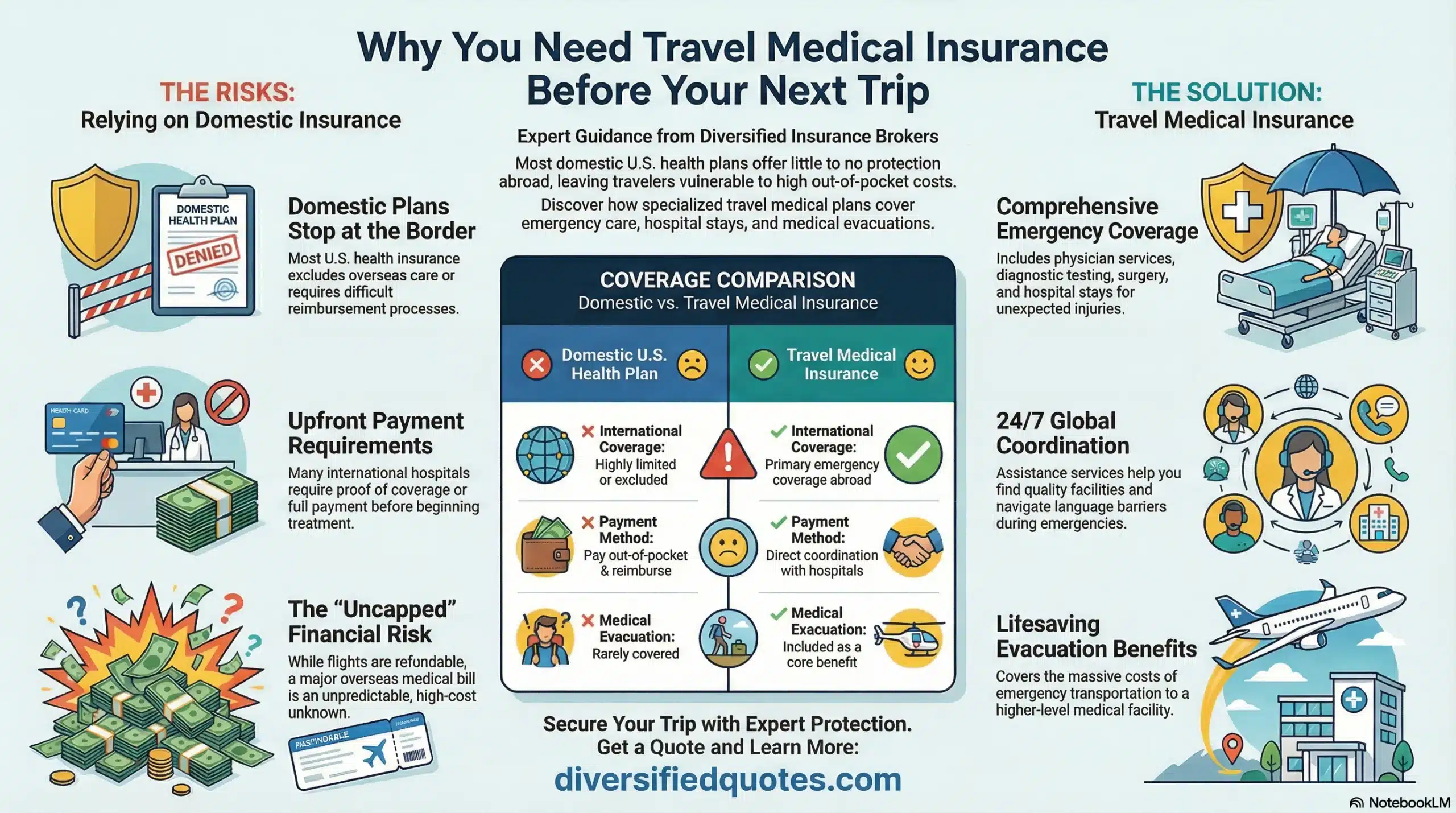
If you’re traveling to Italy, the goal is usually simple: enjoy the trip, stay flexible, and avoid expensive surprises. What catches many travelers off guard is that “good” health insurance at home often becomes limited—or completely unusable—once you’re outside the U.S. Travel medical coverage fills that gap by paying for eligible emergency treatment abroad, while medical evacuation coverage helps with transport to an appropriate facility (or back home) when the best care isn’t local. At Diversified Insurance Brokers, we build travel medical plans around real-world scenarios: an ER visit in Rome, a broken ankle in the Dolomites, a sudden illness in Florence, a hospital admission in Naples, or a situation where an English-speaking facility and coordinated evacuation matter more than price alone.
Ready to Lock In Coverage Before You Depart?
If you’re traveling soon, getting coverage in place early helps you avoid last-minute stress and ensures your dates and destinations are correctly reflected.
Italy is not considered a “high risk” destination in the typical travel-insurance sense, but it’s still international travel. That means different healthcare networks, different billing practices, different up-front deposit expectations, and a different claims process than you’re used to at home. It also means that a minor incident can become an expensive logistical problem when the trip is mid-stream and you need help coordinating care, payment, prescriptions, follow-up visits, and (in some cases) transport to a better-equipped facility. The right travel medical plan is designed to keep a health issue from turning into a financial or administrative crisis while you’re abroad.
When we say “travel medical and evacuation from Italy,” we’re describing two protections working together. Travel medical coverage focuses on eligible medical costs incurred while you’re in Italy—urgent care, emergency room services, physician visits, diagnostics, hospitalization, and certain prescriptions related to a covered event. Evacuation coverage focuses on movement: getting you to an appropriate level of care when your location, condition, or local resources make that necessary. That can mean transport to a different hospital in Italy, a transfer to another country if that’s medically appropriate, or repatriation home when the plan and medical team determine it’s the right course.
One common mistake is assuming that travel coverage is only about catastrophic events. In reality, many claims are ordinary: dehydration, food-related illness, infections, asthma flare-ups, a fall on uneven stone steps, or a minor accident that still needs imaging and follow-up. The best travel medical plan is the one that handles the ordinary issues cleanly, because those are the ones most likely to happen. If you want a broader overview of how these plans work across destinations, start with our main guide to travel medical insurance and then apply those rules to Italy-specific trip details like itinerary, season, and activities.
Another common mistake is choosing a plan based on a single number—like the cheapest premium or the highest medical limit—without understanding the structure underneath it. Two plans can show similar medical maximums but behave very differently when you actually need help. That difference usually comes down to exclusions, pre-existing condition language, deductibles, how the plan defines “emergency,” and how the plan handles evacuation coordination. For many travelers, the claims experience depends less on the headline limit and more on whether the plan’s assistance team is responsive and whether the coverage matches the realities of the trip.
Italy is also a destination where travelers often mix city travel with region-to-region movement. You might spend time in Rome and then head north to Tuscany, across to the Adriatic coast, or into the mountains. When you’re moving frequently, a plan with strong assistance and straightforward coverage definitions matters more, because the “where” of treatment and the “how” of follow-up can change quickly. If your trip includes rural areas, smaller towns, or high-mobility travel days, evacuation and coordination become even more valuable—not because Italy lacks healthcare, but because the right facility for your condition may not be the closest one.
We also build plans differently depending on who is traveling. A 26-year-old on a short vacation needs something very different than a 72-year-old taking a multi-city itinerary, and that difference is not just the price. Seniors typically benefit from higher medical limits, careful deductible selection, and clarity around stability and recent treatment history. If your trip includes older travelers—or if you’re arranging coverage for parents—review travel medical insurance for seniors before choosing the minimum option, because the best plan is the one that still works when a minor issue becomes a hospital observation stay.
If you’re traveling for school or an academic program in Italy, the “right plan” often means longer coverage duration, reliable access to outpatient care, and clarity on how ongoing follow-up is handled. Students and families should think about everyday medical needs, not just emergencies. Many Italy programs involve months abroad, not days, so you want a plan that feels usable. If your Italy trip is study-related, compare options using our guide to travel medical insurance for studying abroad and then tailor the final selection to your program length and housing location.
Volunteer travel has its own considerations. You may be in group settings, working in variable environments, or traveling outside major city centers. The plan should handle urgent care and injury cleanly, and it should include strong coordination support if you need transport. If your Italy itinerary includes service travel, review travel medical insurance for volunteer groups to align coverage with the structure of the trip.
Families traveling with teams or organized youth groups also need to think about injury patterns, sports-related treatment, and the practical need for fast care and documentation. Even in a “safe” destination, a sprain, fracture, or concussion can mean multiple visits. If that describes your situation, use travel medical for youth sports as your baseline and then adjust limits and deductibles for Italy’s travel style and your group’s schedule.
One of the most important coverage choices is the medical maximum. A low-limit plan might be fine for very short trips when you’re comfortable with more out-of-pocket exposure. But many travelers prefer to set limits high enough that the plan isn’t “used up” by one hospital episode. Italy’s healthcare system can be excellent, but you’re still dealing with international billing and the possibility of private facilities. If you want a practical rule of thumb, choose a limit that would still feel adequate if the event turned into a few days of hospital monitoring, imaging, and specialist consults, not just one urgent care visit.
Deductibles matter too, especially for travelers who are more likely to use the plan for outpatient issues. If you choose a higher deductible to reduce premium, you’re essentially self-insuring the first layer of costs. That can be a smart choice if you want protection primarily for higher-severity events. But if you want a plan you’ll actually use for urgent care and minor treatment abroad, a lower deductible often creates a better experience. The right deductible is the one you’d be comfortable paying in Italy without hesitation if a medical issue disrupts a travel day.
Evacuation benefits are the coverage people underestimate until they need them. Evacuation is not about “calling an ambulance home” because you’d rather be treated in the U.S. It is typically based on medical necessity and coordinated through the plan’s assistance team. The real value is that you have a structured process and a team that can coordinate transport, medical records transfer, facility coordination, and the logistics of getting you to the appropriate level of care. If you travel to Italy with any medical complexity—or you simply want the confidence that you’re not on your own if something serious happens—evacuation coverage is often one of the highest-value parts of the plan.
Another area where travelers get confused is pre-existing conditions. Many plans define pre-existing conditions based on a “look-back period,” and the exact definitions differ. Some plans exclude anything related to a pre-existing condition outright, while others may cover acute onset events or include waivers if you meet specific purchase timing rules. This is why the best approach is not guessing what will happen, but selecting a plan with language that matches your medical stability and your risk tolerance. If you’re managing ongoing conditions and still want strong travel coverage for Italy, it’s worth comparing plan language carefully instead of defaulting to the cheapest option.
Prescription medication is another practical reality. Your U.S. pharmacy network won’t follow you to Italy. If you lose medication, need a temporary supply, or need a physician visit to support a medication-related issue, the plan’s structure matters. Travel medical coverage is typically designed around new issues that arise on the trip, but assistance teams can also help coordinate local care and pharmacy access. The best strategy is still preparation—carry medication properly, keep a list of prescriptions, and travel with enough supply—but the plan can become a valuable backstop when travel goes sideways.
Even in Italy’s major cities, language and administrative processes can be a barrier during a stressful moment. A strong travel medical plan can help because the assistance team can coordinate care recommendations, help with hospital admissions logistics, and support documentation for claims. If your goal is to avoid spending your trip in “paperwork mode,” prioritize plans with clear instructions and accessible assistance, not just a big number on the brochure.
Trip duration changes everything. A ten-day vacation has a different risk profile than a sixty-day itinerary. The longer you’re abroad, the more likely it is you’ll have some kind of medical interaction—even if it’s minor. That doesn’t mean you should fear travel; it means you should pick a plan that doesn’t collapse under ordinary use. If you’re doing a longer Italy stay, prioritize usability: outpatient benefits that aren’t overly restrictive, medical limits that still feel meaningful, and evacuation coverage that is strong enough to matter if you’re far from your preferred facilities.
Activities matter too. Italy trips often include walking-heavy city days, hiking, skiing (seasonal), cycling, and boat excursions. If your itinerary includes higher-risk activities, you want to confirm the plan’s coverage stance. Some plans restrict coverage for certain activities, while others cover them if they’re recreational and non-professional. A plan that fits your itinerary reduces the odds of a denied claim when the injury is directly connected to what you were doing.
There is also the practical question of “what happens after the emergency.” Many travelers assume the plan only matters during the moment of crisis. In reality, follow-up is where the plan’s value is often felt. A hospital visit can lead to a follow-up visit, a prescription, a physical therapy recommendation, or a need for medical documentation for travel changes. The plan’s coordination support can help you make decisions faster and reduce the friction of getting appropriate care in an unfamiliar system.
Another real-world detail is payment. Some facilities abroad expect payment at the time of service, while others bill. Travel medical plans often reimburse covered expenses, and some coordinate direct payment in certain settings, but it depends on the plan and the facility. A strong assistance team can be very helpful here, because they can coordinate, confirm coverage, and help you avoid unnecessary upfront payments when another approach is available. The goal is not to assume you will never have out-of-pocket costs, but to choose a plan where the process is clear, and where you’re not stuck making expensive decisions without guidance.
If you’re comparing travel coverage options across our site, you can also explore the broader travel category here: Short-Term and Travel Medical. Even though your Italy trip is a traditional destination, the framework for comparing plans is the same: choose a plan that is easy to use, align limits and deductibles with your real risk, and make sure evacuation support is strong enough to matter when needed.
We also recommend thinking about what you want the plan to do emotionally, not just financially. Some travelers buy travel coverage because they’re worried about a catastrophic expense. Others buy it because they want a structured process and someone to call when something goes wrong. Both are valid goals, but they lead to different plan choices. If the primary concern is “I want a high limit so I’m protected,” you may lean toward higher medical maximums and strong evacuation. If the primary concern is “I want something I’ll actually use,” you may choose a lower deductible and a plan with strong outpatient usability.
For many Italy travelers, the simplest way to get the right plan is to start with a short set of questions: Who is traveling? How long are you staying? Are there any ongoing conditions that you’re actively treating? Are you planning strenuous activities? Do you want the plan mainly for catastrophic protection or for everyday usability? Once those are answered, the plan selection usually becomes much clearer.
Get a Travel Medical Quote for Italy
Compare travel medical and evacuation options designed for international trips, then choose the coverage level that fits your itinerary.
Once you have quotes in front of you, we encourage a “compare the levers” approach. Look at medical maximum, deductible, evacuation amount, and how the plan describes pre-existing conditions and acute onset events. Then look at what the plan includes for outpatient visits and prescriptions related to a covered event. Finally, consider the assistance experience: how easy it is to contact the support team, and what kind of coordination they provide when you’re abroad. That combination typically determines whether the plan feels smooth or frustrating during a real claim.
Travelers also ask whether they need evacuation coverage if they’re in a country with good hospitals. The reason evacuation still matters is not because Italy lacks quality care; it’s because the right facility for your condition may not be the closest one, and because international transport coordination is complicated. If you have a situation that requires specialized care, or if you’re in a location where the closest appropriate facility is a transfer away, evacuation benefits can be what turns a complicated situation into a managed one. In many cases, the financial value is only part of it; the coordination value is the bigger benefit.
If your Italy trip includes multiple countries—like France, Switzerland, Austria, or Germany—make sure the policy is structured for the full itinerary. Travel plans are typically based on travel dates and destination region, and you want the coverage to match where you’ll actually be. The same is true for cruises or ferry travel where the “location” of treatment could vary unexpectedly. A plan built for your full itinerary helps avoid gaps where a technicality becomes a problem.
For families, a key planning question is how decisions get made if the traveler is hospitalized abroad. Who has access to documents? Who will coordinate flights if plans change? Who can speak with assistance teams and providers? Travel medical and evacuation coverage is stronger when it’s paired with a simple documentation plan: a list of emergency contacts, medical info, and a way for a trusted person to access itinerary details. It’s not complicated, but it can prevent confusion when time is sensitive.
If your trip is primarily a leisure vacation, the coverage decision can be very straightforward: choose a plan you can afford, set limits that protect you from the major events, and don’t overcomplicate it. If your trip involves age-related considerations, health history, longer duration, or high-activity travel, the plan selection benefits from a more careful comparison. In either case, the goal is the same: a plan that does what you think it does, when you need it to.
At Diversified Insurance Brokers, we approach travel medical planning like we approach all protection decisions: make the coverage understandable, match it to the real scenario, and avoid surprises in the fine print. You shouldn’t have to become an insurance expert to travel confidently. You just need a plan that fits your trip and a clear path to getting help if something goes wrong.
Ready to Lock In Coverage Before You Depart?
If you’re traveling soon, getting coverage in place early helps you avoid last-minute stress and ensures your dates and destinations are correctly reflected.
Related Travel Medical Pages
Use these guides to compare plan structures, traveler types, and common coverage decisions before you buy.
Related Destination Pages
If you’re comparing coverage styles by region or itinerary complexity, these destination guides show how plan choices shift.
Talk With an Advisor Today
Choose how you’d like to connect—call or message us, then book a time that works for you.
Schedule here:
calendly.com/jason-dibcompanies/diversified-quotes
Licensed in all 50 states • Fiduciary, family-owned since 1980
FAQs: Travel Medical and Evacuation from Italy
Do I really need travel medical insurance for Italy if I have U.S. health insurance?
In many cases, yes. U.S. health plans often have limited or no coverage outside the country, and reimbursement rules can be restrictive. Travel medical coverage is designed to pay eligible medical expenses while you’re abroad and to provide coordination support when you need care in another healthcare system.
What does “medical evacuation” mean in a travel plan?
Medical evacuation typically means medically necessary transport to an appropriate facility when the local option is not adequate for your condition. It is usually coordinated by the plan’s assistance team and based on medical necessity—not personal preference.
Will the plan pay for a hospital visit in Italy?
Travel medical plans commonly cover eligible emergency treatment, diagnostics, and hospitalization for covered illnesses or injuries that occur during the trip, subject to policy terms, exclusions, deductibles, and maximum limits.
Is there coverage for minor issues like urgent care or doctor visits?
Many plans include outpatient benefits for eligible urgent care or doctor visits related to a covered event, but the details vary. If you want a plan you’ll actually use for non-catastrophic issues, focus on deductible selection and outpatient structure, not just the headline maximum.
How do pre-existing conditions work with travel medical coverage?
Pre-existing conditions are handled differently by different plans. Some exclude them entirely, while others may cover acute onset events or offer waivers if specific timing and eligibility rules are met. The exact definition and look-back period matter, so choose a plan whose language matches your situation.
What is a graded benefit period, and does it apply to travel medical?
Graded benefit periods are most commonly associated with certain life insurance policies, not travel medical. For travel medical, the key “fine print” issues are typically exclusions, pre-existing condition language, and how the plan defines emergencies and medically necessary evacuation.
Can I buy coverage for a longer stay in Italy?
Yes. Many travel medical plans can be structured for longer durations. For longer trips, prioritize usability—adequate medical limits, clear outpatient benefits, and strong assistance coordination—because ordinary medical needs are more likely over time.
Does the plan cover recreational activities during my Italy trip?
Many plans cover typical recreational activities, but restrictions can apply depending on the activity and the plan. If your itinerary includes higher-risk activities like certain alpine excursions, confirm the plan’s coverage stance before purchasing.
How quickly can I get a quote and purchase coverage?
Often within minutes. The key is making sure your travel dates, destination region, traveler ages, and any relevant options are entered accurately so the plan matches your actual itinerary.
About the Author:
Jason Stolz, CLTC, CRPC and Chief Underwriter at Diversified Insurance Brokers (NPN 20471358), is a senior insurance and retirement professional with more than two decades of real-world experience helping individuals, families, and business owners protect their income, assets, and long-term financial stability. As a long-time partner of the nationally licensed independent agency Diversified Insurance Brokers, Jason provides trusted guidance across multiple specialties—including fixed and indexed annuities, long-term care planning, personal and business disability insurance, life insurance solutions, Group Health, and short-term health coverage. Diversified Insurance Brokers maintains active contracts with over 100 highly rated insurance carriers, ensuring clients have access to a broad and competitive marketplace.
His practical, education-first approach has earned recognition in publications such as VoyageATL, highlighting his commitment to financial clarity and client-focused planning. Drawing on deep product knowledge and years of hands-on field experience, Jason helps clients evaluate carriers, compare strategies, and build retirement and protection plans that are both secure and cost-efficient. Visitors who want to explore current annuity rates and compare options across multiple insurers can also use this annuity quote and comparison tool.
