
Travel Medical and Evacuation from Liberia

Jason Stolz CLTC, CRPC
If you’re traveling to Liberia for work, volunteering, family visits, mission trips, or long-term assignments, having travel medical and evacuation insurance from Liberia is one of the smartest decisions you can make before you arrive. Liberia is a beautiful and resilient country with a growing international presence—especially in and around Monrovia—but travelers should plan ahead because access to advanced medical care can be limited, and serious cases often require transfer to another country for treatment. When you’re far from home, the issue isn’t only “Can I find a doctor?” It’s “If something goes wrong, do I have a plan that can handle the emergency, coordinate care, and cover the cost of getting me to the right place?”
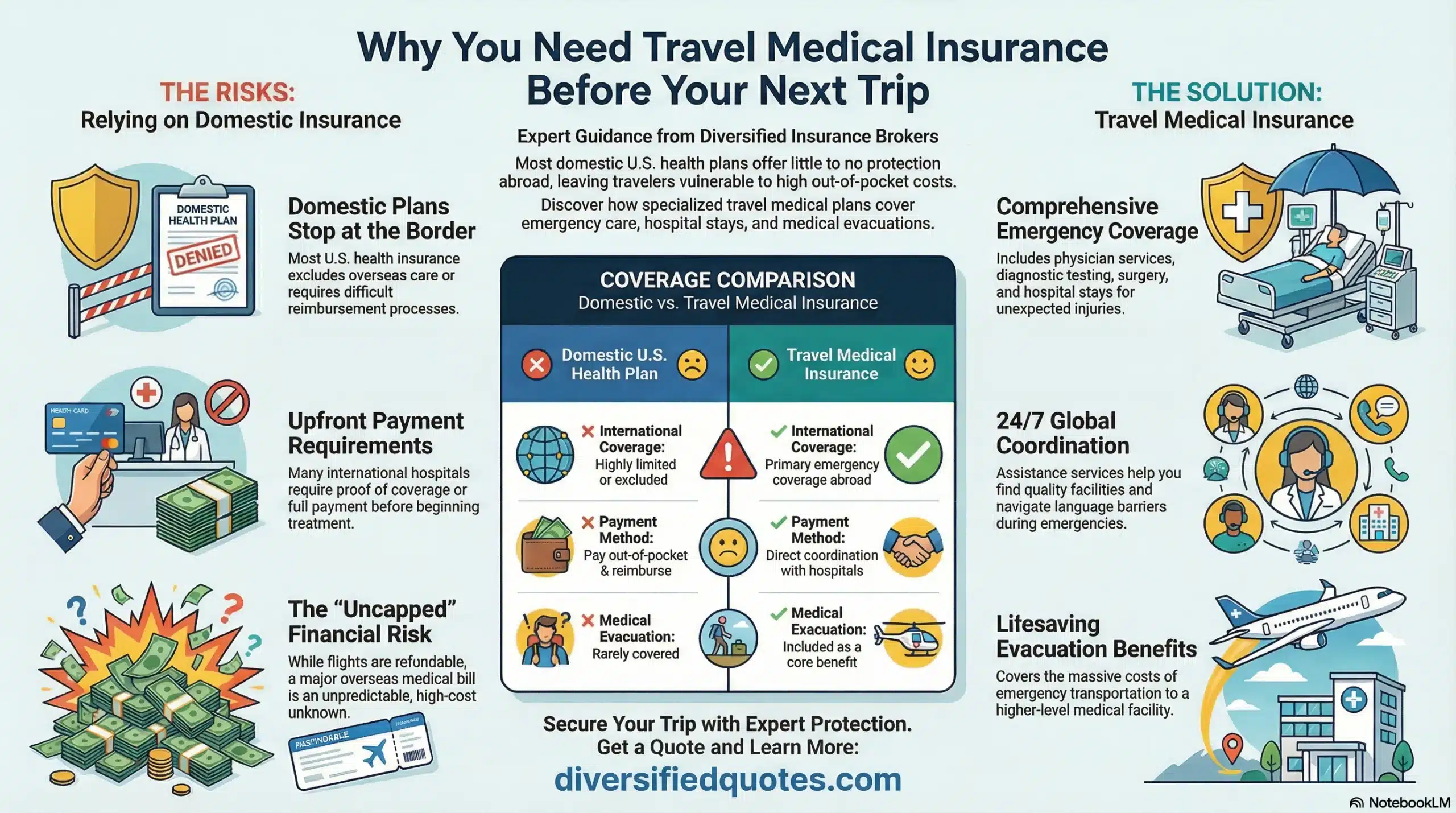
At Diversified Insurance Brokers, we help individuals and families compare international medical options that are built for real-world emergencies. Many travelers assume their regular health insurance or credit card benefits will protect them overseas. In most cases, that coverage is limited, delayed, or not designed for international hospital billing and emergency evacuation logistics. A strong travel medical plan is designed specifically for situations where you’re outside your home healthcare system and need urgent medical treatment, coordination, and support.
If you are comparing plan types, it can also help to review the difference between short-term travel medical plans and longer-stay coverage designed more like major medical abroad. To see how these options compare, visit our guides on Travel Medical Insurance, International Health Insurance, and Emergency Medical Evacuation Insurance. Each one serves a different purpose depending on whether you need short-term coverage, extended coverage, or a plan focused heavily on evacuation and coordination.
Travel Medical & Evacuation Coverage for Liberia
Apply online for travel medical insurance that includes emergency care and evacuation coordination for travel and extended stays.
Why Travel Medical Coverage Matters More in Liberia Than Most People Expect
Liberia is not a destination where you want to “figure it out as you go” if a medical emergency happens. A minor situation—dehydration, foodborne illness, respiratory infection, a fall, or a vehicle-related injury—can turn into something more serious if treatment is delayed or if the best facility is far away. In many countries, the question is simply “Which hospital should I go to?” In Liberia, the question can become “Is this facility capable of handling the situation—and if not, how do we escalate care quickly?”
That’s one of the biggest reasons travel medical and evacuation coverage exists. The coverage is not just about paying a bill. It’s about access, speed, and coordination. In high-stress situations, the assistance team built into the plan can help identify where to go, coordinate admission, and manage next steps if the situation requires transfer. Travelers often underestimate how difficult those decisions can be when you’re sick, injured, or trying to help someone else in a crisis.
Even if your trip is primarily in Monrovia, the coverage is still important. Serious medical issues don’t wait until you’re near the best hospital, and the level of care you need may involve specialized treatment, advanced diagnostics, ICU capability, or surgical resources that may not be readily available. When a treating physician determines you need a higher level of care than what’s available locally, evacuation stops being a “maybe” and becomes the plan.
What Travel Medical & Evacuation Insurance Is Designed to Cover
Travel medical and evacuation plans are built to protect you from the largest financial risks that can happen when you’re outside your home health system. Most of the value comes from three major areas: emergency medical care, evacuation logistics, and 24/7 assistance coordination.
Emergency medical benefits are designed to cover eligible urgent care such as doctor visits, emergency room treatment, hospital stays, diagnostic testing, imaging, surgeries, and medically necessary prescriptions. In practical terms, this coverage helps you respond immediately to an unexpected event without worrying that every decision is a financial gamble.
Medical evacuation benefits are designed to solve the “what happens next” problem. If local care is not sufficient, your plan may cover medically necessary transportation to the nearest appropriate facility where the required level of care exists. That may be inside Liberia, or it may require leaving the country depending on the case and local medical availability. In serious situations, evacuation can involve ground ambulances, commercial flights with medical escorts, or dedicated air ambulance transport.
Assistance services are one of the most overlooked features of international travel medical insurance. Many policies include a 24/7 assistance team that helps coordinate treatment and transfer decisions. This matters because evacuation usually must be coordinated or approved through the assistance provider to be covered. Having a plan without strong assistance support can leave you trying to manage decisions, paperwork, and logistics during the worst moment of the trip.
For travelers in Liberia, evacuation is often the biggest cost exposure. Even if the initial medical event is relatively manageable, transportation logistics can escalate rapidly when long distances, limited options, or medical staffing requirements are involved. That is why we generally encourage travelers to treat evacuation as a real possibility in Liberia—not an unlikely edge case.
Medical Evacuation Is Not Just “An Air Ambulance”
One of the most common misconceptions is that evacuation is simply “getting on a plane and flying home.” In the real world, evacuation is a coordinated process. The assistance team and medical providers assess what level of care is required, what facility can provide it, and what type of transport is medically appropriate. In some cases, the safest transport is a medical escort on a commercial flight. In other cases, air ambulance is the only safe option.
Another key point is that many plans define evacuation as transport to the nearest appropriate medical facility. That may not be the same as “back to the U.S.” or “home country.” Some plans include repatriation once you’re stable, but it depends on the policy terms. This is why plan structure matters. Two travel medical policies can look very similar on the surface, but the evacuation definitions, approval process, and limits can be dramatically different.
If you want to understand evacuation terms more deeply before buying coverage, review our overview on Emergency Medical Evacuation Insurance, which explains how evacuation decisions are made, what triggers approval, and why the assistance process is a major part of the value.
Example Scenario: A Realistic Emergency in Liberia
Imagine a contractor working in Liberia who develops severe abdominal pain and high fever. Initial evaluation may be available locally, but depending on the diagnosis, the traveler could need advanced imaging, surgical intervention, or a higher acuity hospital setting. If local capability is limited for that specific case, the next step might be transfer to another country with stronger specialty care.
Without travel medical and evacuation coverage, the traveler and their family may be forced into fast decisions under financial pressure. They could be dealing with deposit requirements, limited availability, and unclear transport logistics. In contrast, with a strong plan in place, the assistance team can coordinate case management, confirm where treatment should occur, arrange appropriate transport, and manage eligible expenses according to the policy.
The practical point is simple: travel medical insurance helps pay for the care, but the evacuation and assistance structure helps you access the care in the first place. For destinations where medical escalation is more likely, that coordination can be the difference between a controlled response and a scramble.
Who Should Consider Travel Medical and Evacuation Coverage for Liberia?
Travel medical and evacuation insurance is valuable for nearly anyone visiting Liberia, but it becomes especially important when your trip involves long distances, extended stays, higher-risk work environments, or remote travel away from major facilities. This includes business travelers, NGO teams, missionaries, contractors, journalists, students, and families living abroad. It also includes travelers who may be healthy today but do not want to gamble on what happens if a serious emergency occurs.
Volunteers and mission teams often benefit from stronger travel medical coverage because their work may bring them into rural areas where access to capable medical facilities can be limited. In those settings, evacuation becomes a real planning issue rather than a hypothetical risk.
Business travelers and contractors often benefit because downtime is expensive, and emergency situations can disrupt travel schedules and projects. Having the right coverage can reduce delays and help coordinate a quicker response.
Families and expats often want a plan that provides peace of mind for day-to-day risks while also including evacuation as a backstop. Even when basic medical needs are manageable, serious emergencies are different, and the ability to transfer care is often the most important protection.
Older travelers may also want stronger limits and better assistance coordination because medical issues can escalate faster and require more intensive treatment or monitoring.
Common Coverage Gaps and Limitations to Understand Before You Buy
The best travel medical plan is the plan that matches your real risk, not the one that looks cheapest on a quote page. Travel coverage has exclusions and requirements that matter, especially in high-stakes destinations.
Pre-existing conditions are one of the biggest planning points. Some policies exclude them entirely, while others offer limited coverage for certain events. If you have a known condition, you should assume that not all plans treat it the same way. The exact language matters because you don’t want to discover limitations after the emergency has already started.
Evacuation authorization requirements are another major factor. Many policies require you to contact the assistance provider before arranging evacuation for the claim to be covered. In a true emergency, you seek immediate care first, but as soon as it is safe, you should involve the assistance team so the plan’s process is followed.
Activity exclusions may apply if your trip involves higher-risk excursions or rugged travel. If you are traveling to interior areas, using motorcycles, working physical job sites, or participating in adventure activities, confirm whether your coverage includes those risks or requires a rider.
Benefit limits matter more than most travelers realize. A plan that covers small doctor visits may not be built for the kind of event where evacuation becomes medically necessary. For Liberia, we generally recommend focusing on meaningful emergency medical maximums and strong evacuation limits because the most expensive part of a serious claim is often the transport and logistics, not the initial evaluation.
How to Choose the Right Travel Medical Plan for Liberia
When choosing coverage for Liberia, focus on the real scenario you want the policy to handle. If your goal is to protect against minor inconvenience costs, a basic plan may work. But if your goal is to protect your family from the financial and logistical fallout of a serious emergency, the plan should be built for escalation.
We typically recommend travelers think through three core questions before purchasing:
First, what level of emergency medical coverage do you want if you need hospital care, surgery, imaging, or specialist treatment? This is where higher limits provide more peace of mind.
Second, what evacuation framework do you want? Some travelers want evacuation to the nearest adequate facility. Others want the option of repatriation once stabilized. The best option depends on how long you’re away, your home country, and where you’d want long-term recovery to occur.
Third, how important is assistance coordination to you? A plan that includes 24/7 global support can be extremely valuable when you need help navigating decisions, documentation, provider communication, and transfers.
If you’re unsure which structure makes sense, we often recommend comparing a short-term travel medical plan against a longer-stay international medical plan. You can see those differences more clearly by reviewing Travel Medical Insurance and International Health Insurance side by side.
Why Travelers Use Diversified Insurance Brokers
When it comes to travel medical and evacuation coverage, the details matter. Two plans can look similar until you actually need them. The key differences show up in the claim process, the assistance structure, the evacuation definitions, and what the policy requires during an emergency.
At Diversified Insurance Brokers, we help you choose coverage that fits how you’re traveling—short trip or long stay, city-based or remote travel, solo or family travel, lower-risk itinerary or higher-risk assignment. Our goal is simple: help you get into a plan that responds well in the moment you actually need it, with coordination and support instead of confusion.
If you’re planning travel to Liberia and want to be confident your coverage is built for real emergencies, we can help you compare options and select a plan designed for the realities of international care and evacuation planning.
Get Covered Before You Travel
Apply online now to secure travel medical and evacuation coverage for Liberia.
Related Travel Medical Pages
If you’re comparing plan types or building a multi-country route, these pages help you line up coverage design with real-world medical access and evacuation needs.
Related Destination Pages
These destination pages help you compare how needs change based on infrastructure, distance to care, and travel logistics.
Talk With an Advisor Today
Choose how you’d like to connect—call or message us, then book a time that works for you.
Schedule here:
calendly.com/jason-dibcompanies/diversified-quotes
Licensed in all 50 states • Fiduciary, family-owned since 1980
Travel Medical & Evacuation from Liberia — FAQs
Do I need travel medical & evacuation insurance for Liberia?
What does medical evacuation typically include in Liberia?
How much medical and evacuation coverage should I carry?
Will the policy help if a facility requires payment up front?
Are pre-existing conditions covered?
Does travel coverage include security or political evacuation?
Are remote travel and higher-risk activities covered?
What should I keep accessible for emergencies in Liberia?
How do I request evacuation or start a claim?
When should I purchase coverage and how long should it last?
About the Author:
Jason Stolz, CLTC, CRPC and Chief Underwriter at Diversified Insurance Brokers (NPN 20471358), is a senior insurance and retirement professional with more than two decades of real-world experience helping individuals, families, and business owners protect their income, assets, and long-term financial stability. As a long-time partner of the nationally licensed independent agency Diversified Insurance Brokers, Jason provides trusted guidance across multiple specialties—including fixed and indexed annuities, long-term care planning, personal and business disability insurance, life insurance solutions, Group Health, and short-term health coverage. Diversified Insurance Brokers maintains active contracts with over 100 highly rated insurance carriers, ensuring clients have access to a broad and competitive marketplace.
His practical, education-first approach has earned recognition in publications such as VoyageATL, highlighting his commitment to financial clarity and client-focused planning. Drawing on deep product knowledge and years of hands-on field experience, Jason helps clients evaluate carriers, compare strategies, and build retirement and protection plans that are both secure and cost-efficient. Visitors who want to explore current annuity rates and compare options across multiple insurers can also use this annuity quote and comparison tool.
