
Travel Medical and Evacuation from Venezuela

Jason Stolz CLTC, CRPC
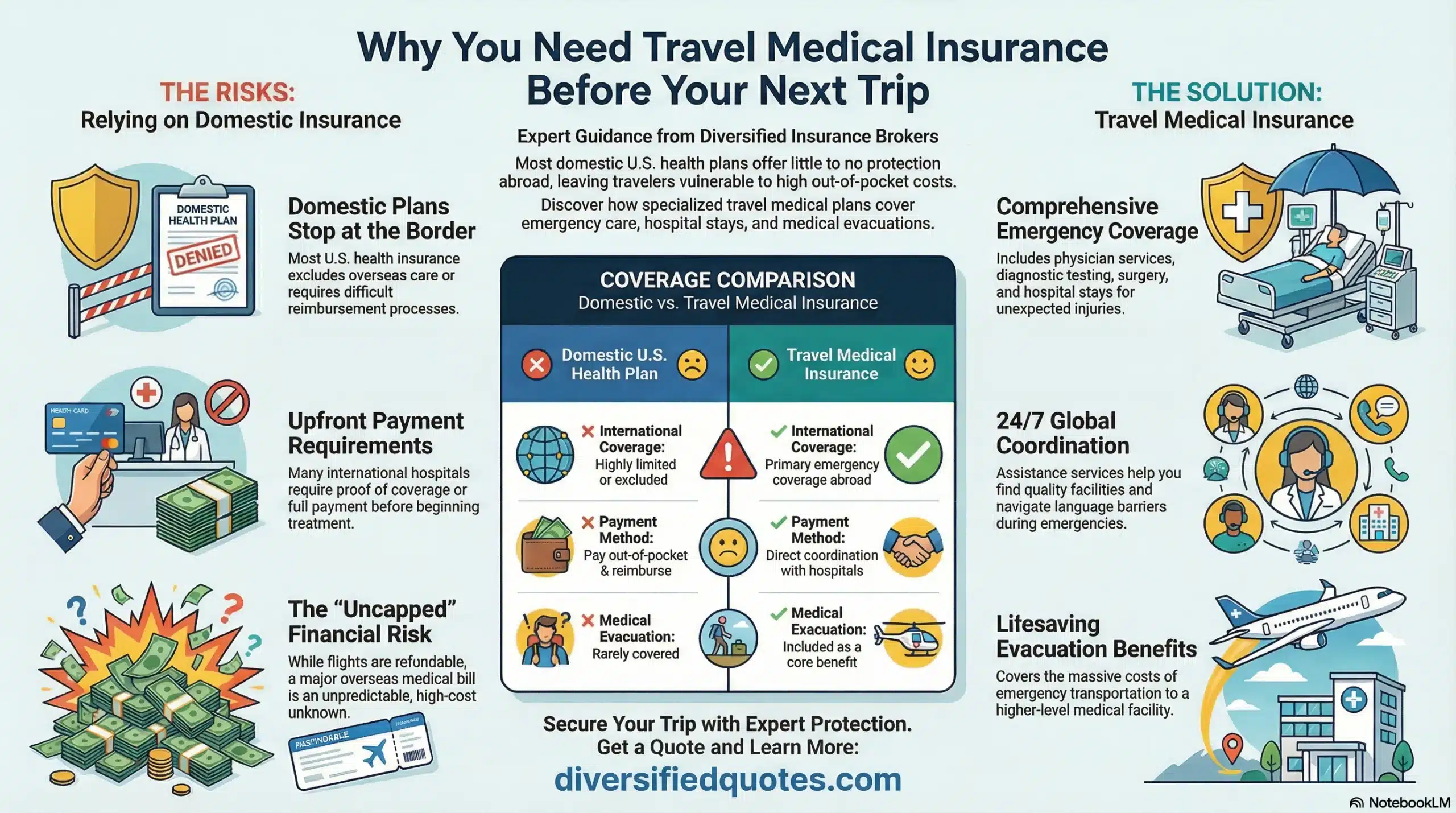
Travel to Venezuela can be meaningful for family visits, business, academic work, and long-stay projects, but it requires realistic planning around healthcare access and what happens if something goes wrong. Even in larger cities, the availability of specialists, diagnostics, reliable medications, and consistent hospital operations can vary. Outside of major private clinics, getting advanced care quickly can be difficult, especially when you’re far from urban centers or when local resources are strained. That’s why travel medical and evacuation insurance from Venezuela is strongly recommended for visitors, contractors, NGO staff, and anyone who wants a clear plan for emergencies.
This page focuses on emergency medical coverage plus medical evacuation only. If you suffer a serious illness or injury, the right plan can help cover eligible emergency treatment and coordinate transport to the nearest facility capable of providing appropriate care—whether that’s within Venezuela (when available) or in a nearby country. It’s also important to be clear about what this protection does not include: non-medical evacuation (political, security, or “get me out” events) is not covered under medical-only evacuation benefits. Medical necessity is required for evacuation to be approved and coordinated by the assistance team.
At Diversified Insurance Brokers, we help travelers compare international medical plans with strong emergency assistance services, because in higher-risk destinations the “what now?” moment matters as much as the coverage limit. A policy is not just a reimbursement tool. It’s a coordinated response system—especially when you may need help locating appropriate care, arranging admission, or navigating a medically necessary transfer. If you’re also evaluating other complex destinations, you can compare coverage approaches on our High Risk Travel Insurance page or review how evacuations work on our Emergency Medical Evacuation Insurance overview.
Why Coverage Matters in Venezuela
Venezuela’s medical landscape is uneven. In some areas, private clinics may be available, but accessing timely care can still involve practical barriers such as deposits, upfront payment requirements, limited appointment availability, or delays for imaging and specialist evaluation. In other areas, capacity constraints and logistics can make it difficult to secure the level of treatment you would expect in more stable healthcare environments. A travel medical plan helps protect you from the worst-case financial exposure, while evacuation coverage addresses the bigger issue: continuity of care when the nearest facility cannot provide what your condition requires.
Medical evacuation is not something you want to “figure out later.” The cost of air ambulance services, cross-border transfers, medical escorts, and receiving-facility coordination can climb quickly. Without coverage and a 24/7 assistance team, travelers can face five-figure expenses and delays at the exact time they need speed and clarity. If you are comparing price-sensitive options but still want real protection, start with our Cheap Travel Insurance guide to understand where people unintentionally cut the coverage that matters most in serious emergencies.
It’s also important to align coverage expectations with reality. This page is about medical care and medical evacuation only. That means evacuation must be medically necessary, based on your condition and the local ability (or inability) to provide appropriate treatment. Plans generally do not respond to political unrest evacuation, security extraction, or non-medical relocation. If your trip involves elevated operational risk, you may also want to review our Travel and Medical Insurance for High Risk Travel resource so you’re matching coverage to the trip you’re actually taking.
For many travelers, the biggest “hidden” risk is not a minor illness. It’s a serious medical event that requires urgent stabilization, advanced diagnostics, surgery, or ICU-level monitoring. In that situation, your plan is only as good as the assistance team’s ability to coordinate care and move you appropriately. Venezuela travel planning is often about building a realistic medical response path—not assuming you will never need it.
Apply for Venezuela Travel Medical Coverage
Get emergency medical and medical-evacuation-only protection in minutes.
What “Medical Evacuation Only” Actually Means
“Medical evacuation” is a coordinated medical service—not just a flight. In a real emergency, the process typically starts with triage and stabilization at the nearest appropriate clinic or hospital. From there, the assistance team evaluates whether local treatment is adequate. If it isn’t, they coordinate transfer to the nearest facility capable of handling your condition, which may involve ground transport, air ambulance, or scheduled commercial transport with a medical escort (depending on your medical status and clearance).
A quality plan focuses heavily on assistance coordination. That means you’re not calling hospitals, negotiating logistics, or trying to arrange cross-border care alone. The assistance provider helps identify the destination facility, confirms the appropriate level of care, manages medical handoffs, and coordinates transport planning. In many cases, this coordination is the difference between a manageable medical event and a chaotic situation with delays, uncertainty, and major out-of-pocket exposure.
It’s also important to understand the “only” part of medical evacuation only. Medical evacuation does not mean “evacuate me because I’m uncomfortable here.” It requires medical necessity. If you have a serious illness or injury and local care cannot meet your needs, evacuation can be appropriate. If your situation is non-medical, medical-only policies generally won’t respond. Setting expectations upfront helps you buy the right kind of protection and prevents unpleasant surprises during a crisis.
In practice, medically necessary evacuation is often triggered by the gap between the care you need and the care available. That could mean the local facility cannot perform a required surgery, lacks appropriate imaging, cannot provide ICU monitoring, does not have the necessary specialist, or cannot safely manage complex complications. In those moments, the assistance team’s job is to coordinate the safest path to appropriate treatment.
Emergency Assistance: Why It Matters More Than Most Travelers Realize
When people think “travel insurance,” they often picture paperwork and reimbursement. In higher-risk destinations, the most valuable piece of the plan is frequently the 24/7 assistance center. If you or a family member is ill or injured, you may be stressed, in pain, or dealing with limited communications. You may not know which facilities are appropriate or how to coordinate admission. You may also face language barriers, deposit requirements, or sudden changes in local capacity.
A strong assistance team can help with the practical “next steps” that matter during a real emergency. That includes identifying appropriate facilities, coordinating transfers, helping with medical handoffs, and arranging evacuation if local care is inadequate. Travelers who have needed evacuation often describe the assistance team as the real engine of the policy, because without coordination the best coverage limit in the world may not help you fast enough.
If you expect a longer stay abroad or want broader access outside urgent emergencies, you may also want to compare options on our International Health Insurance page. International medical plans are often a better fit for extended time overseas, while travel medical is typically designed around unexpected events and urgent needs.
What Emergency Medical Coverage Helps Pay For
Emergency medical benefits are designed to cover eligible costs when something unexpected happens—appendicitis, fractures, infections, severe dehydration, foodborne illness, respiratory complications, and other sudden medical events that require urgent care. Depending on the plan, that can include physician evaluation, diagnostics, hospitalization, surgery, and prescribed medications. For many travelers, the practical value is being able to seek appropriate care without risking a financial disaster.
Even when local care is available, travelers can run into logistical problems: limited specialist availability, delays for imaging, inconsistent medication supply, or the need to move to a different city for a higher level of care. Emergency medical coverage helps handle eligible treatment costs, while evacuation benefits address the larger question of “Where can I actually get the appropriate level of care for this condition?”
In serious cases, the medical costs are not the only issue. The cost and complexity of coordination can be just as significant—especially if you need a medically supervised transfer. That’s why travelers should evaluate both medical benefits and evacuation benefits as a paired protection strategy, not as separate products.
Example Scenario
A business traveler in Valencia develops acute abdominal pain that quickly worsens. A local facility can evaluate them, but surgical staffing is limited that day and a transfer is needed to a private clinic with the right resources. With coverage in place, the traveler contacts the 24/7 assistance line, receives guidance on where to go, and gets help coordinating transfer. Eligible emergency treatment costs are covered according to the plan, and if specialty care cannot be delivered locally, a medically necessary evacuation to a nearby country for definitive treatment can be arranged. Without coverage, the traveler could face a large deposit requirement, out-of-pocket hospital bills, and the full cost of transport.
While each event is different, the pattern is common: the emergency itself is stressful enough, and the last thing you want is to be negotiating logistics or costs while trying to receive care. That’s what the combination of medical benefits and medical evacuation coordination is designed to address.
Who Should Consider Travel Medical and Evacuation Coverage for Venezuela
This type of coverage is a strong fit for travelers who want a clear emergency plan and financial protection if serious illness or injury occurs. That includes tourists visiting family, travelers exploring coastal regions, business travelers on short assignments, contractors and consultants traveling between cities, and NGO or education staff who may spend time outside the most resourced urban areas. It can also be a smart fit for longer-stay visitors who want a defined pathway to higher-level care if a medical event happens.
If your itinerary includes remote areas, frequent driving, or limited access to high-quality hospitals, the evacuation component becomes more important. In those cases, higher evacuation limits and a strong assistance provider matter as much as (or more than) the medical limit itself. The goal is not just to buy a policy—it’s to build an emergency plan you can rely on.
Families traveling together may also value having a coordinated assistance team available. When a child or older traveler becomes ill, decisions need to be made quickly, and having expert guidance can reduce uncertainty. The policy becomes a practical support system rather than a simple financial product.
Smart Pre-Travel Steps for Venezuela
Before you depart, make sure your policy dates cover your entire trip, including travel days and potential delays. Save your policy number and emergency assistance contact in multiple places—on your phone, in a printed copy, and shared with a trusted contact. If you take prescription medications, bring enough supply for your stay plus extra buffer, and keep copies of prescriptions. Also plan for the practical reality that some facilities may request deposits or upfront payment, even when you have coverage. Being prepared reduces stress and speeds up care when time matters.
If you have medical history that could affect coverage, review whether the plan treats pre-existing conditions as excluded, limited, or eligible under stability rules. The goal is to understand the boundaries of coverage before you travel, not while you’re seeking urgent care. If you’re unsure how a plan approaches your medical history, it’s worth clarifying the eligibility language and stability rules ahead of time.
Finally, treat your assistance hotline like your first step during a serious event. Don’t wait until the situation becomes worse. If you think you may need a transfer or if the local facility is not appropriate for your condition, calling the assistance team early gives them more time to coordinate the safest path to care.
Get Covered for Travel to Venezuela
Apply online for emergency medical and medical-evacuation-only benefits.
Related Travel Medical Pages
Explore more travel medical and evacuation resources to compare coverage options, limits, and exclusions before you travel.
Talk With an Advisor Today
Choose how you’d like to connect—call or message us, then book a time that works for you.
Schedule here:
calendly.com/jason-dibcompanies/diversified-quotes
Licensed in all 50 states • Fiduciary, family-owned since 1980
Travel Medical & Evacuation Insurance — Venezuela (FAQ)
Do I need travel medical and evacuation insurance for Venezuela?
Yes. Access to reliable advanced care can vary, and serious illness or injury may require transfer to a private facility or evacuation to a nearby country. Coverage helps protect you from large out-of-pocket medical and transport costs.
What does “medical evacuation only” mean?
It means evacuation is covered only when it is medically necessary due to illness or injury. Non-medical evacuations (political, security, civil unrest, or “get me out” situations) are not included under medical-only evacuation benefits.
What does medical evacuation typically include?
Most plans include coordination through a 24/7 assistance center, stabilization at the nearest appropriate facility, and transport by ground or air ambulance when necessary. Depending on medical necessity and logistics, evacuation may be to a capable in-country facility or across the border to the nearest appropriate hospital.
How much medical and evacuation coverage should I consider?
Many travelers target at least $100,000 for emergency medical expenses and $250,000–$500,000+ for evacuation and repatriation. Higher limits are smart if you’ll be outside major cities, traveling frequently, or working in remote areas.
Will hospitals in Venezuela bill my insurer directly?
Direct billing is not guaranteed. Some private facilities may work with international networks, but many clinics require deposits or payment up front. Keep your policy number and assistance hotline available, and save all receipts and medical records for claims.
Are pre-existing conditions covered?
It depends on the plan. Some policies cover stable pre-existing conditions under specific rules, while others exclude them or limit coverage to acute onset events. Review any look-back period, stability requirement, and how the policy defines “pre-existing.”
Does the plan cover routine care or only emergencies?
Most travel medical plans are designed for unexpected illness or injury and emergency care. Routine checkups and non-urgent care may be limited or excluded depending on the policy. If you need broader coverage for longer stays, an international medical plan may be a better fit.
What should I do first in an emergency?
Call the 24/7 assistance hotline as soon as possible. They can direct you to the most appropriate facility, help coordinate guarantees of payment when available, and manage evacuation logistics if medically necessary.
What documents should I carry while traveling in Venezuela?
Carry your passport/ID, insurance certificate and policy number, the emergency assistance contact, a medication list, prescriptions, and digital backups of everything. It’s also wise to share your policy details and itinerary with a trusted contact.
When should I buy coverage and how long should it last?
Purchase before your trip begins and cover the entire itinerary, including travel days and any side trips. If you’re staying longer, moving between cities, or traveling to remote regions, consider higher evacuation limits and a plan with strong assistance coordination.
About the Author:
Jason Stolz, CLTC, CRPC and Chief Underwriter at Diversified Insurance Brokers (NPN 20471358), is a senior insurance and retirement professional with more than two decades of real-world experience helping individuals, families, and business owners protect their income, assets, and long-term financial stability. As a long-time partner of the nationally licensed independent agency Diversified Insurance Brokers, Jason provides trusted guidance across multiple specialties—including fixed and indexed annuities, long-term care planning, personal and business disability insurance, life insurance solutions, Group Health, and short-term health coverage. Diversified Insurance Brokers maintains active contracts with over 100 highly rated insurance carriers, ensuring clients have access to a broad and competitive marketplace.
His practical, education-first approach has earned recognition in publications such as VoyageATL, highlighting his commitment to financial clarity and client-focused planning. Drawing on deep product knowledge and years of hands-on field experience, Jason helps clients evaluate carriers, compare strategies, and build retirement and protection plans that are both secure and cost-efficient. Visitors who want to explore current annuity rates and compare options across multiple insurers can also use this annuity quote and comparison tool.
