
Travel Medical Insurance for Seniors

Jason Stolz CLTC, CRPC
Travel medical insurance for seniors is one of the simplest ways to keep a great trip from turning into a financial emergency. Even healthy retirees can get hit with unexpected medical issues abroad—an infection that needs antibiotics, a fall that requires imaging, or a complication that calls for hospitalization. The problem is that standard Medicare and many retiree health plans offer limited help outside the United States, which can leave you exposed to provider deposits, out-of-pocket medical bills, and the hidden cost most travelers don’t plan for: emergency medical evacuation if adequate care isn’t available locally.
At Diversified Insurance Brokers, we help seniors choose travel medical coverage based on the trip you’re actually taking—your destination, trip length, medical history, and the level of “worst-case” protection you want. Some travelers want a lean plan that covers the basics. Others want higher medical limits, stronger evacuation benefits, and better assistance support. Either way, the goal is the same: you should be able to travel knowing that a medical surprise won’t force you to drain savings, cancel the rest of your trip, or scramble for care in an unfamiliar system.
Get Travel Medical Insurance for Seniors
Quick, secure online enrollment for seniors needing medical coverage while traveling abroad.
Start Your QuoteWhy Seniors Need Travel Medical Insurance
International travel is different in retirement because medical “small issues” can become “big issues” faster—especially when dehydration, jet lag, a long flight, unfamiliar food, and a change in routine stack on top of each other. A senior travel medical policy isn’t about assuming something will go wrong. It’s about making sure that if something does go wrong, you have a clear path to care, a support team to coordinate next steps, and financial protection that keeps a disruption from turning into a crisis.
Seniors also face a practical reality: many overseas providers and private hospitals expect deposits or payment arrangements up front. If you pay cash and seek reimbursement later, timing can be unpredictable—and that’s a stressful situation when you’re trying to recover. Travel medical coverage helps reduce that burden by pairing benefits with 24/7 assistance support that can guide you to the right facility and help coordinate billing and documentation.
If your trip includes multiple countries, rural stops, cruise ports, or islands, you’ll want to pay extra attention to how the plan handles care access and transport. That is where evacuation wording and assistance services matter most—more than a glossy “benefit list.”
What Medicare (and Many Retiree Plans) Typically Don’t Cover Abroad
A major reason seniors purchase travel medical insurance is that Medicare coverage is generally limited outside the United States. Even when a retiree has supplemental coverage or other arrangements, it often doesn’t function like a travel-ready solution with strong emergency medical benefits, evacuation coordination, and predictable assistance services overseas. That’s why travel medical is usually treated as a separate, trip-specific policy that stands on its own when you’re outside the U.S.
If you want to review your Medicare setup before you travel, our Medicare calculator can help you compare options and confirm what you have in place. It’s a simple way to reduce assumptions before you rely on coverage that may not apply overseas.
For longer trips or extended stays, it can also be worth comparing a travel medical plan with broader options found in international health insurance, especially if you want more comprehensive access to care over a longer period.
What Senior Travel Medical Insurance Usually Covers
While benefits vary by plan, senior travel medical coverage is typically designed around the expenses that create the biggest financial risk abroad: emergency treatment, hospitalization, and evacuation logistics. A strong plan also includes 24/7 assistance services that help you navigate a different healthcare system when you’re under stress, dealing with language barriers, or uncertain where to go for appropriate care.
Emergency medical care commonly includes physician visits, urgent care, diagnostic testing, hospitalization, and medically necessary treatment for illness or injury that occurs during the covered trip. Depending on the plan structure, it may also include limited follow-up care when needed to stabilize recovery.
Emergency medical evacuation is often the most important benefit for older travelers. If adequate care is not available locally, evacuation benefits can help coordinate and pay for medically necessary transport to the nearest appropriate facility. This is why we encourage seniors to review evacuation wording carefully—because in a real emergency, the assistance provider and the definition of “medical necessity” matter just as much as the dollar limit. For a full breakdown, see our Emergency Medical Evacuation Insurance guide.
Repatriation of remains is also commonly included. It’s not pleasant to think about, but it is a meaningful logistical and financial benefit when families need support coordinating international arrangements.
24/7 assistance services can include multilingual support, help locating providers, coordination with hospitals, and guidance on documentation for claims. For many seniors, the real value is that there is a process and a support team—not just a reimbursement promise.
Choosing the Right Limits and Deductible
Senior travel medical plans aren’t “one size fits all,” and the most common mistake is choosing the cheapest plan without connecting the price to the coverage tradeoffs. For many retirees, the big decisions come down to the emergency medical limit, the evacuation benefit, the deductible, and how the plan treats pre-existing conditions.
A higher deductible can reduce premium, but it also increases what you may need to pay out of pocket before the policy begins to pay. That can be perfectly fine if you’re comfortable self-funding a larger first layer of costs. If you prefer to reduce “surprise cost” exposure—especially on longer trips—many seniors choose a lower deductible and stronger limits so a single urgent care visit or hospital evaluation doesn’t become a stressful budgeting event.
If you’re trying to keep costs reasonable without sacrificing the benefits that matter most, it helps to understand where budget plans often reduce protection. Our Cheap Travel Insurance resource explains how limits, deductibles, exclusions, and evacuation structure affect real-world value.
Why Medical Evacuation Matters More for Older Travelers
For seniors, evacuation isn’t just a “remote jungle” scenario. Evacuation becomes relevant on cruises, islands, rural routes, and even in major destinations when the nearest appropriate facility for your specific condition is not close. The cost can include air ambulance transport, medical staff, coordination, and specialized logistics—expenses that can dwarf the original medical bill.
It’s also important to understand the difference between medical evacuation and other “evacuation” concepts travelers hear about. Travel medical plans are generally focused on medically necessary evacuation to an appropriate facility. Separate benefits or services are usually needed for non-medical extraction or security evacuation. If your itinerary includes higher-risk regions or unstable environments, you may also want to compare broader options on High Risk Travel Insurance and our deeper guide on Travel and Medical Insurance for High Risk Travel.
For travelers who also want to protect prepaid costs, it can help to compare medical protection with trip-cost protection. Trip Cancellation Insurance addresses non-refundable trip expenses; travel medical addresses the medical and evacuation problem. Many seniors use both—because they solve different risks.
Pre-Existing Conditions and “Stability” Questions
Many seniors assume a pre-existing condition automatically disqualifies them from travel coverage. In practice, the question is usually more specific: how the plan defines a pre-existing condition, what look-back period applies, and whether the condition has been stable (based on the plan’s definition) before travel begins. Stability often relates to medication changes, new symptoms, hospitalization, or changes in treatment within a defined time window before the effective date.
This is why matching the plan to the traveler matters. The best fit depends on health profile, how recently treatment changed, and the type of trip you’re taking. If you’re comparing other temporary coverage types while planning the year, it can also help to understand how trip-based travel coverage differs from temporary domestic coverage like short-term health insurance. They are built for different use cases, and mixing categories is a common source of confusion.
The practical takeaway is simple: don’t assume—verify. If pre-existing conditions are part of your planning, you want a plan whose rules you understand before you leave.
Who This Coverage Is Best For
Senior travel medical insurance is a strong fit for retirees traveling internationally for leisure, cruises, milestone trips, and family visits. It becomes more important for extended stays abroad, because the probability of needing care increases with trip length. Grandparents visiting children or grandchildren overseas often prioritize this coverage because they want the freedom to travel without relying on “hope” as a strategy for medical costs and logistics.
It’s also a smart choice for senior travelers who want evacuation protection as a priority—not because the trip is inherently dangerous, but because medical transport and care coordination become more important as we age, especially when recovery time and comfort matter.
How to Choose a Plan That Fits Your Trip
The best senior travel medical plan is the one that matches the financial risks you actually face. Start by identifying what would be most disruptive: a hospital bill you’d need to pay immediately, the cost of evacuation, or uncertainty about how a pre-existing condition might be treated under the plan rules. Then choose a deductible that fits how you prefer to manage “first layer” costs versus monthly premium.
If you’re traveling to a destination where hospitals are limited—or your itinerary includes rural routes, islands, cruise ports, or multiple countries—stronger evacuation and higher medical limits are often worth it. If you’re traveling to a major metro area with strong healthcare infrastructure, your priorities may shift toward deductible and ease of use. Either way, the goal is to align the policy with the trip, not just the price.
If you’d like to enroll online, use the quote button below. Online enrollment is fast, and it gives you a clear plan for how to handle medical surprises while you travel.
Protect Your Next Trip
Enroll online in minutes and travel with confidence knowing you have protection for medical emergencies abroad.
Start Your Quote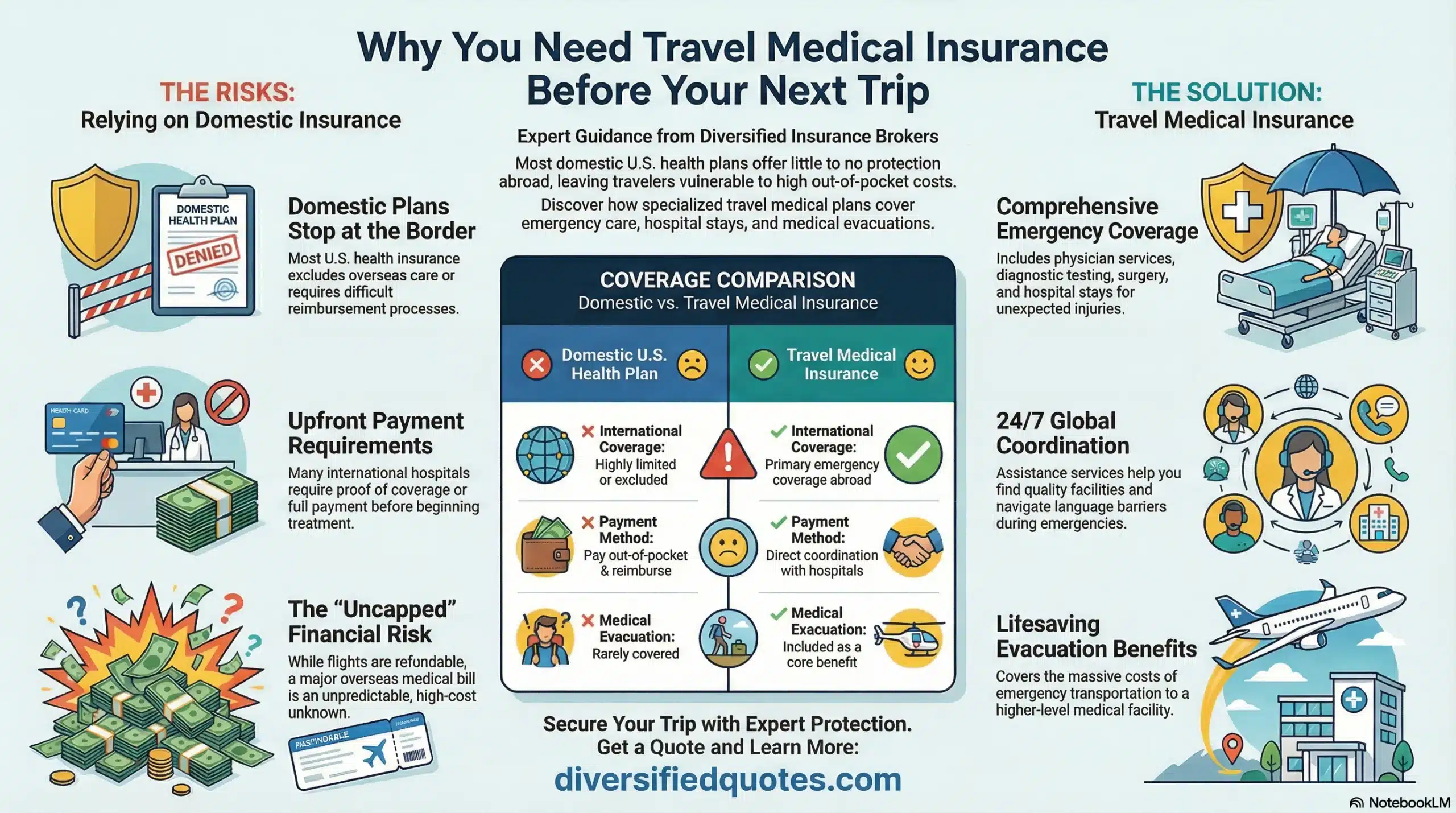
Talk With an Advisor Today
Choose how you’d like to connect—call or message us, then book a time that works for you.
Schedule here:
calendly.com/jason-dibcompanies/diversified-quotes
Licensed in all 50 states • Fiduciary, family-owned since 1980
FAQs: Travel Medical Insurance for Seniors
Does Medicare cover medical care outside the United States?
In most situations, Medicare provides little to no coverage for routine international medical care. That’s why seniors often use travel medical insurance to protect against unexpected overseas medical bills and evacuation costs.
What’s the difference between travel medical insurance and trip cancellation insurance?
Travel medical insurance focuses on medical treatment and emergency services while you’re traveling. Trip cancellation insurance focuses on reimbursing certain prepaid trip costs if you must cancel or interrupt the trip for covered reasons.
Does senior travel medical insurance include emergency medical evacuation?
Many plans include evacuation benefits, but limits and rules vary by plan. For seniors, evacuation is often one of the most important benefits to evaluate because costs can be extremely high depending on location and medical needs.
Will a pre-existing condition prevent me from getting coverage?
Not necessarily. The key is how the plan defines a pre-existing condition, the look-back window, and whether your condition is considered “stable” under the plan’s rules. Plan selection matters when you have ongoing conditions or recent treatment changes.
How do I choose the right coverage limit and deductible?
Start with destination, trip length, your comfort with out-of-pocket costs, and how much risk you want the plan to absorb. Higher deductibles typically lower premium, while higher limits can better protect against expensive hospitalization or transport scenarios.
Is senior travel medical insurance worth it for short trips?
For many seniors, yes—because a single emergency room visit, hospitalization, or evacuation can exceed the cost of coverage by a wide margin. The value is less about trip length and more about the potential cost of an unexpected event.
When should I purchase my travel medical plan?
It’s generally best to buy coverage before you travel and before any new symptoms or treatment changes occur. Purchasing earlier also gives you time to review plan rules, confirm effective dates, and ensure the coverage matches your itinerary.
About the Author:
Jason Stolz, CLTC, CRPC and Chief Underwriter at Diversified Insurance Brokers (NPN 20471358), is a senior insurance and retirement professional with more than two decades of real-world experience helping individuals, families, and business owners protect their income, assets, and long-term financial stability. As a long-time partner of the nationally licensed independent agency Diversified Insurance Brokers, Jason provides trusted guidance across multiple specialties—including fixed and indexed annuities, long-term care planning, personal and business disability insurance, life insurance solutions, Group Health, and short-term health coverage. Diversified Insurance Brokers maintains active contracts with over 100 highly rated insurance carriers, ensuring clients have access to a broad and competitive marketplace.
His practical, education-first approach has earned recognition in publications such as VoyageATL, highlighting his commitment to financial clarity and client-focused planning. Drawing on deep product knowledge and years of hands-on field experience, Jason helps clients evaluate carriers, compare strategies, and build retirement and protection plans that are both secure and cost-efficient. Visitors who want to explore current annuity rates and compare options across multiple insurers can also use this annuity quote and comparison tool.
