
17-Year Term Life Insurance

Jason Stolz CLTC, CRPC
17-Year Term Life Insurance is a strategic option for people who want coverage that aligns closely with a real-world financial timeline—without paying for years of insurance they may not need. While it’s less common than the standard term lengths most shoppers ask for, a 17-year policy can be an excellent fit when your biggest obligations land squarely between the usual durations. If your need is clearly “longer than mid-range” but doesn’t extend all the way into a longer planning horizon, this type of policy can deliver a cleaner match between coverage and purpose.
At Diversified Insurance Brokers, we help you evaluate whether a 17-year term is the most efficient way to protect your plan. That means comparing carriers, underwriting outcomes, and the fine print that matters—like conversion rules and renewal options—so your coverage ends when your need actually ends, not when a generic term length says it should.
Get a Term Life Insurance Quote
See how a 17-year term compares with 15-, 20-, and longer options based on your timeline.
How 17-Year Term Life Insurance Works
A 17-year term life insurance policy provides a guaranteed death benefit and level premiums for a fixed 17-year period. If the insured passes away during that timeframe, the policy pays the death benefit to the named beneficiaries. As long as premiums are paid on time, both the cost and the coverage amount remain unchanged throughout the term, which makes budgeting simple and predictable.
Like other level-term policies, 17-year term life insurance is designed primarily for protection—not savings or investment growth. There is typically no cash value component, which helps keep premiums lower than permanent life insurance options. The purpose is straightforward: protect your household financially during a specific window when your income, debts, and dependents create meaningful financial exposure.
When term insurance is structured well, it prevents worst-case financial decisions from being forced in the middle of a crisis. Instead of a family having to sell a home quickly, drain retirement assets early, or take on high-interest debt, life insurance helps preserve stability while the household regains footing.
Why Someone Might Choose a 17-Year Term Policy
Life doesn’t always fit neatly into the term lengths most carriers market. A 17-year term can be a strong fit when your largest obligation has a clear end date that doesn’t line up with standard durations. That could be a mortgage payoff schedule, the years remaining until kids are financially independent, or the time you expect to work before a planned retirement or career shift.
For example, if you are 43 and your mortgage is scheduled to be paid off around age 60, a 17-year policy can align more precisely than a shorter policy that could end early, or a longer policy that might extend beyond your real risk period. The same logic applies to income replacement planning when you expect to reach a more independent financial position within a defined window, such as when savings are on track, debt is reduced, and dependents require less support.
The appeal of a 17-year term is efficiency. You’re not automatically paying for extra years “just in case,” but you’re also avoiding the risk of your protection ending while obligations are still meaningful. In the real world, it’s often that “last year or two” where families are most exposed because the plan is close—but not quite finished.
How to Evaluate Whether 17 Years Is the Right Timeline
The best way to decide if a 17-year term makes sense is to work backward from the date your household would be materially less vulnerable without your income. If your largest risks are tied to a mortgage payoff window, you can map the remaining balance and confirm how long it would take for a surviving spouse to maintain the home without making drastic changes.
If your plan centers on children, you can estimate when your household would reasonably shift from being heavily income-dependent to being more flexible, whether that means kids are out of the home, college costs are accounted for, or childcare expenses are no longer part of the monthly budget.
For business owners, the timeline may be tied to a loan, a partner arrangement, or an expected transition event. In those cases, matching the length of your insurance to the time the business is most dependent on you can be a practical way to avoid under-insuring or paying for protection longer than the risk exists.
Who Is a Good Fit for 17-Year Term Life Insurance?
A 17-year term policy is often a good match for people who have a clearly defined exit point for major financial risk. This might include homeowners nearing the final stretch of their mortgage, parents whose children will be financially independent within a known period, or professionals who plan to retire or significantly reduce work within that timeframe.
It can also be appropriate for business owners who need coverage tied to a fixed contract, loan schedule, or succession plan. Matching the term to the obligation helps avoid both under-insuring and carrying coverage that no longer serves a real purpose once the risk has passed.
If you expect your need for coverage to continue well beyond 17 years—such as long-term dependent care planning, estate planning, or a scenario where a spouse will rely on your income for decades—then a longer strategy may be more appropriate. The key is not choosing a term length because it “sounds right,” but choosing one because it fits the job your policy needs to do.
Estimate Your Term Life Premiums
Compare 17-year term pricing with other term lengths and coverage amounts.
Life Insurance Quoter
What Affects 17-Year Term Life Insurance Rates
Pricing for a 17-year term policy follows the same underwriting fundamentals as other term durations. Carriers primarily evaluate age, medical history, tobacco use, height and weight, family medical history, driving record, occupation, and lifestyle factors. While term length plays a role, underwriting class often matters more. Two applicants the same age can receive very different premiums depending on whether they qualify for a top risk class or land in a standard or rated category.
Some applicants qualify for accelerated underwriting, which may not require a medical exam. Others—particularly those applying for higher coverage amounts or with more complex medical histories—may receive better pricing through traditional underwriting that includes labs and vitals. The most efficient approach is usually not guessing which underwriting path is best, but matching the strategy to your profile so you get the strongest long-term pricing and policy flexibility.
If you want a clearer picture of what insurers review, see what is a life insurance exam.
Conversion Options on a 17-Year Term Policy
One of the most valuable features of many term policies is the conversion option. Conversion allows you to exchange your term policy for a permanent life insurance policy—typically without having to prove insurability again. Even if you believe you only need coverage for 17 years, conversion can serve as a “backup plan” if your health changes and you still need insurance beyond the original term.
Conversion periods vary by carrier. Some allow conversion for the full term, while others limit it to a shorter window, such as the first 10 or 12 years. If you are considering a 17-year term as part of a longer strategy, understanding conversion rules is essential, because the policy that looks best today may not be the one that offers the strongest flexibility later.
For a deeper explanation of how this works, review convert term to permanent life insurance.
What Happens When a 17-Year Term Ends?
When the 17-year level-premium period ends, the policy typically expires. Some policies allow annual renewal at significantly higher rates based on your age at the time, but renewal is usually expensive and is rarely intended as a long-term solution. It is better viewed as a short bridge than a permanent plan.
This is why many people reassess their coverage during the final one to two years of the term. If coverage is still needed, you may replace the policy with a new term, convert it to permanent coverage, or restructure your plan depending on your health and financial position. If you anticipate any possibility of still needing coverage after the term ends, planning earlier is almost always better than waiting until the final months.
Choosing the Right Coverage Amount for 17 Years
The right death benefit is based on what your household would need if your income disappeared tomorrow. For most families, that includes income replacement, debt payoff, and the ability to maintain stability during a transition. In practical terms, that often means keeping the home, keeping children in the same school or community, protecting retirement assets from being drained early, and ensuring the household isn’t forced to make rushed decisions.
The goal is not to maximize coverage at all costs, but to choose an amount you can comfortably maintain for the entire 17-year term. Consistency is what makes term insurance effective. A policy that lapses provides no benefit, so premium sustainability matters just as much as the death benefit amount.
Common Mistakes with Non-Standard Term Lengths
One common mistake is choosing a shorter term simply because it appears cheaper, without confirming that the need truly ends when the policy does. Another is assuming that a non-standard term is always harder or more expensive to obtain. Depending on the carrier and your profile, a custom term can still be competitive, and sometimes it matches the financial job of the policy better than a standard duration.
Another mistake is not considering underwriting risk. If you choose a term that ends too early, you may need to re-apply later. If health changes in the meantime, replacement coverage can become substantially more expensive. That’s why term length should be chosen with an honest view of timeline risk, not only premium today.
Carrier selection matters. Some insurers price certain ages and term structures more competitively than others. Working with an independent broker allows you to compare those differences and choose the best fit rather than guessing.
Why Work With Diversified Insurance Brokers?
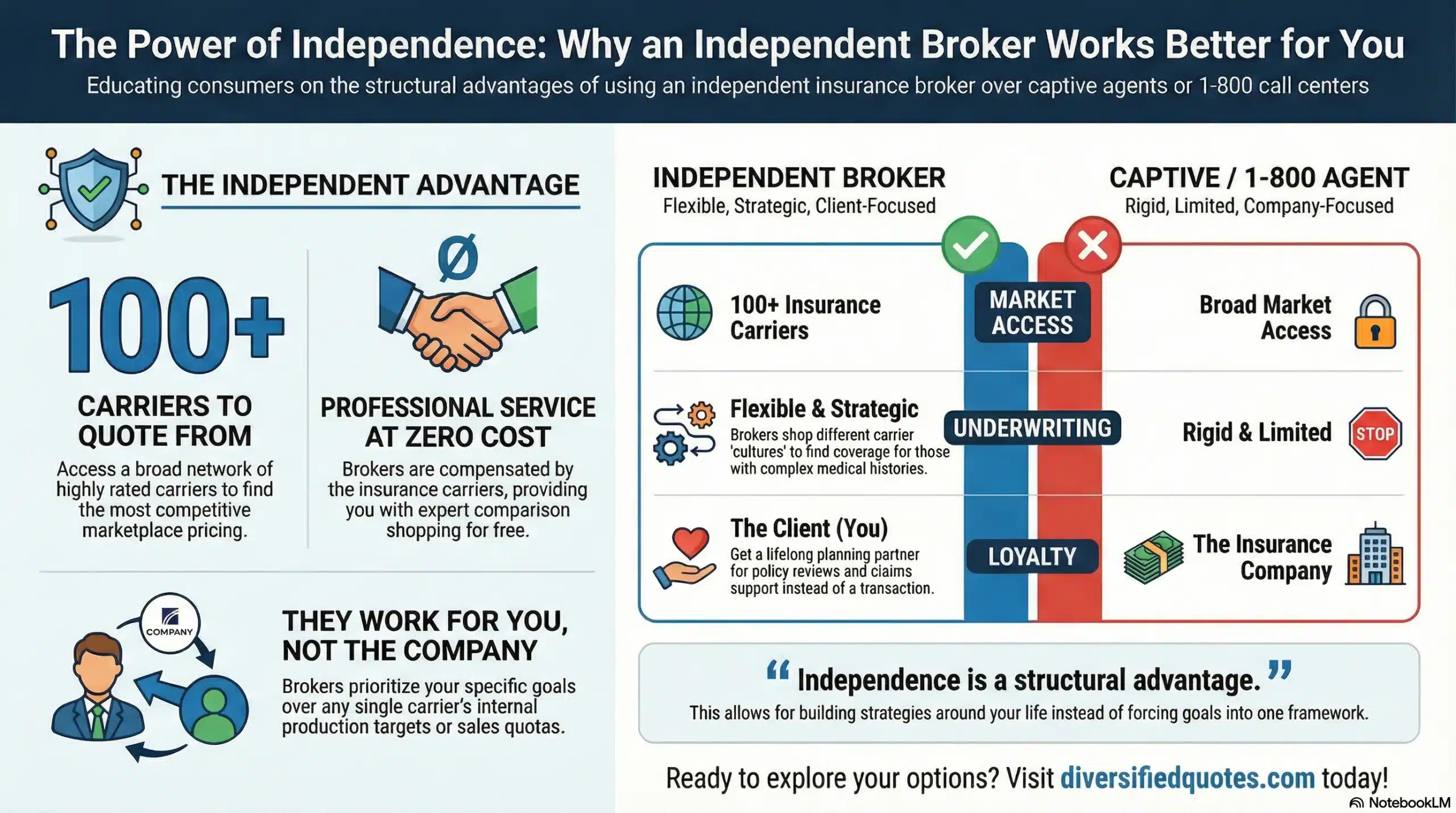
Since 1980, Diversified Insurance Brokers has helped families match life insurance coverage to real timelines—not generic assumptions. Our advisors compare carrier options, underwriting approaches, conversion rules, and pricing so your policy fits your plan from day one. We help you avoid common pitfalls, like selecting a term that ends too early, choosing a carrier that is not favorable for your underwriting profile, or missing important policy features that matter later.
You can learn more about our life insurance services, and if you are also evaluating final-expense coverage, explore our burial insurance resources.
Related Pages
Here are a few helpful pages to explore next:
Financial Protection Essentials
Carrier evaluations, senior burial planning, and guaranteed issue life insurance strategies to strengthen financial protection.
Compare Term Life Insurance Lengths
Explore different term periods to find coverage that best matches your timeline and budget.
Talk With an Advisor Today
Choose how you’d like to connect—call or message us, then book a time that works for you.
Schedule here:
calendly.com/jason-dibcompanies/diversified-quotes
Licensed in all 50 states • Fiduciary, family-owned since 1980
FAQs: 17-Year Term Life Insurance
What is 17-year term life insurance?
17-year term life insurance provides a fixed death benefit with level premiums for 17 years. If you pass away during the term, beneficiaries receive the payout. Reviewing broader life insurance rates can help determine how this term length compares with other options.
Who is a 17-year term life policy best for?
This term can be ideal for individuals with a defined timeline, such as income replacement until retirement or a remaining mortgage balance. Parents often evaluate protection through resources like life insurance for new parents when structuring mid-range coverage periods.
Is 17-year term life insurance widely available?
It is less common than traditional 10-, 15-, or 20-year terms. If unavailable, comparing nearby options may provide similar value. Understanding whether life insurance is expensive across different term lengths can help guide the decision.
Are premiums guaranteed to stay level for all 17 years?
With a level-term contract, premiums and the death benefit are generally guaranteed for the entire term if paid on time. Comparing permanent structures like guaranteed universal life insurance can clarify how long-term guarantees differ from term coverage.
What happens when a 17-year term policy ends?
When the level period ends, coverage usually expires unless renewed annually at higher age-based rates. Planning ahead by reviewing when to stop buying term life insurance can help prevent coverage gaps.
Can a 17-year term policy be converted to permanent life insurance?
Many carriers allow conversion to permanent coverage without a new medical exam if done within the specified window. Learning how whole life insurance works can help determine whether conversion aligns with long-term goals.
Is a medical exam required for 17-year term life insurance?
Not always. Some applicants qualify for accelerated underwriting, while others may need traditional underwriting. Younger applicants may also explore no-exam life insurance options depending on eligibility.
How much coverage should I buy for a 17-year term?
Coverage is typically based on income replacement, debts, and future expenses such as education. Guidance on choosing the right life insurance policy can help determine an appropriate amount.
Should I choose 17-year term or 20-year term instead?
If obligations extend slightly longer than 17 years, a 20-year term may offer added security for a modest premium difference. Understanding policy exclusions and coverage limits can also help ensure your coverage aligns with your financial plan.
About the Author:
Jason Stolz, CLTC, CRPC and Chief Underwriter at Diversified Insurance Brokers (NPN 20471358), is a senior insurance and retirement professional with more than two decades of real-world experience helping individuals, families, and business owners protect their income, assets, and long-term financial stability. As a long-time partner of the nationally licensed independent agency Diversified Insurance Brokers, Jason provides trusted guidance across multiple specialties—including fixed and indexed annuities, long-term care planning, personal and business disability insurance, life insurance solutions, Group Health, and short-term health coverage. Diversified Insurance Brokers maintains active contracts with over 100 highly rated insurance carriers, ensuring clients have access to a broad and competitive marketplace.
His practical, education-first approach has earned recognition in publications such as VoyageATL, highlighting his commitment to financial clarity and client-focused planning. Drawing on deep product knowledge and years of hands-on field experience, Jason helps clients evaluate carriers, compare strategies, and build retirement and protection plans that are both secure and cost-efficient. Visitors who want to explore current annuity rates and compare options across multiple insurers can also use this annuity quote and comparison tool.
