
21-Year Term Life Insurance

Jason Stolz CLTC, CRPC
21-Year Term Life Insurance is a tailored duration that bridges shorter and longer protection windows—often aligning closely with goals like a mortgage payoff schedule, a business obligation, or a long income-replacement runway that doesn’t neatly match the most common term lengths. Instead of forcing your plan into a “close enough” duration, a 21-year term can be a clean way to keep coverage in place for the years you actually need it and avoid paying for unused time. At Diversified Insurance Brokers, we help you evaluate whether 21-year coverage is available and competitive for your age and health profile, then compare pricing and underwriting paths across 75+ carriers to find the best overall value.
Because this is a non-standard term length, the most important step is verifying what’s truly available in your state and how the pricing compares. Some carriers offer “custom” terms, some offer terms in specific increments, and some may effectively “price it like” a nearby duration. That’s why we approach 21-year term planning as a fit-and-value exercise: first we confirm the carriers that will actually issue the duration, then we compare premiums, conversion rules, and underwriting approaches so you can choose confidently.
Request a 21-Year Term Quote Review
We’ll compare carrier pricing, confirm underwriting paths (no-exam vs exam), and help you identify the best term length for your timeline.
Prefer to talk? Call 800-533-5969
How 21-Year Term Life Insurance Works
A 21-year term life policy provides level death benefit protection for a defined 21-year window with premiums typically fixed for the duration. You choose the coverage amount, the insurer evaluates your application, and the carrier offers a premium based on age, health, and other underwriting factors. If the insured passes away while the policy is in force, the death benefit is paid to the beneficiaries (most often tax-free). If you outlive the term, the level-premium period ends and coverage generally expires unless a renewal feature is exercised or the policy is converted to a permanent plan within the allowed conversion window.
Like most term coverage, a 21-year term is pure protection with no cash value. That’s why it can be such an efficient tool for securing a substantial death benefit during years when your household has defined financial responsibilities—such as a mortgage, dependent-care years, or business obligations that rely on a key person’s income. The policy’s job is to replace financial support during a specific period, not to function as an investment vehicle.
When 21-Year Term Life Insurance Makes Sense
People often choose a non-standard term like 21 years when their key obligations don’t align perfectly with off-the-shelf durations. For instance, if your mortgage payoff, business debt schedule, or long-term income replacement plan ends in roughly two decades plus a few extra years, a 21-year term can be a better match than a shorter term that ends too soon or a longer term that forces you to keep paying after the need has already dropped.
This can show up in several real-world scenarios. A refinance may leave you with a payoff schedule that lands slightly past the 20-year mark. A family plan might call for coverage through the end of high school plus the first years of college-age transition, rather than stopping earlier. A business owner might want coverage tied to a contract, loan, or buy-sell timeline that has an end date not based on “round numbers.” In each case, the goal is the same: align the coverage window with the obligation window as closely as possible.
It can also be useful as part of a laddering strategy, where multiple term layers are stacked so higher coverage is in place early, then scales down as financial responsibilities diminish. Laddering can be very effective when the timeline of your obligations is predictable, but it should be structured carefully so you don’t create complexity that’s hard to maintain.
21-Year Term vs. Nearby Term Durations
Comparing nearby term lengths is the best way to determine whether a 21-year plan truly maximizes value or whether a more common term is worth the slight difference in coverage duration. In some situations, a 21-year duration is priced very close to a longer term, meaning you may be able to get additional years of guaranteed protection for a relatively small premium difference. In other cases, the custom duration is priced efficiently and provides savings without sacrificing the years you actually need.
The real takeaway is that “best” depends on how the carrier prices your exact age and underwriting class. Term pricing doesn’t move in a straight line. Two people can be the same age applying for the same coverage amount and see different carriers emerge as the best value because each company has slightly different underwriting guidelines and pricing philosophy. That’s why a comparison across multiple carriers is so important before you pick a duration.
Compare Term Length Options
Matching your coverage period to your obligations can prevent coverage gaps or overpaying for unused years.
What Drives a 21-Year Term Life Insurance Premium
Like other term lengths, pricing for a 21-year policy depends primarily on underwriting class and risk factors. Term life insurance is priced based on the carrier’s assessment of mortality risk over the duration of the coverage. A small shift in rate class can matter just as much as the term length itself, which is why “cheapest” is usually a combination of term, carrier, and underwriting path.
The most influential factors typically include age and overall health, tobacco or nicotine use, build (height and weight), medical history and medications, family history, driving record, and lifestyle factors that influence risk. Coverage amount matters as well, but larger face amounts can sometimes be surprisingly efficient on a cost-per-$1,000 basis depending on the carrier and your risk class.
Underwriting approach also matters. Some applicants qualify for accelerated underwriting, where the carrier may approve coverage using third-party data sources without requiring a medical exam. Other applicants—especially those applying for larger amounts or those with more complex health histories—may get better pricing by completing traditional underwriting with labs and vitals. If you want a clearer overview of what insurers evaluate, see what is a life insurance exam.
How to Choose the Right Coverage Amount for a 21-Year Term
Coverage planning should start with what you want protected over the next two decades plus a bit more. Many buyers focus first on income replacement, because income is what powers the household plan. Next, add large obligations like a mortgage payoff, other debts that would be difficult to service on one income, and any goals you want protected—such as education costs or keeping a spouse’s retirement plan on track.
From there, subtract resources that would realistically be used, such as savings, existing insurance, and expected survivor income. The goal isn’t to “buy the max.” The goal is to buy a death benefit amount you can keep in force consistently for the full 21 years. Term insurance only protects your plan if it stays active, and sustainable premiums are what keep coverage in place.
Estimate Your Term Life Prices
Use our calculator to compare rates for term lengths, coverage amounts, and underwriting paths.
Conversion Options for Term Policies
A valuable feature of many level-term policies is the ability to convert to a permanent policy with the same insurer—often without a new medical exam—during a specified window. Conversion can preserve insurability if your health changes and you still want coverage after your 21-year term, or if your needs evolve and permanent coverage becomes a better fit.
Conversion rules vary widely by carrier. Some allow conversion for most or all of the term, while others shorten the conversion window or restrict which permanent products you can convert into. If conversion flexibility matters to you, it should be evaluated before you finalize the policy—not after health changes make the option more important.
If you want to understand how conversion works in more detail, see convert term to permanent life insurance.
Other Paths When Your 21-Year Term Ends
At the end of the policy’s term, typical options include letting coverage expire, renewing on an annual basis at higher attained-age rates (if offered), or converting to a permanent plan if the conversion window is still open. Renewals are usually much more expensive because they are priced for older ages and shorter-term mortality risk. That’s why many buyers plan ahead and evaluate replacement or conversion well before the final year.
A smart review window is the final 24 to 36 months of the level term period. That gives you enough time to compare options, gather medical records if needed, and apply while you still have leverage—rather than rushing into a decision because a term is about to end.
Case Example: 21-Year Term Planning
A 39-year-old homeowner wanted coverage to match a long loan payoff schedule plus a few additional years of income protection. A 21-year term matched the timeline closely, providing strong death benefit protection with predictable premiums that fit the budget. Comparing nearby options helped confirm that this slightly extended duration offered the best balance between cost and coverage for the household’s real timeline.
Why Work With Diversified Insurance Brokers?
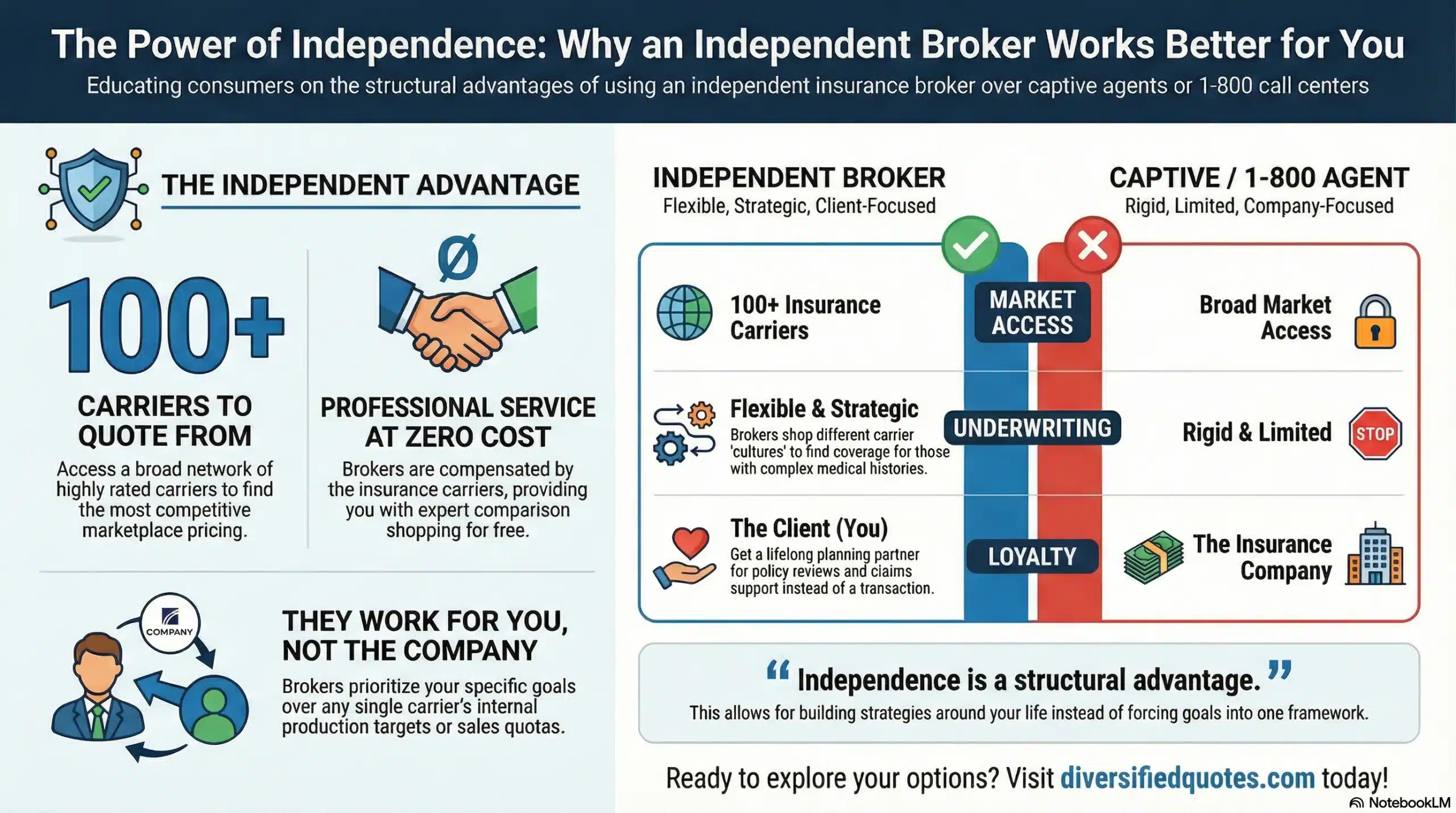
Since 1980, Diversified Insurance Brokers has helped clients match term life protection to real financial timelines—not generic defaults. With access to 75+ carriers, we compare underwriting rules, conversion options, and pricing so you can choose coverage that aligns with both your timeline and your budget.
Learn more about our life insurance services and explore how our advisors help families protect what matters most.
Related Pages
Here are a few helpful pages to explore next:
Financial Protection Essentials
Carrier evaluations, senior burial planning, and guaranteed issue life insurance strategies to strengthen financial protection.
Compare Term Life Insurance Lengths
Explore different term periods to find coverage that best matches your timeline and budget.
Talk With an Advisor Today
Choose how you’d like to connect—call or message us, then book a time that works for you.
Schedule here:
calendly.com/jason-dibcompanies/diversified-quotes
Licensed in all 50 states • Fiduciary, family-owned since 1980
FAQs: 21-Year Term Life Insurance
What is a 21-year term life policy?
A 21-year term life policy provides level premiums and a guaranteed death benefit for a 21-year period. If death occurs during the term, beneficiaries receive the payout. Reviewing current life insurance rates can help you compare this term length with other available options.
Is 21-year term life insurance widely available?
Not all carriers offer custom 21-year terms. If unavailable, selecting a nearby standard term or building a layered strategy may achieve a similar result. Working with a best independent life insurance broker can help identify carriers with flexible term structures.
How is pricing different from 20 or 25 years?
Pricing varies by age, health class, and insurer. A 21-year term may fall between 20- and 25-year premiums. Understanding what affects life insurance costs helps clarify whether extending coverage is worth the added premium.
Can I convert to permanent coverage?
Many level-term contracts include a conversion feature allowing you to switch to permanent coverage within a defined window without new medical underwriting. Learning how whole life insurance works can help determine if conversion aligns with long-term goals.
Are medical exams required?
Some applicants qualify for accelerated underwriting with no exam, while others may require traditional underwriting. If health conditions complicate approval, reviewing guidance from our high-risk life insurance playbook can provide helpful insight.
What happens at the end of the term?
At the end of 21 years, coverage typically expires unless renewed at higher rates or converted before the deadline. Planning ahead by understanding when to stop buying term life insurance can help prevent coverage gaps.
About the Author:
Jason Stolz, CLTC, CRPC and Chief Underwriter at Diversified Insurance Brokers (NPN 20471358), is a senior insurance and retirement professional with more than two decades of real-world experience helping individuals, families, and business owners protect their income, assets, and long-term financial stability. As a long-time partner of the nationally licensed independent agency Diversified Insurance Brokers, Jason provides trusted guidance across multiple specialties—including fixed and indexed annuities, long-term care planning, personal and business disability insurance, life insurance solutions, Group Health, and short-term health coverage. Diversified Insurance Brokers maintains active contracts with over 100 highly rated insurance carriers, ensuring clients have access to a broad and competitive marketplace.
His practical, education-first approach has earned recognition in publications such as VoyageATL, highlighting his commitment to financial clarity and client-focused planning. Drawing on deep product knowledge and years of hands-on field experience, Jason helps clients evaluate carriers, compare strategies, and build retirement and protection plans that are both secure and cost-efficient. Visitors who want to explore current annuity rates and compare options across multiple insurers can also use this annuity quote and comparison tool.
